Neuroradiology vs Neurosurgery: How Diagnosis and Treatment Roles Differ

Neuroradiology uses imaging such as MRI, CT, and angiography to diagnose nervous system conditions. Neurosurgery treats disorders of the brain, spine, and nerves with operations and other procedural care.
Key Takeaways
- Neuroradiology uses imaging such as MRI, CT, and angiography to diagnose nervous system conditions.
- Neurosurgery treats disorders of the brain, spine, and nerves with operations and other procedural care.
- Some conditions are managed by both specialties, often as part of a multidisciplinary team.
- Interventional neuroradiology can treat selected blood vessel and spine conditions through minimally invasive, image-guided techniques.
- The right specialist depends on the diagnosis, symptoms, urgency, and whether surgery is needed.
- Patients often see both a neuroradiologist and a neurosurgeon during evaluation and treatment planning.
Neuroradiology and neurosurgery both help diagnose and treat conditions of the brain, spine, head, and nervous system, but they do so in different ways. Neuroradiology focuses on imaging and image-guided procedures, while neurosurgery focuses on operations and surgical decision-making.
Overview: What Is the Difference?
When people hear the terms neuroradiology and neurosurgery, they may assume they refer to the same type of care. In reality, these are closely related but different medical specialties. Both focus on conditions affecting the brain, spinal cord, head, neck, and nervous system, yet their main roles in diagnosis and treatment are distinct.
Neuroradiology is a subspecialty of radiology that uses advanced imaging to examine the nervous system. A neuroradiologist interprets tests such as magnetic resonance imaging (MRI), computed tomography (CT), and vascular imaging to help identify problems like stroke, brain tumors, aneurysms, bleeding, spinal disc disease, infections, and congenital abnormalities. Some neuroradiologists also perform minimally invasive image-guided procedures, an area often called interventional neuroradiology.
Neurosurgery is a surgical specialty focused on treating diseases and injuries of the brain, spine, and peripheral nerves. A neurosurgeon evaluates whether an operation is needed, discusses surgical risks and benefits, and performs procedures ranging from emergency surgery for bleeding in the brain to planned operations for tumors, spinal conditions, and nerve compression.
In many cases, these specialists work together rather than separately. A neuroradiologist may identify the abnormality, help define its exact location, and support treatment planning. A neurosurgeon may then decide whether surgery is appropriate, or work with interventional specialists when a less invasive procedure is possible.
What Neuroradiologists Do
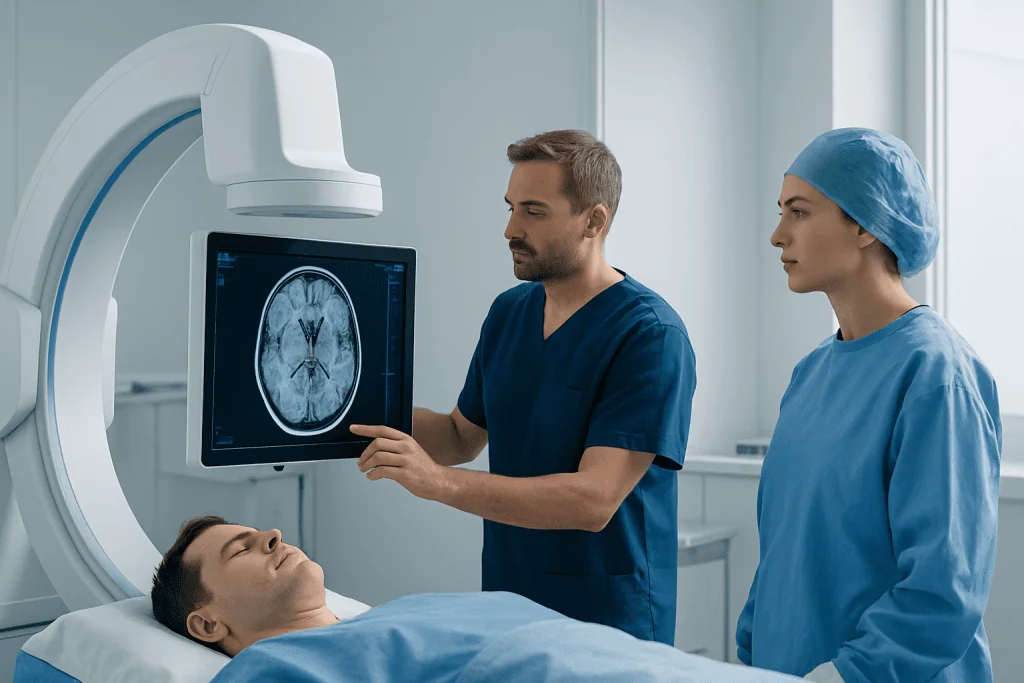
The central role of neuroradiology is diagnosis through imaging. Neuroradiologists are physicians with specialized training in reading scans of the brain, spine, and nervous system. They look for subtle findings that can explain symptoms such as headaches, seizures, weakness, numbness, dizziness, memory changes, visual symptoms, trauma-related problems, or back and neck pain.
Common tests interpreted by neuroradiologists include MRI of the brain and spine, CT scans, CT angiography, MR angiography, and catheter angiography. These studies help doctors assess blood vessels, tumors, inflammation, infections, structural abnormalities, degenerative spine disease, and signs of acute conditions such as bleeding or stroke. Their reports guide the next steps in care, whether that means watchful monitoring, medication, urgent intervention, or referral to surgery.
Some neuroradiologists also perform procedures using imaging guidance. This may include angiography to study blood vessels in detail, biopsies in selected cases, vertebral procedures for some spine problems, or catheter-based treatments for certain vascular disorders. In this interventional role, they may help treat conditions like aneurysms, arteriovenous malformations, or some forms of acute stroke using highly targeted techniques. Patients may hear this described as interventional neuroradiology treatment when discussing minimally invasive options.
Although neuroradiologists usually do not perform open surgery, their expertise is often essential to safe and accurate treatment. Imaging can help confirm a diagnosis, map anatomy before an operation, monitor disease over time, and check results after treatment.
What Neurosurgeons Do

Neurosurgeons are doctors trained to treat disorders of the nervous system through surgery and comprehensive procedural care. Their work includes evaluating whether a problem can be managed without surgery, determining when an operation is necessary, and carrying out procedures involving the brain, spine, skull, nerves, and sometimes blood vessels.
A neurosurgeon may treat brain tumors, traumatic brain injuries, herniated discs, spinal stenosis, hydrocephalus, nerve compression syndromes, epilepsy in selected cases, and bleeding in or around the brain. Neurosurgeons also manage emergencies, such as head trauma or spinal cord compression, when rapid intervention may protect function or save life.
Not all neurosurgical care involves major open surgery. Modern neurosurgery may use microscopic techniques, endoscopy, image guidance, navigation systems, and minimally invasive approaches when appropriate. However, the defining feature of the specialty is that the neurosurgeon is trained to operate and to manage the full surgical pathway before, during, and after the procedure. In some situations, a patient may be evaluated for neurosurgery after imaging shows a structural problem that cannot be safely or effectively managed in another way.
Neurosurgeons also work closely with neurologists, neuroradiologists, anesthesiologists, rehabilitation specialists, and intensive care teams. This team-based approach is especially important for complex conditions involving the brain and spine.
Conditions Where the Two Specialties Overlap
There is significant overlap between neuroradiology and neurosurgery because many neurological conditions require both precise imaging and procedural treatment. A patient with a suspected brain aneurysm, for example, may first undergo CT or MRI and then vascular imaging interpreted by a neuroradiologist. Depending on the aneurysm’s size, shape, and location, treatment may be planned by either an interventional neuroradiology team, a neurosurgical team, or both together.
Stroke is another area where collaboration is common. Imaging is critical in determining whether symptoms are caused by bleeding or a blocked blood vessel and whether urgent intervention is possible. In selected cases, catheter-based clot removal may be considered as part of stroke treatment. At the same time, some stroke-related complications may require neurosurgical care, such as surgery to relieve pressure from swelling or bleeding.
Brain tumors also often involve both specialties. A neuroradiologist helps define the tumor’s location, features, and relationship to nearby structures. A neurosurgeon may remove part or all of the tumor, obtain tissue for diagnosis, or plan a biopsy. This kind of team care is central to the management of brain tumor cases.
Spinal conditions can overlap as well. Imaging may identify disc herniation, stenosis, fractures, infection, or tumors, while the neurosurgeon decides whether surgery is needed. In many patients, scans explain symptoms but treatment remains non-surgical, showing how neuroradiology can support care even when an operation is not necessary.
How Diagnosis and Treatment Pathways Usually Work
For many patients, care begins with symptoms rather than a specialist. A person may see a primary care physician, neurologist, emergency doctor, or spine specialist because of headache, weakness, seizures, severe back pain, numbness, or head injury. That clinician often orders imaging, which is then interpreted by a neuroradiologist.
The imaging results help answer several important questions: Is there a structural problem? Is it urgent? Does it involve blood vessels, nerves, bone, or soft tissue? Does it appear inflammatory, degenerative, traumatic, infectious, or cancer-related? These answers help determine whether a patient should continue with medical treatment, undergo follow-up scans, or meet a procedural or surgical specialist.
If surgery may be needed, a neurosurgeon reviews the scans along with the patient’s symptoms, examination findings, and overall health. The neurosurgeon then explains whether surgery is indicated, what the goals are, what alternatives exist, and what recovery may involve. If a minimally invasive vascular approach is more suitable, interventional neuroradiology may be recommended instead of open surgery.
This process shows why neuroradiology vs neurosurgery is not an either-or choice in many situations. One specialty often identifies and characterizes the problem, while the other determines and delivers the most appropriate intervention. Good communication between teams supports safer and more personalized care.
When a Patient May See One Specialist, the Other, or Both
A patient may interact with a neuroradiologist without meeting them directly, because much of neuroradiology involves expert interpretation of scans behind the scenes. Even so, the neuroradiologist’s input can strongly shape diagnosis and treatment. Patients are more likely to meet the neuroradiologist in person if they are having a vascular study, image-guided procedure, or interventional treatment.
Patients usually see a neurosurgeon directly when there is a condition that might benefit from surgery or when urgent surgical assessment is needed. Typical reasons include a brain mass, worsening spinal nerve compression, trauma, hydrocephalus, some vascular lesions, or persistent symptoms linked to a structural abnormality on imaging.
In some cases, both specialists are involved from the beginning. This is common in aneurysms, complex stroke care, vascular malformations, skull base disease, and certain spinal disorders. It may also happen in conditions like brain aneurysm, where imaging detail is essential and treatment options may include either catheter-based techniques or surgery.
Patients should feel comfortable asking who is leading their care, what each specialist’s role is, and whether the plan is diagnostic, therapeutic, surgical, or a combination. Clear explanations can make a complex process feel more understandable and less stressful.
Benefits, Limitations, and How Specialists Choose the Best Approach
Neuroradiology offers major advantages in accuracy and planning. High-quality imaging can reveal the exact location and nature of a problem, help avoid unnecessary procedures, and support monitoring over time. Interventional neuroradiology may also provide treatment through very small catheters or needles, which can reduce recovery time for selected conditions. However, imaging alone does not treat every problem, and minimally invasive procedures are not appropriate for all patients.
Neurosurgery can directly relieve pressure, remove tumors, stabilize the spine, repair injuries, or address conditions that cannot be treated effectively by medication or catheter-based techniques. It is often the best option when structural correction is needed. Still, surgery is more invasive than diagnostic imaging, and in many cases doctors first consider whether non-surgical or less invasive care can achieve the same goal safely.
Choosing between these specialties is not simply about preference. Doctors consider the diagnosis, the patient’s symptoms, scan findings, age, general health, urgency, and treatment goals. They also consider whether observation, medication, image-guided intervention, or surgery offers the best balance of benefit and risk.
Near the end of this process, patients may benefit from care in a center where multiple neurological specialties work together. Acibadem International’s multidisciplinary specialists and JCI-accredited hospitals diagnose and treat complex brain, spine, and vascular conditions for international patients, helping coordinate imaging, interventional care, and surgery when needed.
Questions Patients Can Ask and When to Seek Medical Attention
When facing a neurological diagnosis, practical questions can help patients understand the plan. Useful questions include what the imaging shows, whether the finding explains the symptoms, whether the condition is urgent, whether follow-up imaging is needed, and whether surgery or a minimally invasive procedure is being considered. Patients may also ask who will perform the procedure and what recovery typically involves.
Urgent medical attention is important for sudden severe headache, new weakness, facial drooping, trouble speaking, seizures, confusion, loss of consciousness, sudden vision loss, serious head injury, or sudden loss of bladder or bowel control with back pain. These symptoms can signal a neurological emergency that requires immediate evaluation and often rapid imaging.
For non-emergency symptoms, such as persistent headaches, ongoing neck or back pain with numbness, balance problems, memory changes, or unexplained neurological symptoms, a routine medical review is still wise. Early assessment can help identify whether imaging is needed and whether referral to neurology, neuroradiology, interventional neuroradiology, or neurosurgery is appropriate.
The main message is reassuring: neuroradiology and neurosurgery are different, but they are complementary. Their shared goal is to diagnose problems accurately and choose the safest, most effective treatment path for each individual patient.
Frequently asked questions
Is neuroradiology the same as neurosurgery?
No. Neuroradiology focuses on imaging of the brain, spine, and nervous system, and in some cases performs minimally invasive image-guided procedures. Neurosurgery focuses on operations and surgical treatment of disorders affecting these areas.
Does a neuroradiologist perform surgery?
A neuroradiologist usually does not perform open surgery. Some do perform minimally invasive procedures, especially for blood vessel problems or selected spine conditions, using imaging to guide treatment.
Why might a patient need both a neuroradiologist and a neurosurgeon?
Many neurological conditions require both accurate imaging and procedural treatment planning. The neuroradiologist helps define the problem, and the neurosurgeon decides whether surgery is needed and how it should be performed.
Which specialist treats brain aneurysms?
Both may be involved. A neuroradiologist helps diagnose and map the aneurysm, while treatment may be carried out by an interventional neuroradiology team, a neurosurgeon, or a combined multidisciplinary team depending on the aneurysm’s features.
Who reads MRI and CT scans of the brain and spine?
These scans are often interpreted by a neuroradiologist, a radiology specialist with advanced training in nervous system imaging. Their report helps the referring doctor decide on the next step in care.
When is neurosurgery necessary?
Neurosurgery may be necessary when a structural problem needs direct surgical treatment, such as some tumors, bleeding, trauma, spinal cord compression, or severe nerve compression. The decision depends on symptoms, scan findings, urgency, and whether non-surgical options are suitable.
References
- World Health Organization
- American College of Radiology
- Radiological Society of North America
- American Association of Neurological Surgeons
- National Institute of Neurological Disorders and Stroke
This article is for general information only and is not a substitute for professional medical advice. Please consult a qualified doctor about your individual situation.
Neuroradiology in Turkey — costs, top hospitals & a free quote
JCI-accredited · board-certified surgeons · reply within 24h
Add us as a Preferred Source to see more of our trusted health content across Google Search, AI Overviews and Discover.