

What Are Dental Implants? How They Work and Who May Need Them

Dental implants replace missing tooth roots and support crowns, bridges, or dentures. They can improve chewing, speech, smile appearance, and jawbone support.
Key Takeaways
- Dental implants replace missing tooth roots and support crowns, bridges, or dentures.
- They can improve chewing, speech, smile appearance, and jawbone support.
- Not everyone is an immediate candidate, but many people can qualify with proper planning and oral care.
- Evaluation usually includes a dental exam, imaging, and review of general health and gum condition.
- Good oral hygiene, avoiding smoking, and regular dental follow-up help implants last longer.
Dental implants are a long-term option for replacing missing teeth. They are designed to look, feel, and function more like natural teeth by anchoring a replacement tooth to the jawbone.
Overview
Dental implants are small posts, usually made of biocompatible titanium or similar materials, that are placed into the jawbone to act like artificial tooth roots. Once the implant bonds with the bone, it can support a replacement tooth such as a crown, bridge, or denture. The goal is to restore both function and appearance in a way that feels stable and natural.
Unlike removable dentures, implants are fixed in the mouth and do not rely on neighboring teeth for support in the same way a traditional bridge may. This can help preserve surrounding tooth structure and provide a firmer biting surface. Many people choose implants because they can make eating and speaking easier and may improve comfort in daily life.
Dental implants are not a single product but a treatment process that is tailored to each person. Some patients need one implant for a single missing tooth, while others may need several implants to support multiple teeth or even a full arch. In many cases, treatment is planned as part of broader general dental care to support long-term oral health.
How Dental Implants Work
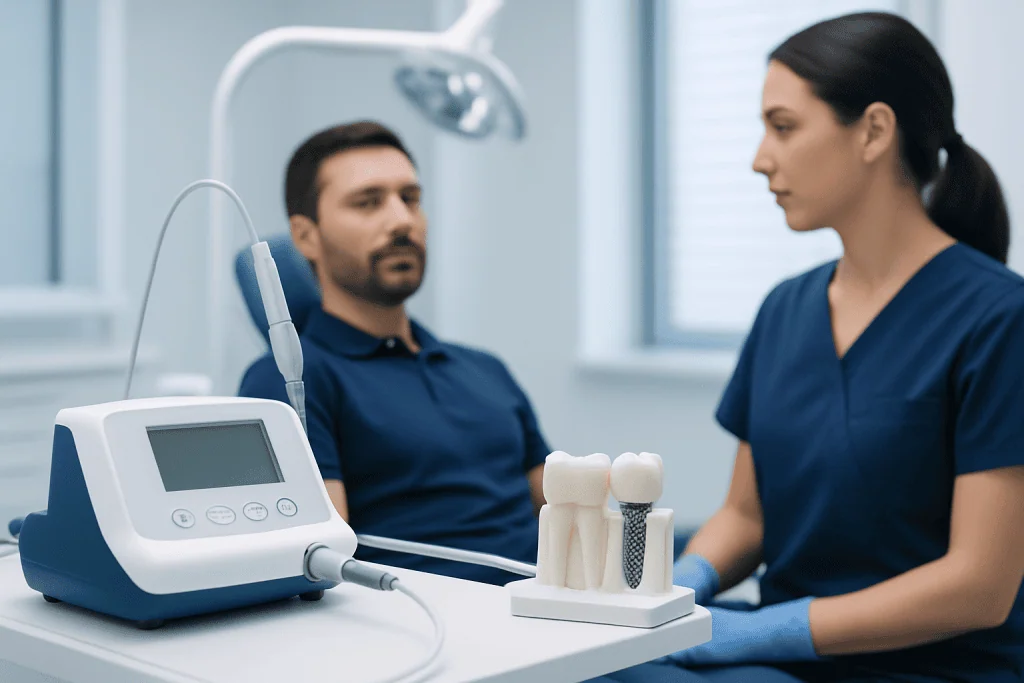
A dental implant has two main roles: it replaces the root of a missing tooth and provides a secure base for the visible replacement tooth. After the implant is placed in the jawbone, the body gradually forms a bond between the bone and the implant surface. This process, called osseointegration, is what gives implants their stability.
Once healing is far enough along, a connector piece called an abutment may be attached to the implant. The final restoration, such as a crown, is then fixed to the abutment. The result is a tooth replacement designed to match the shape, size, and color of the surrounding teeth as closely as possible.
The full treatment timeline varies. Some people can receive an implant and a temporary tooth in a shorter period, while others need staged treatment over several months, especially if bone grafting or gum treatment is needed first. Careful planning with imaging and digital measurements often helps improve fit and precision, and some clinics may use digital dentistry tools during this process.
- Implant: the post placed in the jawbone
- Abutment: the connecting piece above the implant
- Restoration: the visible tooth replacement, such as a crown or bridge
Who May Need Dental Implants

Dental implants may be suitable for adults who have lost one tooth, several teeth, or all teeth in one or both jaws. Tooth loss can happen for many reasons, including decay, gum disease, trauma, or failed dental work. Replacing missing teeth is not only about appearance; it can also help maintain chewing efficiency, speech clarity, and the alignment of remaining teeth.
People who find removable dentures uncomfortable or unstable may also consider implants. In some cases, implants are used to secure dentures more firmly, helping reduce slipping during speaking or eating. Others choose implants as an alternative to a fixed bridge if they want to avoid preparing adjacent healthy teeth.
Good candidates usually have healthy gums, enough bone to support an implant, and a commitment to oral hygiene and follow-up care. However, not having enough bone does not always rule treatment out. Some patients can still become candidates after preparatory procedures or management of related issues such as gum recession or periodontal problems.
Causes of Tooth Loss and Risk Factors to Consider
Common causes of tooth loss include untreated tooth decay, advanced gum disease, severe tooth fracture, and dental trauma. Sometimes a tooth must be removed because it cannot be repaired safely or predictably. In other cases, congenital absence of a tooth or complications from previous treatment may create a need for replacement.
Several health and lifestyle factors can affect whether implants are appropriate and how well they heal. Smoking is one of the best-known risks because it can interfere with blood flow and healing in the gums and bone. Poor oral hygiene, uncontrolled diabetes, active gum disease, and certain medications or medical conditions may also increase the risk of complications.
Teeth grinding or clenching can place extra force on implants and restorations. This does not always prevent treatment, but it may influence the design of the bite and the need for protective measures. If grinding is suspected, the dentist may discuss related evaluation or care such as bruxism management to help protect both natural teeth and implants.
Diagnosis and Treatment Planning
Before recommending dental implants, the dentist or oral surgeon usually performs a detailed examination. This often includes checking the teeth, gums, bite, and jaw function, as well as reviewing medical history and medications. Imaging such as dental X-rays or three-dimensional scans helps assess bone quality, important anatomical structures, and the best implant position.
Planning also includes deciding what type of restoration will be used after the implant heals. A single missing tooth may need one implant and one crown, while several missing teeth may be restored with an implant-supported bridge. Patients who have extensive tooth loss may benefit from full-arch solutions supported by multiple implants.
Sometimes additional treatment is needed first. Examples include treating gum disease, removing non-restorable teeth, improving oral hygiene, or rebuilding lost bone with grafting material. When the visible part of the restoration is being planned, the team may also discuss options such as dental crowns for the final tooth replacement.
Treatment Options, Procedure, and Recovery
The implant procedure is usually performed in stages. First, the implant is placed into the jawbone under local anesthesia, and sometimes sedation may be considered depending on the case and patient comfort. After placement, the area heals while the implant bonds with the bone. Once the implant is stable, the final restoration is attached.
Some patients are candidates for immediate or early loading, meaning a temporary or even final tooth may be placed sooner. Others need a longer healing period, especially if they have had bone grafting, sinus lifting, or complex reconstruction. The dentist will choose the safest approach based on bone support, bite forces, and overall oral health.
Recovery is often manageable with short-term soreness, swelling, or mild bruising that improves over several days. Soft foods may be recommended at first, and careful cleaning around the implant site is important. Patients considering dental implants should understand that long-term success depends not only on the procedure itself but also on maintenance after treatment.
- Single-tooth implant: replaces one missing tooth
- Implant-supported bridge: replaces several missing teeth
- Implant-supported denture: helps stabilize a removable denture
- Full-arch implant treatment: restores most or all teeth in one jaw
Benefits, Limits, and Possible Complications
Dental implants can offer several important benefits. They may improve chewing strength, support clearer speech, and help maintain facial structure by stimulating the jawbone. Many people also appreciate that implants are fixed in place and can be cared for much like natural teeth, depending on the design of the restoration.
At the same time, implants are not the right choice for every situation. Treatment can take time, may involve surgery, and sometimes requires preparatory procedures before placement. Cost, healing time, smoking status, gum health, and bone quantity all play a role in deciding whether implants are the best option compared with alternatives such as bridges or removable dentures.
Possible complications include infection, delayed healing, loosening of components, gum inflammation around the implant, or failure of the implant to bond properly with bone. Nerve irritation or sinus-related issues are less common but are important reasons why detailed imaging and experienced planning matter. Prompt follow-up can often identify problems early and improve the chance of successful treatment.
Prevention, Self-care, and When to See a Doctor
Whether a person already has implants or is considering them, daily oral care is essential. Brushing twice a day, cleaning between teeth, and keeping regular dental checkups help protect both natural teeth and implant-supported restorations. Avoiding tobacco and managing health conditions such as diabetes can also support healing and long-term stability.
People should contact a dentist if they have a missing tooth, a loose tooth, difficulty chewing, ill-fitting dentures, or signs of gum disease such as bleeding, swelling, or persistent bad breath. After implant placement, it is important to seek review if there is increasing pain, ongoing swelling, pus, unusual mobility, or difficulty biting comfortably. Early attention often helps prevent more serious problems.
If expert assessment is needed, Acibadem International’s multidisciplinary dental specialists in JCI-accredited hospitals diagnose and treat patients from around the world, including those seeking implant-based tooth replacement. A qualified dentist or oral surgeon can explain whether implants, bridges, or other restorative options are most appropriate for the individual case.
Frequently asked questions
Are dental implants painful?
The procedure is usually done with local anesthesia, so the area is numb during treatment. Some soreness, swelling, or tenderness afterward is common, but many people find it manageable with the aftercare recommended by their dentist.
How long do dental implants last?
Dental implants can last many years and may remain successful long term with good care. Their lifespan depends on oral hygiene, regular checkups, smoking status, bite forces, and overall gum and bone health.
Can anyone get dental implants?
Not everyone is an immediate candidate, but many people can become eligible after evaluation and preparation. Healthy gums, enough bone support, and good control of medical conditions are important factors.
What if there is not enough bone for an implant?
Insufficient bone does not always rule out treatment. In some cases, bone grafting or other preparatory procedures can create better support before an implant is placed.
Are dental implants better than bridges or dentures?
Each option has benefits and limitations, so the best choice depends on the person's oral health, goals, budget, and anatomy. Implants can offer strong stability and bone support, while bridges or dentures may be more suitable in some situations.
How should dental implants be cleaned?
They should be cleaned carefully every day, much like natural teeth, using brushing and cleaning between teeth or around the restoration. A dentist may recommend specific tools depending on whether the implant supports a crown, bridge, or denture.
References
- American Dental Association
- National Institute of Dental and Craniofacial Research
- Mayo Clinic
- National Health Service
- European Federation of Periodontology
This article is for general information only and is not a substitute for professional medical advice. Please consult a qualified doctor about your individual situation.
Dental Implants in Turkey — costs, top hospitals & a free quote
JCI-accredited · board-certified surgeons · reply within 24h
Add us as a Preferred Source to see more of our trusted health content across Google Search, AI Overviews and Discover.

Dental & Oral Health
Full-scope dental care from implants and aesthetics to oral and maxillofacial surgery.
158 specialists in this unitRelated Treatments
More from the Health Library



Related Specialists

Assoc. Prof. Dr. Ferit Bayram
Oral & Dental Health
Assoc. Prof. Dr. Yeliz Çavuşoğlu Yüce
Oral & Dental Health
Assoc. Prof. Dr. Mutlu Keskin
Oral & Dental Health
Prof. Dr. Ülkü Noyan
Oral & Dental Health