What Does Skin Cancer Look Like? Spot Changes That Should Be Checked
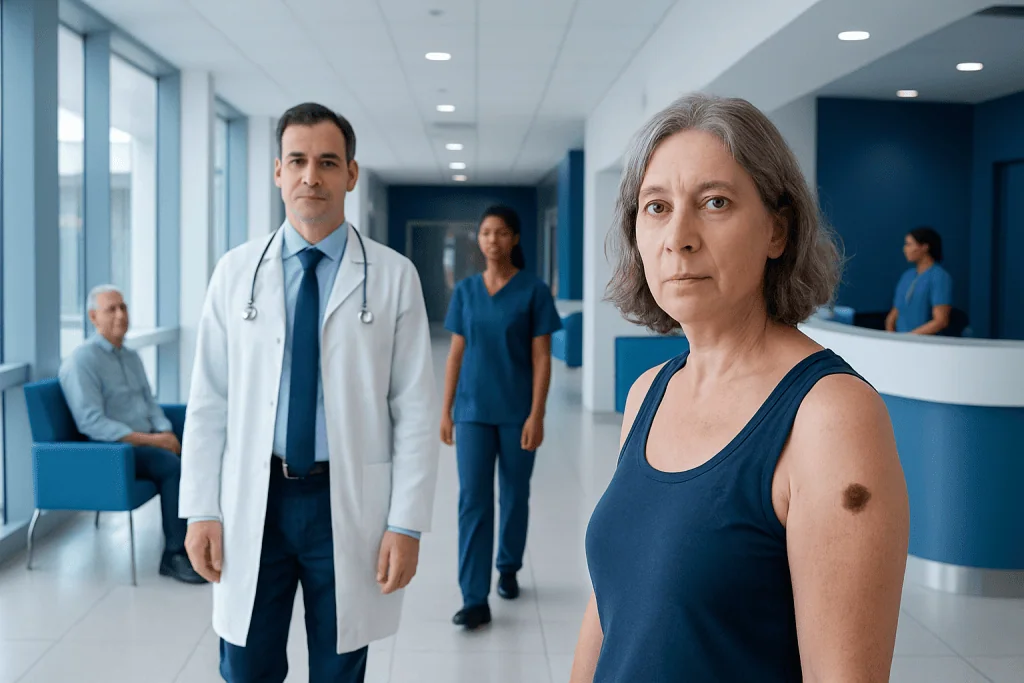
Skin cancer may look like a new spot, a mole that changes, or a patch or sore that does not heal. The ABCDE rule can help identify warning signs of melanoma.
Key Takeaways
- Skin cancer may look like a new spot, a mole that changes, or a patch or sore that does not heal.
- The ABCDE rule can help identify warning signs of melanoma.
- Basal cell carcinoma, squamous cell carcinoma, and melanoma can look different from one another.
- Anyone who notices a persistent or changing skin lesion should arrange a medical skin check.
- Sun protection and regular self-exams can help lower risk and support early detection.
Skin cancer often appears as a new growth, a changing mole, or a sore that does not heal. Knowing the common warning signs can help a person seek medical advice early and get an accurate diagnosis.
Overview: what skin cancer can look like
Skin cancer does not have one single appearance. It may show up as a new mole, a spot that changes over time, a shiny bump, a scaly patch, or a sore that bleeds or does not heal. Some skin cancers are dark brown or black, but others may be pink, red, skin-colored, or even nearly invisible at first glance.
Because appearances vary, the most helpful clue is often change. A lesion that becomes larger, darker, more raised, crusted, itchy, tender, or irregular deserves attention. A mark that looks different from the surrounding moles or spots can also be important.
Skin cancer can develop on skin that gets frequent sun exposure, such as the face, ears, scalp, neck, shoulders, arms, and legs. However, it can also appear in less exposed areas, including the soles of the feet, under the nails, the genitals, and between the toes. For this reason, a full-skin check is important rather than only looking at sun-exposed areas.
Common skin cancer warning signs
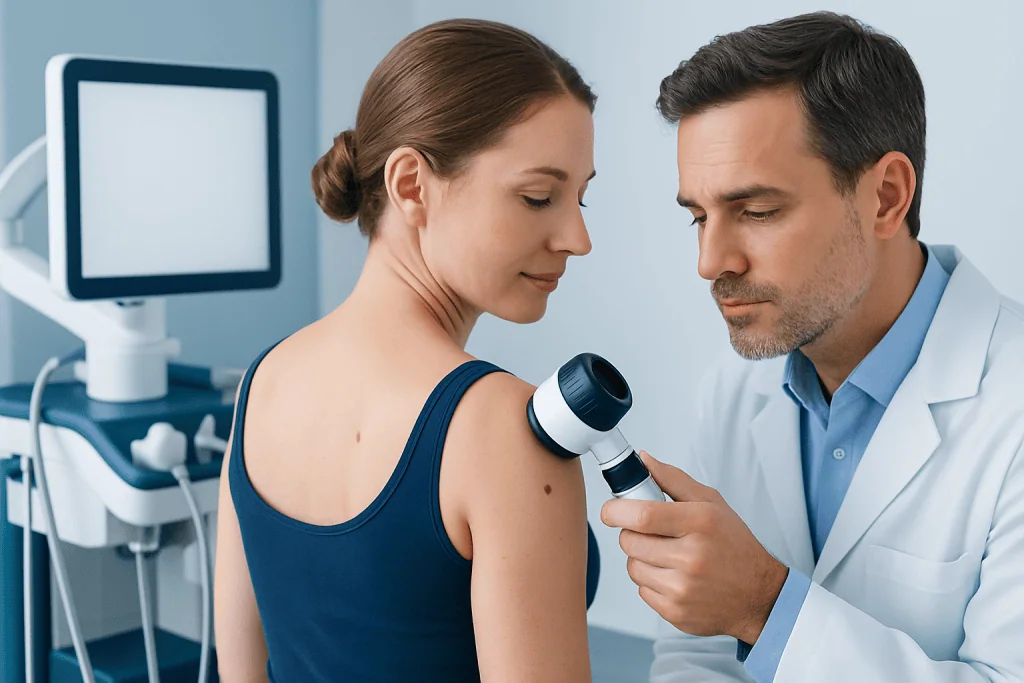
One of the best-known tools for spotting possible melanoma is the ABCDE rule. This guide can help a person decide whether a mole or pigmented lesion should be checked by a doctor:
- A – Asymmetry: one half does not match the other.
- B – Border: edges are irregular, blurred, or uneven.
- C – Color: there are multiple shades, such as brown, black, red, white, or blue.
- D – Diameter: the spot is larger than about 6 mm, although melanomas can also be smaller.
- E – Evolving: the mole changes in size, shape, color, or symptoms.
Another useful idea is the “ugly duckling” sign. This means a spot looks noticeably different from the person’s other moles. For someone who has many moles, the unusual one may be easier to notice than applying a checklist to every mark.
Warning signs are not limited to dark moles. A persistent red patch, a pearly bump, a rough or wart-like growth, or a sore that repeatedly crusts and returns can also suggest skin cancer. Symptoms such as itching, tenderness, bleeding, or failure to heal after several weeks should be assessed by a healthcare professional.
How different types of skin cancer may appear
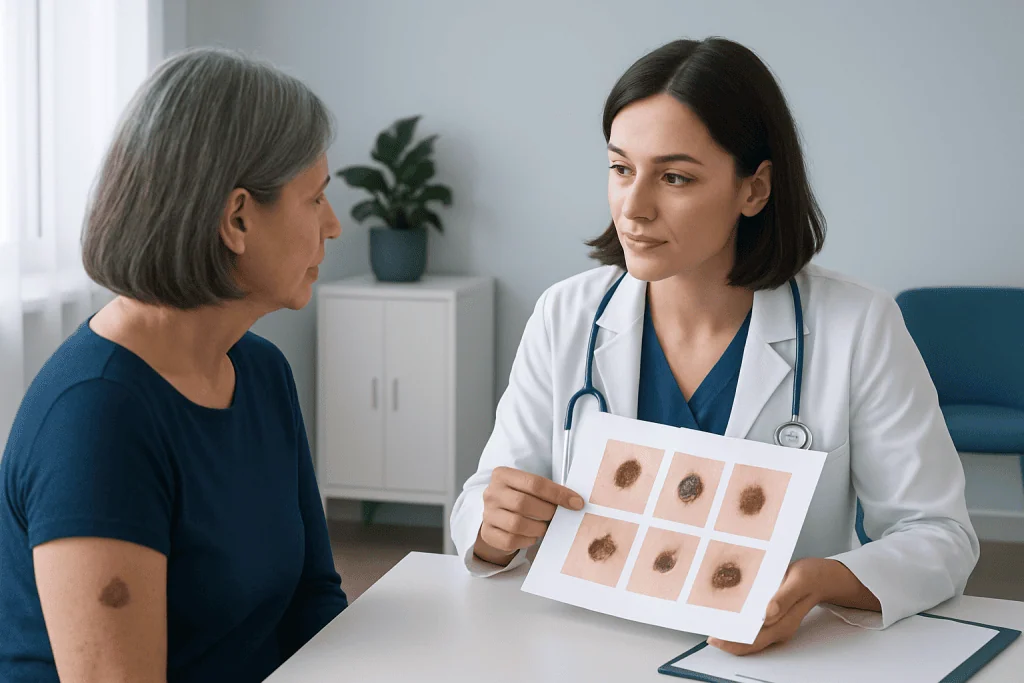
Basal cell carcinoma is the most common type of skin cancer. It often looks like a small shiny or pearly bump, a pink patch, or a sore that heals and then returns. Tiny visible blood vessels may run across the surface. Some basal cell cancers can look flat and scar-like rather than raised.
Squamous cell carcinoma may appear as a firm red bump, a rough scaly patch, a crusted lesion, or a sore that does not heal. It can develop on sun-exposed skin, especially the face, ears, lips, and backs of the hands. In some people, it resembles an irritated patch of eczema or a wart that continues to enlarge.
Melanoma can start in an existing mole or as a new dark spot. It may have uneven borders, mixed colors, and ongoing change. Not all melanomas are very dark; some are pink or red and are called amelanotic melanomas, which can make them harder to recognize. Anyone worried about possible melanoma or another suspicious lesion should seek prompt evaluation.
Less common skin cancers also exist, so any unusual skin change should be taken seriously even if it does not fit a classic description. A dermatologist may examine the area with dermoscopy and decide whether further testing is needed.
Causes and risk factors
Skin cancer develops when skin cells acquire DNA damage and begin to grow abnormally. Ultraviolet (UV) radiation from the sun is a major cause, and tanning beds can also increase risk. Damage often builds over time, which is why skin cancer can appear years after repeated sun exposure or sunburns.
Several factors can raise the likelihood of developing skin cancer. These include fair skin, light eyes, freckles, a history of blistering sunburns, many moles, atypical moles, older age, and a personal or family history of skin cancer. People with weakened immune systems may also have higher risk.
Risk is not limited to one skin tone. Although skin cancer is more common in lighter skin, it can affect people of all ethnic backgrounds. In darker skin, some skin cancers may be diagnosed later because they are less expected or occur in less visible places such as the palms, soles, or under nails. This makes awareness especially important for everyone.
How doctors diagnose suspicious skin changes
Diagnosis usually begins with a medical history and a close skin examination. The doctor will ask when the spot appeared, whether it has changed, and whether there are symptoms such as itching, pain, bleeding, or crusting. A full-body skin check may be recommended because more than one suspicious lesion can be present.
Many specialists use a dermatoscope, a handheld magnifying device that helps reveal patterns not visible to the naked eye. Dermoscopy can improve assessment, but it does not replace tissue testing when cancer is suspected. Photos may also be taken to monitor lesions over time.
The only way to confirm skin cancer is usually a biopsy, in which part or all of the lesion is removed and examined in a laboratory. If a suspicious area is confirmed as cancer, treatment planning depends on the type, size, depth, and location of the tumor. In selected cases, imaging or additional tests may be needed, especially for higher-risk or more advanced disease.
Treatment options
Treatment depends on the type of skin cancer and how advanced it is. Many nonmelanoma skin cancers are treated successfully with minor surgery to remove the lesion and a margin of surrounding tissue. Techniques may include standard surgical excision or Mohs surgery for cancers in delicate areas or those with a higher risk of recurrence.
Some superficial lesions may be managed with other approaches, such as cryotherapy, curettage and cautery, topical medicines, or light-based treatment, depending on the diagnosis. These options are chosen carefully because they are not suitable for every skin cancer. If a lesion is deeper or more aggressive, wider surgery may be required.
Melanoma often needs surgical removal, and additional treatment may be considered based on tumor depth and spread. In more advanced cases, care can involve immunotherapy, targeted therapy, or radiation therapy in selected situations. The treatment plan is individualized after specialist review.
Near the end of the diagnostic and treatment journey, some patients benefit from coordinated multidisciplinary care. Acibadem International’s multidisciplinary specialists and JCI-accredited hospitals diagnose and treat skin cancers for international patients when expert evaluation is needed.
Prevention and self-care
Not every skin cancer can be prevented, but reducing UV exposure is an important step. Helpful habits include using a broad-spectrum sunscreen, wearing protective clothing and a wide-brimmed hat, seeking shade during strong midday sun, and avoiding tanning beds. Sunscreen works best when applied generously and reapplied as directed, especially after swimming or sweating.
Regular self-exams can support early detection. A person can check the entire skin surface once a month in good light, using a full-length mirror and a hand mirror for hard-to-see areas. The scalp, back, buttocks, soles, and between the toes should not be forgotten. Taking photos of moles or spots can make subtle changes easier to notice over time.
Self-care also means paying attention to wounds or spots that do not behave as expected. A sore that lingers, a spot that repeatedly bleeds, or a mole that looks different from others should not be ignored. Early medical review is often the safest approach, even when the change turns out to be benign.
When to see a doctor
A doctor should be consulted if a person notices a new skin lesion that persists, a mole that changes, or a sore that does not heal within a few weeks. Bleeding, crusting, tenderness, itching, or rapid growth are also reasons to arrange an appointment. A prompt check is especially important for people with a previous history of skin cancer or many atypical moles.
It is sensible to seek medical advice even if the spot does not look dramatic. Early skin cancers can be subtle, and many noncancerous conditions can look similar. An expert examination helps clarify what is harmless and what needs treatment.
Routine skin checks may also be recommended for people at higher risk, such as those with fair skin, heavy lifetime sun exposure, a strong family history, or prior skin cancers. A dermatologist can advise how often follow-up should be scheduled based on individual risk.
Frequently asked questions
Can skin cancer look like a normal mole?
Yes. Some skin cancers, especially melanoma, can begin in a mole or resemble one at first. The key warning sign is change in size, shape, color, or symptoms such as itching or bleeding.
Does skin cancer always hurt or itch?
No. Many skin cancers are painless in the early stages. Some may itch, bleed, crust, or become tender, but the absence of symptoms does not rule out cancer.
Can people with darker skin get skin cancer?
Yes. Skin cancer can affect people of every skin tone. In darker skin, it may appear in less sun-exposed areas, such as the palms, soles, or under the nails, so full-body checks are still important.
What is the difference between melanoma and nonmelanoma skin cancer?
Melanoma starts in pigment-producing cells and is more likely to spread if not treated early. Nonmelanoma skin cancers, such as basal cell and squamous cell carcinoma, are often more common and may grow differently, but they still need proper diagnosis and treatment.
Should every changing skin spot be biopsied?
Not always, but every suspicious or persistent change should be assessed by a qualified doctor. After examination, the doctor may recommend monitoring, treatment, or a biopsy to confirm the diagnosis.
How often should a person check their skin?
A monthly self-exam is a practical habit for many people, especially those with many moles or higher risk factors. A doctor may also recommend regular professional skin checks depending on personal history and skin type.
References
- World Health Organization
- American Academy of Dermatology
- National Cancer Institute
- American Cancer Society
- National Health Service
This article is for general information only and is not a substitute for professional medical advice. Please consult a qualified doctor about your individual situation.
Skin Cancer in Turkey — costs, top hospitals & a free quote
JCI-accredited · board-certified surgeons · reply within 24h
Add us as a Preferred Source to see more of our trusted health content across Google Search, AI Overviews and Discover.