What Does Skin Cancer Look Like? Warning Signs and Images

Skin cancer often appears as a new spot or a change in an existing mole, patch, or sore. The ABCDE rule can help people recognize warning signs of melanoma.
Key Takeaways
- Skin cancer often appears as a new spot or a change in an existing mole, patch, or sore.
- The ABCDE rule can help people recognize warning signs of melanoma.
- Basal cell carcinoma, squamous cell carcinoma, and melanoma can look different from one another.
- Not every suspicious skin change is cancer, but any lesion that changes, bleeds, or does not heal should be checked.
- Sun protection and regular skin self-checks can help lower risk and support early detection.
Skin cancer can look different from person to person, but common warning signs include a new growth, a changing mole, a sore that does not heal, or a patch that bleeds, crusts, or itches. Knowing what changes to look for can help people seek medical advice early and improve the chance of effective treatment.
Overview
Skin cancer is a common cancer that begins when abnormal skin cells grow out of control. It can develop anywhere on the body, but it is most often found on areas that receive frequent sun exposure, such as the face, ears, scalp, neck, shoulders, chest, arms, and legs. It can also appear in places that get little sun, including the soles of the feet, under the nails, or the genital area.
When people ask what skin cancer looks like, the answer is not always simple. Skin cancer does not have one single appearance. It may look like a new mole, a sore that does not heal, a scaly patch, a shiny bump, a dark streak under a nail, or an existing spot that begins to change. Because appearances vary, any unusual or persistent skin change deserves attention.
The three main types are basal cell carcinoma, squamous cell carcinoma, and melanoma. Basal cell carcinoma and squamous cell carcinoma are often grouped as non-melanoma skin cancers. Melanoma is less common but more likely to spread if not found early. Recognizing suspicious changes and arranging a skin examination can help lead to earlier diagnosis and treatment.
What Skin Cancer Can Look Like
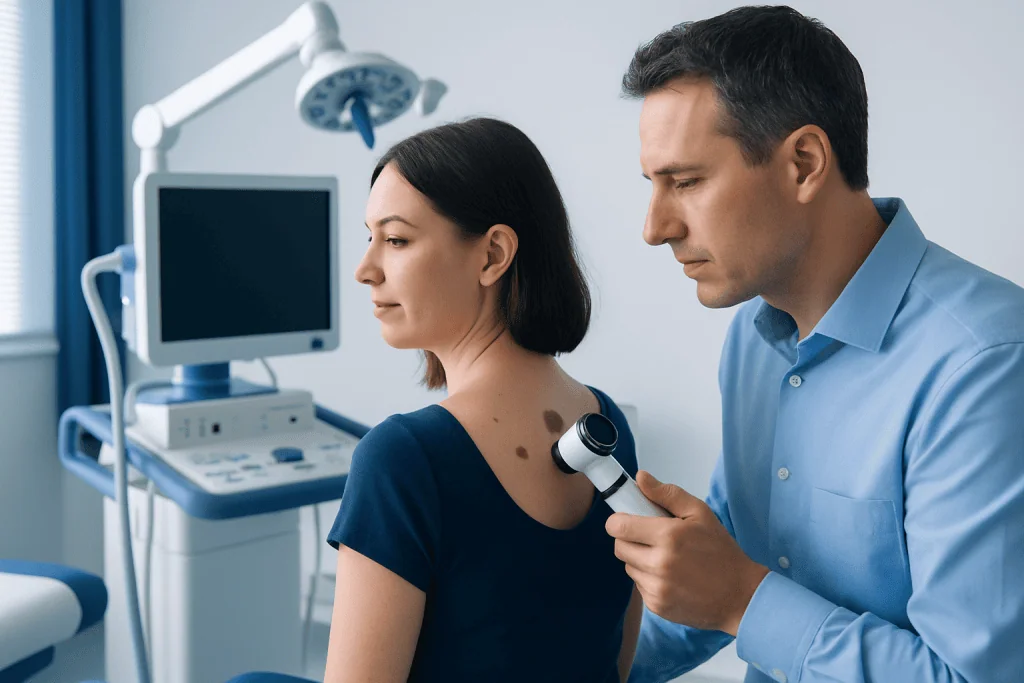
Skin cancer can appear in several ways, and it may be different on lighter and darker skin tones. Some lesions are pink or red, while others are brown, black, tan, white, or skin-colored. In some cases, a cancerous spot may be flat. In others, it may be raised, crusted, ulcerated, or tender. The key feature is often change over time rather than color alone.
Basal cell carcinoma often appears as a pearly or shiny bump, a pink growth, or a sore that repeatedly heals and returns. Tiny visible blood vessels may be seen on the surface. Squamous cell carcinoma may look like a rough, scaly patch, a thickened wart-like growth, or an open sore. Melanoma may develop in a mole or as a new dark or unevenly colored spot, but some melanomas are pink or flesh-colored rather than dark.
Warning signs can include:
- A new spot that looks different from other marks on the skin
- A mole that changes in size, shape, color, or height
- A sore that does not heal within several weeks
- A patch that crusts, bleeds, oozes, or becomes painful
- Persistent itching, tenderness, or burning in one area
- A dark streak under a fingernail or toenail without clear injury
Photographs can be helpful for education, but they cannot confirm a diagnosis. Many harmless conditions, such as eczema, psoriasis, seborrheic keratoses, cysts, or benign moles, can resemble skin cancer. A trained clinician usually needs to examine the skin directly and may recommend a biopsy to know for sure.
Melanoma and the ABCDE Rule
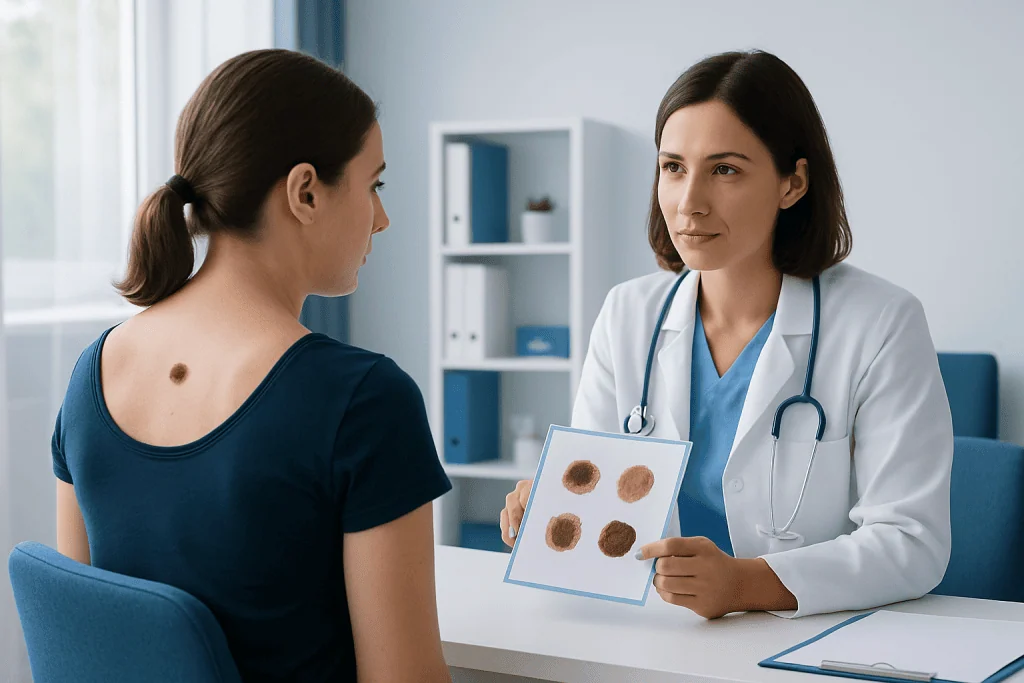
Melanoma is the type of skin cancer people often worry about most because it can spread to other parts of the body. It may begin in an existing mole or arise as a new spot. One practical way to assess a suspicious mole is the ABCDE rule, which highlights common warning signs seen in melanoma.
The ABCDE rule stands for:
- A – Asymmetry: one half does not match the other half
- B – Border: edges are irregular, blurred, notched, or ragged
- C – Color: the spot has more than one color or an uneven color pattern
- D – Diameter: it is larger than about 6 mm, although melanomas can be smaller
- E – Evolving: the mole changes in appearance or symptoms over time
Another useful idea is the “ugly duckling” sign. This refers to a mole or spot that looks noticeably different from the person’s other moles. For many people, that outlier deserves extra attention, especially if it is changing. Melanoma can also appear on the scalp, palms, soles, nail beds, or mucosal surfaces, so skin checks should go beyond commonly exposed areas.
Although melanoma is a major concern, not every unusual mole is melanoma. Dermatologists often use dermoscopy, a special magnifying tool, to examine patterns that are not visible to the naked eye. If needed, a biopsy can determine whether the lesion is benign or part of melanoma.
Causes and Risk Factors
Skin cancer develops because of damage to the DNA of skin cells. Ultraviolet, or UV, radiation from the sun is a major cause, and indoor tanning devices also increase risk. Repeated sun exposure over many years, as well as a history of sunburns, can contribute to the development of skin cancer.
Some people have a higher risk than others. Risk factors include fair skin, light eyes, freckles, red or blond hair, a large number of moles, atypical moles, older age, and a personal or family history of skin cancer. However, skin cancer can occur in people of all skin tones and ages, so changes should never be ignored simply because someone does not fit a typical risk profile.
Other risk factors include a weakened immune system, previous radiation exposure, certain inherited conditions, and long-term exposure to substances such as arsenic. Skin that has chronic wounds, scars, or ongoing inflammation may also be more vulnerable in some cases. People who work outdoors or spend significant time in strong sunlight may accumulate more UV damage over time.
It is also important to remember that skin cancer may develop on areas that are not regularly exposed to sunlight. For this reason, full-body skin awareness matters. A doctor may also evaluate whether a suspicious lesion could relate to another form of skin cancer with a different pattern of risk and appearance.
How Doctors Diagnose Skin Cancer
Diagnosis begins with a careful medical history and skin examination. A doctor may ask when the spot first appeared, whether it has changed, and whether it bleeds, itches, or becomes painful. They may also ask about sun exposure, tanning bed use, previous skin cancers, family history, and medications that affect the immune system.
During the examination, the clinician looks at the size, shape, color, border, and location of the lesion and may inspect the rest of the skin for other suspicious areas. A dermatoscope can help reveal structures beneath the skin surface. If a lesion looks concerning, the next step is usually a skin biopsy, which means taking part or all of the spot for laboratory analysis.
A biopsy is the only reliable way to confirm whether a lesion is cancerous and what type it is. If cancer is found, further assessment may be needed to determine how deep it goes and whether additional treatment is necessary. In some situations, imaging or lymph node evaluation may be considered, especially for higher-risk melanoma or more advanced squamous cell carcinoma.
People should avoid trying to diagnose skin cancer from online images alone. Educational images can raise awareness, but they cannot replace a professional assessment. If there is concern, evaluation by a dermatologist or other qualified physician is the safest path.
Treatment Options
Treatment depends on the type of skin cancer, its size, depth, location, and whether it has spread. Many skin cancers can be treated successfully when found early. Common treatments include surgical removal, specialized excision techniques, cryotherapy for certain superficial lesions, topical medicines in selected cases, and radiation therapy when surgery is not suitable or when additional treatment is needed.
For basal cell carcinoma and squamous cell carcinoma, surgery is often the main treatment. This may involve standard excision or Mohs surgery for cancers in cosmetically or functionally sensitive areas, or for lesions with a higher risk of recurrence. Some superficial cancers may be treated with creams, light-based techniques, or other local therapies depending on the clinical situation.
Melanoma usually requires surgical removal with an appropriate margin of normal skin. Depending on the depth and stage, doctors may recommend additional procedures or treatments, such as lymph node evaluation, immunotherapy, targeted therapy, or radiation therapy. Care is individualized, and treatment decisions are based on pathology results and overall health.
Near the end of the care pathway, some patients may benefit from support by a multidisciplinary team that includes dermatology, surgical oncology, medical oncology, pathology, and radiology specialists. Acibadem International’s multidisciplinary specialists and JCI-accredited hospitals diagnose and treat skin cancer for international patients when advanced evaluation or treatment planning is needed.
Prevention and Self-care
Prevention focuses mainly on protecting the skin from UV damage. Helpful steps include using a broad-spectrum sunscreen, seeking shade during strong midday sun, wearing protective clothing and a wide-brimmed hat, and using UV-blocking sunglasses. Avoiding indoor tanning is especially important, because tanning beds expose the skin to concentrated UV radiation.
Regular skin self-checks can also support early detection. A person can examine the entire body once a month in good light using a full-length mirror and a hand mirror. It helps to check the scalp, back, buttocks, soles of the feet, between the toes, and under the nails. Taking photographs of moles can make it easier to notice change over time.
Self-care does not mean self-diagnosis. If a spot looks unusual, changes, or does not heal, it is better to seek medical advice than to wait. People with many moles, a past history of skin cancer, or higher risk factors may need regular skin checks by a dermatologist as part of ongoing prevention and follow-up.
When to See a Doctor
A doctor should evaluate any skin lesion that is new, changing, bleeding, crusting, painful, or not healing. This is especially true if a mole meets any part of the ABCDE rule or stands out as an “ugly duckling.” Prompt assessment is sensible, even though many suspicious-looking spots turn out to be noncancerous.
People should also seek medical care for a persistent rough patch, a pearly bump, a wart-like growth, a sore that returns after healing, or a dark streak under the nail with no clear explanation. New skin changes in a scar, chronic wound, or previously treated area also deserve attention.
Urgency does not need to cause panic. Skin changes are common, and many are harmless. Still, early medical advice is the best way to find out what a lesion is and whether treatment is needed. Timely diagnosis can make management simpler and more effective.
Frequently asked questions
Does skin cancer always look like a dark mole?
No. Skin cancer can be brown or black, but it can also be pink, red, white, skin-colored, or even nearly transparent. Some skin cancers look like a shiny bump, a scaly patch, or a sore that will not heal rather than a dark mole.
Can a harmless-looking spot still be skin cancer?
Yes. Some skin cancers look subtle in the early stages and may not seem dramatic or painful. A spot that is new, persistent, or changing should be checked even if it appears small or mild.
What is the difference between melanoma and other skin cancers?
Melanoma begins in pigment-producing cells and is more likely to spread if not detected early. Basal cell carcinoma and squamous cell carcinoma are often less aggressive, but they can still grow deeper, damage nearby tissue, and sometimes spread.
Is skin cancer possible on darker skin tones?
Yes. Although the overall risk may differ, skin cancer can affect people of every skin tone. In darker skin, it may be found more often on the palms, soles, under the nails, or in areas not usually exposed to the sun.
How can someone check their skin at home?
A monthly self-check in a well-lit room can help. It is useful to examine the front and back of the body, the scalp, under the nails, the soles of the feet, and areas that are hard to see with the help of mirrors or another person.
Should every suspicious spot be biopsied?
Not always. A doctor may first examine the lesion closely and decide whether monitoring or biopsy is the best next step. If a spot has concerning features, a biopsy is the most reliable way to confirm whether it is skin cancer.
References
- World Health Organization
- American Academy of Dermatology
- National Cancer Institute
- American Cancer Society
- National Health Service
This article is for general information only and is not a substitute for professional medical advice. Please consult a qualified doctor about your individual situation.
Skin Cancer in Turkey — costs, top hospitals & a free quote
JCI-accredited · board-certified surgeons · reply within 24h
Add us as a Preferred Source to see more of our trusted health content across Google Search, AI Overviews and Discover.

More from the Health Library



Related Specialists

Fzt. Yusuf Mücahit Turan
Physical Medicine & Rehabilitation
Prof. Dr. Özmen Öztürk
Ear Nose & Throat
Prof. Dr. Gökhan Demir
Medical Oncology
Asst. Prof. Dr. Hamdi Toköz
Cardiovascular Surgery