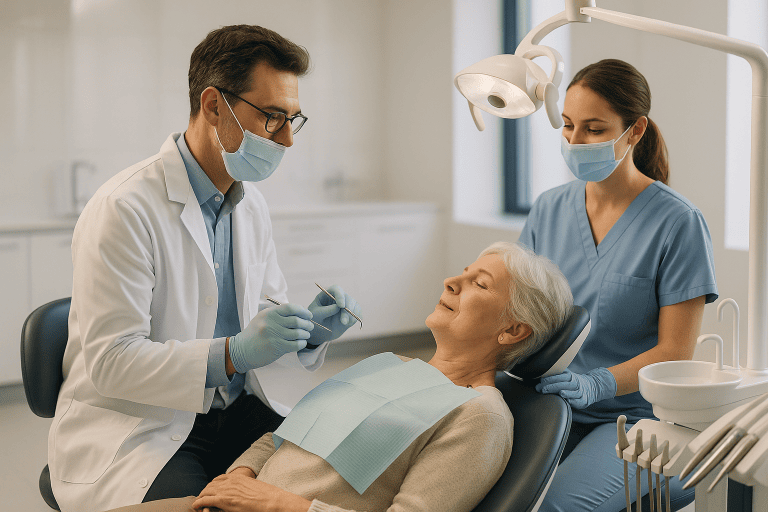
Full Mouth Reconstruction
Full mouth reconstruction combines restorative and cosmetic dental treatments to rebuild damaged, worn or missing teeth. It aims to improve chewing function, bite balance, oral comfort and smile appearance.
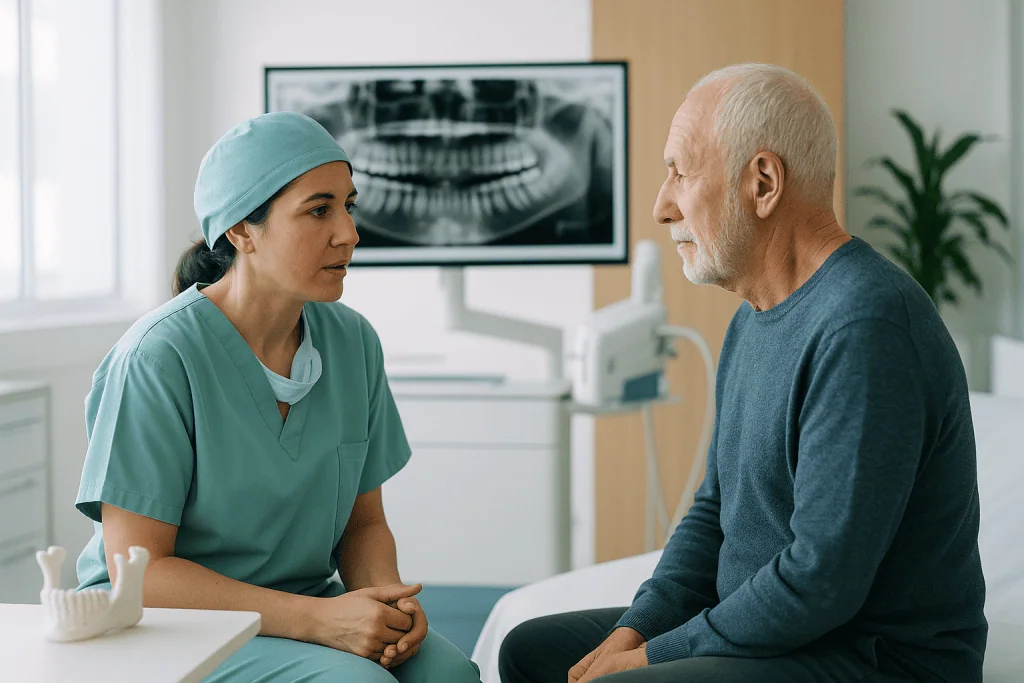
Quick answer
Full mouth reconstruction is a planned series of dental treatments that rebuilds most or all of the teeth in one or both jaws. Depending on the case, it can combine crowns, bridges, implants, root canal treatment, gum therapy and bite correction. Treatment is staged over weeks to months, beginning with diagnosis and disease control and ending with fitted, adjusted final restorations.
What Is Full Mouth Reconstruction?
Full mouth reconstruction is a planned series of dental treatments that rebuilds most or all of the teeth in one or both jaws. It is designed for people whose teeth are extensively damaged, worn, missing or failing, and its purpose is functional as much as cosmetic: a stable bite, comfortable chewing, healthy gums and teeth that look natural and hold up in daily use. You may also see it called full mouth restoration or full mouth rehabilitation, in practice, the terms describe the same process.
The need for this kind of treatment usually builds over years rather than arriving overnight. When several teeth are damaged, worn down, missing, painful or no longer meeting together comfortably, the effects reach well beyond appearance. Eating becomes slow or uncomfortable. You start avoiding certain foods. You may feel self-conscious when speaking or smiling, or notice recurring jaw tension, headaches and changes in the way your teeth come together. For many people the real question is not “how can I improve my smile?” but “how can I eat, speak and feel normal again?”
What sets full mouth reconstruction apart from routine dentistry is the unit of planning. Rather than treating each tooth as an isolated problem, the dental team evaluates how your teeth, gums, jaw joints, bite, facial proportions and underlying bone work together as a system. A single crown placed into an unstable bite tends to fail. A crown placed into a bite that has been deliberately rebuilt around it has a far better working environment. The objective is a stable, comfortable bite first, with individual restorations designed to serve it.
The decision can feel significant, particularly when treatment involves multiple appointments and a combination of procedures. It is reasonable to ask whether the plan you have been offered is medically appropriate or unnecessarily extensive, how long each stage takes, and how the finished work will be maintained afterwards. A responsible full mouth reconstruction begins with clear diagnosis, realistic planning and an open discussion of alternatives, timing and long-term care, before any irreversible work starts.
At Acibadem, planning for this treatment is based on your oral health, functional needs, aesthetic preferences, medical history and practical circumstances. The goal is not to produce an identical smile for every patient. It is to restore a healthy, reliable foundation for daily life while respecting your natural facial features and your own expectations.
What does full mouth reconstruction involve?
Full mouth reconstruction involves a personalised combination of restorative, surgical, periodontal and cosmetic procedures, selected according to what your mouth actually needs. Depending on the case, the disciplines involved can include restorative dentistry, prosthodontics, periodontics, endodontics, oral and maxillofacial surgery and orthodontics. A plan may include one or more of the following:
- Dental crowns to protect weakened teeth and restore their shape, strength and bite position.
- Dental bridges to replace one or more missing teeth where the neighbouring teeth are suitable supports.
- Dental implants to replace missing tooth roots and carry single crowns, bridges or full-arch restorations.
- Veneers or bonded restorations for selected teeth when conservative aesthetic enhancement is appropriate.
- Root canal treatment when an infected or damaged tooth can be preserved rather than removed.
- Periodontal treatment to manage gum disease and establish a healthier foundation for restorations.
- Bone grafting or sinus-related procedures when additional support is needed before implants can be placed.
- Extractions for teeth that cannot be predictably restored.
- Orthodontic treatment or bite adjustment in selected cases where tooth position affects the final result.
- Removable partial or complete dentures when they are the most suitable solution for your oral condition and preferences.
Not every patient requires every element. In some cases the reconstruction can be completed in a relatively concentrated treatment period. In others it is safer to proceed in stages: treating infection or gum inflammation first, then placing implants or restoring teeth after adequate healing. The correct sequence is determined by biology and function, not by a one-size-fits-all timeline, and a plan that promises to skip healing time deserves scrutiny rather than enthusiasm.
Full mouth restoration and full mouth rehabilitation: are they different?
Full mouth restoration and full mouth rehabilitation are, for practical purposes, the same treatment as full mouth reconstruction. The names are used interchangeably by most clinics. Some dentists prefer “rehabilitation” when the emphasis is on rebuilding the bite height and jaw function in a severely worn dentition, and “restoration” when the plan leans on repairing existing teeth rather than replacing them. None of these labels changes what happens in the chair. What matters is the scope of the written plan in front of you: which teeth are kept, which are replaced, in what order, and why. Judge the plan, not the name it carries.
Full mouth reconstruction vs smile makeover: which do you need?
The difference between full mouth reconstruction and a smile makeover is the starting problem. A smile makeover is cosmetic-led: it focuses on tooth colour, shape, alignment and the visible appearance of the smile, often using veneers, whitening or contouring, and it assumes the underlying mouth is broadly healthy. Full mouth reconstruction is health- and function-led: it exists to solve extensive decay, severe wear, unstable bite relationships, missing teeth, failing restorations, gum disease or structural damage after trauma. A more attractive smile is usually an important benefit, but it is developed alongside durability, comfort and chewing efficiency, not instead of them. The two can overlap; some reconstructions include veneers on selected teeth, and related concerns such as a gummy smile can be addressed within a wider plan. If you are weighing up the cosmetic route, it is worth understanding exactly what that pathway involves, and what it cannot fix, before choosing between the two.
Who May Need Full Mouth Reconstruction?
People come to full mouth reconstruction along different roads. Some have watched dental problems accumulate gradually over decades. Others have had an accident, a period of extensive decay, or a medical condition that affected their teeth and gums. You can still have many natural teeth and yet need comprehensive rehabilitation, because those teeth are shortened, fractured, heavily restored, or no longer meeting correctly. Common symptoms and concerns include:
- Difficulty chewing, biting into food, or eating a varied diet.
- Repeated tooth fractures, loose fillings, broken crowns, or restorations that keep failing.
- Worn, flattened, chipped or unusually sensitive teeth.
- Several missing teeth, or teeth that have shifted into the gaps.
- Persistent toothache, sensitivity to hot or cold, or recurrent dental infection.
- Bleeding gums, gum recession, bad breath, or teeth that feel mobile.
- Jaw soreness, facial muscle fatigue, clenching, grinding, or an uneven bite.
- Changes in facial support, such as a collapsed appearance around the mouth after tooth loss or severe wear.
- Concern about the appearance of discoloured, irregular, damaged or mismatched teeth.
- Discomfort or instability with existing dentures, bridges, crowns or implant restorations.
How is the need for full mouth reconstruction diagnosed?
Diagnosis begins with a detailed clinical examination, not a price list. The dentist reviews your teeth, gums, bite, jaw movement, facial proportions, prior dental work, oral hygiene and relevant medical history. Digital dental imaging helps assess tooth roots, bone levels, sinus anatomy, hidden infection and the condition of previous restorations. In more complex implant or surgical cases, three-dimensional imaging is used to evaluate the jawbone and support precise planning.
Dental photographs, digital scans, diagnostic models and bite analysis are often added to the record. These help the team understand how your teeth fit together and allow the proposed changes to be reviewed before anything irreversible starts. You can often see a digital preview, or wear a temporary trial restoration that demonstrates the planned tooth length, shape, bite position and smile design in your own mouth: a far more reliable test than a picture on a screen.
A full mouth reconstruction is generally considered when isolated treatment would not adequately solve the larger functional problem. Placing a crown on one broken tooth is appropriate if the surrounding bite is stable. But if teeth throughout the mouth are severely worn because of grinding or acid erosion, rebuilding only one tooth places excessive stress on that single restoration and leaves the underlying cause untouched. In that situation, tooth-by-tooth dentistry becomes a cycle of repairs; whole-mouth planning breaks the cycle.
Conditions and Dental Problems Full Mouth Reconstruction Can Address
Full mouth reconstruction is not a single diagnosis. It is a treatment framework for people with complex or widespread oral health needs, and a single plan may address several conditions at once, provided treatment is sequenced carefully and your general health allows.
One common indication is advanced tooth wear. Teeth become shorter, thinner and more fragile through bruxism, frequent clenching, acid reflux, dietary acids, certain eating disorders or long-term mechanical wear. As enamel is lost, teeth grow sensitive and prone to cracking. The bite can also collapse, altering facial support and making chewing less efficient. Rebuilding a worn dentition usually means restoring lost bite height across the whole mouth, not patching individual teeth.
Extensive decay and recurrent restoration failure are another frequent reason for comprehensive care. Large fillings, old crowns or bridges eventually leak, fracture, or stop protecting the remaining tooth structure. Some teeth can be repaired with new restorations; others need root canal treatment, or extraction and replacement. The honest answer differs tooth by tooth, and a sound plan states the prognosis for each.
Multiple missing teeth affect much more than the spaces themselves. Neighbouring teeth drift or tilt, opposing teeth over-erupt into the gap, and chewing forces concentrate on the teeth that remain. Dental implants, bridges or dentures can be built into a reconstruction to restore more balanced function before the knock-on damage spreads further.
Periodontal disease causes inflammation, gum recession, bone loss and tooth mobility. Restorative work should never be placed over untreated active gum disease: it fails, and it takes healthy investment with it. Periodontal care is therefore often an early and essential phase of reconstruction, creating the stable tissue conditions final restorations depend on.
Other indications include trauma-related tooth loss or fractures, developmental enamel defects, congenital absence of teeth, bite abnormalities, failed previous full-mouth dental work, and complications from poorly fitting dentures or prostheses. Patients who have undergone cancer treatment, facial surgery or other medical therapies may also need individualised dental rehabilitation, coordinated with their wider medical team where necessary.
How Full Mouth Reconstruction Is Performed
Because no two mouths share the same starting point, full mouth reconstruction is planned as a sequence rather than a single procedure. The order is consistent even when the contents differ:
- 1. Comprehensive examination, imaging and records.
- 2. Diagnosis and a written, staged treatment plan.
- 3. Disease control, gum treatment, root canals, removal of hopeless teeth.
- 4. Foundation work, grafting and implant placement where needed, with healing time.
- 5. Trial restorations to test the new bite, speech and appearance.
- 6. Final restorations, fitted, adjusted and placed on a maintenance schedule.
Initial consultation and comprehensive assessment
The first stage is a detailed consultation. The team listens to your concerns, discomfort, eating limitations, aesthetic priorities, previous dental experiences and expectations about timing. Medical conditions such as diabetes, heart disease, osteoporosis, autoimmune disorders and bleeding disorders, along with smoking history, medication use and any previous radiation therapy, can influence surgical planning and healing, so these are discussed carefully and honestly at the outset rather than discovered mid-treatment.
The examination itself may include periodontal charting, photographs, intraoral scanning, digital X-rays and three-dimensional imaging where indicated. The team assesses each tooth individually, but also studies the relationship between the upper and lower jaws, the jaw joints, muscles, lips and facial profile. If you clench, grind, notice clicking, jaw pain or limited opening, additional evaluation of bite-related and temporomandibular concerns may be appropriate before any restorative decisions are fixed.
Designing the treatment plan
After the assessment, the dentist develops a proposed plan: which teeth can be retained, which require treatment or removal, whether implants are appropriate, and how the final bite will be restored. Where several specialties are involved, the case is reviewed through a multidisciplinary specialist discussion, prosthodontists, periodontists, oral and maxillofacial surgeons, endodontists, orthodontists and restorative dentists each contributing according to what your case actually needs.
Digital smile design tools and diagnostic wax-ups or virtual models help you understand the proposed result before committing. A mock-up or temporary version of the final smile can be placed in the mouth to test tooth proportions, speech, comfort and appearance. This trial phase is particularly valuable when the plan changes your bite height or rebuilds severely worn teeth: it lets problems surface while they are still easy to correct.
Preparing the mouth for reconstruction
Before final restorations are placed, active disease is treated. This may involve professional hygiene care, deep gum treatment, root canal treatment, replacement of leaking restorations, or extraction of teeth with a poor long-term outlook. If implants are planned, bone grafting is considered where bone volume is insufficient to support predictable placement.
Temporary crowns, bridges or provisional dentures are often used while the mouth heals or while final restorations are being designed. These temporaries are not merely cosmetic. They let you and your dentist evaluate the new bite, chewing comfort, speech and appearance in real daily life, eating, talking, sleeping, before the final materials are made. Adjustments at this stage cost little; adjustments after final ceramics are fitted cost far more.
Implants, restorations and final rehabilitation
Dental implants, where they are part of the plan, are placed surgically into the jawbone. They act as artificial tooth roots and can support crowns, bridges or fixed full-arch restorations. Depending on bone quality, implant stability, gum condition and the complexity of the case, a temporary restoration can sometimes be attached relatively soon after surgery; in other situations, a healing period is needed before the tooth replacement goes on. Which of these applies to you is a biological judgement, not a scheduling preference.
Natural teeth that are retained are rebuilt with crowns, onlays, veneers, fillings or other restorations. The choice depends on how much healthy tooth structure remains, the forces acting on the tooth, aesthetic goals and the long-term maintenance plan. Modern ceramics and other dental materials are selected for strength, translucency, wear resistance and suitability for different areas of the mouth: a molar and a front tooth do different jobs and are restored accordingly.
Once the final bite has been verified, the definitive restorations are fitted and adjusted. The dentist checks how your teeth contact during chewing and side-to-side movements, along with speech, gum contours and overall comfort. Fine adjustments over more than one visit are normal and should be expected; a successful rehabilitation depends on details that simply cannot all be resolved in a single appointment.
Technology used in planning and treatment
Modern full mouth reconstruction commonly uses digital intraoral scanners, high-resolution dental radiography and three-dimensional imaging for implant and surgical planning. These tools reduce the need for conventional impressions, improve visualisation of bone and root anatomy, and help the team position restorations with greater accuracy.
Computer-assisted planning can be used to assess implant placement, create surgical guides, design restorations and compare the planned bite with your current one. Digital photography and smile analysis support the conversation about tooth shape, lip support and facial balance, and advanced laboratory workflows help produce restorations with precise fit and natural-looking surfaces. A caution worth stating plainly: technology supports clinical decision-making, but it does not replace experienced examination, biological judgement and careful follow-up. A scanner cannot decide whether a tooth is worth saving.
How Long Does Full Mouth Reconstruction Take?
Full mouth reconstruction takes anywhere from a few weeks to well over a year, depending entirely on what your plan contains. A reconstruction built around crowns and conservative restorative treatment can be completed over a shorter period once oral health is stable. Cases involving gum treatment, bone grafting, extractions, implants, orthodontics or complex bite rehabilitation usually require staged care over several months, because implant healing and tissue maturation cannot be reliably accelerated without compromising the result. The main factors that stretch or shorten the timeline are:
- Whether active gum disease or infection must be controlled first.
- Whether implants are involved, and whether bone grafting is needed before them.
- How many teeth are being rebuilt, and whether the bite height is changing.
- How your tissues heal, which is influenced by health, smoking and hygiene.
- How long you choose to test trial restorations before finalising them.
If you are travelling for treatment, the practical question is which stages must be completed in person and how follow-up will be handled afterwards. Some patients travel for an initial diagnostic and treatment phase, then return later for final restorations once healing is complete. Others complete selected preliminary care with their local dentist before travelling. The safest arrangement depends on the procedures involved, the expected healing, and whether appropriate follow-up care is genuinely available to you at home: that last point deserves as much attention as the treatment itself.
Why Early Treatment Matters
Dental problems do not stand still. A cracked tooth can progress to a deeper fracture or infection. Gum disease can continue destroying bone. Missing teeth allow neighbours to shift, which makes later replacement more complex. Severe wear gradually alters the bite and increases strain on the remaining tooth structure, the muscles and the jaw joints.
Delay also narrows your options. A tooth that could initially have been protected with a crown or saved with root canal treatment may eventually become non-restorable. Prolonged tooth loss leads to bone reduction in the jaw, sometimes requiring additional grafting procedures before implant treatment is even possible. In other words, waiting does not just postpone treatment: it can change what treatment is available and add stages to it.
Early assessment does not mean every patient needs immediate full reconstruction. It means understanding the cause and severity of the problem before it advances. In some cases, a staged plan that prioritises infection, unstable teeth, gum disease or acute pain is the right first step, with the wider rebuild following later. Timely care protects oral health, maintains function, and makes whatever comes next more predictable.
Benefits of Full Mouth Reconstruction
When carefully planned and properly maintained, full mouth reconstruction can deliver meaningful functional, health and aesthetic benefits. Here is what each one means in practice:
| Benefit | What It Means for You |
|---|---|
| Improved chewing function | Rebuilding damaged or missing teeth can make it easier to eat a broader range of foods and distribute chewing forces more evenly. |
| A more stable bite | Restoring the way upper and lower teeth meet may reduce uneven pressure on individual teeth and improve comfort during chewing. |
| Protection of remaining teeth | Crowns, onlays and other restorations can reinforce weakened teeth and help reduce the risk of further fractures or breakdown. |
| Replacement of missing teeth | Implants, bridges or dentures can restore gaps, support speech and chewing, and help limit unwanted movement of neighbouring teeth. |
| Healthier gums and oral environment | Addressing periodontal inflammation, infection and poorly fitting restorations creates a more stable foundation for long-term dental care. |
| More natural smile appearance | Tooth colour, shape, proportion and alignment can be improved in a way that is planned around your facial features and preferences. |
| Greater day-to-day confidence | Many patients find that improved comfort, clearer speech and less worry about damaged teeth make social and professional life easier. |
Recovery and Adjustment Timeline
Recovery depends on the procedures included in your plan. The timeline below is a general guide; surgical treatment, implant healing and extensive bite changes need a longer adjustment period, and your team will tell you where your plan sits within it.
| Time Period | What Patients Can Expect |
|---|---|
| Day 1 | After restorative care, mild sensitivity or gum tenderness may occur. After extractions or implant surgery, swelling, minor bleeding and discomfort are possible. Pain relief instructions, diet guidance and oral hygiene advice are provided. |
| First week | Soft foods may be recommended, especially after surgery or placement of temporary restorations. Swelling generally begins to settle. Avoid putting excessive pressure on healing areas and follow the cleaning instructions closely. |
| First month | Temporary restorations, new bite positions or removable appliances may need adjustment. Follow-up visits allow the dentist to refine comfort, speech, bite contacts and gum response. |
| Several months | Where implants, grafting or periodontal therapy are involved, healing and tissue stabilisation continue. Final restorations are planned once the supporting tissues are ready. |
| Longer term | Ongoing hygiene care, professional reviews and protective appliances such as a night guard may be recommended. Final restorations need regular monitoring and maintenance to support their longevity. |
Full Mouth Reconstruction Cost: What Determines It
Full mouth reconstruction cost varies more widely than almost any other dental treatment, because the term covers everything from a set of crowns on natural teeth to full-arch implant rehabilitation with bone grafting. No single figure describes it honestly. What can be described honestly are the factors that move the price: how many teeth are treated, whether implants and grafting are needed, the materials chosen, the laboratory work involved, how many specialists contribute, and how many stages and visits the plan requires.
How much is full mouth reconstruction?
The only reliable answer comes from an itemised written plan produced after a full examination of your own mouth, not from a generic quote. Two patients asking for “full mouth reconstruction” can need entirely different treatment, so a price offered before diagnosis is a guess dressed as a promise. When comparing quotes, check that each covers the same scope: disease control, temporaries, the final restorations, follow-up adjustments and any protective appliance. A low headline price that omits stages you will inevitably need is not the cheaper option; it is an incomplete quote, and the missing stages tend to resurface later as unplanned costs.
How to pay for full mouth reconstruction
Because the treatment is naturally staged, its cost can often be staged too. Many plans begin with urgent disease control and phase the restorative work over months, which spreads payments across the same timeline as the biology. Dental insurance policies sometimes distinguish between functional treatment, such as managing infection or replacing failing restorations, and purely cosmetic work, so it is worth checking your own policy’s wording before assuming anything is or is not covered. Whatever route you take, insist on the itemised written plan first: it is the document that lets you budget by stage, compare providers on equal terms, and avoid paying twice for work that was quoted incompletely.
What Influences Outcomes and Long-Term Success?
A good result is measured by more than how the teeth look immediately after treatment. It includes comfort, chewing function, stable gums, appropriate bite forces, durable restorations, and your ability to maintain oral health over time. Outcomes vary because every case carries different biological, mechanical and behavioural factors, which is why honest planning matters more than glossy previews.
The quality of diagnosis is fundamental. A reconstruction should address the causes of dental damage, not only its visible effects. If tooth wear is driven by grinding, acid exposure or an unstable bite, the plan should include a protective night guard, dietary or medical guidance, and monitoring of the new restorations. If gum disease contributed to tooth loss, periodontal maintenance remains essential long after the restorative work is finished.
Bone quality and gum health influence implant treatment. Smoking, uncontrolled diabetes, certain medications, immune conditions and inadequate oral hygiene can affect healing and raise the risk of complications. These factors do not automatically exclude treatment, but they require frank discussion and may change the recommended approach. Be wary of any plan that never asks about them.
The amount of healthy tooth structure remaining matters too. Dentists aim to preserve natural teeth when their long-term outlook is favourable, but keeping a severely compromised tooth can jeopardise the wider rehabilitation built around it. Decisions about extraction and replacement should rest on clinical evidence, imaging, periodontal support and a realistic prognosis, not on sentiment in either direction.
Your own participation carries real weight. Brushing effectively, cleaning between teeth and around implants, attending professional maintenance visits, wearing any recommended protective appliance and reporting changes promptly all contribute to a stable result. Crowns, bridges, implants and veneers are durable solutions, but they are not maintenance-free. Like natural teeth, they need consistent care, and the most realistic expectation is not that the work will never need attention again, but that it gives you a healthier, more functional and more manageable foundation.
What is the downside of full mouth implants?
The main downsides of implant-based full-arch treatment are surgery, time and maintenance. Implant placement is a surgical procedure with the usual surgical considerations, swelling, healing periods, and in some cases the need for bone grafting first, which adds months to the timeline. Implants can develop gum-type inflammation around them (peri-implant disease) if hygiene and professional maintenance lapse, and fixed full-arch restorations demand careful cleaning that some patients underestimate. Removing many remaining natural teeth to fit implants is also irreversible, so that decision deserves genuine deliberation: a tooth with a good prognosis is usually worth keeping. Finally, not everyone is an immediate candidate, bone volume, smoking and certain medical conditions all shape whether, and how, implants make sense for you.
Is full mouth reconstruction worth it?
Full mouth reconstruction is most worth it when there is a real functional problem, pain, failing dental work, difficulty eating, an unstable bite, and the plan addresses the cause as well as the symptoms. In those circumstances it can change daily life in a way that piecemeal repairs never manage, because it stops the cycle of one restoration failing after another. It is least worth it when a smaller, cheaper, more conservative plan would honestly solve the problem; comprehensive treatment for its own sake serves the clinic, not the patient. Weigh the written plan, the reasoning behind each element, the maintenance you are willing to commit to, and whether the alternative, leaving things as they are, is genuinely stable or quietly worsening.
How Acibadem Approaches Full Mouth Reconstruction
Complex dental reconstruction benefits from coordinated expertise. At Acibadem, patients with extensive restorative needs are assessed through a multidisciplinary approach that brings relevant dental specialists together where the case requires it. A prosthodontic perspective typically guides the final functional and aesthetic design, while periodontal, surgical, endodontic, orthodontic and restorative expertise is integrated into the treatment sequence, so decisions are made in the context of the whole mouth rather than tooth by tooth. The team can also coordinate with medical specialists when a patient’s general health needs additional attention.
Digital imaging, three-dimensional assessment, intraoral scanning and computer-assisted restorative planning are used according to the clinical needs of the case. For patients travelling for treatment, planning also covers the practical side: which stages can be completed during a visit, where healing time is required between them, and what follow-up should be arranged at home afterwards. Personalised phasing remains central, some patients prioritise preserving as many natural teeth as possible, others need an implant-supported solution after longstanding tooth loss, and some require staged care because of gum health, medical conditions or travel constraints. In each case, the clinical rationale, the alternatives, the expected maintenance and the limitations that apply are set out plainly.
Before You Commit to a Reconstruction Plan
Living with damaged, missing, painful or worn teeth wears down the simplest parts of daily life, and full mouth reconstruction offers a structured way out, but only when the plan in front of you is a good one. A sound plan has recognisable features. It explains which teeth will be kept and why, and which will be replaced and why. It sequences disease control before restoration. It states where healing time is required and does not promise to compress it. It includes temporaries, adjustments and maintenance, not just the final ceramics. And it acknowledges the limits of your individual case rather than promising a universal result.
Thorough records make any assessment better. Recent X-rays, a history of previous dental work and a clear account of your symptoms and priorities give any clinician a head start, although a complete in-person examination is always needed before final recommendations can honestly be made. For treatment of this scale, a second opinion is a reasonable and normal step, not a discourtesy: a well-founded plan survives scrutiny, and a plan that cannot explain itself has told you something useful too. The aim, wherever you are treated, is the same: a stable, comfortable, maintainable mouth that lets you eat, speak and smile without thinking about it.
Preparation
- Your dentist performs a detailed oral examination, reviews your medical history and may take dental X-rays or digital impressions. A personalized plan is created based on tooth condition, gum health, bite alignment and aesthetic goals. Existing decay, gum disease or infection may need treatment before reconstruction begins.
Aftercare
- Follow your dentist’s instructions for brushing, flossing and caring for temporary or final restorations. Choose soft foods initially if advised, particularly after implant placement or extensive treatment. Attend follow-up appointments for bite adjustments, healing checks and professional maintenance.
Frequently Asked Questions
What is full mouth reconstruction?
Full mouth reconstruction is a customized dental treatment plan that restores the function, health and appearance of most or all teeth in the upper and lower jaws. It may combine dental implants, crowns, bridges, veneers, gum treatment, root canal therapy, extractions and bite correction. The aim is not only to improve the smile but also to help patients chew comfortably, speak clearly and protect the jaw joints. Acibadem dental specialists create plans according to each patient’s oral health needs.
Who is a good candidate for full mouth reconstruction?
Full mouth reconstruction may be suitable for people with multiple missing, broken, worn, decayed or heavily restored teeth. It can also help patients with advanced gum disease, bite problems, tooth grinding, dental trauma or discomfort caused by failing old crowns and bridges. A detailed examination is needed to determine whether it is appropriate. At Acibadem, specialists assess your teeth, gums, bone structure, bite, medical history and aesthetic expectations before recommending a personalized treatment approach.
What procedures are included in a full mouth reconstruction?
The procedures depend on your individual dental condition. A full mouth reconstruction can include professional cleaning, periodontal treatment, fillings, root canal treatment, tooth extraction, bone grafting, dental implants, implant-supported bridges, crowns, veneers or removable dentures. Some patients also need treatment for jaw alignment or teeth grinding. Not every patient requires every procedure. Your dentist will explain which treatments are necessary first and how they fit into a step-by-step restoration plan.
How long does full mouth reconstruction take in Turkey?
The timeline varies based on the treatments required and whether healing time is needed. Simple crown or veneer-based reconstructions may be completed over several visits, while implant-based plans often require healing between surgical and final restoration stages. Bone grafting, gum treatment or infection control can also extend the process. International patients may need more than one trip. Acibadem specialists can organize a personalized schedule after reviewing clinical findings and digital imaging.
Is full mouth reconstruction painful?
Treatment is planned to keep you as comfortable as possible. Local anesthesia is commonly used for procedures such as extractions, implant placement and tooth preparation. Depending on the treatment and your medical suitability, additional sedation options may be discussed. Mild soreness, swelling or sensitivity can occur after certain procedures, especially surgery, but these symptoms are usually manageable with the instructions and medications recommended by your dental team. Your comfort is monitored throughout the treatment process.
Can full mouth reconstruction be done with dental implants?
Yes. Dental implants are often used when teeth are missing or cannot be saved. They can support individual crowns, fixed bridges or full-arch restorations, helping create a stable and natural-feeling result. However, implants are not the right option for everyone immediately. Gum health, jawbone volume, smoking, uncontrolled medical conditions and oral hygiene habits all need consideration. If bone support is insufficient, preparatory treatment such as bone grafting may be recommended before implant placement.
How much does full mouth reconstruction cost in Turkey?
The cost of full mouth reconstruction depends on the number of teeth involved, the condition of your gums and bone, the need for implants or grafting, the materials selected and the complexity of your bite restoration. Because every plan is different, a reliable estimate requires a dental examination and imaging. Patients should also consider travel, accommodation, follow-up visits and any temporary restorations. Acibadem can provide a personalized treatment plan and cost information after clinical evaluation.
How many visits do I need for full mouth reconstruction?
The number of visits depends on whether your reconstruction involves restorative dentistry alone or includes surgery and implants. Many patients need an initial consultation and planning appointment, treatment visits for gum care or tooth preparation, fitting appointments for temporary and final restorations, and follow-up reviews. Implant treatment may require additional visits after healing. For international patients, the dental team can outline expected visit dates, treatment phases and the recommended time to stay in Turkey.
How long do crowns, bridges and implants last after full mouth reconstruction?
Well-designed restorations can provide long-term function, but their lifespan varies according to the material used, bite forces, gum health, daily cleaning habits, smoking and regular dental check-ups. Crowns, bridges and implant restorations may eventually need repair, adjustment or replacement. Wearing a night guard can be important for patients who grind or clench their teeth. Maintaining excellent oral hygiene and attending periodic professional reviews are essential for protecting your reconstruction over time.
What should I expect after full mouth reconstruction?
After treatment, it is common to need time to adapt to your new bite, chewing pattern or temporary restorations. Your dentist may recommend a soft diet initially, especially after implant surgery or extensive restorative work. Follow instructions for brushing, interdental cleaning, medication and follow-up appointments carefully. Contact your dental team if you experience persistent pain, increasing swelling, looseness or bite discomfort. Regular maintenance visits help ensure that restorations, gums and implants remain healthy.
What has the biggest effect on the cost of full mouth reconstruction?
The main factors are the condition of your teeth and gums, the amount of missing or damaged tooth structure, whether implants or bone grafting are needed, the type of restorations selected and the complexity of bite rehabilitation. A free consultation can help define the likely scope of treatment and provide a personalised quote.
Can I receive a quote before travelling?
A preliminary estimate may be possible after reviewing dental photographs, existing radiographs and medical information. A final treatment plan and quote usually require an in-person examination and diagnostic assessment.
What may be included in a full mouth reconstruction package?
Inclusions vary by provider, but may cover consultations, imaging, treatment planning, dental procedures, laboratory-made restorations, temporary restorations and selected international patient services. Ask for a written outline of what is included and what may be additional.
Why might the final treatment plan differ from an initial estimate?
An examination may identify issues not visible in photographs or previous scans, such as gum disease, infection, bone loss, cracks, bite problems or teeth that cannot be retained. These findings can change the recommended sequence and scope of care.
How should I plan follow-up care if I travel for treatment?
Discuss the expected treatment stages, healing periods, temporary restorations, maintenance needs and follow-up schedule before travel. It is also helpful to arrange ongoing dental care with a local dentist after returning home.
Is full mouth reconstruction suitable for everyone?
Not always. Suitability depends on oral health, bone and gum condition, bite, general health, smoking status, oral hygiene and treatment goals. This information is general and not medical or financial advice; a free specialist consultation is the best way to receive personalised guidance and a quote.
Medically reviewed by the Acıbadem International Medical Board September 1, 2026
See our medical review board →
Update history
- PublishedAugust 4, 2026
- Medical review approvedSeptember 1, 2026
- Last content updateSeptember 1, 2026
Planning tools for this treatment
Indicative figures for orientation only: your written plan and quote follow a free medical review.
Trusted care for international patients
From the Acibadem Blog
How Long Does Full Mouth Reconstruction Take? Phases, Healing Gaps and Temporary Teeth
Full mouth reconstruction usually unfolds over several months to more than a year rather than in a single procedure. Planning takes weeks, gum and…