Implantology
Implantology replaces missing teeth with titanium dental implants that support crowns, bridges, or dentures, helping restore chewing function, speech, and a natural-looking smile.
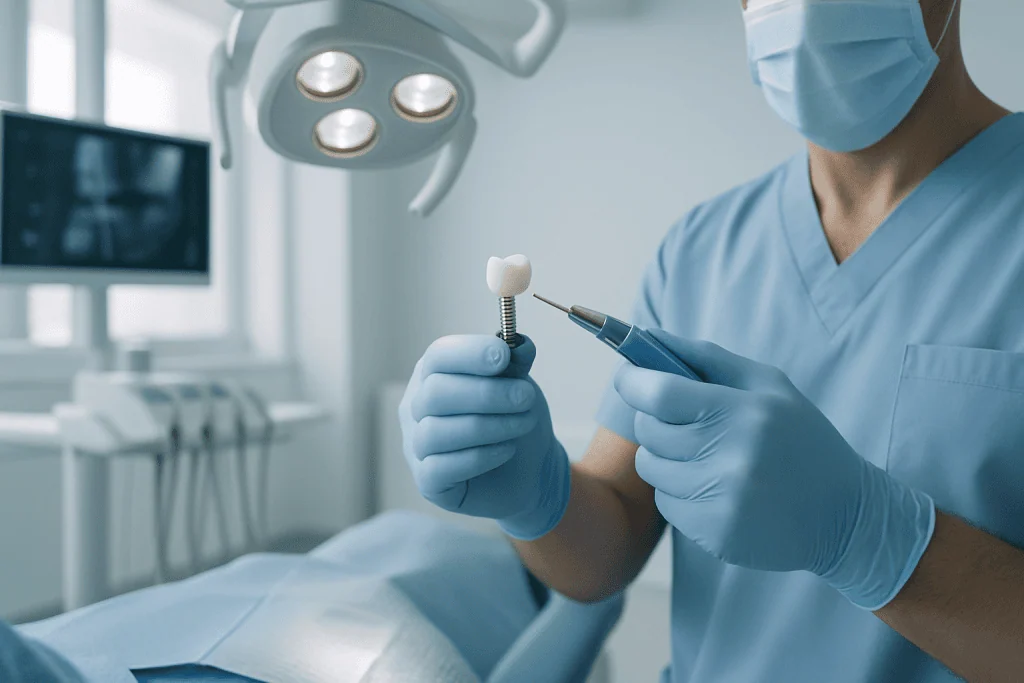
Quick answer
Dental implants are small titanium posts placed into the jawbone to replace missing tooth roots. Once the bone bonds to the implant — a process called osseointegration — it supports a crown, bridge or denture. Treatment typically involves assessment and imaging, implant placement under local anaesthesia, a healing period of several months, and fitting of the final restoration.
Dental Implants: Replacing Missing Teeth from the Root Up
Dental implants are small posts, usually made of titanium, placed into the jawbone to take the place of missing tooth roots. Once the bone has bonded to them, they support crowns, bridges or dentures built to look and function like natural teeth. They are an option for adults missing a single tooth, several teeth, or every tooth in one or both jaws.
Living with missing teeth affects more than the appearance of your smile, often in ways that are easy to underestimate until they happen. You may begin chewing on one side, avoiding certain foods, covering your mouth when speaking, or feeling self-conscious in photographs. Over time, gaps can also affect your bite, the health of neighbouring teeth, and the shape of the jawbone beneath the gum. Bone that no longer supports a tooth root gradually shrinks, which is one reason the timing of treatment matters.
The decision to consider dental implants usually comes with practical and emotional questions. Will the implant feel natural? Does the procedure hurt? How long does the whole process take? Can several teeth be replaced at once? These are reasonable concerns, and this page answers them as plainly as the evidence allows — including the limits and downsides that a brochure would leave out.
Implantology is one of the most established areas of modern restorative dentistry. When carefully planned and performed by experienced clinicians, dental implants provide a stable foundation for replacement teeth. Treatment is not only about filling a visible gap. It is about restoring chewing function, supporting clear speech, preserving oral structures where possible, and helping you regain confidence in everyday interactions.
At Acibadem, dental implant care is approached as a personalised medical and dental treatment, not a standard cosmetic service. Each case begins with a careful assessment of oral health, bone quality, medical history, aesthetic goals and long-term function — and the plan considers how the result will be maintained in the years after the final restoration is fitted, not only how it will look on the day.
What Is Implantology?
Implantology is the field of dentistry that focuses on replacing missing teeth with implants anchored in the jawbone. It is both a surgical discipline — placing the implant precisely and safely in bone — and a restorative one, designing the crown, bridge or denture that the implant will carry. The two halves have to be planned together. An implant placed without regard to the tooth it must eventually support is a common cause of compromised results, which is why good implantology begins with the final restoration and works backwards to the surgical position.
What are dental implants?
Dental implants are artificial tooth roots, usually small posts of titanium or titanium alloy, placed into the jawbone where a natural root once sat. After placement, the surrounding bone gradually bonds to the implant surface through a biological process called osseointegration. Once this bond is stable, the implant can carry chewing forces the way a natural root does. The implant itself is not the visible tooth; it is the foundation beneath the gum.
A completed implant restoration has three parts:
- The implant — the post within the bone, invisible once healed.
- The abutment — a connector that emerges through the gum, providing the correct shape, support and angle for the restoration above.
- The restoration — the visible replacement: a single crown for one missing tooth, a bridge for several missing teeth, or a fixed or removable denture for a full arch.
Understanding this three-part structure helps make sense of the treatment timeline. The implant needs biological healing time in bone; the abutment and restoration are prosthetic components fitted once that healing is confirmed.
What are dental implants made of?
Most implants are made of commercially pure titanium or a titanium alloy, materials used in bone surgery for decades because bone bonds to them reliably and allergic reactions are rare. The implant surface is usually treated — roughened at a microscopic level — to encourage stronger integration. Ceramic implants made of zirconia exist as a metal-free alternative and may be discussed for patients with specific sensitivities or aesthetic requirements, though titanium remains the most extensively documented material. The visible restoration on top is a separate decision: crowns and bridges may be made of layered ceramic, monolithic zirconia or metal-ceramic combinations, chosen for strength in the back of the mouth and appearance at the front. Material choices are clinical decisions made case by case, weighing bite forces, aesthetics, gum condition and the design of the whole restoration.
Tooth implant, teeth implants or dental implants — is there a difference?
Tooth implant, teeth implants and dental implants all describe the same treatment; the terms differ only in whether one tooth or several are being discussed. There is no separate clinical procedure behind each phrase. What genuinely differs from case to case is the design of the restoration on top — one crown, a multi-unit bridge, or a full-arch prosthesis — and the number and position of implants needed to support it safely.
What is oral implantology?
Oral implantology is simply the more precise name for the same discipline: the placement and restoration of implants in the mouth. The qualifier distinguishes it from implant work in other branches of medicine — orthopaedic trauma implantology, for example, deals with plates, screws and joint components placed in bones elsewhere in the body, and has nothing to do with teeth. If you see the terms implantology, oral implantology and implant dentistry used interchangeably on clinical websites, they refer to the same field.
Implants differ from traditional removable dentures because they are anchored in bone rather than resting only on the gum tissue, which is why they do not shift during chewing in the way a loose denture can. They also differ from conventional bridges because, in many cases, they do not require healthy neighbouring teeth to be ground down for support. This makes implants an important option for patients who want a stable, long-term tooth replacement that protects what remains as well as replacing what is lost.
Implant treatment can be straightforward or complex depending on the number of missing teeth, the condition of the jawbone, the health of the gums, the bite relationship and your general medical status. Some patients can receive an implant soon after a tooth is removed; others need bone grafting, sinus lifting, gum treatment or staged procedures before the final restoration can be placed. Neither route is inherently better — the right sequence is the one your anatomy supports.
In well-selected patients, implants have a strong record of durability and patient satisfaction. Success, however, is never automatic. It depends on careful diagnosis, precise surgical placement, sound prosthetic design, healthy gums, consistent home care and regular professional follow-up. That is the honest shape of implantology: a reliable treatment whose reliability is earned at every stage, not assumed.
Who May Need Dental Implant Treatment?
Dental implants may be considered for adults who are missing one tooth, several teeth, or all teeth in one or both jaws. Some patients seek treatment soon after losing a tooth; others have lived with gaps, loose dentures or failing dental work for many years. The right timing and approach depend on the cause of tooth loss, current oral health and the condition of the supporting bone.
Common reasons people consider a tooth implant include difficulty chewing, changes in speech, visible gaps, shifting teeth, repeated denture discomfort, or the wish for something more stable than a removable prosthesis. Missing back teeth reduce chewing efficiency and place extra stress on the teeth that remain. Missing front teeth can affect speech sounds, lip support and facial expression — problems that are functional as well as cosmetic.
Diagnosis begins with a detailed dental examination. The dentist evaluates the gums, remaining teeth, bite alignment, jaw movement, oral hygiene and the space available for implant placement. Digital X-rays and three-dimensional imaging assess bone height, width and density, and locate structures that must be protected, such as nerves and the sinus floor. In complex cases, diagnostic models, intraoral scans, photographic records and digital planning tools help the team design a restoration that fits both the mouth and the face.
Medical history matters as much as the mouth itself. Uncontrolled diabetes, active gum disease, heavy smoking, immune suppression, certain bone disorders and some medicines can affect healing and implant integration. These factors do not always rule out treatment, but they must be reviewed openly. Patients with cardiovascular disease, previous cancer treatment, exposure to certain osteoporosis medicines, or bleeding risks may need additional coordination between the dental team and their physician before surgery is planned. Any decision about medicines belongs to the doctors managing them, which is why this review happens before a date is set, not after.
Many patients ask whether age is a barrier. In general, suitability is tied to health status, bone quality and oral hygiene rather than age alone. Implants are usually considered only after jaw growth is complete, which excludes adolescents. At the other end of life, older adults are often excellent candidates, provided their general health allows minor oral surgery and the plan is adapted to their needs and ability to maintain the result.
Patients who have been told they do not have enough bone may still have options. Modern planning can include bone augmentation, sinus elevation, narrow-diameter or angled implant strategies in selected cases, or alternative prosthetic designs. In severely resorbed upper jaws, zygomatic implants anchored in the cheekbone are sometimes considered. A careful evaluation is essential, because the safest and most predictable approach is not always the fastest one — and a clinic that promises speed before it has seen your imaging is telling you about its schedule, not your anatomy.
What Conditions Can Dental Implants Address?
The most common indication is replacement of a single missing tooth, particularly when the neighbouring teeth are healthy and do not need crowns of their own. Here an implant-supported crown fills the gap without relying on adjacent teeth for support — one of the clearest advantages implants hold over a conventional bridge.
For patients missing several teeth in a row, implants can support a fixed bridge. This may remove the need for a removable partial denture and improves chewing stability. The number and position of implants required depend on where the teeth are missing, the bite forces in that region, the available bone and the prosthetic design. Two implants may carry a three-unit bridge in one mouth and be insufficient in another; the plan is anatomical, not formulaic.
Full mouth dental implants
Full mouth dental implants replace every tooth in the upper or lower jaw — or both — using a small number of implants to support a complete arch of teeth. The restoration may be fixed, staying in the mouth permanently and cleaned like a bridge, or an overdenture that clips onto the implants for stability but is removed for cleaning. Which design suits you depends on bone structure, lip support, speech, your ability to clean around the prosthesis, aesthetic goals and budget. Full-arch treatment is often one component of broader full mouth reconstruction, where the bite, remaining teeth and soft tissues are rebuilt as a coordinated whole rather than tooth by tooth.
Implants may also be considered when existing bridges are failing, when dentures are loose or painful, or when teeth have been lost to trauma, advanced decay, root fracture or periodontal disease. In the aesthetic zone at the front of the mouth, planning must account for gum-line symmetry, bone volume, the smile line, tooth colour and soft-tissue contours. A technically successful implant that looks wrong within the smile is not a successful treatment.
In patients with periodontal disease, implant treatment should not begin until infection and gum inflammation are controlled. The same bacteria and risk factors that destroyed the natural teeth can attack the tissues around implants. Responsible implantology therefore includes periodontal evaluation, hygiene stabilisation and a long-term maintenance plan — not as an add-on, but as a condition of proceeding.
Implants are not always the only option, and they are not always the best one. Conventional bridges, removable dentures, resin-bonded bridges, orthodontic space closure, or in some cases no replacement at all may be appropriate. A responsible treatment plan sets these alternatives out honestly, with the advantages, limitations, timing and care requirements of each, and lets you choose with the full picture in front of you.
How Dental Implant Treatment Is Performed
Dental implant treatment is completed in stages. The exact sequence depends on your anatomy, the number of teeth being replaced, whether extractions are needed, and whether bone or gum grafting is required. Some plans move relatively quickly; others need several months of healing between stages. A typical pathway looks like this:
- Consultation, examination and three-dimensional imaging
- Preparation: hygiene, gum treatment, extractions or grafting where needed
- Implant placement surgery
- Healing and osseointegration, with temporary teeth where appropriate
- Design and fitting of the final crown, bridge or denture
- Long-term maintenance and review
Initial consultation and treatment planning
The first step is a comprehensive consultation. The dental team reviews your concerns, expectations, medical history, current medicines, previous dental work and any imaging already available. Recent X-rays, photographs and dental reports can inform early planning, though final decisions always require in-person examination and up-to-date imaging, and any preliminary impression should be understood as provisional.
During the clinical examination, the dentist assesses the mouth as a whole: the condition of remaining teeth, gum health, bite stability, jaw joint function, smile dynamics and oral hygiene. A plan that replaces one missing tooth while ignoring the health of the rest of the mouth may look complete on paper and fail in practice.
Three-dimensional imaging is usually central to planning. It lets the clinician measure bone volume and identify the structures that must be protected during surgery. Digital impressions or intraoral scans create a virtual model of the teeth and gums, and in many cases digital planning aligns the surgical implant position with the planned final crown or bridge before anything is touched in the mouth. This alignment — restoration first, implant position second — is critical for both function and appearance.
Preparation before implant placement
Preparation may include professional cleaning, treatment of gum disease, removal of teeth that cannot be saved, management of cavities, or adjustment of the bite. If a tooth was lost some time ago, the bone beneath may have changed shape. If a tooth still needs to come out, the team decides whether extraction and implant placement can happen together or should be staged, based on infection, bone condition and aesthetic demands. The trade-offs involved are explained in our guide to implant timing after tooth extraction.
Some patients need bone grafting before or during placement. Grafting rebuilds support where bone has thinned, using bone substitute material, your own bone in selected cases, or a combination. In the upper back jaw, a sinus lift may be required when the sinus cavity sits close to the jawbone and there is not enough height for stable placement. Soft-tissue grafting may be recommended when gum thickness or contour needs improvement around the future restoration — particularly in the visible front of the mouth.
Preparation also covers anaesthesia and comfort. Many implant procedures are performed under local anaesthesia alone. Sedation may be considered for anxious patients, longer procedures or complex surgery; the choice depends on medical suitability, procedure length and your preference. Before surgery you receive clear instructions on eating, oral hygiene, smoking and what to expect afterwards, and the team explains how your regular medicines will be handled in coordination with your treating doctors.
The implant placement procedure
On the day of surgery, the treatment area is numbed thoroughly. The dentist or oral surgeon prepares the implant site in the jawbone with carefully controlled instruments, then places the implant in the planned position. Depending on the approach, the implant is either covered by the gum to heal undisturbed or fitted with a healing component that shapes the gum for the future restoration. Where digital planning was used, a surgical guide can transfer the virtual plan to the mouth with considerable precision.
Modern implant surgery is designed to be precise and tissue-conscious. Imaging, planning software, digital impressions and guided techniques help the clinician fix the implant’s position, angle and depth before the first incision, and may reduce unnecessary tissue trauma. It is worth being clear about what technology does and does not do: it supports careful decision-making and accurate execution, but it does not replace clinical judgement, and no scanner has ever rescued a poorly conceived plan.
Procedure length varies. A single straightforward implant takes a relatively short appointment; multiple implants, extractions, grafting or full-arch treatment take longer. Patients almost always go home the same day, with written instructions explaining which symptoms are a normal part of healing, which warning signs need clinical attention, and when the next review is due.
Is a dental implant painful?
You should not feel pain during the surgery itself, because the area is fully numbed with local anaesthesia — pressure and vibration are commonly felt, pain is not. Afterwards, most patients describe tenderness, swelling and sometimes bruising for a few days rather than severe pain, and discomfort is typically managed with the medicines your dentist recommends, cold compresses and rest. Complex procedures involving grafting or multiple sites tend to produce more post-operative soreness than a single implant. Honest expectation-setting matters here: recovery involves some discomfort, it is generally short-lived, and it is usually described by patients as easier than they had feared.
Healing and osseointegration
After placement, the implant needs time to integrate with the jawbone. This period varies with bone quality, implant location, grafting, general health and surgical complexity. During healing you may wear a temporary tooth, temporary bridge or adjusted denture for appearance and basic function. Temporary restorations protect the healing tissues and should not be used for heavy chewing unless specifically allowed. Two habits influence this phase more than almost anything else: what you eat and whether you smoke. Our day-by-day diet guide after implant surgery covers the first, and our guide to smoking after dental implants explains honestly why the second threatens integration.
Some patients are candidates for immediate provisional restorations, often marketed as same-day teeth. It is important to understand what this means: a temporary restoration is attached under carefully controlled conditions on the day of surgery. It does not mean treatment is finished that day. The implant still requires months of biological healing, and you must follow a soft diet and strict care instructions to keep chewing stress off the implants while the bone bonds to them.
Final restoration
Once healing is confirmed, the restorative phase begins. The dentist takes digital or conventional impressions to design the crown, bridge or denture. Colour, shape, size, bite contacts, the emergence profile through the gum and the relationship to neighbouring teeth are all planned deliberately. In front teeth, aesthetic detail may require additional try-in visits or custom shading — time well spent, since this is the part of the treatment you will see every day.
The finished restoration is then attached to the abutment. It may be screw-retained, cement-retained, or designed as a removable implant-supported prosthesis. Each has specific advantages: screw-retained restorations can usually be removed by the dentist for maintenance and repair, while cement-retained designs suit certain aesthetic or angulation situations. The choice is clinical, made for long-term serviceability rather than convenience on the day of fitting.
Recovery and follow-up
Initial recovery after implant surgery is typically manageable. Mild swelling, tenderness, bruising or minor bleeding can occur for a few days. Most patients return to light daily activities quickly, though strenuous exercise, smoking, alcohol and hard foods are usually restricted during early healing. If you have a flight scheduled soon after surgery, timing matters: our guide to flying after dental surgery and implants explains how long to allow before flying and why.
Follow-up visits let the clinician check healing, remove sutures where needed, adjust temporary restorations and confirm when the implant is ready for the prosthetic phase. Long-term maintenance is not optional. Implants cannot decay the way natural teeth do, but the gum and bone around them can become inflamed if plaque accumulates. Professional cleanings, daily home care and periodic X-rays are what protect the investment over the years that follow.
Dental Implant Recovery Timeline
Recovery varies with the complexity of the procedure, but most patients follow a broadly similar pattern after implant placement. Treat the table below as a general map, not a schedule — your own plan will state the intervals that apply to you.
| Time Period | What Patients Can Expect |
|---|---|
| Day 1 | Numbness wears off gradually. Mild bleeding, swelling and tenderness may occur. Patients usually follow a soft diet and avoid touching the surgical area. |
| First week | Swelling and discomfort typically improve. Oral hygiene resumes carefully according to instructions, and strenuous activity may still be limited. |
| First month | Gum tissues continue to heal. Temporary restorations may be adjusted, and heavy chewing on the implant area is avoided unless the dentist has cleared it. |
| Integration period | The implant bonds with the jawbone over time. This phase may take several months, especially if grafting was performed or bone quality calls for a longer healing interval. |
| Longer term | The final crown, bridge or denture is placed once healing is confirmed. Regular maintenance visits protect the implant and the tissues around it. |
Why Acting Early Matters
When a tooth is lost, the jawbone in that area no longer receives stimulation from chewing forces, and it responds by shrinking in height and width. This natural resorption can make future implant placement more complex, sometimes requiring grafting or alternative implant positions that would not have been necessary a year earlier. Acting early does not always mean immediate surgery — it means obtaining a timely assessment before the bone and bite change further, so the decision is made with options still open.
Neighbouring teeth drift into an empty space, and opposing teeth can over-erupt because nothing meets them during chewing. These movements alter the bite, create food traps, accelerate wear and complicate later restoration. In some patients, a single missing tooth quietly reshapes the way the whole jaw works, contributing to uneven chewing patterns or jaw discomfort.
Delay also affects gum contours, especially in the visible part of the smile. Once soft-tissue and bone architecture are lost, recreating a natural-looking gum line becomes genuinely difficult, even for skilled clinicians. Early planning after extraction or trauma helps preserve these structures and may reduce the number of procedures needed overall.
There are quality-of-life considerations too. Avoiding certain foods, worrying about a loose denture, or holding back in conversation can gradually change social behaviour and nutrition. A timely evaluation lets you understand your options before the problem grows more complex — physically or emotionally.
Benefits of Dental Implant Treatment
For appropriate candidates, implantology offers functional, aesthetic and long-term oral health benefits. The table below sets out what each means in practice.
| Benefit | What It Means for You |
|---|---|
| Stable tooth replacement | Implants are anchored in the jawbone, helping crowns, bridges or dentures feel secure during chewing and speaking. |
| Improved chewing function | Patients can often return to a broader range of foods compared with loose or uncomfortable removable dentures. |
| Natural-looking restoration | The visible crown or bridge is designed to match the surrounding teeth, facial proportions and smile line. |
| Protection of neighbouring teeth | In many cases, implants replace missing teeth without reshaping healthy adjacent teeth for a conventional bridge. |
| Support for jawbone maintenance | Implants transmit chewing forces to the bone, which may help reduce bone loss in the treated area compared with leaving a gap untreated. |
| Better denture retention | Implant-supported dentures can reduce slipping, rubbing and the need for adhesive in selected patients. |
Risks and Limitations: The Honest Picture
Implants are a well-established treatment, but no surgical procedure is without risk, and a page that only lists benefits is not informing you. The realistic downsides deserve the same clarity as the advantages.
What is the downside of a dental implant?
A dental implant requires minor surgery, healing time measured in months rather than weeks, and a lifelong commitment to cleaning and maintenance — those are its main downsides. Some patients need grafting first, which adds procedures and time. Biological complications can occur: the gum and bone around an implant can become inflamed if plaque accumulates, a condition called peri-implantitis, and in a minority of cases an implant fails to integrate and must be removed. Mechanical complications happen too — porcelain can chip, screws can loosen, and restorations need servicing over the years. Implants also cost more upfront than most alternatives. None of this makes implants a poor choice; it makes them a treatment to enter with open eyes, healthy gums and realistic expectations. Smoking, uncontrolled diabetes and neglected hygiene raise every one of these risks, which is why an honest clinic asks about them before it talks about schedules.
How Long Will Dental Implants Last?
There is no fixed lifespan, and no honest clinic will promise one — but well-planned, well-maintained implants routinely function for many years, and some serve their owners for the rest of their lives. Two clarifications matter. First, the implant in the bone and the restoration on top age differently: the crown, bridge or denture is subject to wear and may need repair or replacement long before the implant itself gives any trouble. Second, longevity is not a property of the implant alone. It reflects the quality of the original planning and placement, the health of your gums, your daily cleaning, whether you smoke, how you manage grinding or clenching, and how consistently you attend maintenance visits. An implant is best thought of not as a purchase with a warranty but as a restoration with a partnership behind it — the clinician’s work and your care, both continuing.
What Affects the Cost of Dental Implant Treatment?
You will notice this page quotes no prices. That is deliberate: any figure given before examination and imaging is a guess dressed up as an answer. What can be explained honestly is what drives cost — the number of implants, whether extractions or bone grafting are needed, the type of restoration (a single crown, a bridge, a fixed full-arch prosthesis or an overdenture), the materials chosen, the use of sedation, the imaging and planning involved, and the follow-up the plan requires.
How much does a full set of implants usually cost?
Full-arch treatment varies more in cost than any other implant procedure, because it varies more in design: the number of implants per jaw, whether grafting or sinus work is needed, whether the prosthesis is fixed or removable, and the materials of the final teeth all change the figure substantially. Quotes that name a price before anyone has seen your bone are marketing, not medicine. The only reliable figure is a written, itemised treatment plan produced after clinical examination and three-dimensional imaging — one that states what is included, what would only be discovered during surgery, and what future maintenance the design will need. When comparing plans, compare those documents, not headline numbers.
What Influences a Good Implant Result?
A successful implant result depends on far more than the placement of a titanium post. It begins with correct diagnosis and runs through surgery, prosthetic design, healing and maintenance. The best outcomes come from planning backwards: where the crown or bridge must sit for proper chewing, speech and appearance determines where the implant belongs — never the other way around.
Bone quality and quantity are major factors. Adequate bone provides stability; insufficient bone means grafting or a different design. Gum health is equally important. Healthy, stable soft tissue around the implant protects the underlying bone and shapes the natural appearance of the restoration, particularly in the front of the mouth where every millimetre of gum contour is visible.
General health matters throughout. Well-controlled medical conditions are usually compatible with implant treatment, but uncontrolled diabetes, active infection, heavy tobacco use and certain medicines increase the risk of delayed healing or complications. A careful medical review lets the dental team reduce avoidable risks and coordinate with your physicians where needed — quiet, unglamorous work that shows up in the result years later.
Oral hygiene is the single most important long-term factor within your control. Implants need daily cleaning around the gum line and beneath bridges or dentures, and depending on the design you may need interdental brushes, floss threaders, water irrigation devices or techniques customised to your restoration. Professional maintenance is part of implant therapy, not an optional extra sold alongside it.
Bite forces must be managed too. Patients who grind or clench may need a night guard or bite adjustment to spare the implants and restorations from excessive stress. Full-arch restorations require careful engineering, since chewing forces are distributed across multiple implants and prosthetic components that all have to work as one structure.
Team experience and communication influence everything above. In complex cases, oral surgeons, periodontists, prosthodontists, restorative dentists, radiologists and dental laboratory technicians all contribute, and the surgical and prosthetic plans must agree from the start. Finally, realistic expectations are part of the treatment itself. Implants are highly effective for many patients, but they are not natural teeth and they are not immune to problems. A responsible clinic explains the responsibilities alongside the advantages before care begins — and a patient who understands both tends to keep their result longest.
How Acibadem Approaches Implantology
Patients considering implant treatment usually need more than a technical procedure. They need confidence in the diagnosis, clarity about timing, transparent communication, and a team that plans the whole journey rather than the surgical appointment alone. Acibadem’s approach to implantology is built around that fuller picture.
Dental surgical care is delivered within a hospital-group environment. For patients with medical conditions, or those who may need more advanced anaesthesia support, this matters: it allows access to relevant medical consultation when needed and supports a fuller assessment of health risks before treatment. Implant planning is individualised — the team evaluates not only the missing teeth but the gums, jawbone, bite, facial aesthetics, existing restorations and long-term maintenance needs, using digital imaging, three-dimensional planning, intraoral scanning, guided surgery concepts and modern prosthetic workflows where appropriate.
Multidisciplinary planning is especially valuable in complex cases. A patient who needs extractions, bone grafting, periodontal treatment, sinus evaluation, orthodontic input or full-mouth rehabilitation benefits from having the surgical, restorative, periodontal and aesthetic decisions reviewed together, so every specialist is working toward the same final restoration rather than solving one problem at a time.
Some patients arrive having been told they need extensive extractions, full-arch replacement or major grafting; others carry conflicting recommendations from different dentists. A structured second opinion — reviewing imaging, oral health status, functional needs and aesthetic goals, then setting out the options in plain language — often changes the plan, and sometimes simplifies it. The aim is never to offer the same treatment to every patient. Some people need a single implant crown. Others need staged grafting, periodontal stabilisation or a full-arch solution. Some are better served by a non-implant alternative, and a careful recommendation says so.
Living With Dental Implants: The Long View
Missing teeth affect how you eat, speak, smile and carry yourself in daily life, and dental implants are a well-established way to change that. But the right plan is always individual. The number of implants, the need for grafting, the timing of the final restoration and the expected recovery all follow from your own oral and medical situation — not from a package. What a good implantology service owes you is a careful evaluation, an honest account of the options including the non-implant ones, a written plan you can scrutinise, and a maintenance pathway that extends well beyond the day the final teeth are fitted.
How do you care for implants day to day?
Daily care means cleaning around the gum line twice a day, cleaning between the implant and neighbouring teeth, and cleaning beneath any bridge or bar the implants support — plaque left at the implant-gum junction is the main driver of peri-implant inflammation. Depending on your restoration, the team may recommend interdental brushes sized to the spaces, floss threaders or specialised implant floss for under-bridge cleaning, single-tuft brushes for awkward angles, or a water irrigation device as a supplement. Professional maintenance visits complete the picture: the hygienist removes deposits with instruments that do not scratch implant surfaces, the dentist checks the gum condition, bite contacts and prosthetic components, and periodic X-rays confirm that the bone level around each implant remains stable. Small problems found at these visits — a loosening screw, early gum inflammation, a worn night guard — are simple to correct; the same problems ignored for years are not. Judged this way, the treatment does not end when the crown is attached; it settles into an ordinary, sustainable routine of daily cleaning and periodic review — which is precisely what a stable, natural-looking and maintainable result looks like from the inside.
Preparation
- A dentist or oral and maxillofacial surgeon evaluates oral health, jawbone volume, bite, and medical history. Dental imaging is used to plan implant position and determine whether bone grafting or other preparatory treatment is needed. Patients may be advised to stop smoking and follow medication or fasting instructions if sedation is planned.
Aftercare
- Mild swelling, tenderness, or minor bleeding can occur for a few days and is usually managed with prescribed medication and careful oral hygiene. Patients should eat soft foods initially, avoid smoking, and attend follow-up visits to monitor healing. Final crowns or prosthetics are placed after the implant has bonded securely with the jawbone.
Turkey vs UK, Germany & USA
Implantology costs vary because each treatment plan depends on the number of missing teeth, jawbone condition, implant system, and final restoration type. Comparing destinations can help patients understand differences in care pathways, logistics, and package inclusions.
This comparison focuses on factors that may influence the overall cost and patient experience for dental implant treatment abroad or at home.
| Factor | Turkey | UK | Germany | USA |
|---|---|---|---|---|
| Price structure | Often package-oriented for international patients; final cost depends on diagnostics, implant brand, restoration material, and any bone procedures. | Private dentistry is usually itemised; public access to implants is generally limited to strict clinical indications. | Costs are commonly itemised with detailed treatment plans; insurance contribution varies by policy and indication. | Typically itemised and practice-dependent; insurance coverage may be limited or conditional. |
| Hospital and dentist factors | Cost may vary by clinic setting, dental surgeon experience, prosthodontic planning, and laboratory quality. | Fees vary between private clinics, specialist practices, and hospital-based care. | Specialist qualifications, digital planning, and dental laboratory standards can influence cost. | Provider location, specialist involvement, sedation options, and lab fees can strongly affect the total. |
| Accreditation and quality systems | International patients may choose hospital groups with global accreditation such as JCI and multilingual coordination. | Care is regulated through national professional and healthcare standards; accreditation varies by provider. | Care is regulated through national and regional healthcare standards; clinic systems vary. | Care is regulated by state and professional bodies; accreditation and facility standards vary by provider. |
| Typical waiting times | Private appointments may be arranged with coordinated scheduling for consultation, imaging, surgery, and follow-up. | Private access can be faster than public pathways; scheduling depends on specialist availability. | Specialist appointments and staged implant treatment may require planned scheduling. | Private access is usually appointment-based; timing depends on provider availability and insurance processes. |
| Travel and language logistics | International patient services may assist with appointment planning, translation, transfers, and hotel guidance. | Travel may be simpler for residents; international patients may need to arrange logistics independently. | International patients may need translation support depending on provider language services. | Long-distance travel and local accommodation can add complexity for international patients. |
| Typical package inclusions | Packages may include consultation coordination, imaging, surgery planning, implant placement, temporary solutions, and follow-up planning, depending on the case. | Consultations, imaging, surgery, temporary restorations, and final prosthetics are often billed separately. | Treatment plans often separate surgical, prosthetic, imaging, and laboratory components. | Consultation, imaging, sedation, surgery, abutments, crowns, and follow-up may be charged as separate items. |
What affects your final cost
- Number and location of missing teeth.
- Jawbone volume and need for bone grafting or sinus lift procedures.
- Implant brand, abutment type, and crown or bridge material.
- Use of digital imaging, guided surgery, or sedation.
- Complexity of gum health, bite alignment, and previous dental work.
- Temporary teeth, final restorations, laboratory work, and follow-up schedule.
- Travel, accommodation, translation, and aftercare coordination.
Compare your options
Implantology can involve different clinical approaches depending on oral health, bone condition, aesthetic goals, and the number of teeth being replaced. Suitability is decided by a dental implant specialist after examination and imaging.
| Option | What it is | Typical use | Key considerations |
|---|---|---|---|
| Implant with crown | A titanium implant supports an individual dental crown. | Replacement of an isolated missing tooth when surrounding teeth are healthy. | Requires adequate bone and gum support; crown material and aesthetic zone planning affect the plan. |
| Implant-supported bridge | Several missing teeth are replaced with a bridge supported by implants. | Gaps involving multiple adjacent missing teeth. | May reduce the need to prepare neighbouring natural teeth; planning depends on bite forces and implant positions. |
| Implant-supported denture | A removable or fixed denture is stabilised by implants. | Patients with widespread tooth loss who need improved chewing comfort and denture stability. | Choice between removable and fixed designs affects maintenance, hygiene, and laboratory work. |
| Immediate implant placement | An implant is placed soon after tooth removal when conditions are suitable. | Selected cases with healthy surrounding bone and no uncontrolled infection. | Not suitable for every patient; gum aesthetics and healing stability are important. |
| Immediate temporary restoration | A temporary tooth or bridge is fitted during the healing phase when implant stability allows. | Visible areas where appearance during healing is a priority. | Requires careful case selection; the temporary restoration is not the final crown or bridge. |
| Bone grafting or sinus lift | Additional procedures to improve bone volume before or during implant placement. | Cases with bone loss after extraction, gum disease, trauma, or long-term denture use. | Can extend the treatment timeline and affect cost; healing must be monitored before final restoration. |
General information only — not medical or financial advice. Final costs depend on the factors above and your individual case; request a free, personalised quote.
Frequently Asked Questions
What affects the cost of dental implants?
The main factors are the number of teeth to be replaced, bone and gum condition, implant system, need for grafting, type of crown or bridge, sedation needs, laboratory work, and follow-up requirements.
How can I get a personalised quote for implantology in Turkey?
A personalised quote usually requires dental photographs, recent imaging if available, medical history, and a specialist review. Acibadem International can arrange a free consultation to assess your case and outline the likely treatment pathway.
Are implant packages all-inclusive?
Packages vary by clinic and by case. Some may include consultation coordination, imaging, implant placement, temporary solutions, and follow-up planning, while grafting, sedation, final prosthetics, or extra treatments may be separate.
Why might the quote change after examination?
A quote may change if detailed imaging shows bone loss, infection, bite problems, or a need for additional procedures. Final planning is confirmed after a clinical examination by the dental specialist.
Does the implant brand affect cost and outcome?
Implant brand can affect cost because systems differ in design, components, availability, and prosthetic options. The most suitable choice should be made by the specialist based on your anatomy, restoration plan, and long-term maintenance needs.
Is this information medical or financial advice?
No. This is general educational information. Treatment suitability and cost can only be confirmed after specialist assessment, and patients are encouraged to request a free personalised consultation.
Medically reviewed by the Acıbadem International Medical Board — August 30, 2026
See our medical review board →
Update history
- PublishedJune 8, 2026
- Medical review approvedAugust 30, 2026
- Last content updateAugust 30, 2026
Trusted care for international patients
Doctors Performing This Treatment

Assoc. Prof. Dr. Ferit Bayram
Oral & Dental Health
Dr. Ezgi Gülüm
Oral Dental & Maxillofacial Surgery
Dr. Emre Çengelli
Oral Dental & Maxillofacial Surgery
Dr. Arzu Morçiçek
Oral & Dental HealthDr. Deniz Turgut
Oral & Dental Health
Dr. Ceyda Sabancı
Oral & Dental Health
Dr. Çağla Su Doğangün Ayduk
Oral & Dental Health
Dr. Begüm Öykü Kesim
Oral & Dental Health
Dr. Eylül Türsen
Oral & Dental Health
Dr. Metin Kınacı
Oral & Dental Health
Dr. Duygu Yavuzer Karadeniz
PeriodontolgyDr. Ali Riza Özdurmuş
Oral & Dental Health
Dr. Bedii Ender Topçu
Oral & Dental Health
Dr. Sebiha Nihal Yılmaz
Oral Dental & Maxillofacial SurgeryDr. Seda Saygılı Özaydın
Oral & Dental Health
Dr. Zeynep Ekin Kılınç
Oral & Dental Health
Dr. Uğur Önder
Oral & Dental Health
Dr. Helin Kuşsever Topçu
Oral & Dental Health
Dr. Pelin Açık
Oral & Dental Health
Dr. İpek Saygılı
Oral & Dental Health
Dr. Halime Bayram
Oral & Dental Health
Dr. Havva Gölalan
Oral & Dental Health
Dr. Merve Ağartıoğlu
Oral & Dental Health
Dr. Mücahit Güner
Oral & Dental HealthMedical Units
Available at These Hospitals