Aortic Aneurysm: Silent Enlargement and Monitoring

An aortic aneurysm is a bulging or widening of part of the aorta, most often in the abdomen or chest. Many aneurysms cause no symptoms, so imaging tests are important for detection and follow-up.
Key Takeaways
- An aortic aneurysm is a bulging or widening of part of the aorta, most often in the abdomen or chest.
- Many aneurysms cause no symptoms, so imaging tests are important for detection and follow-up.
- Treatment depends on the aneurysm’s size, location, growth rate, symptoms, and the patient’s overall health.
- Blood pressure control, not smoking, and regular medical follow-up are key parts of self-care.
- Sudden severe chest, back, or abdominal pain requires urgent medical attention.
An aortic aneurysm is an enlargement of the body’s main artery that often develops quietly and may be found during imaging for another reason. Regular monitoring, risk-factor control, and timely specialist care help many patients manage the condition safely.
Overview
The aorta is the largest artery in the body. It carries oxygen-rich blood from the heart to the chest, abdomen, pelvis, and legs. An aortic aneurysm occurs when a section of the aortic wall becomes weakened and enlarges or bulges outward. This enlargement may remain stable for years, grow slowly, or, less commonly, progress more quickly.
Aortic aneurysms are often described by their location. A thoracic aortic aneurysm develops in the chest, while an abdominal aortic aneurysm develops in the part of the aorta that passes through the abdomen. Some aneurysms involve both regions. The medical team also considers the exact segment affected, because this influences monitoring and treatment decisions.
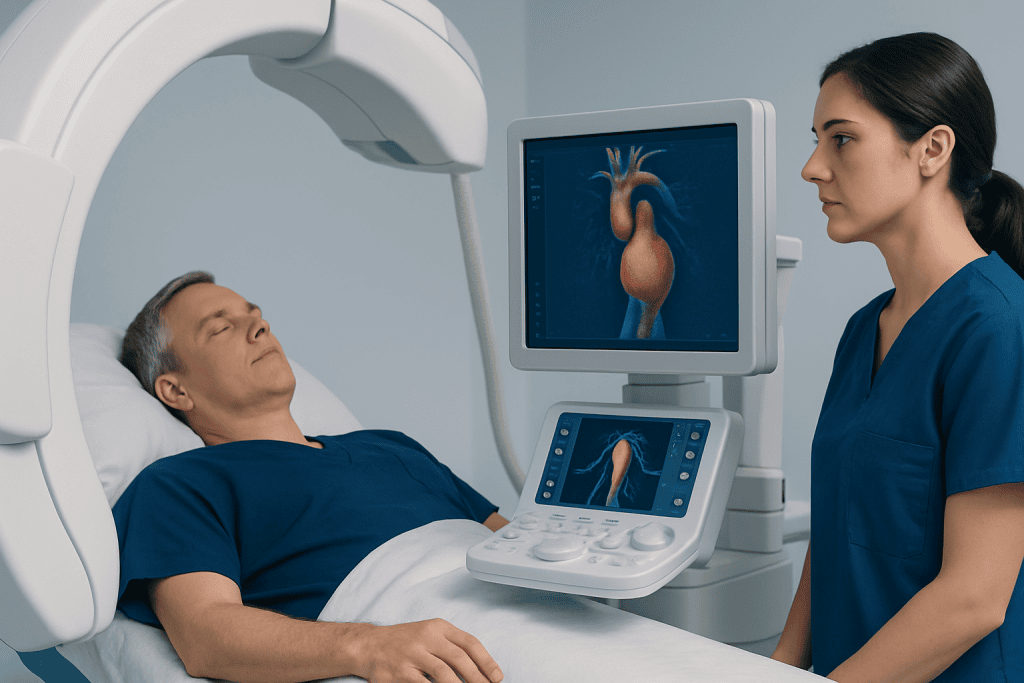
Many people feel well and have no warning signs. For this reason, an aneurysm may be found during an ultrasound, echocardiogram, CT scan, or MRI performed for another health concern. Once identified, careful measurement and periodic imaging help doctors understand whether the aneurysm is stable or changing.
Symptoms
Most aortic aneurysms do not cause symptoms, especially when they are small or moderate in size. A person may continue normal activities without noticing any change. This quiet nature is why screening and follow-up are important in people with known risk factors or a previously diagnosed aneurysm.
When symptoms occur, they can vary by location. A thoracic aortic aneurysm may be associated with chest, upper back, shoulder, or neck discomfort; hoarseness; cough; shortness of breath; or difficulty swallowing if the enlarged aorta presses on nearby structures. An abdominal aortic aneurysm may cause deep abdominal, back, side, or groin discomfort, or a pulsing sensation in the abdomen.
Sudden, severe, or tearing pain in the chest, back, or abdomen can be a sign of a serious aortic complication, such as dissection or rupture. Fainting, weakness, shortness of breath, cold sweating, or symptoms of stroke should also be treated as urgent. These symptoms require emergency medical care rather than routine appointment scheduling.
Causes and Risk Factors

An aortic aneurysm develops when the wall of the aorta loses strength and elasticity. This can happen gradually due to age-related changes, high blood pressure, atherosclerosis, inflammation, infection, injury, or inherited conditions that affect connective tissue. In many patients, several factors contribute at the same time.
Risk factors differ somewhat between abdominal and thoracic aneurysms, but common contributors include older age, male sex, current or past smoking, high blood pressure, high cholesterol, and a family history of aortic aneurysm or aortic dissection. Conditions such as bicuspid aortic valve, Marfan syndrome, Loeys-Dietz syndrome, vascular Ehlers-Danlos syndrome, and other heritable aortic disorders can increase risk, sometimes at a younger age.
Understanding risk factors helps guide screening and family counseling. If a first-degree relative has had an aortic aneurysm or dissection, a doctor may recommend imaging for close family members, even if they feel healthy. Genetic evaluation may be considered when aneurysms occur at a young age, involve certain parts of the aorta, or appear in multiple relatives.
Diagnosis and Monitoring
Diagnosis is based on imaging that measures the aorta accurately. For abdominal aortic aneurysms, ultrasound is commonly used because it is noninvasive and does not involve radiation. CT angiography can provide detailed information about size, shape, and involvement of branch arteries. MRI or MR angiography may be used in selected patients, especially when repeated imaging is expected.
Thoracic aortic aneurysms may be evaluated with echocardiography, CT angiography, or MRI. Echocardiography is particularly useful for assessing the aortic root, the heart valves, and heart function. CT and MRI give detailed views of the entire thoracic aorta and help specialists plan follow-up or treatment if needed.
Monitoring focuses on three main questions: how large the aneurysm is, how quickly it is growing, and whether it is causing symptoms or affecting nearby structures. Follow-up intervals vary. Smaller, stable aneurysms may be checked less often, while larger aneurysms or those showing growth are monitored more closely. It is important to compare measurements using consistent imaging techniques whenever possible, because small measurement differences can occur between tests.
Patients can support good monitoring by keeping copies of imaging reports, knowing the aneurysm location and latest measurement, and attending follow-up appointments on schedule. If imaging is performed at different facilities, sharing previous scans with the treating specialist can help avoid unnecessary uncertainty.
Treatment Options
Treatment depends on the aneurysm’s size, location, growth rate, symptoms, underlying cause, and the patient’s overall health. Not every aneurysm needs immediate repair. Many are managed with surveillance and risk-factor control, especially when the expected benefit of surgery does not outweigh the risks.
Medical management usually includes careful blood pressure control. Doctors may prescribe medications to reduce stress on the aortic wall, manage cholesterol, or treat other cardiovascular risks. Patients should not start, stop, or change medications without medical advice. Smoking cessation is one of the most important steps for people with aortic aneurysm, because smoking is strongly linked with aneurysm development and growth.
Repair may be recommended when an aneurysm reaches a size at which the risk of complications becomes higher, when it grows faster than expected, or when symptoms develop. Surgical options include open repair, in which the weakened section is replaced with a graft, and endovascular repair, in which a stent-graft is placed inside the aorta through blood vessels, usually accessed from the groin. Endovascular techniques include EVAR for many abdominal aneurysms and TEVAR for selected thoracic aneurysms.
The best option is individualized. Anatomy, kidney function, age, other heart or lung conditions, and the involvement of branch arteries all influence the plan. Some patients need lifelong imaging after repair to ensure the graft remains well positioned and the aneurysm sac is not enlarging.
Prevention and Self-Care
Not all aortic aneurysms can be prevented, especially when inherited connective tissue conditions are involved. However, healthy cardiovascular habits can reduce strain on the aorta and support overall vascular health. A patient’s care plan should be personalized by a cardiologist, cardiovascular surgeon, or vascular specialist.
Helpful self-care measures include taking prescribed medications consistently, keeping blood pressure within the target range set by the doctor, stopping smoking, eating a heart-healthy diet, and staying physically active within safe limits. Regular walking and moderate activity are often encouraged, but heavy lifting or intense straining may be restricted in some patients because these can raise blood pressure suddenly.
- Ask the doctor what types and levels of exercise are appropriate.
- Attend all scheduled imaging follow-ups, even when there are no symptoms.
- Inform healthcare providers about the aneurysm before major procedures or new medications.
- Seek advice before using stimulant medications or supplements that may raise blood pressure.
- Encourage close relatives to ask their doctors about screening if there is a family history.
Living with an aneurysm can understandably cause worry. Clear information, a written follow-up plan, and knowing which symptoms require urgent care can help patients feel more confident and supported.
When to See a Doctor
A person should see a doctor if they have a known aortic aneurysm and develop new chest, back, abdominal, flank, or groin discomfort, even if the symptoms are mild or intermittent. A review is also appropriate if blood pressure becomes difficult to control, if there are medication side effects, or if a follow-up scan is overdue.
Emergency care is needed for sudden severe chest, back, or abdominal pain; fainting; shortness of breath; sudden weakness or numbness; trouble speaking; or signs of shock such as cold sweating and extreme weakness. These symptoms do not always mean an aneurysm complication, but they should be assessed immediately.
People with risk factors, such as a strong family history, known connective tissue disorder, bicuspid aortic valve, or a history of smoking, should ask their doctor whether screening is appropriate. At Acibadem International, multidisciplinary specialists in JCI-accredited hospitals evaluate and treat aortic aneurysms for international patients, including diagnostic imaging, surveillance planning, and surgical consultation when indicated.
Frequently asked questions
Is an aortic aneurysm the same as a blood clot?
No. An aortic aneurysm is an enlargement or bulging of the aortic wall. A blood clot is a mass of blood that has thickened or solidified. Sometimes clot-like material can form inside an aneurysm, but the conditions are not the same.
Can an aortic aneurysm go away on its own?
An aortic aneurysm usually does not shrink or disappear on its own. The goal is to monitor it and reduce factors that may promote growth. If it becomes large, grows quickly, or causes symptoms, repair may be considered.
How often should an aortic aneurysm be checked?
The follow-up schedule depends on the aneurysm’s size, location, growth pattern, and the patient’s medical history. Some stable aneurysms are monitored at longer intervals, while larger or changing aneurysms need closer follow-up. The treating specialist will set the safest schedule.
Can someone exercise with an aortic aneurysm?
Many people with an aortic aneurysm can do regular moderate activity, such as walking, if their doctor agrees. However, heavy lifting, straining, or high-intensity exercise may not be suitable for some patients. Exercise guidance should be individualized.
What is the difference between abdominal and thoracic aortic aneurysm?
An abdominal aortic aneurysm occurs in the part of the aorta that runs through the abdomen. A thoracic aortic aneurysm occurs in the chest. They are monitored with different imaging approaches and may have different treatment considerations.
Does every aortic aneurysm need surgery?
No. Many aneurysms are monitored with imaging and managed with blood pressure control and lifestyle changes. Surgery or endovascular repair is considered when the risk of leaving the aneurysm untreated is higher than the risk of repair.
References
- American Heart Association
- Society for Vascular Surgery
- European Society of Cardiology
- National Heart, Lung, and Blood Institute
- Mayo Clinic
This article is for general information only and is not a substitute for professional medical advice. Please consult a qualified doctor about your individual situation.
Aortic Aneurysm in Turkey — costs, top hospitals & a free quote
JCI-accredited · board-certified surgeons · reply within 24h
Add us as a Preferred Source to see more of our trusted health content across Google Search, AI Overviews and Discover.
Check your numbers in seconds
BMI, calories, due date, blood pressure and 30+ more clinical calculators — free, instant, doctor-reviewed ranges.

Cardiology Department
Diagnosis and treatment of heart and vascular conditions, from prevention to advanced interventional procedures.
91 specialists in this unit