Androgenetic Alopecia
Androgenetic Alopecia is common hereditary hair loss. Learn symptoms, causes, diagnosis, treatments, and when to see a dermatologist.
Quick answer
Androgenetic alopecia is a common form of hereditary hair loss caused by sensitivity of hair follicles to androgens, leading to gradual thinning on the scalp in men and women. At Acibadem in Turkey, it is evaluated by dermatology specialists and managed with a personalized plan that may include medical treatments, supportive scalp care, and hair transplantation when appropriate.
Androgenetic alopecia is a common, hereditary form of hair loss caused by genetic sensitivity of hair follicles to androgens, leading to gradual thinning on the scalp. It can affect men and women, often following different patterns, and several medical and procedural treatments may help slow progression or improve hair density.
Overview
Androgenetic alopecia is a long-term, genetically influenced condition in which scalp hair follicles gradually become smaller and produce thinner, shorter hairs. It is also known as male pattern hair loss or female pattern hair loss, depending on the pattern and the person affected. The condition is not dangerous to physical health, but it can affect self-confidence and quality of life.
The term “androgenetic” reflects two key factors: androgens, which are hormones involved in hair follicle changes, and genetics, which determines a person’s susceptibility. In people with a genetic predisposition, certain scalp follicles are sensitive to the effects of androgens. Over time, these follicles spend less time in the active growth phase and produce finer hair.
Androgenetic alopecia usually develops gradually. It may begin after puberty, become more noticeable in adulthood, and progress at different speeds from person to person. Although it cannot always be fully reversed, early diagnosis and appropriate treatment can often slow progression, improve hair thickness, or help patients choose effective cosmetic and procedural options.
Symptoms
The main symptom of androgenetic alopecia is gradual thinning of scalp hair rather than sudden complete hair loss. Hair may appear less dense, the scalp may become more visible under bright light, and hairstyles may no longer provide the same coverage. The condition usually affects specific areas of the scalp and does not typically cause redness, scaling, pain, or scarring.
In men, androgenetic alopecia often starts with recession at the temples, creating an M-shaped hairline. Thinning may also appear at the crown, and over time these areas can enlarge and connect. Some men retain a band of hair around the sides and back of the scalp because follicles in those areas are less sensitive to androgen-related miniaturization.
In women, the pattern is often different. Hair usually thins diffusely over the crown and top of the scalp while the frontal hairline is relatively preserved. A widening central part is a common early sign. Women may also notice increased shedding, although shedding alone can have many causes and should be assessed carefully.
- Gradual reduction in hair volume or ponytail thickness
- Widening part line or more visible scalp
- Receding hairline, especially at the temples
- Thinning at the crown or top of the scalp
- Shorter, finer hairs in areas that used to be thicker
Causes & Risk Factors
Androgenetic alopecia is caused by inherited sensitivity of hair follicles to androgens. In susceptible follicles, androgen-related signaling contributes to a process called miniaturization. This means the follicle gradually shrinks, the hair shaft becomes thinner, and the growth phase becomes shorter. Eventually, some follicles may produce only very fine, barely visible hair.
Family history is the most important risk factor, and inherited tendency can come from either side of the family. The age of onset, speed of progression, and pattern of thinning can vary widely even among relatives. Hormonal influences also matter, which is why the condition often becomes more noticeable after puberty and may change during life stages such as menopause.
Other factors can make hair thinning more obvious or occur at the same time as androgenetic alopecia. These include iron deficiency, thyroid disease, major illness, rapid weight loss, certain medications, childbirth-related shedding, and high physical or emotional stress. These conditions do not necessarily cause androgenetic alopecia, but they can increase shedding or reduce hair density, so a medical evaluation is often useful.
- Family history of patterned hair loss
- Increasing age
- Hormonal changes, including menopause in women
- Coexisting scalp conditions or hair shedding disorders
- Nutritional deficiencies or medical conditions that affect hair growth
Diagnosis
A dermatologist usually diagnoses androgenetic alopecia through a detailed medical history and scalp examination. The doctor may ask when hair loss began, whether it is gradual or sudden, whether shedding is increased, what areas are affected, and whether there is a family history of similar hair loss. Information about recent illness, medications, childbirth, diet, and menstrual or hormonal changes can also be important.
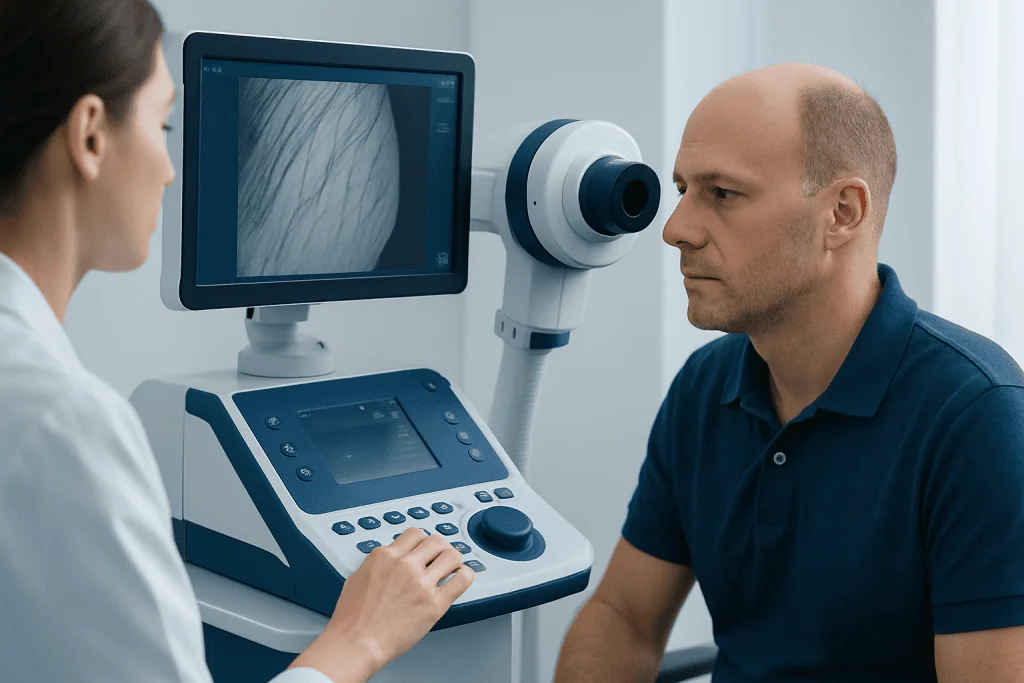
During examination, the dermatologist looks at the distribution of thinning, scalp health, and hair shaft diameter. A handheld dermatoscope or trichoscope may be used to magnify the scalp and hair follicles. Findings such as variation in hair shaft thickness and increased miniaturized hairs support the diagnosis of androgenetic alopecia.
Blood tests are not always required, but they may be recommended when the pattern is unusual, shedding is sudden, or symptoms suggest another condition. Tests may check for anemia, thyroid problems, iron stores, vitamin deficiencies, or hormone-related disorders. In rare or unclear cases, a small scalp biopsy may be performed to distinguish androgenetic alopecia from scarring alopecia, alopecia areata, or other scalp diseases.
Treatment Options
Treatment for androgenetic alopecia is individualized. The right approach depends on the patient’s sex, age, pattern and severity of hair loss, medical history, pregnancy plans, expectations, and whether other causes of shedding are present. A dermatologist or hair specialist should assess the scalp before treatment is started, because different types of hair loss require different management.
Medical treatments may be used to slow follicle miniaturization, support hair growth, or reduce the effect of androgen signaling on susceptible follicles. Some treatments are applied to the scalp, while others are taken by mouth when appropriate. These options may take several months to show visible benefit, and continued treatment is often needed to maintain results. Patients should discuss possible side effects, precautions, and suitability with a qualified doctor.
Procedural treatments may be considered for selected patients. Platelet-rich plasma therapy is sometimes used to stimulate the scalp environment, although response varies. Hair transplantation can move follicles from areas less affected by androgenetic alopecia to thinning areas, but it requires careful planning, adequate donor hair, and realistic expectations. Low-level light therapy devices may also be discussed in some cases as an adjunctive option.
Supportive care is also important. Treating dandruff, scalp inflammation, iron deficiency, thyroid disease, or other contributing problems may improve overall hair health. Gentle hair care, avoiding tight hairstyles, limiting harsh chemical treatments, and using cosmetic camouflage products can help reduce breakage and improve appearance while medical treatments take effect.
Living With / Prognosis
Androgenetic alopecia is usually a chronic condition, meaning it tends to progress over time without treatment. However, the rate of progression is highly variable. Some people notice only mild thinning for many years, while others develop more visible loss earlier. With timely evaluation and consistent treatment, many patients can slow further loss and may see improved density or coverage.
Living with hair loss can have emotional and social effects. People may feel frustrated, self-conscious, or worried about how their appearance is changing. These reactions are common and valid. A supportive discussion with a dermatologist can help patients understand what is medically possible, what results may be realistic, and which options fit their lifestyle and preferences.
Daily habits can support scalp and hair health, although they cannot change genetic sensitivity by themselves. A balanced diet, management of medical conditions, adequate sleep, and gentle hair practices can help minimize additional shedding or breakage. Patients should be cautious with unproven products that promise rapid regrowth, especially if they are expensive or not medically supervised.
For international patients seeking specialist assessment, Acibadem International’s multidisciplinary teams and JCI-accredited hospitals diagnose and treat hair and scalp conditions, including androgenetic alopecia. Care decisions should always be based on an individual medical examination and a clear discussion of benefits, limitations, and alternatives.
When to See a Doctor
A person should consider seeing a dermatologist when hair thinning becomes noticeable, progresses over time, or causes concern. Early assessment is helpful because treatment is often more effective at preserving existing hair than restoring areas where follicles have been inactive for a long time. A doctor can confirm whether the pattern fits androgenetic alopecia and check for other treatable causes.
Medical evaluation is especially important if hair loss is sudden, patchy, associated with itching, pain, scaling, redness, or scarring, or accompanied by symptoms such as fatigue, weight changes, irregular periods, acne, or increased facial hair. These features may suggest another condition that requires different treatment.
Women who are pregnant, planning pregnancy, or breastfeeding should seek medical advice before using any hair loss treatment. People taking long-term medications or those with liver, kidney, heart, hormonal, or prostate-related conditions should also consult a doctor before starting oral or topical therapies. A qualified specialist can guide safe choices and follow-up.
Frequently asked questions
What is androgenetic alopecia?
Androgenetic alopecia is a common inherited form of scalp hair loss caused by follicle sensitivity to androgens. It leads to gradual miniaturization of hair follicles, producing thinner and shorter hairs over time. It is known as male pattern hair loss in men and female pattern hair loss in women.
Is androgenetic alopecia permanent?
Androgenetic alopecia is a chronic condition, and without treatment it often continues gradually. Some miniaturized follicles can respond to treatment, especially in earlier stages. Areas with long-standing complete loss are less likely to regrow without procedural options such as hair transplantation.
How is androgenetic alopecia different in men and women?
Men often develop a receding hairline and thinning at the crown, sometimes progressing to more extensive scalp hair loss. Women more commonly develop diffuse thinning over the top of the scalp with a widening part, while the frontal hairline is usually maintained. A dermatologist can identify the pattern and rule out other causes.
Can stress cause androgenetic alopecia?
Stress does not usually cause androgenetic alopecia by itself because the condition is primarily genetic and hormone-related. However, significant physical or emotional stress can trigger increased shedding, which may make underlying patterned hair loss more noticeable. If shedding is sudden or heavy, medical evaluation is recommended.
What treatments are available for androgenetic alopecia?
Treatment options may include topical or oral medicines, scalp procedures, light-based devices, hair transplantation, and supportive management of scalp or medical conditions. The best choice depends on the patient’s pattern of hair loss, medical background, and goals. A dermatologist should assess the patient before recommending a treatment plan.
How long does treatment take to work?
Hair grows slowly, so visible improvement usually takes several months. Early changes may include reduced shedding, followed later by thicker or denser-looking hair in some patients. Ongoing follow-up helps determine whether the treatment is working and whether adjustments are needed.
When should someone seek medical help for hair loss?
A person should seek medical help when hair thinning is progressive, distressing, sudden, patchy, or associated with scalp symptoms such as redness, scaling, pain, or scarring. Women with irregular periods, acne, increased facial hair, or symptoms of thyroid or iron deficiency should also be evaluated. Early diagnosis can improve management options.
References
- American Academy of Dermatology Association
- British Association of Dermatologists
- European Dermatology Forum
- DermNet New Zealand
- UpToDate
This article is for general information only and is not a substitute for professional medical advice. Please consult a qualified doctor about your individual situation.
Treatments for This Condition
Doctors Who Treat This Condition

Prof. Dr. Bülent Saçak
Aesthetic Plastic & Reconstructive Surgery
Prof. Dr. Ersin Ülkür
Aesthetic Plastic & Reconstructive Surgery
Prof. Dr. Hakan Ağır
Aesthetic Plastic & Reconstructive Surgery
Prof. Dr. Mehmet Veli Karaaltın
Aesthetic Plastic & Reconstructive Surgery
Prof. Dr. Çiğdem Ünal Gülmeden
Aesthetic Plastic & Reconstructive Surgery
Prof. Dr. Şükrü Yazar
Aesthetic Plastic and Reconstructive Surgery
Dr. Burak Sercan Erçin
Aesthetic Plastic & Reconstructive Surgery
Dr. Cem Öz
Aesthetic Plastic & Reconstructive Surgery
Dr. Mahmut Özyilmaz
Aesthetic Plastic & Reconstructive Surgery
Dr. Mehmet Severcan
Aesthetic Plastic & Reconstructive Surgery
Dr. Mithat Ulay
Aesthetic Plastic & Reconstructive Surgery
Dr. Mutluhan Temizsoy
Aesthetic Plastic & Reconstructive SurgeryRelated Articles
What Is Hair Plantation? Understanding Hair Transplantation

Alopecia Symptoms: Early Signs and When to See a Doctor

Hair Loss Treatment for Women: Effective Medical Options

Alopecia Treatment: How Different Types Are Managed
How Is Female Baldness Treated? Options for Women

Treatment for Baldness: What Works for Hair Regrowth?
Hair Loss Treatment Options: Medicines, PRP, and Transplants

How Fast Does Hair Grow? Normal Rates and What Can Slow It Down

Hair Transplant in Turkey vs at Home: What International Patients Should Compare
How Fast Does Hair Grow After Shedding, Illness, or Treatment?

Scalp Micropigmentation Cost: What Is Included and Who Is It For?