Jaundice in Newborns: Causes, Testing, and When It Becomes Urgent

Jaundice in newborns is common, especially in the first week of life. A bilirubin test helps determine whether jaundice is mild or needs treatment.
Key Takeaways
- Jaundice in newborns is common, especially in the first week of life.
- A bilirubin test helps determine whether jaundice is mild or needs treatment.
- Early jaundice, poor feeding, unusual sleepiness, or rapidly deepening yellow color need prompt medical attention.
- Treatment may include frequent feeding, phototherapy, and in rare cases more intensive care.
- Follow-up after hospital discharge is important because bilirubin levels can rise over the first few days.
Jaundice in newborns is a yellowing of the skin and eyes caused by a buildup of bilirubin. It is common in the first days of life and often improves with monitoring and treatment, but some babies need urgent evaluation to prevent complications.
Overview of Jaundice in Newborns
Jaundice in newborns is a condition in which a baby’s skin and the whites of the eyes look yellow. This happens when bilirubin, a yellow pigment produced during the normal breakdown of red blood cells, builds up in the blood faster than the baby’s body can remove it. A newborn’s liver is still maturing, so it may not process bilirubin efficiently in the first days after birth.
In many babies, jaundice is mild and temporary. This is often called physiologic jaundice and usually appears after the first 24 hours of life, peaks over several days, and then fades as feeding improves and the liver becomes more effective. Premature babies are more likely to develop jaundice because their livers are less mature.
Although newborn jaundice is common, it should never be ignored. Very high bilirubin levels can affect the brain and cause serious complications if not treated in time. This is why healthcare teams check babies carefully before discharge and often recommend follow-up soon after going home. Families may also find it helpful to learn more about newborn jaundice care and evaluation.
Symptoms and Warning Signs
The most noticeable sign of jaundice is yellowing of the skin and eyes. It often starts on the face and may spread to the chest, abdomen, arms, and legs as bilirubin levels rise. In babies with darker skin tones, yellowing may be easier to notice in the whites of the eyes, gums, or inside the lips.
Jaundice itself may not make a baby seem unwell, especially when it is mild. However, parents should watch for signs that suggest the bilirubin level may be higher or that another problem could be present. These warning signs include difficulty waking for feeds, weak sucking, fewer wet diapers, unusual irritability, high-pitched crying, limpness, or arching of the body.
Some situations need prompt medical review. Jaundice that appears within the first 24 hours of life, gets noticeably deeper very quickly, lasts longer than expected, or is associated with pale stools or dark urine can point to a more serious cause. If a baby looks very sleepy, is not feeding well, or seems ill in any way, urgent assessment is important.
- Yellow skin or eyes
- Sleepiness or poor feeding
- Fewer wet or dirty diapers
- Jaundice appearing in the first 24 hours
- Dark urine or pale, chalky stools
Causes and Risk Factors

The most common cause of jaundice in newborns is normal newborn physiology. Babies break down red blood cells rapidly after birth, producing bilirubin, while the liver still has limited ability to process and clear it. In addition, bilirubin can be reabsorbed from the intestines if bowel movements are delayed.
Feeding problems can also contribute. Babies who are not getting enough milk, especially in the first days, may become dehydrated and pass fewer stools, allowing bilirubin to build up. Breastfeeding itself is healthy and encouraged, but some breastfed babies develop jaundice related to low intake early on, and some later develop breast milk jaundice, a usually harmless and temporary form that can last longer.
Less common but more important causes include blood group incompatibility between mother and baby, inherited red blood cell conditions, infection, bruising from birth, prematurity, or liver and bile duct disorders. In prolonged jaundice, doctors may consider conditions that affect bile flow or the liver, including rare disorders sometimes discussed alongside other hepatobiliary conditions such as primary sclerosing cholangitis, although these are not typical causes in healthy newborns. More broadly, specialists may assess babies for liver disease-related causes when jaundice does not follow the usual pattern.
Risk factors that increase the chance of significant jaundice include prematurity, a sibling who needed jaundice treatment, visible bruising after birth, exclusive breastfeeding with feeding difficulties, significant weight loss, East Asian ancestry, and maternal-baby blood type incompatibility.
How Doctors Test for Newborn Jaundice
Diagnosis begins with a physical examination and a review of when the jaundice started, how the baby is feeding, diaper counts, weight change, and any risk factors. A clinician may estimate jaundice by looking at the skin and eyes, but the color alone cannot show the exact bilirubin level. A baby may need more testing even if the yellow color seems mild.
The main test is a bilirubin measurement. This may be done with a skin scanner called a transcutaneous bilirubin meter or with a blood test for total serum bilirubin. Results are interpreted based on the baby’s age in hours, whether the baby was born early, and whether risk factors for bilirubin-related complications are present.
If bilirubin is high, rising quickly, or jaundice starts too early, further tests may be needed to look for the cause. These can include blood type testing for mother and baby, a direct antiglobulin test, complete blood count, reticulocyte count, and tests for infection or dehydration. If jaundice lasts beyond the expected period or there are signs of cholestasis, doctors may check direct bilirubin and liver-related blood tests, sometimes considering broader causes also seen in conditions like hepatitis B or Wilson disease in other age groups, even though these are uncommon explanations in newborns.
Treatment Options
Treatment depends on the baby’s bilirubin level, age in hours, overall health, and the cause of jaundice. Many babies only need close follow-up and support with feeding. Frequent feeds help babies stay hydrated and pass bilirubin out through stools. A lactation consultant or pediatrician can help if breastfeeding is painful, milk transfer seems low, or the baby is too sleepy to feed well.
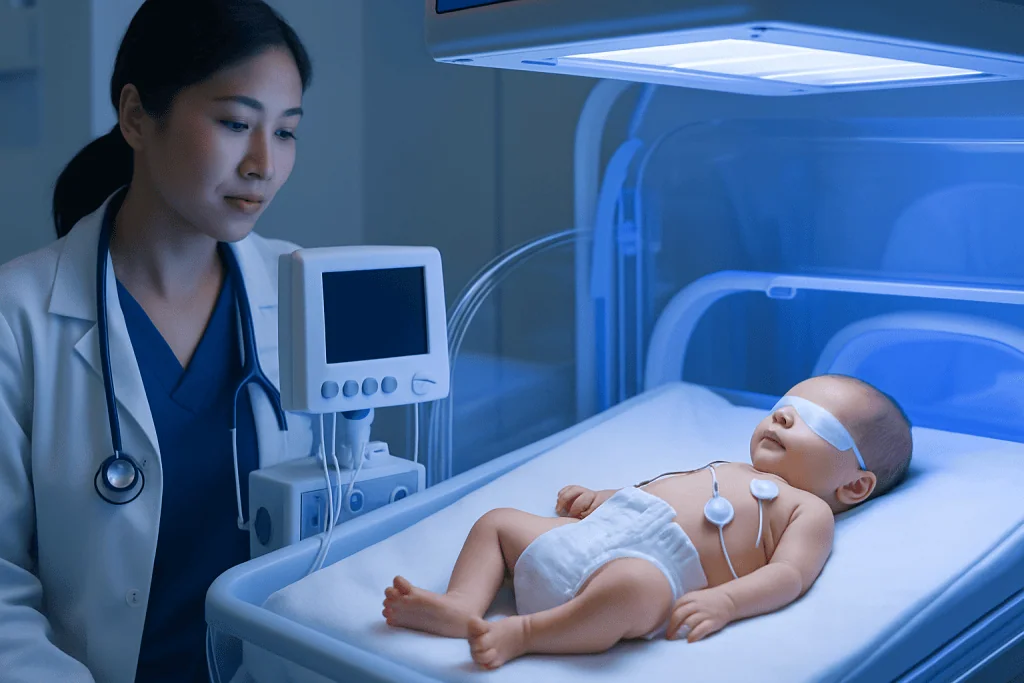
If bilirubin reaches the treatment range, phototherapy is commonly used. During phototherapy, the baby is placed under special blue light that changes bilirubin into a form the body can remove more easily. This treatment is effective and widely used. Babies may receive it in the hospital, and in selected cases, some may be treated at home with supervision if the medical team considers it safe.
In more serious cases, treatment may also include supplemental feeding, intravenous fluids, or addressing an underlying condition such as blood group incompatibility or infection. Rarely, if bilirubin becomes dangerously high or does not respond to other treatment, an exchange transfusion may be needed in a neonatal intensive care setting. Families seeking specialist input may be referred for assessment and treatment for neonatal jaundice when bilirubin is persistent or severe.
Because prolonged jaundice can occasionally reflect liver or bile duct disease, some infants need additional evaluation by pediatric specialists. This is especially important when jaundice continues beyond two to three weeks, stools are pale, or direct bilirubin is elevated.
Prevention and Self-care at Home
Not all jaundice can be prevented, but early feeding and timely follow-up can lower the risk of bilirubin rising too high. Newborns should usually feed often in the first days of life. Parents can monitor for swallowing during feeds, wet diapers, stool output, and normal wakefulness. If feeding seems difficult, help should be sought early rather than waiting.
After discharge, babies should be seen as recommended by their doctor or midwife, especially if they went home within the first 48 hours after birth. Follow-up visits may include a weight check, feeding review, and bilirubin test. Home observation is important because bilirubin often peaks after leaving the hospital.
Parents should not rely on sunlight as a substitute for medical treatment. Exposing a baby to direct sunlight can be unsafe and does not replace bilirubin testing or phototherapy. The safest approach is to follow the pediatric care plan, keep appointments, and ask for urgent advice if the yellow color spreads or the baby seems less alert.
Near the end of the care journey, some families may benefit from support from centers with pediatric, neonatal, and gastroenterology expertise. Acibadem International’s multidisciplinary specialists in JCI-accredited hospitals diagnose and treat this condition for international patients when further evaluation is needed.
When Jaundice Becomes Urgent
Jaundice becomes urgent when there is a higher risk that bilirubin could reach a harmful level or when another serious condition may be causing it. A baby should be assessed quickly if jaundice appears in the first 24 hours, deepens rapidly, or is accompanied by poor feeding, fever, breathing difficulty, unusual limpness, or hard-to-wake sleepiness.
Parents should also seek immediate medical care if the baby has fewer wet diapers than expected, loses too much weight, develops dark urine, or passes pale, white, or clay-colored stools. These stool and urine changes can suggest that bilirubin is not flowing normally through the liver and bile ducts.
Prolonged jaundice also needs attention. In full-term babies, jaundice that lasts beyond about two weeks should be discussed with a doctor, especially if the baby is not gaining weight well or seems unwell. Prompt treatment usually works very well, and early review helps prevent complications and provides reassurance for families.
Frequently asked questions
Is jaundice in newborns always dangerous?
No. Jaundice in newborns is very common and is often a temporary part of adjusting to life after birth. Even so, every baby with jaundice should be assessed appropriately because a small number can develop bilirubin levels that need treatment.
When does newborn jaundice usually start?
Physiologic jaundice usually appears after the first 24 hours of life and becomes more noticeable over the next few days. Jaundice that starts within the first 24 hours is more concerning and should be checked promptly.
How is bilirubin tested in a newborn?
Doctors may use a handheld skin device to estimate bilirubin or take a blood sample to measure it directly. The result is interpreted according to the baby’s age in hours and any risk factors, not by a single number alone.
Can breastfeeding cause jaundice?
Breastfeeding itself is beneficial and should usually continue. Jaundice can be linked to low milk intake in the first days if feeding is not going well, and some healthy breastfed babies develop a longer-lasting but usually harmless type called breast milk jaundice.
What is phototherapy and is it safe?
Phototherapy is a treatment that uses special blue light to help the baby’s body break down bilirubin more easily. It is a standard, effective treatment and is generally safe when used under medical supervision.
How long does newborn jaundice last?
Many cases improve within one to two weeks, though it can last longer in some breastfed babies. If jaundice persists, the baby should be reviewed to make sure there is no underlying problem and that bilirubin is following a safe pattern.
References
- American Academy of Pediatrics
- National Institute for Health and Care Excellence
- Centers for Disease Control and Prevention
- World Health Organization
- MedlinePlus
This article is for general information only and is not a substitute for professional medical advice. Please consult a qualified doctor about your individual situation.
Explore treatments in Turkey — costs, top hospitals & a free quote
JCI-accredited · board-certified surgeons · reply within 24h
Add us as a Preferred Source to see more of our trusted health content across Google Search, AI Overviews and Discover.

Gastroenterology
Diagnosis and treatment of the digestive system and liver, with advanced endoscopy.
46 specialists in this unit