

Can Grinders Have Porcelain Veneers? Night Guards and What Bruxism Changes in Planning

Key Takeaways
- Ceramic resists compression well but is brittle under the sideways, sliding forces of grinding, which is why veneer edges chip in bruxers.
- The resin bond holding a veneer is strongest to enamel and weaker to dentin, so heavy wear that exposes dentin undermines the restoration before it is even placed.
- A night guard keeps the teeth separated and spreads force across acrylic, but Mayo Clinic and the NHS both describe it as protection, not treatment of the grinding itself.
- Mayo Clinic lists obstructive sleep apnea among conditions associated with sleep bruxism, so unexplained grinding with snoring or gasping merits a medical review before cosmetic work.
- Certain antidepressants are associated with grinding as a side effect; any concern belongs with the prescribing clinician, never with a self-directed change.
- Cleveland Clinic gives porcelain veneers a typical lifespan of roughly a decade or more under ordinary use, and bruxism is a recognized factor that can shorten it.
Yes, many people who grind or clench their teeth can have porcelain veneers, but bruxism changes how the work is planned. Dentists usually look for the cause of the grinding, stabilize the bite, choose the ceramic and the design with clenching forces in mind, and provide a custom night guard to protect the finished result. Uncontrolled grinding, severely worn teeth or active gum disease often mean waiting or choosing a different restoration.
The chip was tiny, a missing corner on a front tooth that showed up in a bathroom mirror one Tuesday morning along with a jaw that felt as if it had been doing push-ups all night. She had been thinking about veneers for years. Now she had a new question to bring to the consultation: does the thing that broke this tooth also break the fix?
It is a fair worry. Porcelain veneers with bruxism sit at an awkward intersection: a thin ceramic shell designed to look like enamel, bonded to a mouth that generates unusually high forces while its owner is asleep and cannot moderate them.
The good news is that this is a well-mapped problem. Dentists have a set of planning steps, material choices and protective measures for grinders, and an honest way of deciding when veneers make sense and when something else is the wiser move. This article walks through all of it, including the parts that marketing pages tend to skip.
Can grinders have porcelain veneers? The honest short answer
Bruxism is the medical term for grinding, gnashing or clenching your teeth, either during the day (awake bruxism) or during sleep (sleep bruxism). Mayo Clinic describes it as a condition that ranges from harmless to damaging, depending on how often and how hard it happens. Porcelain veneers are thin ceramic shells, usually well under a millimeter thick, bonded to the front surface of teeth to change shape, color or alignment.
Put those two facts together and the answer becomes conditional rather than binary. Ceramic tolerates being squeezed remarkably well. It tolerates being bent, pried or repeatedly struck on a thin edge far less well. Grinding does exactly that second kind of loading, and it does it for minutes at a time, night after night.
So the useful question is not “can I?” but “under what conditions?” A person whose grinding is mild, whose cause has been identified and addressed, who still has plenty of enamel and who will reliably wear a protective guard is in a different position from someone with flattened teeth, a stiff morning jaw and untreated snoring.
Dentists generally handle this in layers. First they work out why you grind and how much damage it has already done. Then they decide whether veneers, a stronger restoration or no restoration at all fits the picture. Finally they design the veneers so that the front teeth are not taking loads they were never meant to carry, and they fit a guard to absorb what remains.
None of that is a guarantee. Any veneer on any tooth can chip or come loose, and grinders face higher odds. The rest of this article explains how clinicians try to shift those odds and how you can tell whether the plan you are offered has taken your bruxism seriously.
What grinding actually does to enamel, and to ceramic
Start with the natural tooth. Enamel is the hardest substance in the body, yet it is thin, and once it wears it does not grow back. Sleep bruxism is a problem because the reflexes that normally stop you biting too hard are dampened during sleep, so the jaw muscles can contract with unusual force for sustained periods. Over years this leaves shiny flat patches called wear facets, shortened front teeth, fine crack lines and sometimes small notches near the gumline.
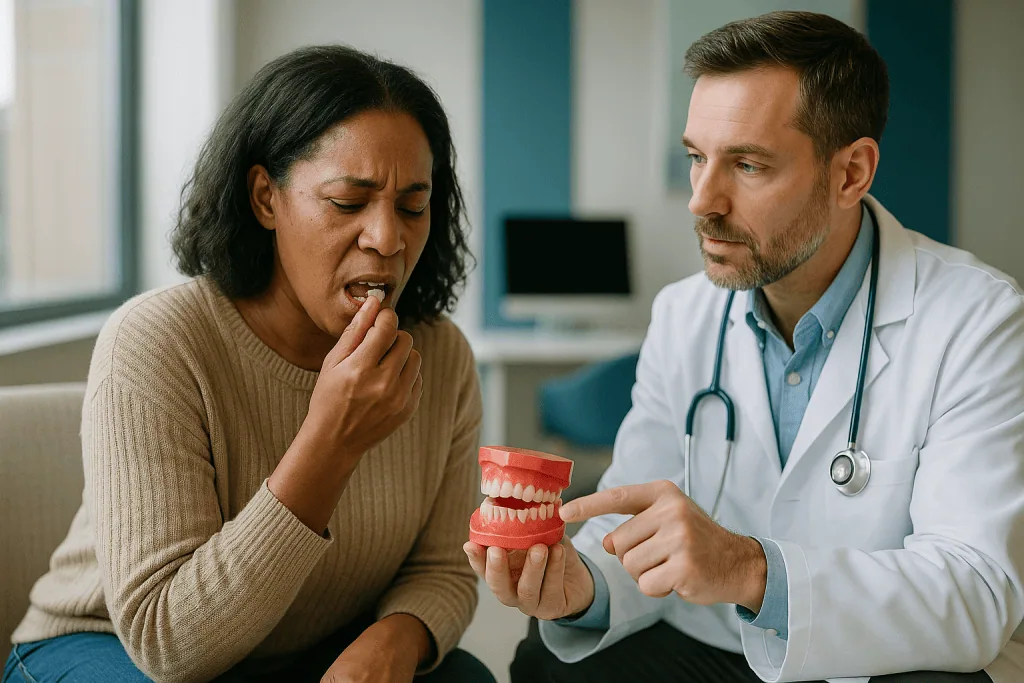
Now consider what a veneer needs to survive. A porcelain veneer is bonded with a resin cement, and that bond is strongest to enamel and considerably weaker to the softer, yellower dentin underneath. Heavy wear exposes dentin exactly where the veneer needs the best grip. It also means the dentist may have to build back lost tooth height, which makes the ceramic longer and more leveraged.
Then there is the direction of force. When you chew, teeth mostly load up and down. When you grind, the lower jaw slides sideways and forward while the muscles are clenched, dragging the edges of the front teeth against each other. Ceramic handles compression well but is brittle under bending and shear. A veneer edge caught in that sliding motion can chip, the ceramic can crack along a line, or the whole shell can pop off if the cement bond fails.
Finally, ceramic can wear the teeth it meets. Polished porcelain is reasonably kind to opposing enamel, but a rough chipped surface acts like a small file every night. Part of planning for a grinder is protecting the teeth on the other side of the bite as much as the veneers themselves.
Understanding these mechanisms is what turns the vague warning “veneers and grinding don’t mix” into a set of specific things a dentist can design around.
Can dentists tell if you have bruxism?
Often, yes, though usually as a strong suspicion rather than a confirmed diagnosis. Many people who grind at night have no idea they do it. Cleveland Clinic notes that a sleeping partner is frequently the first to hear the sound, and the dentist is often the first professional to notice the aftermath.
During an exam a dentist looks at several things. Wear facets on the biting edges are the classic sign, particularly when the flat spots on upper and lower teeth line up like matched puzzle pieces. Chipped or fractured enamel, cracks in fillings, teeth that are unusually sensitive to cold, and slight looseness can all point the same way. Inside the cheek there is sometimes a raised white line where the tissue has been bitten repeatedly, and the tongue edges can look scalloped. Outside the mouth the chewing muscles at the angle of the jaw may be visibly enlarged, and pressing them may be tender. Some people report morning headaches or a jaw that feels tired before breakfast.
None of these findings alone proves bruxism, which is why this is not a checklist for diagnosing yourself. Wear can come from acid erosion or abrasive brushing, and jaw pain has many causes. What the dentist does is assemble the pattern, ask about sleep, stress, snoring, caffeine, alcohol and medications, and sometimes recommend a sleep study, since Mayo Clinic identifies sleep-related disorders such as obstructive sleep apnea as a recognized association with sleep bruxism.
A formal diagnosis of sleep bruxism is made in a sleep laboratory that records muscle activity overnight, but in everyday practice the clinical picture is usually enough to change the plan. If your dentist raises the possibility of grinding before you have mentioned it, that is a sign of careful assessment, not an attempt to talk you out of treatment.
Who porcelain veneers with bruxism usually suit, and who is asked to wait
Dentists tend to think about grinders on a spectrum, and where you sit on it shapes the advice.

People who are generally reasonable candidates share a few features. Their wear is mild to moderate, meaning the teeth are shorter or chipped but still mostly covered in enamel. Their grinding has an identifiable driver that is being addressed, whether that is a sleep disorder under treatment, a stressful period that has eased, or a daytime clenching habit they have learned to notice. Their gums are healthy, their bite is stable, and they are willing to wear a custom night guard every night for as long as the veneers are in place. Cleveland Clinic lists healthy teeth and gums and enough enamel as baseline requirements for any veneer, and those matter twice as much when forces are high.
People who are usually asked to wait, or offered something else, include those with severe wear where large areas of dentin are exposed or where the teeth have lost so much height that the whole bite would need rebuilding. Veneers alone cannot do that job. Active gum disease or untreated decay comes first, always. Someone in the middle of a flare of jaw joint pain is generally stabilized before anything is bonded. Untreated obstructive sleep apnea is a particular reason to pause, because addressing it may reduce the grinding itself and changes the whole risk calculation.
A third group sits in between: people whose grinding is clearly present but whose cause is unclear. Many clinicians fit a guard first and watch how quickly it shows wear marks, using it as a rough gauge of how much force is in play before committing to ceramic.
The point is that “wait” rarely means “never.” It usually means there is a sequence, and skipping steps in it is what leads to broken veneers and disappointment.
What disqualifies you from veneers in general?
Bruxism is a modifier, not an automatic disqualifier. It helps to see it alongside the other factors dentists weigh, because several of them are more decisive.
The first is enamel. Because the resin bond relies on healthy enamel, teeth that have lost most of theirs to wear, erosion or previous drilling are poor veneer candidates. Cleveland Clinic points out that preparing a tooth for a traditional veneer removes a thin layer of enamel, so there has to be enough to spare. Teeth with large existing fillings often lack the sound structure a veneer needs and may be better served by a crown, which wraps the whole tooth.
The second is disease. Active decay or gum inflammation is treated before any cosmetic work. Bonding ceramic over an unstable foundation is a recipe for early failure and hidden problems.
The third is alignment. Veneers can disguise minor crowding or gaps, but they cannot correct a deep overbite or a bite where the front teeth collide edge to edge. In those cases orthodontics comes first, and for grinders it may also reduce the destructive contacts that were driving the wear.
The fourth is habits and expectations. Nail biting, ice chewing, opening packets with the teeth and uncontrolled clenching all raise the chipping risk, and a person who wants a shade whiter than natural enamel can realistically look may be unhappy with a well-made result.
Where does bruxism sit? It interacts with almost every item above. It removes enamel, it accelerates wear on a bad bite, and it is itself a force habit. That is why a good consultation for a grinder spends less time on shade guides and more on models, photographs and questions about sleep. Your dentist is not being difficult; they are protecting the investment you are about to make.
How bruxism changes the planning: bite analysis, mock-ups and material choice
For a non-grinder, veneer planning is mostly about appearance. For a grinder it becomes engineering.
The first change is a detailed look at occlusion, which simply means how your upper and lower teeth meet and slide against each other. The dentist takes impressions or a digital scan, mounts models so they move like your jaw, and studies where the teeth touch when you slide sideways and forward. The aim is to make sure the new veneer edges guide those movements smoothly rather than catching on them. Even a fraction of a millimeter of extra length on a front tooth can turn it into the first point of contact every time you grind.
Next comes a diagnostic wax-up or digital design, followed by a mock-up in the mouth made from temporary material. This lets you and the dentist see the proposed shapes, and it lets a grinder test-drive the new length before anything permanent is done. Chips in the mock-up are useful information.
Material choice shifts too. Traditional layered feldspathic porcelain is beautiful but comparatively fragile. Pressed or milled ceramics such as lithium disilicate are stronger and are commonly favored where forces are high, sometimes with the veneer extended around the biting edge onto the back of the tooth for extra support. Some cases are better served by a crown or an onlay rather than a veneer, and a candid dentist will say so.
Bonding technique matters as well. Keeping the preparation within enamel, isolating the tooth from saliva during cementation and polishing the ceramic edges all reduce the chance of early debonding or chipping.
Finally, the night guard is designed into the plan from the outset, not added as an afterthought, and the dentist records how the completed veneers meet so the bite can be rechecked later. Every one of these decisions is individual, which is why two grinders can leave the same practice with different plans.
Veneers for teeth grinders: how the main options compare
People searching for veneers for teeth grinders usually assume porcelain veneers are the only route. In practice the dentist is choosing among several restorations, and sometimes the best option is to restore nothing yet. The table below summarizes how the common approaches behave under grinding forces. Lifespan figures are general estimates from Cleveland Clinic for ordinary use; grinding tends to shorten them.
| Option | What it is | Tooth removed | How it handles grinding | If it fails |
|---|---|---|---|---|
| Porcelain veneer | Thin ceramic shell bonded to the front of the tooth | Small amount of enamel, usually less than a millimeter | Strong in compression, edge-chip risk under sliding forces | Small chips can sometimes be smoothed or patched; larger fractures need replacement |
| Composite veneer | Tooth-colored resin sculpted directly onto the tooth | Minimal or none | Less brittle, but wears and stains faster; Cleveland Clinic gives a shorter typical lifespan than porcelain | Easily repaired or added to in one visit |
| Ceramic crown | Cap covering the whole tooth | Substantial, all around | More resistant to fracture because it is supported on all sides | Usually replaced as a unit |
| Onlay or palatal veneer | Ceramic covering the biting edge and back of the tooth | Moderate, focused where wear is | Designed specifically to rebuild worn edges under load | Repaired or replaced individually |
| Guard only, restore later | Custom night guard, monitoring, address the cause | None | Protects existing enamel while the grinding is brought under control | Nothing to fail; revisit restoration once stable |
Two observations follow. Composite is often underrated for grinders: it looks less lifelike over time and needs more maintenance, but it is forgiving and fixable, which can suit someone whose grinding is not yet controlled. Crowns and onlays sacrifice more tooth but resist fracture better, so they tend to be reserved for teeth already heavily damaged. The right choice is the one that matches the amount of force, the amount of remaining tooth and how much maintenance you are willing to accept.
Do you need a night guard for veneers if you grind?
Almost every dentist who places veneers on a grinder will provide a night guard for veneers and ask you to wear it every night. It is worth understanding why, and what it does and does not do.
A night guard, also called an occlusal splint, is a custom-made plastic appliance that fits over the upper or lower teeth. Mayo Clinic describes splints and mouth guards as devices that keep the teeth separated to avoid the damage caused by clenching and grinding. The key word is separated. When you clench in a guard, your teeth press into acrylic rather than into each other or into ceramic edges, and the load is spread across a broad flat surface instead of concentrated on a few contact points.
What a guard does not do is stop the grinding. The muscles still contract. The habit continues. This is why the NHS and Mayo Clinic both describe guards as protective rather than as treatment for the underlying cause. Think of it as a helmet: essential when the risk is present, but not a reason to stop looking at why you keep falling.
Design details matter for veneer wearers. Hard or dual-layer custom guards made from an impression of your teeth fit precisely and distribute force evenly. Store-bought boil-and-bite versions are bulkier, fit less well and can concentrate pressure unpredictably; some clinicians also observe that very soft rubbery guards seem to encourage chewing in some people. Your dentist will usually choose the design and adjust it so the bite on the guard is balanced.
Looking after it is simple: rinse and brush it with a soft brush, let it dry in a ventilated case, and bring it to check-ups so the dentist can inspect wear marks, which double as a record of how hard you are grinding. Expect to replace it periodically, since the guard is meant to wear so the veneers do not.
How do you fix bruxism teeth? Treating the grinding, not just the damage
The phrase “fix bruxism teeth” bundles two different tasks: repairing what has worn, and reducing the forces that wore it. Veneers address the first. Ignoring the second is how veneers end up in the same state as the teeth they replaced.
The causes of bruxism are not fully understood, but Mayo Clinic and the NHS list several recognized contributors: stress and anxiety, sleep disorders including obstructive sleep apnea, heavy caffeine or alcohol intake, smoking, certain personality traits, and some medicines. Among medicines, certain antidepressants have been associated with grinding as a side effect. If you suspect this applies to you, the right step is a conversation with the clinician who prescribes it. Stopping or changing a prescribed medicine on your own is never advisable.
Management follows the cause. For awake bruxism, the first line is awareness: noticing when the teeth are touching during the day and deliberately relaxing the jaw, sometimes with the help of reminders or behavioral therapy. Mayo Clinic mentions stress management, relaxation techniques and cognitive behavioral approaches as options. For sleep bruxism linked to apnea, treating the breathing disorder is the priority and may reduce grinding. Cutting back on late caffeine and alcohol and improving sleep routines are low-risk measures that the NHS recommends trying.
Medicines have a smaller role. Mayo Clinic notes that muscle relaxants are occasionally used short term and that botulinum toxin injections into the jaw muscles may be considered for severe cases that have not responded to other measures. The evidence for both is limited, and these are decisions for a physician or dentist with the full picture, not something to request as a routine add-on to cosmetic work.
Once the forces are better controlled, repairing the teeth becomes more predictable. Options range from simple bonding on small chips through veneers, onlays and crowns to orthodontics where a poor bite is contributing. Your dentist will sequence these, usually protecting first and restoring second.
What actually happens during veneer appointments for a grinder
Cleveland Clinic describes traditional veneers as a process spread over several visits, and for a grinder each visit carries a little extra.
The consultation is longer. Beyond photographs and shade matching, the dentist examines wear patterns, palpates the jaw muscles, checks the joints for clicking or tenderness, and asks about sleep quality, snoring, headaches and stress. Impressions or a digital scan are taken so models can be studied. You may leave with a night guard before anything else is done, so the team can assess how much force you generate.
The design stage follows, often with the mock-up described earlier. This is your chance to test length and shape. If the mock-up chips within a week, that is a valuable warning rather than a failure.
Preparation day is when the dentist removes a thin layer of enamel, keeping within it as much as possible because that is where the bond is strongest. Local anesthetic is usually offered. Temporary veneers are placed, and for grinders the dentist checks carefully that they do not stick out into the path of a sideways slide.
At the fitting visit the ceramic veneers are tried in with a water-based paste to check fit and color, then bonded with a resin cement hardened by a blue curing light. The dentist then spends noticeable time on the bite, asking you to tap, slide and clench while marking contacts with thin colored paper and adjusting the ceramic where it catches. This step is often brief for non-grinders and deliberately thorough for grinders.
Finally, a new impression is taken for a night guard that fits the finished veneers, since the old guard will no longer seat correctly. A short follow-up is scheduled to recheck the bite once you have lived with the veneers for a while. Nothing here is unusual; it is the ordinary process with the pressure points given extra attention.
The first days and weeks after veneers when you grind
The early period after bonding is mostly about letting your mouth adjust while protecting the new edges.
Sensitivity to hot and cold is common in the first days, because a small amount of enamel has been removed and the teeth are recovering from the procedure. Cleveland Clinic notes that this usually settles quickly. For grinders, a second kind of discomfort can appear: a sense that the teeth meet differently, or a tender spot on one tooth that seems to take the bite first. This is worth reporting promptly. A single high contact can trigger more clenching, and a small adjustment to the ceramic often resolves it.
The night guard usually arrives within a couple of weeks of fitting. Until then, many dentists ask grinders to avoid hard or sticky foods, not to bite nails or pens, and to be conscious of daytime clenching. Once the guard is delivered, it becomes nightly. Some people find it strange at first and salivate more; that generally fades with habit.
Home care is otherwise ordinary. Brush twice a day with a non-abrasive toothpaste, floss carefully at the edges of each veneer, and avoid whitening products, which do not change ceramic and can irritate the surrounding tooth.
At the follow-up visit the dentist rechecks the bite with marking paper, looks at the guard for early wear marks and inspects the veneer edges under magnification. Small rough spots are polished. This is also the moment to mention any morning jaw tiredness or headaches, since they may signal that the underlying grinding needs more attention.
Beyond the first month, the routine becomes check-ups at the interval your dentist suggests, with the guard brought along each time. The veneers themselves need no special treatment; the vigilance is about what surrounds them.
How long do veneers last with grinding?
This is the question most people really want answered, and the honest response has two parts.
For the general population, Cleveland Clinic gives porcelain veneers a typical lifespan in the range of roughly a decade or more, with composite veneers lasting a shorter time. Those figures come from ordinary wear: eating, brushing, the occasional knock.
For grinders, no reliable per-patient number exists, and anyone who offers one is guessing. What the evidence consistently shows is that bruxism is among the recognized risk factors for veneer fracture and debonding, which is why it features in almost every discussion of case selection. How much it shortens the life of a given veneer depends on the strength and frequency of the grinding, how much enamel was available for bonding, the ceramic chosen, how well the bite was balanced and, above all, whether a guard is actually worn.
It helps to separate the ways veneers fail. A small edge chip can often be smoothed or repaired with composite in a single visit, leaving the veneer in place. A crack running through the ceramic or a veneer that has come off usually means replacement of that one tooth, not the whole set, provided the underlying tooth is sound. Gradual wear of the ceramic edge is slow and can be monitored.
There is also the question of what the veneers are wearing against. A guard protects both sides of the bite at night, but daytime clenching on opposing natural teeth or older fillings continues to load everything. Regular check-ups let the dentist track this and intervene early.
The sensible framing is this: veneers on a well-managed grinder with a nightly guard can serve for many years, veneers on an unmanaged grinder frequently do not, and the difference lies largely in the steps taken before and after bonding rather than in the ceramic itself.
What people often get wrong about porcelain veneers with bruxism
Several beliefs circulate widely enough to deserve direct correction.
“Porcelain is harder than enamel, so grinding won’t hurt it.” Hardness is not toughness. Ceramic resists scratching but is brittle under bending and edge loading, which is exactly what grinding produces. Enamel, backed by flexible dentin, is more forgiving than a thin shell bonded to it.
“Veneers will stop me grinding.” They will not. Grinding is driven by the nervous system, sleep and stress, not by tooth shape. Changing the bite can sometimes alter contact patterns, but it does not switch off the habit.
“A night guard means I don’t need to address the cause.” A guard protects; it does not treat. If sleep apnea, medication effects or daytime clenching are behind the grinding, they continue regardless, and they carry their own health consequences beyond the teeth.
“A store-bought guard is the same as a custom one.” Boil-and-bite guards fit loosely, are bulkier and can concentrate force unevenly. For someone protecting ceramic edges, precise fit matters.
“No-prep veneers are safer for grinders because no enamel is removed.” Preserving enamel is good, but no-prep veneers are often thinner and must be added on top of the existing tooth contour, which can lengthen and thicken the edges that grinding attacks. Suitability depends on the individual bite.
“If one veneer chips, I’ll have to redo them all.” Individual veneers can usually be repaired or replaced, though matching color to older veneers takes skill.
“Bruxism is only about stress.” Stress is one contributor. Sleep disorders, genetics, certain medicines, caffeine, alcohol and tobacco all appear in the mainstream lists from Mayo Clinic and the NHS.
The thread running through all of these is the same: veneers are a restoration, bruxism is a condition, and treating the second is what protects the first.
Questions to ask your care team before agreeing to veneers
A consultation is a two-way assessment. These questions help you judge whether your grinding has been fully considered, and the answers you receive should feel specific to you.
- What signs of grinding did you see in my mouth, and how severe do you judge my wear to be?
- Do you think I should be assessed for a sleep disorder before we plan cosmetic work?
- How much enamel do I have on the teeth you would treat, and will the preparations stay within it?
- Would a mock-up or trial period with a guard help us judge how my bite behaves before anything is bonded?
- Which ceramic are you proposing and why, and would a crown, onlay or composite be a safer choice for any of these teeth?
- How will you check and adjust my bite after bonding, and when will you recheck it?
- What type of night guard will I have, who makes it, and how often should I expect to replace it?
- If a veneer chips or comes off, what are the likely repair options and does your practice provide them?
- Are there habits, foods or daytime behaviors you want me to change?
- How will we monitor the teeth on the opposite side of the bite over time?
Notice that none of these questions is about how the veneers will look. Appearance is the easy part of this decision and the part most consultations already cover well. The questions above are about durability, and a team that answers them readily is telling you they have planned for your bruxism rather than around it.
It is also entirely reasonable to ask for time to think, to request a written summary of the proposed plan, or to seek a second clinical opinion. Veneers are elective. Nothing about the decision needs to be rushed, and the treating team should welcome a patient who wants to understand the trade-offs.
When to call your doctor or dentist
Most veneer aftercare is routine, but a few situations need prompt attention rather than waiting for the next scheduled visit.
Contact your dentist the same day if a veneer cracks, chips leaving a sharp edge, or comes off entirely. Keep the piece if you can. A loose veneer exposes prepared enamel or dentin and can be re-bonded far more easily before it is damaged or swallowed. Also call if you notice a persistent high spot in your bite, if a treated tooth develops a sharp or lingering ache after hot or cold rather than a brief twinge, or if the gum around a veneer stays red, swollen or bleeds for more than a few days after the fitting.
Seek care urgently, through your dentist or an urgent care service, if you develop facial swelling, fever, a foul taste, or throbbing pain that wakes you at night, since these can indicate a dental infection that needs treatment. A jaw that locks open or closed, or severe joint pain that stops you eating, also warrants prompt assessment.
Speak to your physician as well as your dentist if your grinding comes with loud snoring, pauses in breathing noticed by a partner, gasping during sleep, or marked daytime sleepiness. Mayo Clinic links sleep bruxism with obstructive sleep apnea, and untreated apnea carries cardiovascular and metabolic risks well beyond the teeth. Frequent morning headaches, new jaw pain or a change in bite that appears after starting a new medicine are also worth raising with the prescriber.
These red flags are not reasons to panic; they are the moments where a quick call changes the outcome. Whether to adjust, repair, replace or investigate further is always a decision for your treating team, made with the full picture in front of them.
Frequently asked questions
Can I get veneers if I have bruxism?
Often yes, provided the grinding is assessed and managed first. Dentists look at how much enamel remains, how severe the wear is, whether a cause such as sleep apnea or daytime clenching has been addressed, and whether you will wear a custom night guard nightly. Severe wear, active gum disease or uncontrolled grinding usually mean waiting or choosing a stronger restoration. The decision rests with your treating dentist.
Can dentists tell if you have bruxism from an exam?
Usually they can form a strong suspicion. Matching flat wear facets on upper and lower teeth, chipped enamel, cracked fillings, enlarged jaw muscles, a ridged line inside the cheek and reported morning jaw fatigue all point toward grinding. A definitive diagnosis of sleep bruxism requires overnight monitoring in a sleep study, but the clinical pattern is generally enough to change how veneers are planned.
Will a night guard for veneers stop me grinding?
No. A guard separates the teeth and spreads clenching force across a plastic surface so the veneers and opposing teeth are protected, but the muscles still contract. Mayo Clinic and the NHS describe splints as damage prevention rather than treatment of the cause. Reducing the grinding itself involves addressing stress, sleep disorders, caffeine, alcohol, tobacco or medication effects with the appropriate clinician.
How long do veneers last with grinding?
There is no reliable per-person figure. Cleveland Clinic gives porcelain veneers a typical lifespan of roughly a decade or more in ordinary use, and bruxism is a recognized risk factor for chipping and debonding that can shorten this. How much depends on the force involved, the enamel available for bonding, the ceramic chosen, how well the bite was balanced and whether a guard is worn every night.
What disqualifies you from veneers?
The most decisive factors are too little enamel for a reliable bond, untreated decay or gum disease, large existing fillings, and a bite problem such as an edge-to-edge or deep overbite that needs orthodontics first. Uncontrolled grinding and habits like nail biting raise the risk considerably. Bruxism on its own is a reason for careful planning rather than an automatic no.
Are veneers for teeth grinders made from a different porcelain?
Frequently, yes. Dentists often favor stronger pressed or milled ceramics such as lithium disilicate over more delicate layered porcelain when forces are high, and may extend the ceramic around the biting edge for support. In some cases they recommend a crown, an onlay or composite resin instead. The choice depends on how much tooth remains and how much force the bite produces.
How do you fix bruxism teeth that are already worn?
Repair options range from simple composite bonding on small chips to veneers, onlays or crowns on more heavily worn teeth, with orthodontics where the bite itself is contributing. The order matters: dentists typically protect the teeth with a guard and address the cause of the grinding first, because restoring teeth while forces remain uncontrolled tends to lead to repeated fractures.
Can a chipped veneer be repaired, or does the whole set need replacing?
Small edge chips can often be smoothed or patched with composite in a single visit. A crack through the ceramic or a veneer that has fully detached usually means replacing that one veneer, not the entire set, as long as the tooth underneath is healthy. Color matching a single new veneer to older ones is possible but requires skill, so the dentist may discuss options.
Do no-prep veneers work better for grinders because no enamel is removed?
Not necessarily. Keeping enamel is helpful for bonding, but no-prep veneers are often thinner and sit on top of the existing tooth contour, which can make the edges longer and more exposed to grinding forces. Whether they suit a particular grinder depends on the existing bite, tooth position and wear pattern, and is a judgement for the treating dentist after examining models.
Should I see a doctor about grinding before getting veneers?
It is sensible if your grinding comes with snoring, pauses in breathing, gasping during sleep or marked daytime tiredness, because Mayo Clinic links sleep bruxism with obstructive sleep apnea, which has health effects beyond the teeth. It is also worth a conversation if grinding began after a new medicine. Treating an underlying condition may reduce grinding and improves the outlook for any dental work.
References
This article is for general information only and is not a substitute for professional medical advice. Please consult a qualified doctor about your individual situation.

More from the Blog
How a Dental Hygiene Cleaning Works: Scaling, Polishing and Gum Checks Step by Step
A professional dental cleaning usually has three parts: a gum check, in which the hygienist measures the space between gum and tooth in millimeters;…

Can Early Tooth Decay Be Treated Without a Filling? Fluoride, Sealants and Monitoring
Yes, in many cases. When decay is caught while it is still confined to the enamel and has not broken through the surface, dentists…

After Tooth Decay Treatment: Sensitivity, Chewing on the Numb Side and Daily Brushing
After cavity treatment care is mostly patience and protection. Avoid chewing on the numb side until feeling returns, usually within a few hours, keep…

Questions to Ask an Orthodontist Before Treatment: Options, Length and Retention
Before orthodontic treatment, ask what your diagnosis actually is, which options fit your bite and why, how long treatment is expected to take and…

Fissure Sealant Appointment: How the Grooves Are Cleaned, Coated and Set in One Visit
A fissure sealant procedure is a short, non-invasive dental visit in which the deep grooves on the chewing surface of a back tooth are…

Managing TMJ Pain Safely: Heat, Medication Reviewed by Your Team and Physiotherapy
Most TMJ pain responds to conservative, reversible care: heat or cold as preferred, softer foods during flares, avoiding gum and clenching, and gentle jaw…