

How Bruxism Is Diagnosed: Tooth Wear Patterns, Jaw Checks and Sleep History
Key Takeaways
- Bruxism diagnosis rests on three strands weighed together: matching wear facets on the teeth, tenderness or enlargement in the chewing muscles, and a sleep and stress history that often includes a bed partner's report.
- Tooth wear proves grinding happened at some point but cannot show whether it is happening now; recent chips, failing fillings and current muscle tenderness are what indicate active bruxism.
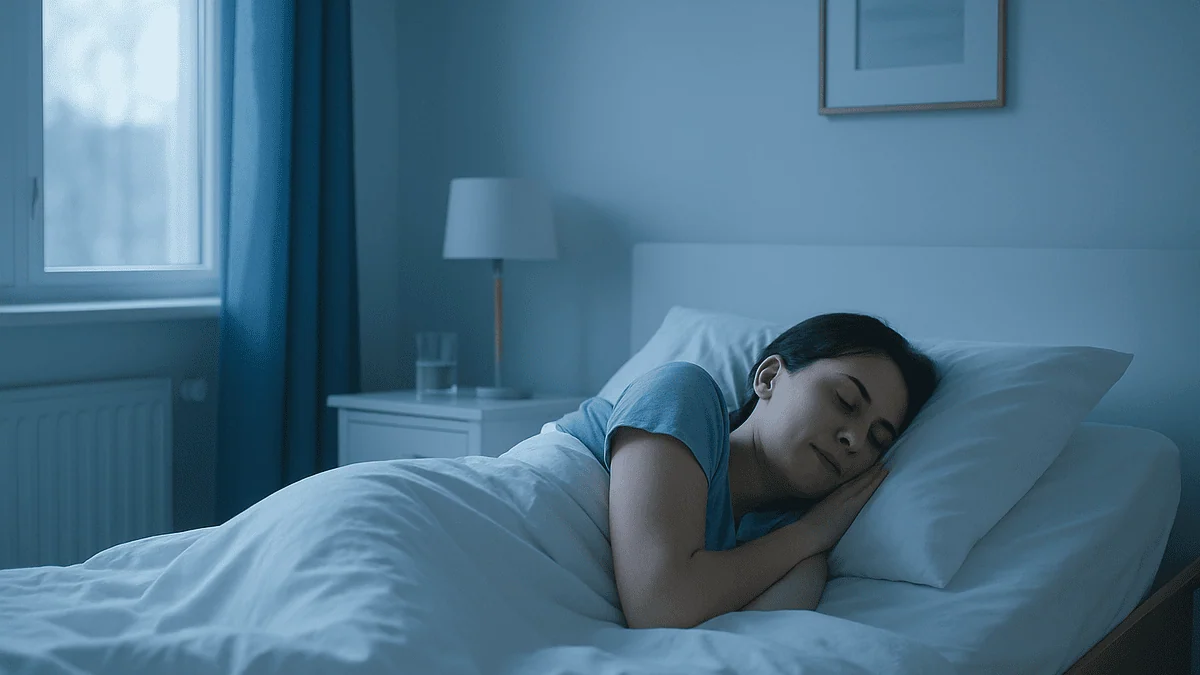
- Clenching is nearly silent while grinding produces a rasping or squeaking sound, so a quiet bedroom does not rule out bruxism.
- Sleep bruxism and awake clenching are assessed differently: sleep grinding relies on partner reports, morning symptoms and sometimes an overnight sleep study, while daytime clenching is identified through structured self-observation.
- Sleep bruxism can accompany obstructive sleep apnea, so loud snoring, witnessed breathing pauses or daytime sleepiness alongside grinding should prompt a conversation with a physician.
- A night guard protects enamel from grinding forces but does not usually stop the grinding itself, and the wear marks that appear on it become further diagnostic evidence at review.
Bruxism is usually diagnosed by a dentist from three strands of evidence gathered together: the pattern of wear, chips or cracks on the teeth; a hands-on check of the jaw muscles and joints; and a careful history of sleep, stress, medicines and any grinding noises a bed partner has noticed. When sleep grinding needs confirming, an overnight sleep study measuring jaw muscle activity can be added.
The first person to notice is rarely the one doing it. A partner lies awake listening to a sound like gravel shifting under a boot, or a hygienist pauses mid-clean and asks, quite casually, whether you have ever been told you grind. You had not. You only knew that mornings began with a dull ache along the jawline and that a molar had lost a corner somewhere between Tuesday and Friday.
That gap between what the body is doing and what the person knows about it is exactly why bruxism diagnosis is more detective work than lab test. There is no single blood marker, no scan that lights up. Instead a clinician assembles clues: the way enamel has flattened, how the chewing muscles feel under the fingertips, and what the last few months of sleep have really been like.
This article walks through that process as it actually unfolds in a dental chair, what each finding does and does not prove, and how the resulting picture shapes the conversation with your care team.
What actually happens during a bruxism diagnosis
Bruxism is the medical term for clenching or grinding the teeth outside normal chewing, either during sleep or while awake. Most people never book an appointment for it. According to Mayo Clinic, it is commonly picked up during a routine dental check, when a dentist notices the physical traces before the patient has connected the dots.
The visit itself has a recognizable shape. The dentist begins with conversation: how you sleep, whether you wake with a sore jaw or a headache around the temples, whether anyone has mentioned noises at night, and what has been happening in your life. Then comes the examination. The teeth are inspected under good light for flattened surfaces, chipped edges and hairline cracks. The dentist presses along the masseter (the thick muscle at the angle of the jaw) and the temporalis (the fan-shaped muscle above the ear) looking for tenderness or enlargement. You will be asked to open, close and slide the jaw sideways while the clinician listens and feels the joint just in front of the ear.
Nothing about this is dramatic. No injections, no equipment beyond a mirror and a probe in most cases. What matters is the pattern. A single chipped tooth means very little on its own; a chipped tooth plus tender muscles plus a partner who hears grinding is a different story.
If the findings suggest sleep bruxism and the picture is unclear, or if there are also signs of a sleep disorder such as loud snoring or gasping, the dentist may involve a physician and an overnight sleep study may be discussed. For most people, though, the diagnosis is made in the chair, from the combination of history and examination, and the next step is a plan for monitoring and protection agreed with the dentist.
Why the sleep history matters more than most people expect
Ask a dentist which part of the assessment they would least like to skip and many would say the history, not the exam. The teeth record the past; the history explains the present and hints at what is driving it.

The questions tend to cluster around a few themes. First, sleep itself: do you snore, wake unrefreshed, or has anyone described pauses in your breathing? The NHS and Mayo Clinic both note that sleep bruxism can sit alongside other sleep problems, including obstructive sleep apnea, a condition in which the airway repeatedly narrows during sleep. That link changes the referral pathway, because grinding may then be a signal of something a sleep physician needs to evaluate.
Second, stress and mood. The NHS describes stress and anxiety as common contributors to teeth grinding, and Mayo Clinic lists heightened emotions, frustration and tension among factors that can increase awake clenching. Dentists are not asking to pry; they are asking because a diagnosis that ignores the trigger is only half a diagnosis.
Third, substances and medicines. Caffeine, alcohol and tobacco are associated with grinding in the NHS guidance, and Mayo Clinic notes that bruxism can be an uncommon side effect of some psychiatric medicines, including certain antidepressants. If you take a prescribed medicine, mention it. The dentist will not tell you to stop; any change is a decision for the prescribing clinician. But knowing about it helps explain the picture.
Finally, the bed partner’s report. It is one of the most useful pieces of evidence available, because the person grinding is asleep and unaware. If you live alone, a dentist may ask about morning jaw stiffness or a sense that the teeth do not meet comfortably on waking, both of which Mayo Clinic lists as possible signs of teeth grinding at night.
What tooth wear patterns tell a dentist, and what they do not
Enamel is the hardest tissue in the body, yet it wears like anything else when two hard surfaces are ground together for years. The classic bruxism finding is attrition: flat, polished facets on the biting surfaces that match up precisely when the upper and lower teeth are brought together. The dentist will often ask you to close and slide, watching whether the flattened areas line up. When they do, it is strong evidence that the wear came from tooth-on-tooth contact rather than something else.
Other traces include chipped or fractured edges on the front teeth, cracks in molars, worn-down or broken fillings and crowns, and, in longer-standing cases, exposed dentin, the softer yellowish layer beneath enamel that can make teeth sensitive to cold. Mayo Clinic and Cleveland Clinic both list this kind of damage among the signs a dentist looks for.
Here is the honest caveat that good clinicians share: wear proves that grinding happened at some point, not that it is happening now. Facets acquired in a stressful decade twenty years ago do not disappear. Wear can also come from acid rather than force. Erosion, caused by reflux, frequent acidic drinks or vomiting, produces smoother, cupped surfaces rather than matching flat facets, and a dentist will weigh which pattern fits.
Soft tissues add supporting evidence. A ridge of thickened tissue along the inside of the cheek where it meets the teeth, or scalloped indentations along the sides of the tongue, can suggest the mouth is being held tightly. None of these is diagnostic alone.
So wear is the fingerprint, not the confession. It tells the dentist grinding has occurred and how forcefully; the history and muscle findings tell them whether it is still active enough to need a plan.
How do dentists diagnose teeth grinding through the jaw check?
If tooth wear is the archive, the muscles are the live feed. Clenching a few nights ago leaves no mark on enamel, but it does leave tenderness in the muscles that did the work, and that is what the jaw examination is designed to find.
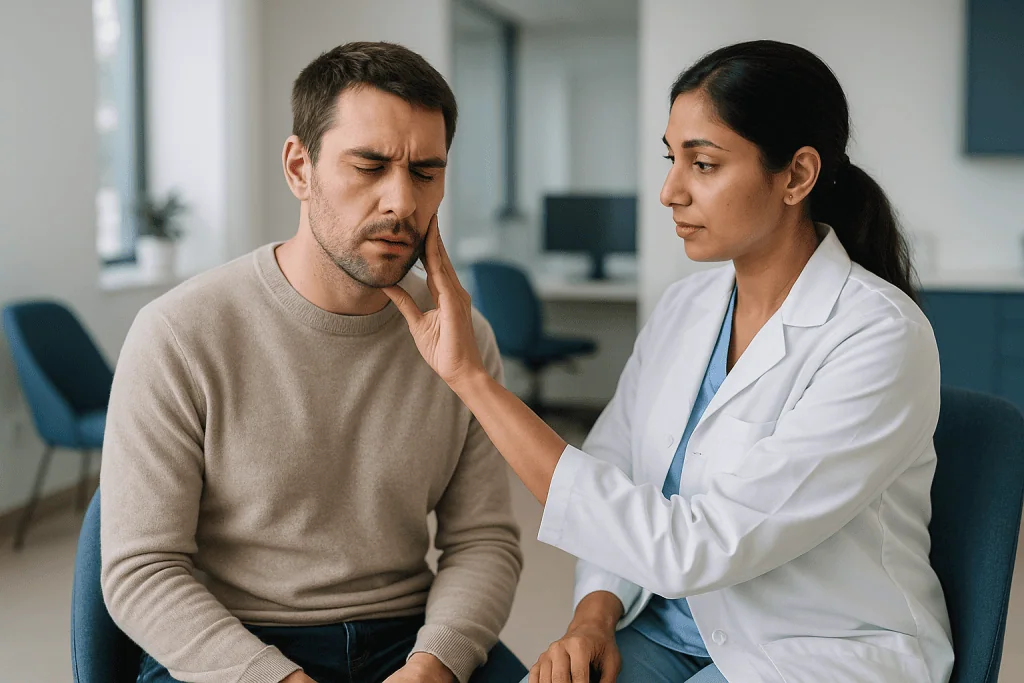
The dentist will palpate, meaning press firmly but gently with the fingertips, along the masseter at the angle of the jaw and the temporalis at the temples. You may be asked to clench so the muscle bulges under their hand; a masseter that is noticeably enlarged on one or both sides suggests it has been getting a workout. Tenderness, or a spot that reproduces your familiar ache, is noted.
Next comes the joint. The temporomandibular joint, or TMJ, is the hinge just in front of each ear that lets the lower jaw open, close and slide. The dentist places fingers there while you open wide and close, feeling for clicking, grating or a jaw that deviates to one side. They may measure how far you can open, since restricted opening or locking points toward a joint problem that needs its own evaluation.
This matters because bruxism and temporomandibular disorders overlap but are not the same thing. Cleveland Clinic notes that grinding can contribute to jaw pain and joint problems, yet joint pain can also arise from arthritis, injury or disc displacement with no grinding at all. The jaw check helps the clinician decide whether they are looking at a muscle problem driven by clenching, a joint problem, or both.
Expect the check to take only a few minutes. It is not painful beyond brief tenderness, and the findings are usually shared with you on the spot in plain language. What you are left with is a fuller answer to the question of whether the jaw is under strain right now, which no photograph of your teeth can provide.
Sleep bruxism vs awake bruxism: why the distinction shapes the diagnosis
Bruxism is not one habit but two, and the diagnostic route differs for each. Sleep bruxism happens during sleep and is considered a sleep-related movement behavior; the person is unaware of it. Awake bruxism happens during the day, is more often clenching than grinding, and is usually linked to concentration, tension or emotion. Mayo Clinic and Cleveland Clinic both draw this line, and clinicians increasingly assess the two separately.
For awake bruxism, the diagnosis leans heavily on self-observation. The dentist may ask you to notice, over a couple of weeks, whether your teeth are touching while you drive, type or scroll. Relaxed jaws keep the teeth slightly apart; if you routinely find yours pressed together, that is the evidence. There is no test for awake clenching beyond this kind of structured awareness, and the muscle tenderness found in the chair supports it.
Sleep bruxism is harder to pin down because the witness is asleep. Diagnosis rests on the bed partner’s report, morning symptoms and physical findings, with an overnight sleep study reserved for uncertain or complex cases. The sleep link also means the dentist thinks about breathing: Mayo Clinic notes sleep bruxism may be associated with sleep apnea, so loud snoring or witnessed pauses in breathing shift the conversation toward a physician referral.
Why does the distinction matter beyond labels? Because the approaches differ. Protecting the teeth at night addresses sleep grinding but does nothing for daytime clenching, which responds to behavioral awareness. Many people have both, and a good assessment says so explicitly rather than lumping them together.
If your dentist uses the phrase “possible,” “probable” or “definite” bruxism, that reflects this framework: possible based on your report alone, probable when examination findings agree, and definite only when sleep recordings confirm it.
What sounds do people make when they grind their teeth?
The sound is often what brings sleep bruxism to light, so it helps to know what a partner is actually describing. Grinding produces a dry, rasping or squeaking noise, sometimes compared to a rusty hinge, a creaking floorboard or fingernails on a hard surface. It comes in bursts of a few seconds, may recur many times through the night, and is often loud enough to be heard from across the room. Mayo Clinic lists grinding “loud enough to wake up your sleep partner” among the signs of bruxism.
Clenching, by contrast, is nearly silent. The jaw closes hard and holds. A partner may notice nothing, or only a faint tapping or a clicking as the teeth come together and part. This is why a quiet bedroom does not rule out bruxism; some of the most forceful clenchers make no sound at all, and the diagnosis in those cases depends entirely on morning symptoms and the examination.
There is one more sound worth mentioning because it is frequently confused with grinding: a click or pop from the jaw joint when opening or chewing. That comes from the TMJ, not the teeth, and while it can coexist with bruxism it points the dentist toward a joint assessment rather than tooth wear.
If you are the partner, a short description helps more than you might think. How often, how loud, at what point in the night, and whether it is accompanied by snoring or breathing pauses are all useful. A brief phone recording, taken with consent, is something dentists increasingly welcome, though it is not a substitute for an examination.
Sound alone is never the full diagnosis. It is a starting point that tells the clinician where to look next.
From dental mirror to sleep study: the tests used in bruxism diagnosis
Most bruxism is diagnosed without any technology beyond a mirror and a pair of trained hands. But when the picture is uncertain, when damage is severe, or when a sleep disorder is suspected, additional tools come in. Here is how they compare.
| Method | What it involves | What it can show | Limits |
|---|---|---|---|
| Clinical history | Questions about sleep, stress, medicines, partner reports | Likelihood of grinding and possible triggers | Relies on memory and awareness |
| Dental examination | Inspection of teeth, fillings and soft tissues | Evidence of past or ongoing wear and damage | Cannot date the wear or confirm current activity |
| Muscle and joint check | Palpation, jaw movement tests | Current muscle strain, joint involvement | Tenderness has other causes |
| Dental X-rays | Standard imaging | Cracks, bone changes, other dental problems | Do not show grinding itself |
| Portable jaw EMG | Small sensor on the cheek overnight | Frequency of jaw muscle activity at home | Cannot distinguish grinding from other movements |
| Polysomnography | Overnight monitored sleep study | Confirms sleep bruxism, detects apnea and other sleep disorders | Requires referral and a night in a sleep laboratory |
Electromyography, or EMG, measures the electrical activity of muscles through skin sensors; in bruxism it records how often and how hard the jaw muscles contract during sleep. Polysomnography is the full overnight sleep study that records brain activity, breathing, heart rate and muscle movement together. Mayo Clinic notes that a sleep medicine specialist may conduct such a study when bruxism appears linked to a sleep disorder.
Neither test is routine. The dentist decides whether they add anything, and for most people the answer is that the history and examination are enough to begin protecting the teeth while the cause is explored.
Teeth grinding symptoms that prompt a diagnosis, and what else can mimic them
People rarely walk in saying “I think I have bruxism.” They come in because something hurts or something broke. The symptoms that most often lead to the diagnosis, according to Mayo Clinic and the NHS, include a dull headache that starts in the temples, jaw or facial pain that is worst on waking, teeth that feel sore or newly sensitive, and a sense of tiredness or tightness in the jaw muscles. Some people describe earache without any ear infection, because the jaw joint sits so close to the ear canal that strain is felt there.
The diagnostic challenge is that every one of these has other explanations. Morning headache can come from sleep apnea, dehydration or caffeine withdrawal. Tooth sensitivity can come from gum recession, decay or acid erosion. Jaw pain can come from a joint disorder, a dental abscess, sinus infection or, rarely, cardiac causes. Earache may be exactly what it seems.
This is why a dentist does not diagnose bruxism from symptoms alone and why a symptom list is a poor self-diagnosis tool. The clinician’s task is to find the combination: symptoms plus wear plus muscle tenderness, ideally plus a witness. When two or three strands agree, the diagnosis is probable. When only one is present, the clinician keeps other possibilities open and may examine further.
Children deserve a specific note. Mayo Clinic describes grinding as common in children and notes it frequently settles as they grow, particularly once adult teeth are established. A parent hearing grinding at night should mention it at the next dental visit, but it is not usually a cause for alarm.
If your symptoms are being attributed to grinding and you are not convinced, it is reasonable to ask what else was considered. A good clinician will have an answer.
Who is usually assessed for bruxism, and who is usually asked to wait
Not every flattened tooth triggers a full work-up, and not every grinding child needs a night guard. Clinicians make judgments about who needs active investigation and who can be monitored, and it helps to understand how those judgments are made.
People who are usually assessed promptly include adults with visible ongoing damage such as fresh chips, cracked teeth or repeatedly failing fillings; anyone with jaw pain, limited opening or joint locking; people whose grinding coincides with loud snoring, witnessed breathing pauses or daytime sleepiness, since Mayo Clinic notes the association between sleep bruxism and sleep apnea; and those who started grinding after beginning a new medicine, so the prescribing clinician can be informed.
People who are often asked to watch and wait include children with grinding and no pain or damage, because Mayo Clinic notes it commonly eases on its own; adults with old, stable wear and no current symptoms; and people whose clenching appears linked to a clearly time-limited period of stress. Waiting does not mean ignoring. It usually means a note in the record, a specific look at the same teeth at the next check-up and an invitation to return sooner if anything changes.
What waiting is not: a judgment that your symptoms are imaginary or unimportant. It reflects the evidence that bruxism fluctuates over time and that intervening when nothing is actively wrong offers little benefit and some inconvenience.
Where you fall on this spectrum is a decision for the dentist who has examined you, weighed against your own priorities. If you would rather have protection in place even for mild wear, say so; if you would rather monitor a little longer, say that too. The assessment is a conversation, not a verdict.
What the weeks after a bruxism diagnosis usually look like
A bruxism diagnosis rarely ends the appointment; it opens a period of watching and adjusting. Knowing the typical shape of that period takes some of the uncertainty out of it.
In the first days, most people are asked to do one simple thing: pay attention. If awake clenching is suspected, the dentist may suggest noticing where your teeth are at set moments through the day, or leaving small reminders in places where you concentrate. This is diagnostic as much as therapeutic, because it reveals how much daytime clenching is actually happening.
If a protective appliance is recommended for sleep, a custom night guard is a plastic device molded to your teeth that absorbs grinding forces and protects enamel. Mayo Clinic and the NHS describe these as a common protective approach. There is usually an impression or scan visit, then a fitting visit. The first nights can feel strange, with extra saliva and a sense of bulk; most people adapt, and the dentist will want to see it after a period of use to check fit and, tellingly, to look at the wear marks on the guard itself. Those marks are further evidence of how active the grinding is and where the force lands.
Where stress is a suspected driver, the dentist may suggest speaking with your physician about approaches to managing it. Where a medicine is a possible trigger, the conversation moves to the prescriber; the dentist will not change it, and neither should you without that discussion.
Review visits are set at intervals the dentist judges appropriate for your level of damage. At each one the same landmarks are checked: the wear facets, the muscle tenderness, the guard. Bruxism tends to wax and wane, so the goal of this period is protection and observation rather than a single decisive fix.
I can't stop clenching my jaw: what a diagnosis changes about that
This is one of the most common things people say once the word bruxism has been mentioned, and it deserves a straight answer. Daytime clenching is largely an unconscious habit, and habits are hard to stop by willpower alone. What a diagnosis adds is structure.
First, it names the two components. Awake clenching and sleep grinding respond to different things, and knowing which you have (or that you have both) stops you trying to solve the wrong problem. Sleep grinding is not something you can consciously stop; it happens while you are unconscious, which is why protection rather than prevention is the realistic aim at night.
Second, it gives you a jaw-clenching cause to work with. The NHS identifies stress and anxiety as the most common drivers; Mayo Clinic adds concentration, frustration and habits such as chewing on pens. Clenching while focused on a screen is extremely common and often the largest single contributor. Recognizing the pattern is the first step of habit reversal, a behavioral approach in which you learn to notice the clench and replace it with a relaxed position: lips together, teeth apart, tongue resting gently behind the front teeth.
Third, it rules things in and out. Muscle tenderness confirms the strain is real; a joint check tells you whether the discomfort is muscular, joint-related or both, which changes what your dentist or physician suggests next.
What a diagnosis does not do is guarantee the clenching will stop. The honest picture is that many people reduce daytime clenching substantially with awareness and stress management, while night grinding is more often protected against than eliminated. If self-management is not enough, the dentist may involve a physician or a physical therapist. The plan is theirs to shape with you, not something to assemble alone from internet advice.
What are some good jaw exercises for bruxism, and what does the evidence say?
Search this question and you will find confident lists. The evidence behind them is thinner than the confidence suggests, so here is a measured account.
Jaw exercises for bruxism generally fall into two groups. Relaxation exercises aim to release the chewing muscles: consciously letting the jaw hang slack, placing the tongue on the roof of the mouth and letting the lower teeth drift away from the upper ones, or gently massaging the masseter with the fingertips in slow circles. Mobility exercises aim to keep the joint moving freely: slow controlled opening and closing, and gentle side-to-side movements within a comfortable range. The NHS suggests relaxation techniques and mentions that a physiotherapist may help with jaw exercises in some cases.
What these exercises can reasonably do is increase awareness of muscle tension and ease the tightness that follows a night of clenching. What they have not been shown to do, in high-quality trials, is stop sleep bruxism itself. Anyone promising that a set of exercises will end grinding is overstating what is known.
Two cautions matter. Exercises should never be painful; stretching a sore or clicking joint aggressively can aggravate a temporomandibular disorder, and a jaw that locks or catches needs assessment rather than home stretching. And exercises are not a substitute for diagnosis. If you have not had the muscle and joint check described earlier, you do not yet know whether your problem is muscular strain that might benefit from gentle release, or a joint issue that needs a different approach.
The sensible route is to ask your dentist or physician whether exercises are appropriate for your situation and, if so, whether a physical therapist with jaw expertise should show you how. A demonstration in person prevents the most common mistake, which is pushing too hard.
What people often get wrong about bruxism diagnosis
Some of the most persistent misunderstandings arrive in the chair before the patient does. Correcting them saves a lot of worry.
“If my teeth are worn, I must be grinding now.” Wear is permanent and may be decades old. Dentists look for current muscle tenderness and recent damage to judge activity. Old, stable facets with no symptoms may need nothing more than watching.
“No one hears me, so I don’t grind.” Clenching is silent. Some of the highest-force bruxism makes no noise at all, and living alone or sleeping in a quiet room proves nothing either way.
“It’s caused by a bad bite, so fixing the bite will stop it.” The evidence for tooth alignment as the main cause of bruxism is weak, and Mayo Clinic lists stress, sleep disorders, medicines and lifestyle factors as the more consistent associations. Irreversible bite adjustment to treat grinding is not supported by good evidence and is something to question if proposed.
“A night guard treats the cause.” It protects the teeth from the force. It does not usually stop the grinding, and it does nothing for daytime clenching. Understanding this prevents disappointment when the guard itself shows wear marks.
“Children who grind need urgent intervention.” Mayo Clinic notes childhood grinding often settles as adult teeth come in. Mentioning it at a dental visit is sensible; alarm usually is not.
“Bruxism is purely a dental problem.” Its links with sleep apnea, stress, anxiety and certain medicines mean the dentist may reasonably involve a physician. That is thoroughness, not a sign that something is seriously wrong.
“There’s a test that gives a yes or no.” Even the sleep study, the most definitive tool available, captures a single night, and grinding varies from night to night. Diagnosis remains a weighing of evidence, and a good clinician is comfortable saying “probable” rather than pretending to certainty.
Questions to ask your care team about a bruxism diagnosis
The most useful appointments are the ones where the patient asks what the clinician is thinking. A bruxism assessment involves judgment at every step, and these questions draw that judgment into the open.
- Which findings led you to this diagnosis, and how confident are you? Ask whether they consider it possible, probable or definite, and why.
- Do you think this is sleep bruxism, awake clenching, or both? The answer determines which approaches make sense.
- Is the wear you can see old and stable, or is there evidence of recent damage? This shapes whether monitoring or protection comes first.
- Did you find any signs of a jaw joint problem, and does that need separate assessment?
- Could my sleep be part of this? If you snore, wake unrefreshed or have been told you stop breathing at night, ask whether a physician or sleep specialist should be involved.
- Could any of my current medicines be contributing, and should I mention this to the clinician who prescribes them? Never adjust a medicine on your own; ask who should be told.
- If you recommend a night guard, what is it expected to do and not do, and how will we know if it is working?
- Are jaw exercises or physical therapy appropriate for me, and who should show me how to do them safely?
- What should I watch for between now and the next visit, and what would make you want to see me sooner?
- How often would you like to review this, and what will you be checking each time?
Bring a bed partner’s observations if you have them, a list of medicines and supplements, and a rough sense of your sleep pattern over recent weeks. Write down the answers; bruxism is a long-game condition and you will want to compare notes at the next review. Every decision about what happens next belongs to you and the clinicians who have examined you, and the better the questions, the better that shared decision will be.
When to call your doctor or dentist about jaw pain and grinding
Bruxism is usually a slow, manageable condition, and most of what it produces can wait for a routine appointment. A few situations should not.
Contact your dentist promptly if a tooth cracks or breaks, if a filling or crown comes loose or falls out, or if a tooth becomes suddenly and severely sensitive to temperature or pressure. These are signs of active damage and are easier to address early. Book a sooner-than-planned visit if morning jaw pain or headaches are becoming more frequent or more intense, if you notice new wear or chipping, or if a partner reports that grinding has become louder or more frequent.
Seek care from a physician or dentist without delay if your jaw locks open or closed, if you cannot open your mouth normally, or if there is swelling, redness or heat over the jaw or face, which can point to infection or a joint problem rather than grinding. A fever alongside facial or dental pain also warrants prompt attention.
Talk to your physician if grinding comes with loud snoring, witnessed pauses in breathing, gasping during sleep or marked daytime sleepiness. Mayo Clinic notes the association between sleep bruxism and sleep apnea, and untreated sleep apnea carries health consequences that go well beyond the teeth.
Finally, if grinding began or worsened after starting a new medicine, tell the clinician who prescribed it. They can weigh whether the two are connected. Do not stop or alter the medicine yourself.
Seek emergency care if jaw or facial pain arrives suddenly with chest pain, shortness of breath, sweating or pain spreading to the arm or neck. Jaw pain can occasionally be a symptom of a heart problem, and the American Heart Association lists it among possible warning signs. That combination is not a dental matter and should be treated as an emergency.
Frequently asked questions
What are the symptoms of bruxism?
The most commonly reported symptoms are a dull headache around the temples on waking, jaw or facial pain that is worst in the morning, sore or newly sensitive teeth, tightness or fatigue in the jaw muscles and sometimes earache without an ear infection. Because every one of these has other possible causes, a dentist confirms bruxism by combining symptoms with tooth wear, muscle tenderness and sleep history rather than relying on symptoms alone.
How do dentists diagnose teeth grinding if I have never noticed it?
Dentists usually spot bruxism during a routine check-up, before the patient is aware of it. They look for flat, matching wear facets on the teeth, chipped edges, cracked fillings and thickened tissue inside the cheeks, then press along the jaw muscles for tenderness and feel the jaw joint while you open and close. Combined with questions about sleep, stress and medicines, this is often enough to make a probable diagnosis without further tests.
What is the difference between sleep bruxism vs awake bruxism?
Sleep bruxism happens during sleep, is classed as a sleep-related movement behavior and is usually unconscious grinding or clenching. Awake bruxism happens during the day, is more often silent clenching and is linked to concentration, tension or emotion. They are diagnosed differently: sleep bruxism through partner reports, morning symptoms and occasionally a sleep study, awake bruxism through structured self-observation. Many people have both, and clinicians assess each separately.
What sounds do people make when they grind their teeth?
Grinding typically produces a dry rasping, squeaking or creaking noise, often compared to a rusty hinge, that comes in short bursts through the night and can be loud enough to wake a partner. Clenching, by contrast, is almost silent apart from an occasional faint tap or click. A pop from the jaw joint on opening is a different sound that points to the joint rather than the teeth.
I can't stop clenching my jaw. What can I do?
Start by asking a dentist to confirm whether you have awake clenching, sleep grinding or both, because they respond to different approaches. Daytime clenching is a habit that many people reduce through awareness: noticing when the teeth touch and consciously resting with lips together and teeth apart, alongside stress management. Sleep grinding cannot be consciously stopped, so protection of the teeth is the realistic aim. Your dentist or physician can guide the plan.
What causes jaw clenching in the first place?
The most consistent associations, according to the NHS and Mayo Clinic, are stress and anxiety, intense concentration, frustration and tension. Sleep grinding is also linked to sleep disorders such as sleep apnea, to caffeine, alcohol and tobacco, and occasionally to certain medicines including some antidepressants. Tooth alignment is a weaker contributor than commonly believed. Identifying which factors apply to you is part of the diagnostic conversation.
Do I need a sleep study to diagnose bruxism?
Usually not. Most bruxism is diagnosed from the history and dental examination alone. An overnight sleep study, called polysomnography, is considered when the picture is unclear, when damage is severe and unexplained, or when grinding appears alongside loud snoring, breathing pauses or daytime sleepiness that suggest sleep apnea. In that situation a physician or sleep specialist becomes involved. Even a sleep study captures only one night, so results are weighed alongside everything else.
What are some good jaw exercises for bruxism?
Gentle relaxation exercises, such as letting the jaw hang slack with the tongue resting on the roof of the mouth, and slow controlled opening and closing within a comfortable range, are commonly suggested to ease muscle tension. The evidence that any exercise stops sleep grinding is limited. Exercises should never hurt, a locking or clicking jaw needs assessment rather than stretching, and a physical therapist can demonstrate safe technique if your dentist thinks it appropriate.
Is teeth grinding in children a problem that needs treatment?
Often not. Mayo Clinic describes grinding as common in children and notes it frequently settles as they grow, particularly once adult teeth are established. Parents who hear grinding should mention it at the child’s next dental visit so the dentist can check for wear or discomfort and keep a note. Active protection is usually reserved for children with pain, visible damage or other concerns, and that judgment belongs to the child’s dentist.
Can a night guard confirm that I grind my teeth?
Indirectly, yes. A custom night guard is molded to fit the teeth and protect them from grinding forces. When a dentist inspects it after a period of use, the wear marks show how forcefully the jaw is working at night and where the pressure lands. This does not replace the initial diagnosis, but it provides useful ongoing evidence of activity, which is one reason dentists ask to see the guard at review visits.
References
This article is for general information only and is not a substitute for professional medical advice. Please consult a qualified doctor about your individual situation.

More from the Blog

The First Weeks With Porcelain Veneers: Adjusting Your Bite, Speech and Sensitivity
In the first weeks with porcelain veneers, a slightly different bite, softer or hissier s sounds, and sensitivity to cold are common while the…
Is Wisdom Teeth Removal Different After 30? What Fully Formed Roots Change
Wisdom teeth removal after 30 is common and there is no age cutoff, but it is usually a slightly different operation. By the mid-twenties…

Impacted Tooth Treatment in Adults vs Teens: Why Timing Changes the Approach
An impacted tooth is one blocked from fully coming through the gum. In teens, roots are still forming and bone is more adaptable, so…

Keeping Up Orofacial Myology Exercises Between Visits: Why Daily Practice Shapes the Result
Daily myofunctional exercises matter because orofacial myology works through motor learning: the tongue, lips and jaw muscles only adopt a new resting posture and…

Bleeding Gums in Pregnancy and With Diabetes: Why Gum Care Is Planned Differently
Bleeding gums in pregnancy are usually pregnancy gingivitis: hormonal changes make gums react more strongly to plaque, so they swell and bleed with brushing.…
How Oral and Maxillofacial Surgeons Train, and Questions to Ask Before Your Procedure
Oral and maxillofacial surgeons first complete dental school, then a hospital-based surgical residency that typically runs four to six years and includes rotations in…