Quick answer
Squamous cell carcinoma is a common skin cancer that begins in the flat cells of the skin or certain mucosal surfaces, often linked to long-term sun exposure and usually treated effectively when found early. At Acibadem in Turkey, evaluation may include skin examination, biopsy, and imaging when needed, with treatment planned according to the tumor’s location and stage using options…
What is squamous cell carcinoma?
Squamous cell carcinoma is a type of cancer that begins in squamous cells. Squamous cells are thin, flat cells that form the outer layer of the skin and also line many internal surfaces of the body, including the mouth, throat, esophagus (the tube that carries food to the stomach), lungs, and cervix. When these cells begin to grow in an uncontrolled way, they can form a tumor, which is an abnormal mass of tissue.
When people ask “what is squamous cell carcinoma,” they are most often thinking of the skin form, which is the second most common type of skin cancer after basal cell carcinoma. However, squamous cell carcinoma can also develop in internal organs. The behavior of the cancer, the symptoms it causes, and the treatment it needs all depend on where in the body it starts and how far it has spread.
Squamous cell carcinoma of the skin most often affects adults with fair skin, especially those who have had many years of sun exposure. It becomes more common with age and is seen more often in men than in women, although anyone can develop it, including people with darker skin. Forms that affect the mouth, throat, and lungs are strongly linked to tobacco and alcohol use, and some head and neck cancers are linked to infection with human papillomavirus (HPV), a common virus that can affect the skin and mucous membranes.
Many cases of squamous cell carcinoma, particularly on the skin, are found early and can be treated successfully. If left untreated, the cancer can grow deeper into surrounding tissue and, in some cases, spread to lymph nodes (small glands that filter fluid in the body) or to distant organs. This spread is called metastasis, and it makes treatment more complex.
Symptoms of squamous cell carcinoma
Squamous cell carcinoma symptoms depend on where the cancer develops. On the skin, the earliest sign is often a change you can see or feel. Internal forms may cause no symptoms at first and are sometimes discovered only when the tumor has grown large enough to affect nearby structures.
Common signs of squamous cell carcinoma of the skin include:
- A firm, red or pink bump that may feel rough or scaly on the surface
- A flat sore or patch with a crusted surface that does not heal within a few weeks
- A sore that heals and then returns in the same spot
- A rough, scaly patch on the lip that may crack or bleed
- A wart-like growth that grows over time
- A raised area or ulcer inside an old scar or long-standing wound
- A red or white patch inside the mouth that does not go away
Skin lesions most often appear on sun-exposed areas such as the face, ears, lips, scalp, neck, backs of the hands, and forearms, although they can occur anywhere on the body, including the genitals. Early lesions are usually painless, which is one reason they are easy to overlook. As a tumor grows, it may become tender, bleed easily, or develop a raised border around a central sore.
Symptoms can also differ by stage. In the early stage, when the cancer is confined to the top layer of the skin (sometimes called squamous cell carcinoma in situ, or Bowen disease), the lesion may look like a flat, scaly, reddish patch that is easily mistaken for eczema or psoriasis. In more advanced stages, the tumor may grow deeper, become larger and more raised, invade nerves and cause numbness or tingling, or spread to nearby lymph nodes, which may then feel like firm lumps under the skin of the neck, armpit, or groin.
When squamous cell carcinoma develops in internal organs, the symptoms reflect that location. For example, cancer in the mouth or throat may cause a persistent sore, difficulty swallowing, a lump in the neck, or a change in the voice. Cancer in the esophagus may cause food to feel stuck when swallowing. Cancer in the lung may cause a lasting cough, coughing up blood, or shortness of breath. None of these symptoms proves that cancer is present, many have other, more common causes, but persistent symptoms should always be checked by a doctor.
Causes and risk factors
Squamous cell carcinoma causes come down to damage to the DNA (the genetic instructions) inside squamous cells. When DNA is damaged, cells can lose their normal controls on growth and begin to multiply abnormally. Different sources of damage matter for different parts of the body.
For skin squamous cell carcinoma, the most important cause is ultraviolet (UV) radiation from sunlight or tanning beds. UV light damages the DNA of skin cells, and this damage builds up over a lifetime. Other established risk factors include:
- Fair skin, light hair, and light eyes, which offer less natural protection against UV light
- A history of frequent sunburns, especially in childhood
- Older age, because DNA damage accumulates over decades
- A weakened immune system, for example after an organ transplant, with certain blood cancers, or with medicines that suppress immunity
- Previous skin cancer or precancerous lesions such as actinic keratoses (rough, scaly patches caused by sun damage)
- Chronic wounds, scars, or long-standing skin inflammation, where cancer can occasionally develop over many years
- Previous radiation therapy to an area of skin
- Exposure to certain chemicals, such as arsenic
- Rare inherited conditions, such as xeroderma pigmentosum, which reduce the body’s ability to repair UV damage
For squamous cell carcinomas of the mouth, throat, esophagus, and lungs, the leading risk factors are tobacco use in any form and heavy alcohol consumption, and the risk is highest when the two are combined. Infection with certain strains of HPV is an important cause of some cancers of the throat, cervix, and genital area. Having one or more risk factors does not mean a person will develop cancer, and some people develop squamous cell carcinoma without any obvious risk factor.
Diagnosis of squamous cell carcinoma
Squamous cell carcinoma diagnosis begins with a careful history and physical examination. For a suspicious skin lesion, a doctor, often a dermatologist, a physician who specializes in skin conditions, will examine the spot, ask how long it has been present and how it has changed, and check nearby lymph nodes for enlargement. A handheld magnifying instrument called a dermatoscope may be used to look at the lesion in detail.
The only way to confirm the diagnosis is a biopsy. A biopsy is a procedure in which a small sample of tissue is removed, usually under local anesthesia (numbing medicine injected into the skin), and examined under a microscope by a pathologist, a doctor who specializes in identifying disease in tissue samples. Depending on the size and location of the lesion, the doctor may remove a thin shaving of tissue, a small cylinder of skin (a punch biopsy), or the entire lesion.
The pathology report describes the type of cancer, how abnormal the cells look (called the grade), how deeply the tumor extends, and whether it has grown into nerves or blood vessels. These features help doctors judge how likely the cancer is to come back or spread.
If the tumor is large, deep, or in a high-risk location, or if the lymph nodes feel enlarged, further tests may be recommended to determine the stage of the cancer: that is, how far it has spread. These may include:
- Ultrasound of nearby lymph nodes, sometimes with a needle biopsy of any suspicious node
- Computed tomography (CT) scan, a detailed X-ray study, to look at deeper tissues, lymph nodes, or the chest
- Magnetic resonance imaging (MRI), which uses magnetic fields to create images and is helpful for judging whether the tumor has invaded nerves, muscle, or bone
- Positron emission tomography (PET) scan in selected cases, to search for spread elsewhere in the body
For squamous cell carcinomas inside the body, diagnosis usually involves an endoscopya procedure in which a thin, flexible tube with a camera is passed into the throat, esophagus, airways, or other area, so that the doctor can see the tumor and take biopsy samples directly.
Treatment options for squamous cell carcinoma
Squamous cell carcinoma treatment depends on the size, depth, and location of the tumor, whether it has spread, and the patient’s overall health and preferences. Most early skin cancers can be removed completely with a minor procedure, while advanced or internal cancers may require a combination of treatments planned by a team of specialists.
Common treatment approaches include:
- Surgical excision. The tumor is cut out along with a margin of healthy tissue, usually under local anesthesia. The removed tissue is examined to confirm that the edges are free of cancer cells. This is the standard treatment for many skin squamous cell carcinomas.
- Mohs micrographic surgery. A specialized technique in which the surgeon removes the tumor in thin layers and examines each layer under a microscope during the procedure, continuing until no cancer cells remain. It is often used for tumors on the face or in other areas where sparing healthy tissue matters, and for tumors with a higher risk of returning.
- Curettage and electrodesiccation. For certain small, low-risk skin lesions, the doctor may scrape away the tumor and then use a controlled electric current to destroy remaining abnormal cells.
- Cryotherapy. Freezing with liquid nitrogen may be used for some very superficial lesions or precancerous changes.
- Topical treatments and photodynamic therapy. For some cancers confined to the top layer of the skin, doctors may consider prescription creams that stimulate the immune system or damage abnormal cells, or photodynamic therapy, in which a light-sensitizing medicine is applied and then activated with a special light. These options are not suitable for invasive tumors.
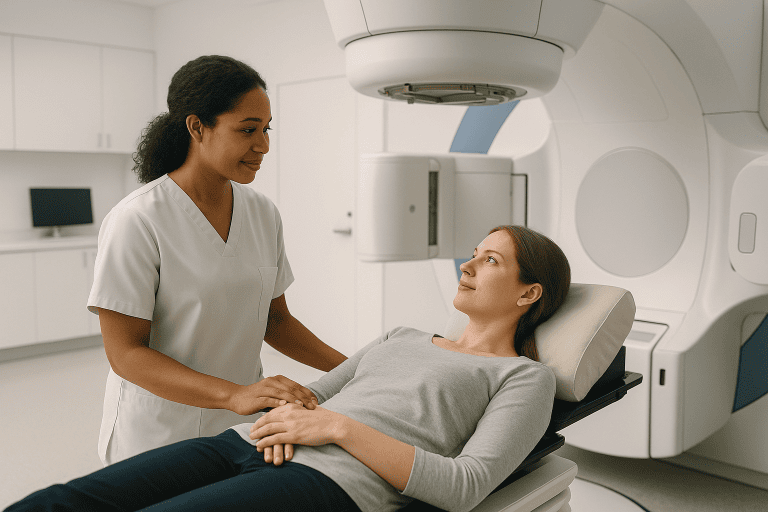
- Radiation therapy. High-energy beams are used to destroy cancer cells. Radiation may be the main treatment for patients who cannot have surgery, or it may be given after surgery when there is a higher risk that cancer cells remain.
- Systemic therapy. When squamous cell carcinoma has spread or cannot be removed, medicines that travel through the whole body may be used. These include chemotherapy (drugs that kill rapidly dividing cells), targeted therapy (drugs aimed at specific features of cancer cells), and immunotherapy (drugs that help the immune system recognize and attack cancer cells). Immunotherapy has become an important option for some advanced skin squamous cell carcinomas. Systemic treatment is typically planned and supervised by a medical oncologist, such as the physicians in a Medical Oncology Department.
Watchful waiting, monitoring without immediate treatment, is generally not appropriate for confirmed invasive squamous cell carcinoma, because the tumor can continue to grow and may spread. However, in very frail patients or in specific low-risk situations, a doctor may discuss the balance between the risks of treatment and the expected behavior of the tumor before deciding how to proceed.
For squamous cell carcinomas of internal organs, such as the head and neck, esophagus, or lung, treatment usually involves some combination of surgery, radiation, and systemic therapy, decided by a multidisciplinary team. At hospitals within the Acibadem group, this coordination typically involves dermatology, surgery, radiation oncology, and medical oncology working together, which reflects standard international practice for this disease.
Living with squamous cell carcinoma and outlook
The outlook for squamous cell carcinoma varies widely. Many skin squamous cell carcinomas are found early, are removed completely, and do not return. In general, small, thin tumors on sun-exposed skin in people with healthy immune systems have a very favorable outlook. Tumors that are large, deep, located on the ear or lip, growing along nerves, or occurring in people with weakened immune systems carry a higher risk of recurrence and spread, and cancers of internal organs often require longer and more intensive treatment.
After treatment, regular follow-up is important. People who have had one squamous cell carcinoma have a higher chance of developing another skin cancer in the future, so doctors usually recommend periodic full-skin examinations for several years, along with self-checks at home. Follow-up visits also allow the doctor to examine the treated area and the nearby lymph nodes for any sign of recurrence.
Practical steps that many doctors recommend after diagnosis include protecting the skin from the sun with clothing, shade, and broad-spectrum sunscreen; avoiding tanning beds; stopping tobacco use; limiting alcohol; and reporting any new or changing skin lesion promptly. A cancer diagnosis can also be emotionally difficult, and it is reasonable to ask the care team about counseling or support services. No doctor can guarantee a particular outcome, but early detection and complete treatment give the best chance of a good result in most cases.
Frequently asked questions
What is squamous cell carcinoma in simple terms?
Squamous cell carcinoma is a cancer that starts in squamous cells, the flat cells that make up the outer layer of the skin and the lining of areas such as the mouth, throat, and lungs. On the skin, it often looks like a rough, scaly bump or a sore that does not heal. It is one of the most common cancers worldwide, and most skin cases are linked to long-term sun exposure.
How serious is squamous cell carcinoma?
Seriousness depends on the tumor’s size, depth, location, and whether it has spread. Many skin squamous cell carcinomas are found early and can be removed completely with a minor procedure. However, this cancer can grow into deeper tissue and, in a minority of cases, spread to lymph nodes or distant organs, which makes it more difficult to treat. This is why doctors advise prompt evaluation rather than waiting to see if a lesion goes away on its own.
Can squamous cell carcinoma be cured?
In many cases, yes, particularly when the cancer is on the skin and is caught early. Complete surgical removal often eliminates the tumor, and long-term outcomes are frequently very good. Cancers that are advanced, have spread, or involve internal organs are harder to cure, though treatments such as surgery, radiation, chemotherapy, and immunotherapy can still control the disease in many situations. Your doctor can explain what is realistic in your individual case.
What does squamous cell carcinoma look like when it starts?
Early squamous cell carcinoma of the skin often appears as a rough, scaly, red or pink patch or a firm bump, usually on sun-exposed skin such as the face, ears, lips, scalp, or hands. It may crust, bleed easily, or form a sore that does not heal within a few weeks. Because early lesions can resemble harmless skin conditions like eczema, any persistent or changing spot should be examined by a doctor rather than self-diagnosed.
How fast does squamous cell carcinoma grow or spread?
Growth rates vary. Some tumors enlarge slowly over months, while others, particularly in people with weakened immune systems or in certain locations, can grow more quickly. Most skin squamous cell carcinomas remain local for a long time, but the risk of spread increases as a tumor becomes larger and deeper. Because there is no reliable way to predict how a specific lesion will behave, early evaluation and treatment are generally recommended.
How is squamous cell carcinoma diagnosed?
Diagnosis is confirmed with a biopsy, in which a small sample of the suspicious tissue is removed under local numbing medicine and examined under a microscope. For skin lesions, this is usually a quick office procedure. If the tumor is large, deep, or high risk, doctors may add imaging tests such as ultrasound, CT, or MRI to check whether it has spread to lymph nodes or other tissues before planning treatment.
What is recovery like after squamous cell carcinoma treatment?
Recovery depends on the treatment. After minor skin surgery, most people heal within a few weeks, often with only a small scar, and can return to normal activities quickly. Larger surgeries, radiation therapy, or systemic treatments involve longer recovery and possible side effects, which the care team will explain in advance. After any treatment, regular skin checks and follow-up visits are important because new skin cancers can develop over time.
When to see a doctor
Make an appointment with a doctor if you notice a new or changing skin lesion, especially a rough, scaly patch, a firm bump, or a sore that has not healed within about four weeks. It is always safer to have a suspicious spot examined than to wait.
Seek medical attention promptly if you notice any of the following warning signs:
- A sore or ulcer that does not heal within a few weeks, or one that heals and keeps coming back
- A skin lesion that is growing, bleeding, or becoming painful
- A rough or crusted patch on the lip that persists or bleeds
- A new firm lump under the skin of the neck, armpit, or groin, which could be an enlarged lymph node
- A persistent white or red patch, sore, or lump inside the mouth
- Numbness, tingling, or persistent pain around a skin lesion or scar
- Difficulty swallowing, a lasting change in your voice, a persistent cough, or coughing up blood, which need urgent evaluation regardless of the cause
These signs do not necessarily mean cancer is present, but they should always be assessed by a qualified medical professional. If you have already been treated for squamous cell carcinoma, contact your care team about any new lesion, any change at the treated site, or any new lump, rather than waiting for your next scheduled follow-up visit.
Medically reviewed by the Acıbadem International Medical Board September 2, 2026
See our medical review board →
Update history
- PublishedJune 14, 2026
- Medical review approvedSeptember 2, 2026
- Last content updateSeptember 2, 2026