Back Brace for Pars Defect: An Evidence-Based Patient Guide
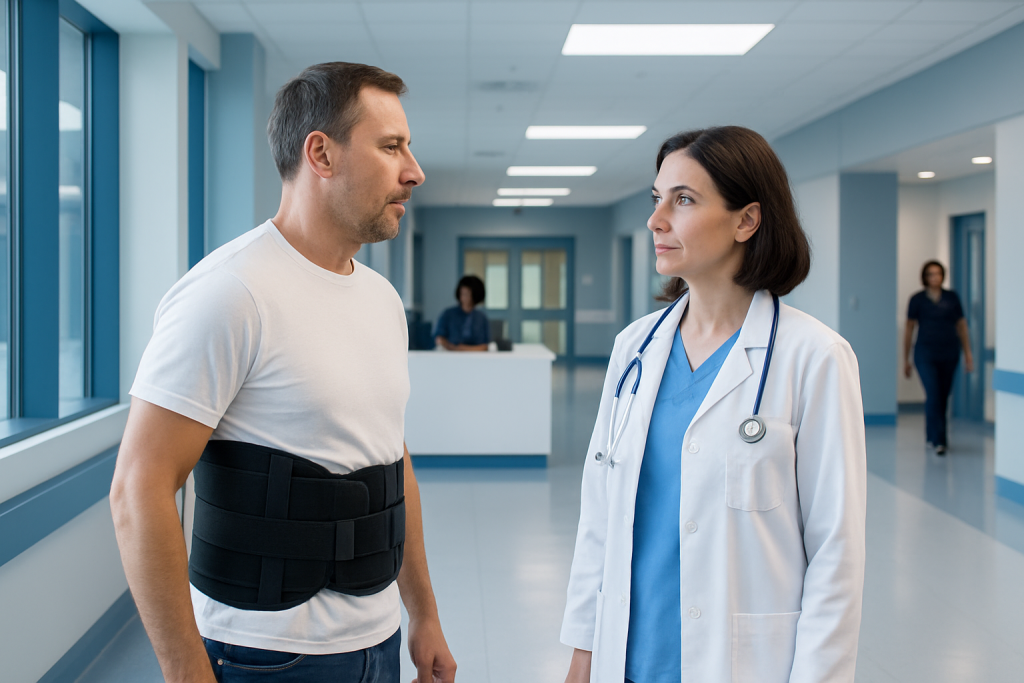
A pars defect is a stress injury or break in a small bridge of bone at the back of a vertebra, most often at L5. Bracing can be used as one part of non-surgical care, alongside activity changes and guided rehabilitation.
Key Takeaways
- A pars defect is a stress injury or break in a small bridge of bone at the back of a vertebra, most often at L5.
- Bracing can be used as one part of non-surgical care, alongside activity changes and guided rehabilitation.
- A brace may relieve symptoms but does not guarantee bone healing or prevent all vertebral slip.
- Most people improve without surgery, although persistent pain, nerve symptoms, or progressive slip require specialist review.
- The correct brace type, duration, and return-to-sport plan should be determined by a spine clinician.
A back brace for pars defect may help selected people control pain by limiting stressful lower-back extension and rotation during an early recovery period. Evidence does not show that bracing is essential for every pars defect, so the decision should be individualized after a clinical assessment and imaging review.
Overview: can a back brace help a pars defect?
A back brace for pars defect can be helpful when pain is triggered by activities that repeatedly arch, twist, or load the lower back. By reducing these movements for a limited time, a brace may make daily activity more comfortable while the person follows a structured plan of relative rest and rehabilitation. It is not a stand-alone cure, and it is not routinely necessary for every patient.
A pars defect, also called spondylolysis, affects the pars interarticularis: a narrow section of bone connecting structures at the back of a spinal vertebra. It commonly occurs in the lower lumbar spine, especially the L5 vertebra. Some defects are recent stress injuries that may heal, while others are longstanding and may be found incidentally on imaging.
If the defect allows one vertebra to move forward relative to the one below it, the condition is called spondylolisthesis. Care is based on symptoms, the person’s age and activity demands, neurological findings, and whether imaging shows a stable or progressing slip. A clinician may also evaluate related lower-back conditions, including spondylolisthesis.
How a back brace works and what evidence shows

Braces used for a pars defect are usually firm lumbosacral supports or thoracolumbosacral orthoses. They aim to reduce lumbar extension, or backward bending, and sometimes rotation. These motions can increase stress across the pars region, particularly in sports involving repetitive arching, such as gymnastics, diving, cricket fast bowling, and some forms of dance.
Bracing is typically considered a symptom-management and motion-control tool rather than a method that reliably repairs bone. Reviews of the medical literature, including searches such as “back brace PubMed,” suggest that outcomes depend on several factors: whether the injury is early, the severity of symptoms, adherence to activity modification, rehabilitation quality, and individual skeletal maturity. Research has not established that every person with a pars defect benefits from routine bracing.
A brace should be fitted and monitored by a qualified clinician or orthotist. Wearing an unsuitable device, wearing it for longer than advised, or relying on it while returning too quickly to painful activity can delay functional recovery. The goal is normally to use the least restrictive support for the shortest appropriate period while rebuilding trunk, hip, and movement control.
Who may be a candidate for bracing?

Bracing may be considered for a child, teenager, or adult with a painful pars stress injury, especially when pain persists despite early activity modification. It may also be used for a short period when movements such as standing, walking, or changing position remain difficult. Young athletes with an early lesion may be more likely than adults with a longstanding defect to be considered for a structured period of protection.
Not everyone needs a back brace. A person with no pain, a chronic stable defect, or rapidly improving symptoms may be managed with education, targeted physiotherapy, and a gradual return to activity. The decision should take account of pain intensity, physical examination findings, imaging results, sport or work demands, and the ability to follow a rehabilitation plan.
Bracing for a pars defect is different from a back brace for Parkinson’s disease, which may be discussed for posture or balance-related concerns in some circumstances. A brace should never be selected simply from a generic online back brace PDF or product guide. The underlying diagnosis and the treatment objective must guide the choice.
Assessment and step-by-step non-surgical care
A clinician will first ask about the location and pattern of pain, previous injuries, sports, work activities, and any symptoms in the legs. The examination may assess posture, spinal movement, hamstring and hip flexibility, abdominal and back muscle control, walking, reflexes, sensation, and strength. X-rays can identify a vertebral slip, while MRI can help assess a stress reaction, nerves, discs, and other soft tissues. CT may be used when a detailed view of bone is needed.
Non-surgical care generally follows a staged process. First, the person reduces or stops activities that provoke pain, particularly repeated hyperextension, impact, and loaded twisting. If prescribed, the brace is fitted and worn according to the clinician’s instructions. Pain-relief medicines may be considered when appropriate for the individual, but medication choices should be discussed with a doctor or pharmacist.
Next, physiotherapy focuses on comfortable movement, trunk stabilization, hip strength, flexibility where needed, and safe movement patterns. As symptoms settle, exercises progress toward functional tasks, work demands, or sport-specific drills. Physical therapy is often central to recovery because it helps restore confidence and capacity rather than simply restricting movement.
Follow-up appointments assess pain, function, neurological status, and readiness to increase activity. Repeat imaging is not always required if symptoms are improving, but it may be useful when clinical progress is unclear, a high-risk athlete is returning to sport, or a clinician suspects progression.
Recovery timeline, benefits, and possible drawbacks
Recovery times vary considerably. Symptoms may begin improving over several weeks with consistent activity modification and rehabilitation, while a return to full sport or physically demanding work often takes longer. A clinician should base progression on pain-free movement, strength, control, and function rather than on a fixed calendar date alone.
The potential benefit of a back brace is reduced pain during everyday movement and a clearer period of protection from aggravating spinal positions. This may allow the person to participate more comfortably in rehabilitation. However, bracing cannot guarantee that a pars defect will heal, and a person may remain pain-free despite imaging that still shows a chronic defect.
Possible drawbacks include skin irritation, heat discomfort, a feeling of stiffness, reduced confidence without the brace, and weakening or deconditioning if it replaces rehabilitation or is used unnecessarily for long periods. The brace should be removed and adjusted only as instructed. New pressure sores, worsening pain, numbness, weakness, or problems with bladder or bowel control require prompt medical assessment.
Is an L5 pars defect serious?
An L5 pars defect can be clinically important, but it is not automatically dangerous. L5 is the most common location because it experiences substantial mechanical stress. Many people have mild symptoms or none at all, while others develop activity-related lower-back pain that needs treatment.
The main concern is whether the defect is painful, recent, associated with a vertebral slip, or causing nerve irritation. A low-grade, stable spondylolisthesis often responds well to non-surgical care. More urgent evaluation is needed if there is increasing leg pain, numbness, weakness, changes in walking, or bowel or bladder symptoms.
Regular review helps identify the relatively uncommon situations in which the slip progresses or symptoms fail to settle. Clear guidance on activities, rehabilitation, and follow-up can help people remain active safely.
Should you wear a back brace with spondylolisthesis?
A back brace with spondylolisthesis may be recommended when there is painful movement, a recent flare, or difficulty remaining active during early rehabilitation. It is more commonly used as a temporary measure than as long-term treatment. The decision depends on the degree and stability of the slip, symptoms, age, and findings on examination and imaging.
For many people, the most important long-term treatments are activity pacing, trunk and hip strengthening, flexibility work where appropriate, and gradual return to daily activity. A brace may support these measures, but it does not replace them. People should avoid self-prescribing a rigid brace without an assessment, particularly if leg symptoms are present.
If pain remains significant despite well-supervised conservative care, a spine specialist may discuss other options. These can include targeted pain-management approaches or, for carefully selected patients with persistent symptoms or instability, spinal fusion surgery.
What not to do with pars defects?
During the painful phase, people should avoid repeatedly forcing the lower back into extension, especially when combined with twisting or impact. Examples may include back walkovers, forceful overhead lifting with a pronounced back arch, heavy lifting with poor technique, and continuing a sport or exercise that reliably causes pain. Complete bed rest is generally not needed and can lead to stiffness and loss of conditioning.
It is also best not to ignore persistent pain in a young athlete, use a brace to continue painful training, or return to unrestricted activity before movement and strength have recovered. Sudden changes in training volume, poor recovery, and inadequate core and hip conditioning can all contribute to recurring symptoms.
Low-impact activity that does not worsen pain may be appropriate, but the right choices are individual. A physiotherapist or spine clinician can advise on modified exercise, lifting technique, and a gradual progression back to sport or work.
How to fix pars defect with spondylolisthesis
“Fixing” a pars defect with spondylolisthesis does not always mean surgery. The first approach is usually non-surgical: reducing painful loading, treating symptoms, restoring trunk and hip function, and returning to activity gradually. Bracing may be included for selected patients, particularly during a limited period of pain control and movement protection.
When symptoms persist despite an adequate course of conservative treatment, or when there is progressive slip, significant nerve compression, or functional limitation, a spine surgeon can review surgical options. Depending on the anatomy and condition of nearby discs, options may include repair of the pars in selected younger patients or stabilization and decompression procedures such as fusion. The appropriate operation is highly individual and should follow careful imaging and specialist assessment.
Acibadem International’s multidisciplinary spine specialists in JCI-accredited hospitals assess pars defects and spondylolisthesis for international patients, coordinating imaging, rehabilitation, and surgical opinions when needed.
When to seek medical care
Medical assessment is appropriate for lower-back pain lasting more than a few weeks, pain that repeatedly returns with sport or work, or pain that prevents normal activity. Children and teenagers with ongoing extension-related back pain should be evaluated rather than encouraged to train through it, as early assessment may help guide safe activity changes.
Urgent medical care is needed for severe or worsening leg weakness, numbness around the groin or saddle area, new loss of bladder or bowel control, fever with severe back pain, unexplained weight loss, or back pain after significant trauma. These symptoms can have causes other than a pars defect and require timely assessment.
A clinician can also help when a brace is causing skin problems, pain is worsening despite treatment, or there is uncertainty about returning to sport. Individualized follow-up is the safest way to balance recovery with a return to valued activities.
Frequently asked questions
How long should a back brace be worn for a pars defect?
The duration varies and should be set by the treating clinician. Some people use a brace for a limited period during painful activity, while others may not need one at all. Progress is usually based on pain, function, examination findings, and rehabilitation goals rather than a standard schedule.
Can a pars defect heal with a brace?
A brace may reduce painful movement and support an early recovery plan, but it cannot guarantee bone healing. Early stress injuries in younger people may have greater healing potential than longstanding defects. Activity modification and guided rehabilitation remain important whether or not a brace is used.
Can I exercise while wearing a back brace for pars defect?
Some gentle exercises may be recommended while using a brace, especially those that do not increase pain or force the spine into extension. The exercise plan should be individualized by a clinician or physiotherapist. Continuing painful training or using the brace to push through symptoms is not recommended.
Does every pars defect lead to spondylolisthesis?
No. Many pars defects remain stable and never lead to meaningful vertebral slip. A clinician can assess for spondylolisthesis with examination and imaging when appropriate, particularly if symptoms persist or change.
What type of brace is used for a pars defect?
A clinician may prescribe a lumbosacral brace or a more rigid thoracolumbosacral orthosis, depending on the condition and treatment goal. The device should be professionally fitted. A generic brace may not limit the movements that are relevant to an individual’s symptoms.
When is surgery considered for pars defect and spondylolisthesis?
Surgery is usually considered only after a well-supervised course of non-surgical treatment has not controlled persistent, function-limiting symptoms. It may also be discussed for progressive slip or significant neurological problems. A spine surgeon determines suitability after reviewing symptoms, examination findings, and imaging.
References
- American Academy of Orthopaedic Surgeons
- North American Spine Society
- American Academy of Pediatrics
- National Institute of Arthritis and Musculoskeletal and Skin Diseases
- Radiological Society of North America
This article is for general information only and is not a substitute for professional medical advice. Please consult a qualified doctor about your individual situation.
Explore treatments in Turkey — costs, top hospitals & a free quote
JCI-accredited · board-certified surgeons · reply within 24h
Add us as a Preferred Source to see more of our trusted health content across Google Search, AI Overviews and Discover.