Basal Cell Carcinoma: Symptoms, Causes, and Treatment

Basal cell carcinoma often appears as a new bump, sore, or patch that does not heal. Long-term ultraviolet exposure from sunlight or tanning beds is the main risk factor.
Key Takeaways
- Basal cell carcinoma often appears as a new bump, sore, or patch that does not heal.
- Long-term ultraviolet exposure from sunlight or tanning beds is the main risk factor.
- Diagnosis is usually made with a skin examination and biopsy.
- Treatment depends on the size, depth, and location of the cancer.
- Early evaluation helps prevent local tissue damage and improves cosmetic outcomes.
Basal cell carcinoma is the most common type of skin cancer. It usually develops on sun-exposed skin, grows slowly, and is often highly treatable when diagnosed early.
Overview
Basal cell carcinoma is a cancer that begins in the basal cells, which are found in the lowest part of the outer skin layer. It is the most common form of skin cancer. This cancer usually grows slowly and is less likely than some other skin cancers to spread to distant parts of the body, but it can still damage nearby skin, nerves, cartilage, or bone if it is not treated.
Most basal cell carcinomas develop on areas that receive frequent sun exposure, such as the face, scalp, ears, neck, shoulders, and arms. However, they can also appear on other parts of the body. Because the changes may seem subtle at first, many people mistake them for a harmless sore, scar, or pimple.
Early recognition matters. When basal cell carcinoma is found and treated promptly, treatment is often simpler and outcomes are usually very good. A dermatologist or other qualified doctor can assess any suspicious skin change and decide whether further testing is needed.
Symptoms
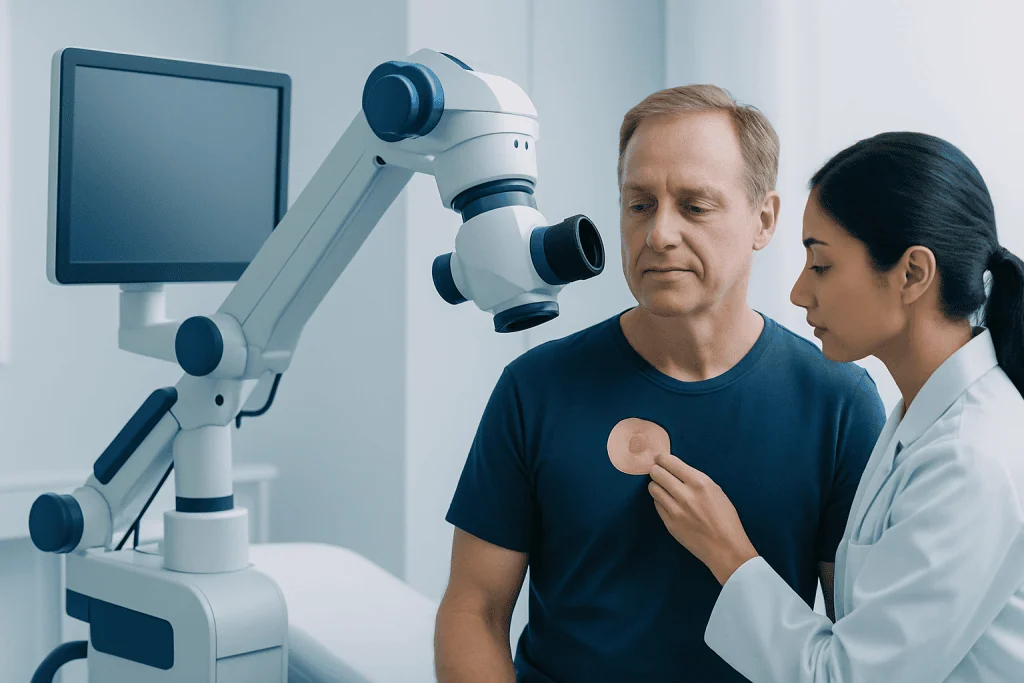
Basal cell carcinoma can look different from person to person. A common sign is a shiny or pearly bump that may be skin-colored, pink, red, or slightly translucent. Tiny blood vessels may be visible on the surface. In some people, the area may darken, especially in darker skin tones.
It may also appear as a flat, scaly patch, a waxy scar-like area, or a sore that bleeds, crusts, and then seems to heal before returning. Some lesions itch, feel tender, or become irritated, while others cause no discomfort at all. A spot that keeps changing or does not fully heal deserves medical attention.
Common features of basal cell carcinoma symptoms include:
- A new bump or patch that grows slowly
- A sore that does not heal within several weeks
- Repeated bleeding, crusting, or oozing
- A shiny, raised edge around a central dip or ulcer
- A scar-like area without a clear cause
Because these changes can resemble eczema, psoriasis, acne, or benign growths, self-diagnosis is not reliable. Any persistent or unusual skin lesion should be evaluated by a healthcare professional.
Causes and Risk Factors
The main cause of basal cell carcinoma is damage to skin cells from ultraviolet, or UV, radiation. This damage usually builds up over time from sunlight, but indoor tanning devices can also contribute. UV exposure can alter the DNA of skin cells, allowing abnormal growth to develop.
Several factors increase the risk. People with fair skin, light-colored eyes, blond or red hair, or skin that burns easily tend to be more vulnerable, but basal cell carcinoma can occur in any skin tone. Risk also rises with increasing age, although younger adults can develop it too, especially after intense sun exposure or tanning bed use.
Other risk factors include:
- A personal or family history of skin cancer
- Frequent outdoor work or hobbies without sun protection
- Living in sunny or high-altitude climates
- Weakened immune function
- Previous radiation therapy to the skin
- Exposure to certain environmental substances such as arsenic
- Rare inherited syndromes that increase skin cancer risk
Having one or more risk factors does not mean a person will definitely develop cancer, but it does make regular skin checks more important. People who have had one basal cell carcinoma are also more likely to develop another in the future.
Diagnosis
Diagnosis usually starts with a clinical skin examination. The doctor asks about when the lesion appeared, whether it has changed, and whether it bleeds, crusts, or causes symptoms. The skin is then examined closely, sometimes using a dermatoscope, a handheld device that helps reveal structures not easily seen by the naked eye.
If the lesion looks suspicious, a biopsy is typically needed to confirm the diagnosis. During a biopsy, the doctor removes all or part of the abnormal area and sends it to a laboratory for examination under a microscope. This is the most reliable way to determine whether the lesion is basal cell carcinoma and what subtype it is.
Once confirmed, the doctor considers the size, depth, exact location, borders, and whether it is a first-time or recurrent tumor. These details help guide treatment planning. In advanced or unusual cases, additional imaging may be considered to assess involvement of deeper tissues, though this is not necessary for most people.
Treatment Options
Basal cell carcinoma treatment depends on the tumor’s size, subtype, depth, and location, as well as the patient’s overall health and preferences. The goal is to remove or destroy the cancer completely while preserving as much healthy tissue as possible. For most people, treatment is highly effective.
Surgery is a common approach. Standard excision removes the cancer along with a margin of normal-looking skin. For tumors on cosmetically or functionally important areas such as the face, Mohs micrographic surgery may be recommended because it checks tissue layer by layer and helps spare healthy skin. Some small, superficial lesions may be treated with curettage and electrodesiccation, cryotherapy, or selected topical medicines.
Non-surgical options can be appropriate in certain situations. These may include topical therapy for superficial tumors, light-based treatment in selected cases, or radiation therapy when surgery is not the best option. Advanced, recurrent, or locally invasive disease may require multidisciplinary care, and some patients may need systemic cancer treatment if the disease cannot be managed with local therapies alone.
Follow-up is an important part of care. Even after successful treatment, regular skin examinations help detect recurrence or new skin cancers early. In complex cases, a team approach that may include dermatology, pathology, surgery, and oncology can support the best treatment plan. Acibadem International’s multidisciplinary specialists and JCI-accredited hospitals diagnose and treat basal cell carcinoma for international patients when coordinated care is needed.
Prevention and Self-care
While not every case can be prevented, lowering UV exposure is the best way to reduce risk. Daily sun protection helps protect the skin from cumulative damage over time. This is especially important for children, outdoor workers, and anyone with a history of skin cancer.
Helpful prevention habits include:
- Using a broad-spectrum sunscreen with appropriate SPF and reapplying as directed
- Wearing wide-brimmed hats, sunglasses, and protective clothing
- Seeking shade during the strongest midday sun
- Avoiding indoor tanning beds
- Protecting the scalp, ears, lips, neck, and backs of the hands
Regular self-checks can also help. People can examine their skin from head to toe once a month, using a mirror for hard-to-see areas. Looking for new lesions, non-healing sores, or changing spots is useful, especially for those who have already had skin cancer.
General skin health habits support early detection. It can help to take photos of a spot over time, note any changes, and bring these observations to a doctor. If there is uncertainty about a lesion, it is safer to ask for a professional opinion than to wait and see.
When to See a Doctor
A doctor should assess any skin lesion that does not heal, keeps returning, or changes in size, shape, color, or texture. A spot that repeatedly bleeds, crusts, or develops a central ulcer also needs attention. These signs do not always mean cancer, but they should not be ignored.
People with a personal history of skin cancer, significant past sun exposure, or a weakened immune system should be especially alert to new or changing lesions. Routine dermatology follow-up may be recommended in these groups, even when no new symptoms are present.
Prompt evaluation is also important for lesions near the eyes, nose, lips, or ears, where even a small tumor can affect appearance or function if it grows. In some cases, basal cell carcinoma can resemble other skin conditions such as melanoma or squamous cell carcinoma, so a professional diagnosis is essential.
Seeking care early is reassuring and practical. Many suspicious spots turn out to be non-cancerous, and if basal cell carcinoma is present, early treatment is usually simpler and more effective.
Frequently asked questions
Is basal cell carcinoma a serious cancer?
Basal cell carcinoma is a form of skin cancer, so it should always be taken seriously. However, it usually grows slowly and is often highly treatable, especially when found early. The main concern is local tissue damage if treatment is delayed.
What does basal cell carcinoma usually look like?
It may look like a shiny bump, a pink or red patch, a sore that does not heal, or a scar-like area. Some lesions bleed or crust repeatedly. Because appearances vary, a doctor should check any persistent or changing spot.
Can basal cell carcinoma spread?
It rarely spreads to distant organs, which is one reason outcomes are often very good. Still, it can grow into nearby skin and deeper tissues if left untreated. Early care helps prevent this type of local damage.
How is basal cell carcinoma confirmed?
A doctor usually confirms it with a biopsy. This means removing all or part of the suspicious skin lesion and examining it under a microscope. A biopsy helps identify the exact type of skin cancer and guide treatment.
What is the best treatment for basal cell carcinoma?
The best treatment depends on where the cancer is, how large it is, and whether it has returned after earlier treatment. Surgery is common, and Mohs surgery may be preferred for certain areas such as the face. Some superficial cases can be treated with topical or other non-surgical methods.
Can basal cell carcinoma come back after treatment?
Yes, it can return, and people who have had one basal cell carcinoma have a higher chance of developing another skin cancer later. That is why regular follow-up and skin checks are important. Ongoing sun protection also lowers future risk.
References
- World Health Organization
- American Academy of Dermatology
- National Cancer Institute
- American Cancer Society
This article is for general information only and is not a substitute for professional medical advice. Please consult a qualified doctor about your individual situation.
Basal Cell Carcinoma in Turkey — costs, top hospitals & a free quote
JCI-accredited · board-certified surgeons · reply within 24h
Add us as a Preferred Source to see more of our trusted health content across Google Search, AI Overviews and Discover.

Medical Oncology Department
Medical treatment of cancer with chemotherapy, immunotherapy and targeted therapies under a multidisciplinary tumor board.
60 specialists in this unitMore from the Health Library



Related Specialists

Dr. Nuri Soysal
Aesthetic Plastic & Reconstructive Surgery
Dr. Ebru Banu Türk
Radiology
Defne Sürek
Physical Medicine & Rehabilitation
Prof. Dr. Muhsin Akbaba
Dermatology