Blood Test or Imaging First? How Doctors Decide

The choice between a blood test and imaging depends on symptoms, physical examination, and suspected cause. Blood tests are often used to look for infection, inflammation, anemia, organ function, and hormone changes.
Key Takeaways
- The choice between a blood test and imaging depends on symptoms, physical examination, and suspected cause.
- Blood tests are often used to look for infection, inflammation, anemia, organ function, and hormone changes.
- Imaging is often chosen first when doctors need to see structure, injury, blockage, bleeding, or a mass.
- Urgency, pregnancy, radiation exposure, and a patient's age or medical history can affect test selection.
- Sometimes both blood tests and imaging are needed because they answer different parts of the same question.
Doctors do not choose blood tests or imaging at random. The first test is usually the one most likely to answer the clinical question safely, quickly, and with the least burden for the patient.
Overview: Why the First Test Matters
When someone has new symptoms, one of the first decisions a doctor makes is whether to start with a blood test, an imaging study, or sometimes neither. This decision is guided by the patient’s story, the physical examination, the likely diagnosis, and how urgently a serious problem needs to be ruled in or ruled out. The aim is not to order more tests, but to choose the test that is most likely to provide useful information first.
Blood tests and imaging look at the body in different ways. Blood tests help show how the body is functioning internally, such as whether there is infection, inflammation, anemia, kidney or liver strain, or changes in hormones and electrolytes. Imaging, such as X-ray, ultrasound, CT, or MRI, helps doctors see body structures, including bones, organs, blood vessels, and soft tissues.
In many situations, the decision is straightforward. A suspected fracture usually needs imaging first, while symptoms suggesting thyroid imbalance may begin with blood work. In other cases, the best path depends on subtle clues, such as how long symptoms have been present, whether there is fever, whether pain is sudden or gradual, and whether the person has risk factors like pregnancy, cancer history, or chronic disease.
How Doctors Choose Between Blood Tests and Imaging
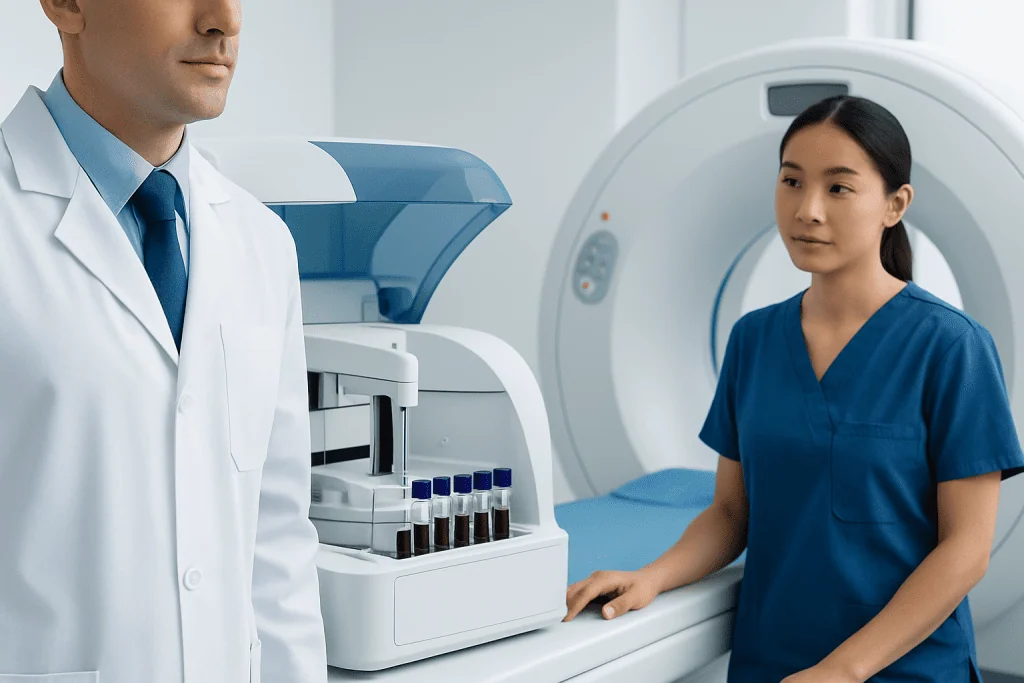
Doctors usually begin with a clinical question: what are they trying to confirm or exclude? If the concern is about function, chemistry, infection, or inflammation, blood tests often come first. If the concern is about anatomy, injury, blockage, bleeding, or a visible structural change, imaging may be the better first step. This approach helps avoid unnecessary testing and makes diagnosis more efficient.
Several practical factors also shape the decision. These include how quickly results are needed, whether the test involves radiation, whether contrast dye may affect the kidneys or trigger allergy, and whether the patient can safely undergo the test. For example, ultrasound may be preferred in pregnancy because it does not use ionizing radiation, while CT may be favored in emergencies because it is fast and widely available.
The patient’s age and overall medical picture also matter. In children, doctors often try to minimize radiation exposure and may start with ultrasound or observation when safe. In older adults, doctors may be more alert to hidden infection, bleeding, heart strain, or malignancy, which can influence whether blood work, imaging, or both are needed early.
- Blood tests are often first for fever, fatigue, unexplained weight change, or suspected metabolic problems.
- Imaging is often first for trauma, suspected fracture, sudden severe headache with warning signs, or abdominal conditions where organ structure matters.
- Combined testing is common when symptoms are complex or potentially urgent.
When Blood Tests Usually Come First

Blood tests are often the first step when symptoms suggest a problem that affects the body’s chemistry or immune response rather than a clearly visible structure. Examples include fatigue, paleness, ongoing fever, dehydration, suspected infection, abnormal bruising, jaundice, and symptoms of hormone imbalance. A blood sample can quickly provide clues about anemia, inflammation, blood sugar, thyroid function, clotting, liver health, kidney function, and more.
They are also useful when symptoms are broad or non-specific. Someone with weakness, dizziness, or loss of appetite may have many possible causes, and blood work can help narrow the list before imaging is considered. In emergency settings, blood tests can support urgent decisions by showing signs of heart damage, severe infection, internal blood loss, or major electrolyte disturbance.
Even when imaging is likely to be needed later, blood tests may still be done first to guide the next step. For example, kidney function may be checked before a scan that uses contrast material, and infection markers may help determine whether symptoms are more likely due to inflammation, bacterial infection, or another cause. Blood tests rarely tell the whole story on their own, but they often provide a fast and useful starting point.
When Imaging Usually Comes First
Imaging is commonly the first test when doctors need to look directly at body structures. This is often the case after injury, when fracture, dislocation, internal bleeding, or organ damage must be assessed quickly. It may also be the first step when symptoms point strongly to a structural problem, such as a lump, a suspected gallstone, kidney stone, appendicitis, or a blocked blood vessel.
The type of imaging depends on the body part and the question being asked. X-rays are often used for bones and the chest. Ultrasound is frequently chosen for the abdomen, pelvis, blood flow, pregnancy, and some soft tissue concerns. CT scans are helpful when speed and detail are important, especially in emergencies. MRI is often used for the brain, spine, joints, and soft tissues when greater detail is needed and time is less critical.
Imaging may also come first when symptoms are highly localized. Severe one-sided abdominal pain, a new breast lump, or sudden shortness of breath with chest pain may require looking directly at the area of concern. In these situations, a scan can answer questions that blood work alone cannot, such as whether there is a blockage, fluid collection, tear, or mass.
Common Symptom Scenarios and the Likely First Step
Different symptoms tend to lead toward different first tests, although there are exceptions. Chest pain may require both blood tests and imaging depending on the suspected cause. If a heart problem is a concern, doctors may order blood markers along with an ECG and sometimes chest imaging. If lung disease, blood clot, or aortic disease is suspected, imaging becomes especially important.
Abdominal pain is another common example. Diffuse discomfort, vomiting, and dehydration may start with blood tests to check infection, inflammation, and organ function. But pain focused in the right lower abdomen, right upper abdomen, or flank may lead quickly to ultrasound or CT because doctors may need to assess the appendix, gallbladder, kidneys, or bowel.
Headache, shortness of breath, back pain, and joint pain each follow similar reasoning. Many headaches do not need imaging, but sudden severe headache, neurological symptoms, or head injury may change that. Back pain often does not need immediate scans unless there are red flags such as weakness, fever, cancer history, or bowel and bladder changes. Shortness of breath may call for blood work, pulse oximetry, and chest imaging together because the cause can involve the lungs, heart, blood, or infection.
- Fever without a clear source often starts with blood tests and sometimes urine tests.
- Trauma usually starts with imaging of the injured area.
- Suspected blood clot, internal bleeding, or stroke symptoms often require urgent imaging.
- Generalized fatigue commonly starts with blood work before imaging is considered.
Why Both Tests Are Often Needed
Blood tests and imaging are not competitors; they are complementary tools. One shows how the body is functioning, while the other shows what the body looks like internally. Many conditions cannot be fully understood with only one type of test. For example, a patient may have signs of infection on blood work, but imaging may be needed to find where the infection is located, such as in the lungs, gallbladder, kidneys, or abdomen.
Likewise, imaging may show a structural change that still needs blood tests for context. A scan might reveal liver enlargement, a thyroid nodule, or swollen lymph nodes, but blood work can help doctors understand whether inflammation, hormone imbalance, or another systemic process is involved. This combination often helps avoid misdiagnosis and supports a more tailored treatment plan.
Doctors may also use one test to decide whether another is necessary. A normal examination and reassuring blood work may make imaging unnecessary in some cases. In other situations, abnormal blood tests can help prioritize urgent scanning. The sequence is part of a stepwise process designed to answer the most important question first while keeping the patient safe.
Safety, Accuracy, and Patient Factors
Choosing the first test is also about safety. Blood tests are generally low risk, though they can cause brief discomfort or bruising. Imaging varies more. X-rays and CT scans use ionizing radiation, so doctors consider whether the expected benefit outweighs that exposure. MRI does not use radiation, but it may not be suitable for every patient, such as some people with certain implanted devices or severe claustrophobia.
Contrast agents used in some CT or MRI studies may be very helpful, but they are not appropriate for everyone. Doctors may review kidney function, allergy history, and current medications before using contrast. Ultrasound is often a reassuring option because it is noninvasive and radiation-free, though it may not answer every question depending on the body area and image quality.
Another important factor is test accuracy in the right setting. The best test is not just the most advanced one; it is the one most likely to be accurate for that specific problem. A simple X-ray may be enough for a suspected broken bone, while an MRI may be much better for ligament injury. A complete blood count may quickly identify infection or anemia, but it cannot diagnose a torn tendon or show the exact location of abdominal inflammation.
What Patients Can Expect and When to Seek Medical Advice
Patients can help the process by giving a clear history of symptoms, including when they began, what makes them better or worse, and whether there are associated symptoms such as fever, weight loss, bleeding, weakness, or shortness of breath. This information often influences whether doctors choose blood work, imaging, or both. Asking why a test is being recommended can also help patients understand the plan and feel more informed.
It is reasonable for patients to ask whether a test is urgent, whether there are alternatives, and whether the results are likely to change treatment. In many cases, a doctor may decide that observation, a physical examination, or repeat assessment is more useful than immediate testing. This does not mean symptoms are being dismissed; it means testing is being matched thoughtfully to the situation.
Medical advice should be sought promptly for severe chest pain, trouble breathing, fainting, stroke-like symptoms, major injury, heavy bleeding, sudden confusion, or severe abdominal pain. Persistent or unexplained symptoms should also be assessed by a qualified clinician. Near the end of a diagnostic pathway, some people may benefit from multidisciplinary evaluation; Acibadem International’s specialists in JCI-accredited hospitals diagnose and treat a wide range of conditions for international patients.
Frequently asked questions
Is a blood test better than imaging?
Neither test is better in every situation. Blood tests and imaging answer different medical questions, so the best first step depends on the symptoms and what the doctor suspects. Many patients need one first and the other only if more detail is needed.
Why would a doctor order blood tests before a scan?
Blood tests can quickly show signs of infection, inflammation, anemia, dehydration, or problems with organs such as the kidneys and liver. They may also help doctors decide which scan is safest and most useful, especially if contrast material is being considered.
Why might imaging be done first even before blood work?
Imaging may come first when a structural problem is suspected, such as a fracture, internal bleeding, gallstones, appendicitis, or a mass. In urgent situations, seeing the problem directly can be the fastest way to guide treatment.
Do all symptoms need tests right away?
No. Some symptoms can be assessed first through medical history, physical examination, and short-term follow-up. Doctors may recommend testing only if there are warning signs, persistent symptoms, or a need to confirm a diagnosis.
Are imaging tests always safe?
Imaging is generally safe, but each type has different considerations. X-rays and CT scans use radiation, while MRI may not suit everyone with certain implants or severe claustrophobia. Doctors weigh benefits and risks before recommending a test.
Can normal blood tests rule out a serious problem?
Not always. Normal blood results can be reassuring, but they do not exclude every structural or early-stage condition. If symptoms are concerning or continue, imaging or further evaluation may still be needed.
This article is for general information only and is not a substitute for professional medical advice. Please consult a qualified doctor about your individual situation.
Explore treatments in Turkey — costs, top hospitals & a free quote
JCI-accredited · board-certified surgeons · reply within 24h
Add us as a Preferred Source to see more of our trusted health content across Google Search, AI Overviews and Discover.

More from the Health Library

Lab Appointment vs Walk-In Testing: Which Option Is Better for Patients?

Diagnostic Medical Ultrasound: How It Works and What It Can Show

Neuroimmunology Testing: MRI, Spinal Fluid, and Antibody Tests Explained

What Happens During a Blood Test Visit?

Brain MRI vs CT for Neurological Symptoms: How Doctors Choose Imaging