Coronary Angiography Before Valve Surgery: Why It May Be Needed

Coronary angiography shows whether the heart’s own arteries have significant narrowing before valve surgery. The test is commonly recommended in older adults, people with chest pain, or those with risk factors for coronary artery disease.
Key Takeaways
- Coronary angiography shows whether the heart’s own arteries have significant narrowing before valve surgery.
- The test is commonly recommended in older adults, people with chest pain, or those with risk factors for coronary artery disease.
- Finding blocked arteries can change the surgical plan, including whether bypass surgery is needed along with valve surgery.
- The procedure is usually brief and is performed with local anesthesia and imaging dye through a catheter.
- Not every patient needs invasive angiography; some may be assessed with noninvasive imaging depending on age, symptoms, and overall risk.
Coronary angiography before valve surgery is often used to look for narrowed or blocked coronary arteries that could affect surgical planning and safety. It helps the care team decide whether valve repair or replacement alone is enough, or whether treatment for coronary artery disease should be done at the same time.
Overview: Why coronary angiography may be part of valve surgery planning
Coronary angiography is a test that uses contrast dye and X-ray imaging to show the inside of the coronary arteries, the blood vessels that supply the heart muscle. Before valve surgery, doctors may recommend this test to see whether these arteries are narrowed or blocked. This is important because coronary artery disease can exist at the same time as a valve problem, especially in older adults or in people with diabetes, high blood pressure, high cholesterol, smoking history, or chest discomfort.
Heart valve surgery is performed to repair or replace a valve that is too narrow, too leaky, or both. Examples include aortic stenosis, aortic regurgitation, and other forms of heart valve disease. If important coronary artery narrowing is present, the surgeon may decide to treat both problems during one operation. This can reduce the chance of future heart-related complications and help avoid a second major procedure later.
The need for coronary angiography is not the same for every patient. The decision usually depends on age, symptoms, medical history, and test results such as echocardiography, electrocardiogram findings, and blood work. In some lower-risk patients, especially younger people without symptoms or risk factors, doctors may use noninvasive imaging instead of invasive angiography.
When doctors are most likely to recommend it
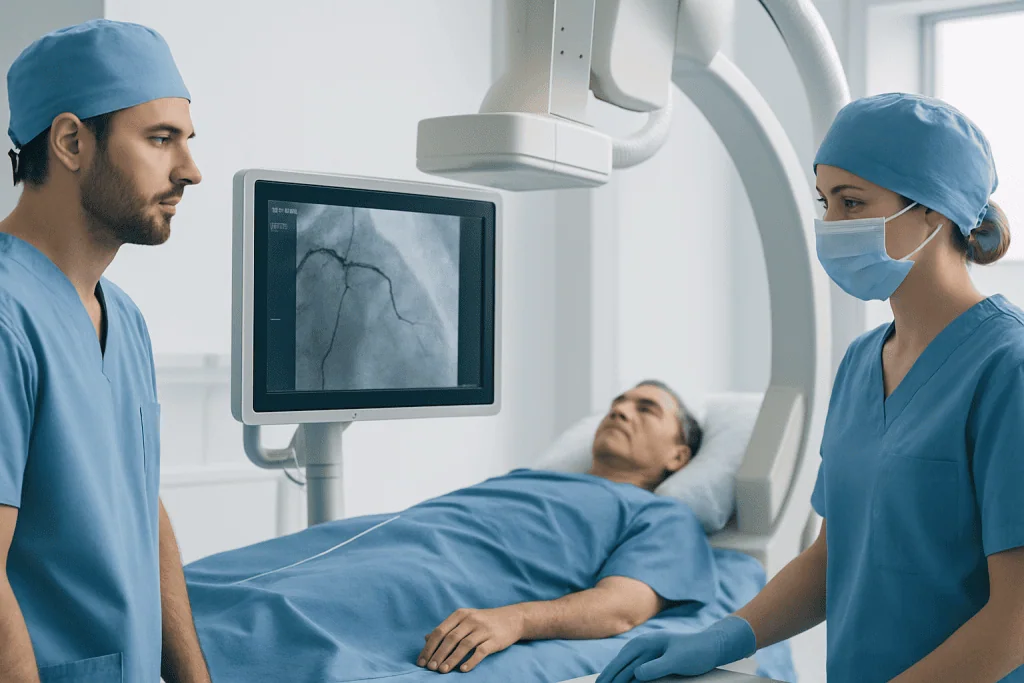
Coronary angiography before valve surgery is most often considered when there is a meaningful chance that a patient also has coronary artery disease. This is more likely in people over a certain age, in those who have chest pain or shortness of breath that could suggest reduced blood flow to the heart, and in those with risk factors such as diabetes, high blood pressure, smoking, kidney disease, or high cholesterol.
It may also be recommended if previous tests suggest possible heart artery disease. For example, abnormal stress test results, a history of heart attack, or reduced heart pumping function may increase the value of seeing the coronary anatomy directly. Patients with calcified aortic valve disease may be evaluated particularly carefully because coronary disease often becomes more common with age.
Doctors also consider the type of valve surgery planned. If a patient is already going to have open-heart surgery, identifying treatable coronary blockages beforehand can be very useful. In selected cases, combining valve surgery with coronary artery bypass surgery may offer a more complete treatment plan than addressing the valve alone.
What the test can reveal and how it affects treatment decisions

The main purpose of coronary angiography in this setting is to find out whether there are any significant blockages in the coronary arteries. If the arteries are clear, the surgeon can proceed with valve surgery alone with greater confidence. If there is mild narrowing, the team may simply note it and continue with the planned valve procedure while managing risk factors with medication and lifestyle changes.
If the test shows more severe narrowing, it can change the treatment plan. Some patients may benefit from combined surgery, where the valve operation is performed together with bypass grafting. In others, the team may discuss whether a catheter-based artery treatment such as stent procedures is appropriate before or after the valve intervention, depending on the type of valve disease, urgency of surgery, and overall health.
Angiography can also help explain symptoms. Shortness of breath, fatigue, or chest pressure may come from the valve problem, blocked arteries, or both. Knowing the exact cause helps the heart team tailor treatment more precisely. In complex cases, cardiologists, cardiac surgeons, anesthesiologists, and imaging specialists often review the findings together to choose the safest route.
- No significant blockage: valve surgery may proceed as planned.
- Moderate disease: treatment may include medications and closer follow-up.
- Severe disease: combined surgery or staged treatment may be considered.
How coronary angiography is performed
Coronary angiography is usually done in a cardiac catheterization laboratory. A doctor inserts a thin tube called a catheter into an artery, often in the wrist or groin, and guides it toward the heart. Contrast dye is then injected so the coronary arteries can be seen on X-ray images. The procedure is commonly performed with local anesthesia and light sedation, so the patient is comfortable but usually awake.
Before the test, the team reviews medications, allergies, kidney function, and bleeding risk. Some medicines may need to be adjusted temporarily, especially blood thinners or drugs related to diabetes. Patients are often asked not to eat or drink for several hours before the procedure, although exact instructions vary by center.
Most people feel little more than pressure at the access site. A brief warm sensation can occur when the contrast dye is injected. Afterward, the catheter is removed and pressure or a closure device is used to reduce bleeding. Many patients go home the same day or after a short observation period, though timing depends on the reason for the test and the patient’s general condition.
Benefits, limitations, and possible risks
The biggest benefit of coronary angiography is clarity. It gives a direct view of the heart arteries and can show whether another important heart problem needs treatment before or during valve surgery. This helps surgeons plan better and may reduce the chance of unexpected findings in the operating room. It can also help avoid under-treating or over-treating a patient.
At the same time, angiography is an invasive procedure, so doctors only recommend it when the expected value is meaningful. Risks are generally low but can include bleeding or bruising at the catheter site, irregular heart rhythm, contrast allergy, kidney strain from the dye, or, more rarely, heart attack, stroke, or artery injury. The care team works to lower these risks by checking kidney function, reviewing allergies, and choosing the safest access route.
There are also limitations. Angiography shows the anatomy of the coronary arteries very well, but it is only one part of preoperative planning. The valve problem itself still requires detailed evaluation with echocardiography and sometimes CT or MRI. In some patients, noninvasive CT coronary angiography may be a suitable alternative, but it is not ideal for everyone, especially if the heart rhythm is irregular, calcification is extensive, or image quality is expected to be limited.
How patients can prepare and what recovery is like
Preparation usually begins with a discussion about medical history, symptoms, and current medications. Patients should tell their doctor about prior reactions to contrast dye, asthma, kidney disease, pregnancy, or any tendency to bleed easily. It is also important to mention over-the-counter products and supplements, because some can affect bleeding or interact with prescribed medicines.
On the day of the test, patients should follow fasting and medication instructions carefully. After the procedure, they are usually advised to drink fluids unless another medical reason prevents it, as this may help the body clear the contrast dye. The access site should be kept clean and observed for swelling, increased pain, or persistent bleeding.
Recovery is often straightforward. Mild soreness or bruising can happen where the catheter was inserted. Many people return to normal light activity within a day or two, though strenuous exercise and heavy lifting may need to wait briefly, especially after groin access. The doctor explains when valve surgery is likely to occur and whether any changes in treatment are needed in the meantime.
Questions to ask the heart team before valve surgery
Patients and families often feel more comfortable when they understand why a test is being recommended. It can help to ask whether coronary angiography is needed because of age, symptoms, risk factors, or findings from earlier tests. Patients may also ask whether a noninvasive alternative is reasonable in their situation and how the results could change the surgical plan.
Other useful questions include whether combined surgery might be needed if a blockage is found, what the expected recovery will be like, and how kidney function or contrast allergy will be managed. If the patient already has a known rhythm problem such as heart rhythm disorders or reduced heart function, it is reasonable to ask how these issues affect overall surgical risk and planning.
For international patients or those seeking care in a specialized center, a coordinated heart team can be especially helpful. Near the end of treatment planning, some patients choose centers with multidisciplinary specialists and JCI-accredited hospitals, such as Acibadem International, where valve disease and coronary disease can be assessed and treated together, including advanced cardiothoracic surgery when appropriate.
Frequently asked questions
Is coronary angiography always required before valve surgery?
No. The need depends on the patient’s age, symptoms, risk factors, and whether there is a significant chance of coronary artery disease. Some patients can be evaluated with noninvasive imaging instead, while others benefit from direct catheter-based angiography.
What happens if a blockage is found during coronary angiography?
If an important coronary blockage is found, the heart team may change the treatment plan. Depending on the location and severity, options can include combined bypass surgery with the valve operation, a staged catheter-based treatment, or medical therapy.
Is coronary angiography painful?
Most people do not describe it as painful, though some discomfort can occur. Local anesthesia is used at the catheter entry site, and patients may feel pressure or a brief warm sensation when contrast dye is injected.
How long does recovery take after coronary angiography?
Recovery is usually short. Many patients go home the same day or after a brief observation period, and light activities often resume within a day or two. The exact timeline depends on the access site, the patient’s health, and whether other procedures were done.
Can valve surgery be done without checking the coronary arteries?
In some low-risk patients, yes. However, when there is a reasonable chance of coronary artery disease, checking the arteries beforehand helps surgeons plan safely and avoid missing a problem that could affect the outcome.
Are there alternatives to invasive coronary angiography?
Yes, in selected patients, CT coronary angiography or other noninvasive tests may be considered. These options are not suitable for everyone, so the doctor chooses the method that is most likely to give reliable information.
References
- American Heart Association
- American College of Cardiology
- European Society of Cardiology
- National Heart, Lung, and Blood Institute
- Society of Thoracic Surgeons
This article is for general information only and is not a substitute for professional medical advice. Please consult a qualified doctor about your individual situation.
Coronary Angiography in Turkey — costs, top hospitals & a free quote
JCI-accredited · board-certified surgeons · reply within 24h
Add us as a Preferred Source to see more of our trusted health content across Google Search, AI Overviews and Discover.
Check your numbers in seconds
BMI, calories, due date, blood pressure and 30+ more clinical calculators — free, instant, doctor-reviewed ranges.

Cardiology Department
Diagnosis and treatment of heart and vascular conditions, from prevention to advanced interventional procedures.
93 specialists in this unit