Does Breast Implant Cause Breast Cancer: An Evidence-Based Patient Guide

Breast implants have not been shown to cause common breast cancer or increase the usual risk of breast cancer. Rare cancers can develop in the scar tissue or fluid surrounding an implant, most notably BIA-ALCL, which is associated mainly with textured implants.
Key Takeaways
- Breast implants have not been shown to cause common breast cancer or increase the usual risk of breast cancer.
- Rare cancers can develop in the scar tissue or fluid surrounding an implant, most notably BIA-ALCL, which is associated mainly with textured implants.
- Breast implants may make some mammogram views more complex, but screening can still be performed with additional implant-displacement images.
- Breast implant illness is a patient-reported term for systemic symptoms; its cause and frequency remain uncertain.
- New breast swelling, a lump, persistent pain, breast shape change, or enlarged lymph nodes should be assessed promptly.
- Implants are not lifetime devices, so follow-up and possible future surgery are important parts of informed decision-making.
Current evidence does not show that breast implants cause common breast cancer. However, implants are linked with a small risk of uncommon implant-associated cancers, especially BIA-ALCL, and can cause complications that should be assessed by a qualified clinician.
Overview: Does Breast Implant Cause Breast Cancer?
Does breast implant cause breast cancer? Available evidence does not show that silicone or saline breast implants cause the common forms of breast cancer that begin in breast tissue. People with implants should still follow the same breast-awareness and age- or risk-appropriate screening advice as people without implants.
Breast implants are associated with a very small risk of certain uncommon cancers that arise in the capsule, the scar tissue the body naturally forms around an implant, or in fluid around it. The best-known is breast implant-associated anaplastic large cell lymphoma (BIA-ALCL), a type of non-Hodgkin lymphoma rather than breast cancer. Rare cases of squamous cell carcinoma and other lymphomas in the capsule have also been reported.
This distinction is important. Understanding the known risks can support informed decisions without assuming that implants are inherently unsafe. A plastic surgeon, breast specialist, and primary care clinician can help a person weigh cosmetic or reconstructive goals, personal health history, and the need for ongoing follow-up.
Is there an increased risk of cancer with breast implants?
Breast implants have not been proven to increase the risk of typical breast cancers, including ductal or lobular breast cancer. Some research has explored whether implants affect cancer detection or breast cancer outcomes, but implants themselves are not considered a cause of ordinary breast cancer.
There is, however, an established association between breast implants and BIA-ALCL. This rare immune-system cancer usually develops in the fluid or capsule around an implant, often years after surgery. It has occurred with both silicone-filled and saline-filled implants, and the risk appears to be higher with certain textured-surface implants than with smooth implants.
Regulatory authorities have also described very rare reports of squamous cell carcinoma and other lymphomas arising in the capsule around breast implants. These conditions are uncommon, and ongoing studies continue to clarify their causes, frequency, and risk factors. Most people with implants will never develop these diseases.
Implants can obscure a small amount of breast tissue on a mammogram. The imaging team should always be told about implants so that extra implant-displacement views can be taken when appropriate. This helps obtain the clearest possible images while protecting the implant.
How breast implants work and who may be a candidate
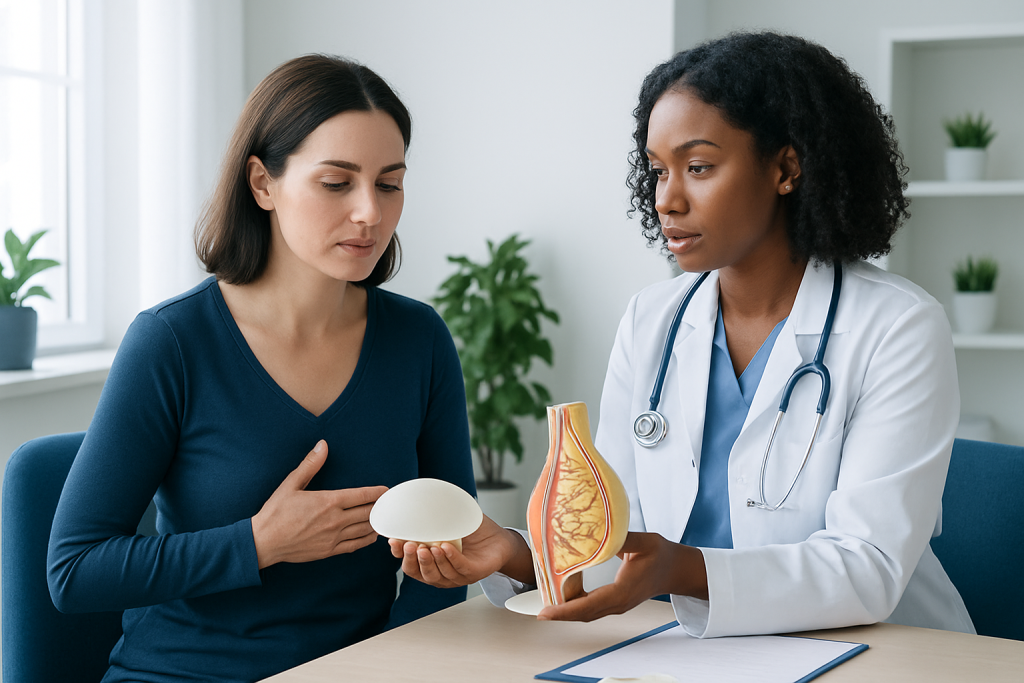
Breast augmentation and breast reconstruction use implants to change breast size, shape, symmetry, or contour. An implant has an outer silicone shell and is generally filled with saline or silicone gel. It may be placed beneath breast tissue or partly or completely beneath the chest muscle, depending on anatomy, tissue coverage, goals, and the surgeon’s assessment.
People may consider implants after pregnancy-related changes, weight changes, congenital breast asymmetry, or mastectomy and other cancer-related surgery. A suitable candidate is generally in good overall health, has realistic expectations, understands that future procedures may be needed, and can attend follow-up appointments. Smoking, uncontrolled medical conditions, active infection, and certain healing risks may affect the timing or suitability of surgery.
A consultation should include discussion of implant type, surface, placement, incision options, expected appearance, mammography, breastfeeding considerations, recovery needs, and alternatives such as fat grafting or external prostheses. For reconstruction after cancer treatment, planning may involve breast surgery, plastic surgery, medical oncology, radiation oncology, and imaging specialists.
Patients considering surgery can discuss individualized options through breast augmentation surgery, including the potential benefits and limitations of saline and silicone implants. Implant choice should be based on shared decision-making rather than on one feature alone.
Procedure, recovery timeline, benefits and possible risks
Before surgery, the clinician reviews medical history, medications, allergies, prior breast procedures, and screening needs. During the procedure, which is usually performed under general anesthesia, the surgeon makes a planned incision, creates an implant pocket, positions the implant, checks symmetry, and closes the incision. The exact technique varies according to the person’s anatomy and surgical plan.
In the first few days, swelling, tightness, bruising, and discomfort are common. Many patients return to light daily activities within about one to two weeks, while strenuous activity and heavy lifting are usually restricted for longer according to the surgeon’s advice. Swelling can take several weeks to settle, and scars and final breast position continue to mature over months.
Potential benefits include improved breast volume, symmetry, body image, or restoration of breast contour after mastectomy. Risks include bleeding, infection, wound-healing problems, altered nipple or breast sensation, asymmetry, scarring, capsular contracture, implant rupture or deflation, shifting of the implant, and the possible need for revision surgery. These risks should be reviewed carefully before consent.
Breast implants are not considered lifetime devices. The longer a person has an implant, the greater the chance that a complication or a future replacement, removal, or revision procedure may be needed. Routine care should include attention to changes in the breasts and scheduled clinical review when advised.
Are breast implants a source of microplastics?
Breast implants have a silicone elastomer outer shell, and research has examined whether very small particles from implant materials can be detected in nearby capsule tissue or lymph nodes. This is an evolving area of science. Findings of particles or silicone migration do not by themselves establish that microplastics from implants cause disease or cancer.
The term “microplastics” is often used broadly in public discussion, but silicone is chemically distinct from many common petroleum-based plastics. Studies are ongoing to understand the biological significance of microscopic material, gel bleed, implant wear, and rupture. At present, there is no reliable evidence that microplastics from breast implants cause common breast cancer.
Anyone with a suspected implant rupture, a new change in breast shape or firmness, persistent local symptoms, or concern about an older implant should speak with a clinician. Ultrasound or MRI may be used when clinically appropriate to assess silicone implant integrity; these tests do not replace routine breast cancer screening.
Is it unhealthy to have breast implants?
Having breast implants is not automatically unhealthy. Many people have implants without serious problems, but all surgery and implanted devices carry potential short- and long-term risks. Whether implants are an appropriate choice depends on a person’s health, goals, anatomy, medical history, and willingness to maintain follow-up.
Local complications such as capsular contracture, rupture, deflation, pain, infection, or changes in appearance can affect wellbeing and may require treatment. Implant-related cancers are very rare, but patients should know the warning signs and report persistent swelling, a new lump, or other changes promptly.
Some people report systemic symptoms such as fatigue, joint or muscle pain, difficulty concentrating, rash, dry eyes or mouth, hair changes, anxiety, or low mood after receiving implants. These symptoms deserve respectful medical assessment because they can have many possible causes, including conditions unrelated to implants. A clinician may recommend examination, appropriate tests, and referral to relevant specialists.
For people who decide that removal is appropriate, the approach depends on symptoms, implant condition, capsule findings, and individual goals. Removing an implant may improve some symptoms for some patients, but improvement cannot be guaranteed and removal is not a universal treatment for nonspecific symptoms.
What percent of people get breast implant illness?
There is no reliable single percentage for how many people get breast implant illness because it is not a formally defined diagnosis with one agreed test, symptom list, or reporting system. “Breast implant illness” is a term used by patients and clinicians to describe a range of systemic symptoms reported in some people with implants.
Research has not yet established exactly why these symptoms occur, which people may be more susceptible, or how often implants are the direct cause. Studies are challenging because the symptoms are common in the general population and can overlap with autoimmune, hormonal, thyroid, sleep, mental health, infectious, nutritional, and other medical conditions.
Symptoms should not be dismissed, but they also should not be assumed to be implant-related without a careful assessment. A clinician can review the timing of symptoms, perform an examination, investigate other possible causes, and discuss the possible benefits and limits of implant removal or replacement.
When to seek medical care
Medical review is recommended for new or persistent breast swelling, a fluid collection, a lump in the breast or armpit, breast pain that does not settle, redness, warmth, skin changes, unexplained asymmetry, hardening around an implant, or a sudden change in breast size or shape. These symptoms often have non-cancerous explanations, but timely assessment is important.
Urgent care may be needed for signs of a significant infection after surgery, such as fever with worsening breast redness, severe pain, pus-like drainage, or feeling acutely unwell. Anyone who has had breast cancer treatment should continue follow-up according to their oncology and breast-care plan.
Routine breast screening should continue as advised for the person’s age and individual risk. Informing the radiology team about implants before mammography supports appropriate imaging technique. Acibadem International’s multidisciplinary specialists and JCI-accredited hospitals can assess implant concerns and coordinate breast, imaging, and plastic-surgery care for international patients.
For an implant concern, the next step is usually an appointment with a qualified plastic surgeon or breast specialist rather than self-diagnosis. Bringing implant information, previous operative records if available, and a list of symptoms can make the consultation more useful.
Frequently asked questions
Do breast implants cause breast cancer?
Current evidence does not show that breast implants cause the common forms of breast cancer that arise in breast tissue. People with implants should still attend recommended breast screening and seek assessment for any new breast change.
What is BIA-ALCL?
BIA-ALCL is a rare type of non-Hodgkin lymphoma associated with breast implants, especially certain textured implants. It usually develops in fluid or scar tissue around the implant rather than in breast tissue itself. New swelling around an implant years after surgery should be evaluated.
Can a mammogram be done with breast implants?
Yes. Mammography can be performed safely with breast implants, although additional views are often needed to visualize as much breast tissue as possible. The imaging facility should be informed about the implants when booking the appointment.
Should breast implants be removed to prevent cancer?
Preventive removal is not routinely recommended for people without symptoms or a diagnosed implant-related complication. The decision should be individualized after discussing implant type, personal concerns, examination findings, and current guidance with a qualified clinician.
Can silicone implants rupture without symptoms?
Yes, silicone implant rupture can sometimes be silent and may not cause an obvious change in breast shape. A clinician may recommend ultrasound or MRI when symptoms, examination findings, or implant history raise concern.
How long do breast implants last?
Breast implants do not have a fixed expiry date and are not lifetime devices. Some remain problem-free for many years, while others need removal or replacement sooner because of rupture, capsular contracture, cosmetic changes, or other complications.
References
- U.S. Food and Drug Administration
- American Society of Plastic Surgeons
- National Cancer Institute
- American Cancer Society
- World Health Organization
This article is for general information only and is not a substitute for professional medical advice. Please consult a qualified doctor about your individual situation.
Breast Cancer in Turkey — costs, top hospitals & a free quote
JCI-accredited · board-certified surgeons · reply within 24h
Add us as a Preferred Source to see more of our trusted health content across Google Search, AI Overviews and Discover.

Medical Oncology Department
Medical treatment of cancer with chemotherapy, immunotherapy and targeted therapies under a multidisciplinary tumor board.
60 specialists in this unit