Heart-Lung Machine During CABG: How Cardiopulmonary Bypass Supports Surgery

The heart-lung machine circulates and oxygenates blood while the heart is slowed or stopped during on-pump CABG. A trained perfusionist manages the cardiopulmonary bypass circuit throughout surgery, working closely with the surgeon and anesthesiologist.
Key Takeaways
- The heart-lung machine circulates and oxygenates blood while the heart is slowed or stopped during on-pump CABG.
- A trained perfusionist manages the cardiopulmonary bypass circuit throughout surgery, working closely with the surgeon and anesthesiologist.
- Cardiopulmonary bypass helps surgeons place bypass grafts accurately on blocked coronary arteries.
- The team uses careful monitoring, blood thinning medication, temperature control, and heart-protective solutions to support safety.
- Most patients do not feel or remember the machine because CABG is performed under general anesthesia.
- Recovery after CABG includes wound care, breathing exercises, gradual activity, medication adherence, and often cardiac rehabilitation.
A heart-lung machine, also called cardiopulmonary bypass, temporarily takes over the work of the heart and lungs during many CABG operations. This allows the surgical team to work safely on a still heart while the body continues to receive oxygen-rich blood.
Overview: What Is the Heart-Lung Machine During CABG?
The heart-lung machine is a specialized medical system used during many coronary artery bypass grafting procedures, commonly called CABG. Its medical name is cardiopulmonary bypass. During on-pump CABG, the machine temporarily performs two essential jobs: it pumps blood around the body and adds oxygen to the blood, similar to the combined function of the heart and lungs.
CABG is performed to improve blood flow to the heart muscle when coronary arteries are narrowed or blocked by atherosclerosis. The surgeon creates new pathways, called grafts, so blood can travel around the blocked areas. In many cases, using cardiopulmonary bypass allows the heart to be still and relatively blood-free, which can help the surgeon attach the grafts with precision.
Patients are asleep under general anesthesia during the operation, so they do not feel the machine working. The heart-lung machine is managed by a highly trained perfusionist, who is part of the operating room team. The perfusionist continuously monitors blood flow, oxygen levels, temperature, pressure, and other measurements while the surgeon and anesthesiologist focus on the heart and the patient as a whole.
How Cardiopulmonary Bypass Works
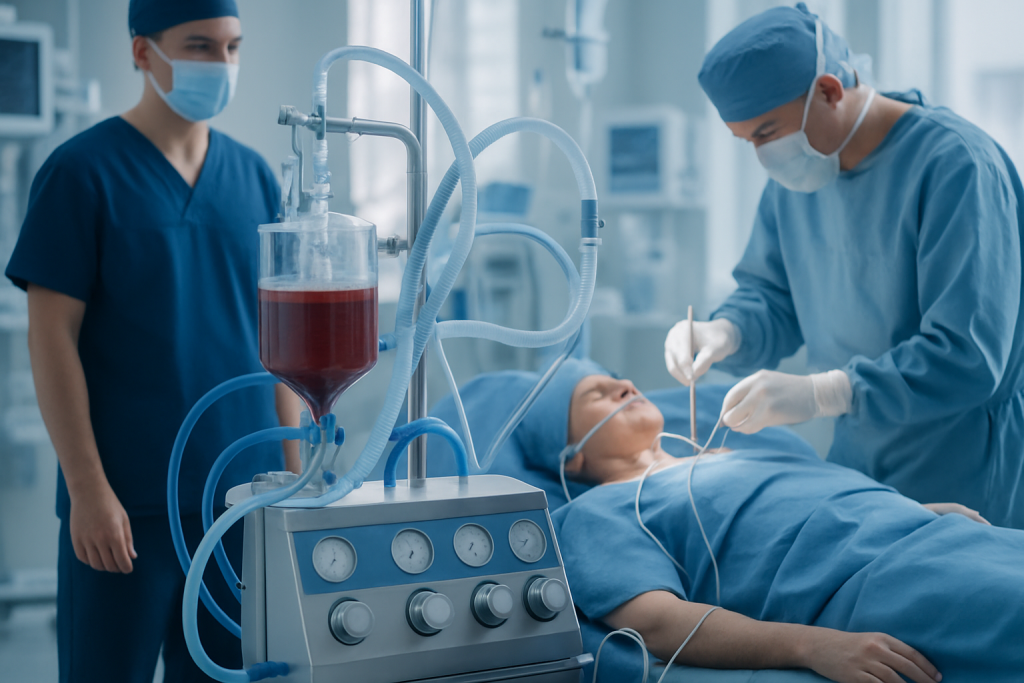
Cardiopulmonary bypass uses a closed circuit of sterile tubing connected to the patient through carefully placed tubes called cannulas. Blood is usually drained from the large veins near the heart into the circuit. It passes through a reservoir and an oxygenator, where carbon dioxide is removed and oxygen is added. A pump then returns the oxygen-rich blood to the body, commonly through the aorta or another large artery.
The oxygenator is often described as an artificial lung. It allows gas exchange to happen outside the body while the patient’s lungs are not doing their usual work during the main part of surgery. A heat exchanger in the circuit can warm or cool the blood, helping the team manage body temperature. Mild cooling may be used in some operations to reduce the body’s oxygen needs and protect organs.
Before bypass begins, the patient receives anticoagulation medicine, often heparin, to reduce the risk of blood clotting in the circuit. Blood clotting status is checked repeatedly during surgery. At the end of bypass, the surgical team gradually lets the heart and lungs resume their usual roles, and the blood thinning effect is reversed with appropriate medication when it is safe to do so.
Why the Machine Is Used in CABG

In traditional on-pump CABG, the heart-lung machine supports the circulation so the surgeon can temporarily stop the heart. A special protective solution, called cardioplegia, is delivered to the heart to slow or stop its beating and reduce its oxygen demand. This creates a quiet surgical field and helps protect the heart muscle while grafts are sewn onto small coronary arteries.
The main purpose is not to replace the heart permanently, but to support the patient for the limited time needed to complete the bypass grafts. Once the grafts are in place, the heart is allowed to restart, and the team carefully checks heart rhythm, blood pressure, bleeding, and graft function. The patient is then gradually separated from the machine when the heart and lungs are ready.
Some CABG operations can be done without cardiopulmonary bypass, known as off-pump CABG or beating-heart surgery. The best approach depends on the patient’s coronary anatomy, heart function, other medical conditions, and the surgeon’s judgment. For many patients, coronary artery bypass surgery with cardiopulmonary bypass remains an established and widely used method.
The Surgical Team and Monitoring During Bypass
CABG with a heart-lung machine is a coordinated team procedure. The cardiac surgeon performs the bypass grafting, the anesthesiologist manages anesthesia and vital organ support, and the perfusionist operates the cardiopulmonary bypass system. Nurses and operating room technicians prepare instruments, maintain sterility, and support the team throughout the operation.
Monitoring is detailed and continuous. The team watches heart rhythm, blood pressure, oxygen levels, carbon dioxide levels, temperature, urine output, blood clotting, acid-base balance, and laboratory values. In many cases, ultrasound imaging of the heart through the esophagus, called transesophageal echocardiography, helps assess heart function and guide decision-making during surgery.
The machine itself has multiple safety features, including pressure monitors, air detection systems, filters, alarms, and backup procedures. The perfusionist adjusts blood flow and oxygen delivery based on the patient’s size, temperature, blood test results, and surgical stage. This close monitoring helps the team respond promptly to changes during heart bypass surgery.
Benefits, Risks, and Safety Considerations
The heart-lung machine allows surgeons to treat complex coronary artery disease in a controlled setting. A still heart can make it easier to place delicate stitches and create secure graft connections. Cardiopulmonary bypass also gives the team time to manage unexpected findings, repair associated problems when needed, and support circulation while the heart is protected.
Like any major medical technology, cardiopulmonary bypass has potential risks. These may include bleeding, inflammation, changes in blood clotting, fluid shifts, temporary kidney strain, irregular heart rhythms, infection risk, or short-term confusion after surgery. Some patients may notice temporary memory or concentration changes during recovery. These concerns are taken seriously, and the care team uses established protocols to reduce risks and detect problems early.
Risk varies from person to person. Important factors include age, diabetes, kidney disease, lung disease, previous stroke, heart pumping function, the number of grafts needed, and whether surgery is planned or urgent. Patients should ask their cardiac surgeon and anesthesiologist how cardiopulmonary bypass fits into their specific treatment plan, including why it is recommended and how the team will monitor safety.
Recovery After On-Pump CABG
After CABG, the patient is moved to an intensive care unit or cardiac surgical recovery area. The breathing tube is removed when the patient is awake enough and breathing safely. Nurses and doctors monitor blood pressure, heart rhythm, oxygen levels, drainage tubes, urine output, pain control, and blood tests. Some temporary lines and tubes are expected and are removed as recovery progresses.
Early recovery focuses on protecting the breastbone incision, preventing lung complications, and restarting movement safely. Patients are encouraged to take deep breaths, cough with support, use an incentive spirometer if provided, and sit or walk with assistance as soon as the team advises. Pain is managed so that breathing and movement are possible, while medications are adjusted to support the heart and grafts.
Longer-term recovery often includes lifestyle changes and medication adherence to reduce the chance of future coronary artery narrowing. The doctor may recommend antiplatelet therapy, cholesterol-lowering medicine, blood pressure control, diabetes management, smoking cessation, and a heart-healthy eating plan. A supervised cardiac rehabilitation program can help patients rebuild strength, improve confidence, and learn safe exercise habits after discharge.
Preparing for Surgery and Questions to Ask
Before planned CABG, patients usually have blood tests, chest imaging, electrocardiography, echocardiography, coronary angiography findings, and anesthesia assessment reviewed. The care team also checks current medications, allergies, previous surgeries, kidney function, lung health, and bleeding risk. Patients may be told to stop or adjust certain medicines before surgery, but this should only be done under medical guidance.
Helpful questions include: Will the operation be on-pump or off-pump? Why is this approach recommended? How many bypass grafts are expected? What type of grafts may be used? How long might intensive care and hospital stay be? What symptoms after discharge should prompt medical attention? Clear answers can reduce uncertainty and help patients and families prepare.
Patients traveling for care should also discuss medical records, medication supply, follow-up plans, wound care, and safe timing for return travel. Acibadem International’s multidisciplinary cardiac teams and JCI-accredited hospitals diagnose and treat coronary artery disease for international patients, including patients who may need CABG, with individualized planning and postoperative follow-up coordination.
When to Contact a Doctor After CABG
Patients should follow their discharge instructions closely and keep scheduled follow-up appointments. After going home, it is important to contact the medical team if there is fever, increasing redness or drainage from an incision, worsening chest discomfort, shortness of breath, fainting, new leg swelling, palpitations, or sudden weight gain. These symptoms do not always mean a serious problem, but they should be assessed promptly.
Emergency medical care is needed for severe chest pain, severe breathing difficulty, stroke-like symptoms such as facial drooping or weakness on one side, loss of consciousness, or heavy bleeding. Patients should not drive themselves in an emergency. Local emergency services or the hospital’s instructions should be followed.
Recovery is different for each person. Some fatigue, appetite changes, mood changes, and sleep disruption can occur after major heart surgery and often improve with time, activity, and support. Open communication with the cardiac team helps patients understand what is expected and what should be checked.
Frequently asked questions
What does the heart-lung machine do during CABG?
The heart-lung machine temporarily pumps blood through the body and adds oxygen to it while the heart is being operated on. This allows the surgeon to work on a still, protected heart during on-pump CABG. The machine is managed continuously by a trained perfusionist.
Is the heart stopped during bypass surgery?
In many on-pump CABG procedures, the heart is temporarily stopped using a protective solution called cardioplegia. The heart-lung machine supports circulation during this time. At the end of the grafting, the team allows the heart to resume beating and carefully monitors its function.
Will the patient feel the heart-lung machine working?
No. CABG is performed under general anesthesia, so the patient is asleep and does not feel the operation or the machine. After surgery, patients usually remember waking up in the recovery area or intensive care unit, not the bypass process itself.
Is cardiopulmonary bypass safe?
Cardiopulmonary bypass is a well-established technique used in cardiac surgery, with extensive monitoring and safety systems. However, it is part of major heart surgery and can have risks such as bleeding, inflammation, rhythm changes, or temporary organ stress. The individual risk depends on the patient’s overall health and surgical complexity.
What is the difference between on-pump and off-pump CABG?
On-pump CABG uses the heart-lung machine and often involves temporarily stopping the heart. Off-pump CABG is performed while the heart continues beating, using stabilizing devices. The most suitable option depends on coronary anatomy, heart function, other health conditions, and the surgeon’s recommendation.
How long does it take to recover after CABG with a heart-lung machine?
Recovery varies, but patients usually spend the first phase in intensive care or a monitored cardiac unit, then continue healing at home for several weeks. Energy, appetite, sleep, and mood may take time to normalize. Cardiac rehabilitation and follow-up visits can support a safer and more structured recovery.
Can the heart-lung machine affect memory or thinking?
Some patients notice temporary confusion, slower thinking, or memory changes after major heart surgery. These changes can be related to many factors, including anesthesia, the operation, inflammation, sleep disruption, and overall health. Most patients improve over time, but persistent or worsening symptoms should be discussed with the doctor.
References
- American Heart Association
- Society of Thoracic Surgeons
- European Association for Cardio-Thoracic Surgery
- National Heart, Lung, and Blood Institute
- Mayo Clinic
This article is for general information only and is not a substitute for professional medical advice. Please consult a qualified doctor about your individual situation.
Explore treatments in Turkey — costs, top hospitals & a free quote
JCI-accredited · board-certified surgeons · reply within 24h
Add us as a Preferred Source to see more of our trusted health content across Google Search, AI Overviews and Discover.
Check your numbers in seconds
BMI, calories, due date, blood pressure and 30+ more clinical calculators — free, instant, doctor-reviewed ranges.

Cardiology Department
Diagnosis and treatment of heart and vascular conditions, from prevention to advanced interventional procedures.
91 specialists in this unit