Laser Eye Surgery Reading Glasses: Procedure, Recovery and Results
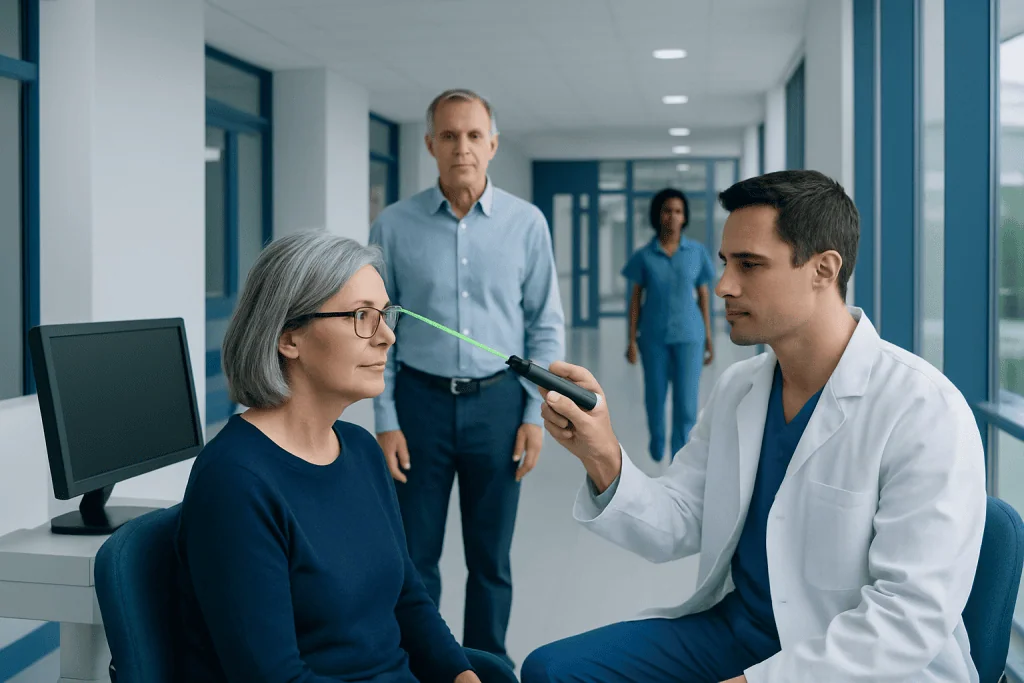
Reading-glasses dependence usually develops because of presbyopia, an age-related loss of near focusing ability. Laser correction for near vision often uses monovision, with one eye focused more for distance and the other for close work.
Key Takeaways
- Reading-glasses dependence usually develops because of presbyopia, an age-related loss of near focusing ability.
- Laser correction for near vision often uses monovision, with one eye focused more for distance and the other for close work.
- A detailed eye assessment and a contact-lens monovision trial can help determine whether the approach is comfortable.
- Most people resume light daily activities within days, but visual stabilization and follow-up care continue for weeks to months.
- Laser eye surgery can reduce reliance on glasses but cannot promise perfect vision or eliminate future age-related eye changes.
Laser eye surgery may reduce the need for reading glasses by correcting presbyopia with strategies such as monovision laser correction. It does not suit every eye, and some people still need glasses for small print, prolonged reading or low-light tasks after treatment.
Laser Eye Surgery for Reading Glasses: An Overview
Laser eye surgery for reading glasses is designed to reduce dependence on near-vision spectacles in people with presbyopia. Presbyopia is a normal age-related change in which the eye’s natural lens becomes less flexible, making close tasks such as reading messages, labels or menus more difficult. It commonly becomes noticeable from the 40s onward.
Unlike standard laser vision correction, which usually aims to sharpen distance vision in both eyes, treatment for presbyopia may intentionally create different focusing ranges between the eyes. The most established approach is monovision: one eye is corrected mainly for distance and the other mainly for near tasks. Laser eye surgery is planned individually after detailed measurements of the cornea, prescription, tear film and overall eye health.
For suitable people, laser correction can provide useful functional vision across everyday distances. However, it cannot restore the natural lens to its younger flexibility. Reading glasses may still be useful for very small print, lengthy close work, dim lighting or visually demanding activities.
How Laser Correction for Near Vision Works
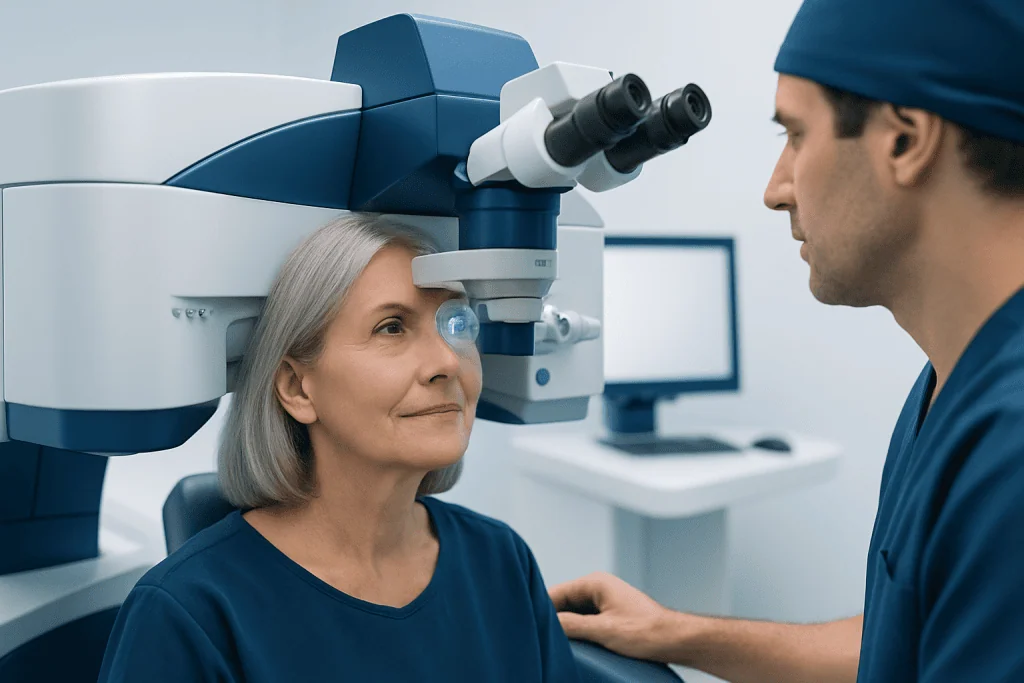
LASIK and related corneal laser procedures reshape the cornea, the clear front surface of the eye. Changing its curvature alters how light is focused on the retina. In monovision treatment, the dominant eye is often optimized for distance vision, while the non-dominant eye is adjusted toward near or intermediate vision.
The brain gradually learns to use the clearer image from each eye at the most useful distance. This process is called neural adaptation. Many people adjust well, but some find the difference between the two eyes uncomfortable or notice reduced depth perception, especially during certain sports, night driving or tasks requiring precise binocular vision.
Some centers may discuss other presbyopia-correction patterns, depending on eye anatomy and technology. For people whose lens changes or cataracts are a more important cause of visual difficulty, lens-based treatment may be more appropriate than corneal laser surgery. A comprehensive ophthalmology assessment helps identify the safest and most suitable option.
Who May Be a Candidate?

Good candidacy depends on more than a person’s wish to stop using reading glasses. An ophthalmologist considers whether the glasses prescription has been stable, whether the cornea has enough thickness and regular shape, and whether the eyes are healthy enough for surgery. A person’s work, hobbies, driving needs and expectations are also important.
People considering presbyopia laser correction generally need a thorough refraction assessment, corneal mapping, pupil measurements and evaluation for dry eye. Existing dry eye should be treated or controlled first because it can affect comfort, measurements and visual quality after surgery. The clinician also checks the retina, optic nerve and natural lens.
Laser surgery may not be advised for everyone. Reasons can include significant cataract, keratoconus or other corneal disease, uncontrolled glaucoma, certain retinal disorders, active eye infection, severe dry eye, unstable prescription or medical factors that may affect healing. A trial of monovision with contact lenses is often recommended before permanent laser correction, as it gives a practical sense of the visual balance after treatment.
Step by Step: What Happens During the Procedure?
Before surgery, the surgeon confirms the treatment plan and reviews the expected visual goals. The eye is prepared with anesthetic drops, so the procedure is usually not painful. Patients remain awake and lie comfortably beneath the laser system while the team gives clear instructions.
With LASIK, a very thin corneal flap is created, lifted and then repositioned after the laser reshapes the tissue beneath. Other surface-laser techniques reshape the cornea after the surface layer is moved or removed, which can involve a longer initial healing period. The laser portion itself generally takes only a short time per eye.
After the procedure, vision may be hazy and the eyes may feel watery, gritty or sensitive to light for a short period. The patient is usually able to go home the same day with protective instructions and prescribed drops. They should not drive themselves home and should attend all scheduled follow-up visits.
Recovery Timeline and Everyday Activities
Recovery varies by laser technique, prescription, tear-film health and individual healing. After LASIK, many people see well enough for basic daily activities within one to several days, although fluctuations in clarity, glare, halos or dry-eye symptoms can occur during early healing. Surface procedures generally require more time for the corneal surface to heal and vision to become clear.
During the first days, patients are usually advised to rest their eyes, use prescribed drops exactly as directed, avoid rubbing the eyes and protect them from accidental contact. Swimming pools, hot tubs, dusty environments and eye makeup may need to be avoided for a period specified by the surgeon. Contact sports and strenuous exercise should only resume when the clinical team confirms that it is safe.
Screen use, reading and television can be resumed gradually when comfortable, but frequent breaks and lubricating drops may help if dryness occurs. Follow-up appointments monitor healing, visual outcome and eye pressure. Vision and adaptation to monovision can continue to improve over several weeks or months.
Benefits, Limits and Possible Risks
The main potential benefit is less dependence on reading glasses and, for some people, less dependence on distance glasses as well. Monovision may support practical day-to-day tasks such as using a phone, shopping, working at a computer and moving around without changing glasses frequently. Satisfaction tends to be highest when the chosen visual target matches the person’s lifestyle and expectations.
It is important to understand the limits. Laser correction does not prevent future presbyopia progression, cataracts or other age-related eye conditions. Some people continue to use glasses for detailed near work, nighttime driving or special tasks. A small residual prescription may remain, and an enhancement procedure is occasionally considered after healing if clinically appropriate.
Possible risks include temporary or persistent dry eye, glare, halos, starbursts, reduced contrast sensitivity, undercorrection, overcorrection, fluctuating vision and difficulty adapting to monovision. Less commonly, infection, inflammation, flap-related problems after LASIK or other complications can affect sight. Careful screening, experienced surgical care and prompt reporting of symptoms help reduce risk, but no elective eye procedure is risk-free.
When to Seek Medical Care
Urgent eye assessment is needed after laser eye surgery if there is severe or worsening pain, a sudden decline in vision, increasing redness, marked light sensitivity, pus-like discharge, injury to the eye or a new curtain-like shadow, flashes or many floaters. These symptoms do not always indicate a serious complication, but they should not be managed at home.
Patients should contact their surgical team if dryness, blurred vision, halos or discomfort are not improving as expected, or if prescribed drops cause a concerning reaction. It is also sensible to arrange an eye examination for gradually worsening near vision, difficulty driving at night or a new change in one eye, even years after laser correction.
Acibadem International’s multidisciplinary eye-care specialists and JCI-accredited hospitals assess and treat vision concerns for international patients, including evaluation of laser vision correction options. Individual recommendations should always follow an in-person ophthalmology examination.
Frequently asked questions
How many days should I rest after laser eye surgery?
Most people are advised to rest on the day of surgery and take at least one or two days away from demanding activities after LASIK. Light daily activity may be possible soon afterward, but the exact timeline depends on the procedure and the surgeon’s instructions. Surface laser procedures often need a longer initial recovery period.
Do you still need reading glasses after laser eye surgery?
Some people still need reading glasses after laser eye surgery, particularly for very small print, low-light conditions or long periods of close work. Monovision laser correction can reduce dependence on reading glasses, but it does not restore the natural focusing flexibility lost with presbyopia. Results vary with age, prescription and visual needs.
Do you get 20/20 vision after laser eye surgery?
Laser eye surgery cannot guarantee 20/20 vision. Many suitable patients achieve strong uncorrected distance vision, but the final result depends on the original prescription, healing response, eye health and the treatment goal. For presbyopia treatment, the aim may be balanced functional distance and near vision rather than 20/20 vision in both eyes.
Can I watch TV 3 days after LASIK?
Many people can watch television three days after LASIK if they are comfortable and their vision is clear enough. It is helpful to take regular breaks, blink often and use lubricating drops if prescribed, because screens can worsen dryness. If television causes pain, significant blur or light sensitivity, the patient should stop and contact the surgical team.
Is monovision LASIK difficult to get used to?
Some people adapt to monovision quickly, while others need several weeks or longer for the brain to adjust to different focus in each eye. It can affect depth perception and visual comfort in certain situations, including night driving. A contact-lens monovision trial before surgery is a useful way to assess personal tolerance.
Can laser eye surgery prevent cataracts?
No. Laser eye surgery reshapes the cornea and does not prevent cataracts, which develop in the eye’s natural lens. If cataracts later affect vision, cataract surgery may be considered and the previous laser procedure should be discussed during planning.
References
- American Academy of Ophthalmology
- U.S. Food and Drug Administration
- National Eye Institute
- Royal College of Ophthalmologists
This article is for general information only and is not a substitute for professional medical advice. Please consult a qualified doctor about your individual situation.
Eye Surgery in Turkey — costs, top hospitals & a free quote
JCI-accredited · board-certified surgeons · reply within 24h
Add us as a Preferred Source to see more of our trusted health content across Google Search, AI Overviews and Discover.

Ophthalmology
Comprehensive eye care from laser vision correction to retina, cornea and cataract surgery.
75 specialists in this unitMore from the Health Library



Related Specialists

Prof. Dr. Remzi Tözün
Orthopedic Surgery & Traumatology
Prof. Dr. Evrim Kadriye Tezcanlı
Radiation Oncology
Dr. Mehtap Baştugral
Clinical Laboratory
Prof. Dr. Ayşe Sesin Kocagöz
Clinical Laboratory