Lenticular Lenses: An Evidence-Based Guide for Patients

Lenticular lenses are used mainly for very high plus or minus prescriptions. They have a central optical zone and a flatter outer area to reduce thickness and weight.
Key Takeaways
- Lenticular lenses are used mainly for very high plus or minus prescriptions.
- They have a central optical zone and a flatter outer area to reduce thickness and weight.
- They may be helpful after lens removal, in aphakia, or for certain complex refractive needs.
- An eye specialist determines whether lenticular lenses, contact lenses, or surgery is the best option.
- Regular follow-up is important to monitor comfort, vision quality, and eye health.
Lenticular lenses are specialty eyeglass lenses designed for people with very strong prescriptions, especially when standard lenses would be very thick or heavy. They can improve comfort, appearance, and vision in selected cases, but they are not the right choice for everyone and should be prescribed after a full eye examination.
Overview: what lenticular lenses are
Lenticular lenses are specialty eyeglass lenses made for people with very strong vision prescriptions. In simple terms, they have a small central area that contains the full corrective power and a wider outer portion with much less power. This design helps reduce the thickness, weight, and edge bulk that can occur with standard high-power lenses.
These lenses are most often considered when a person has a very high plus prescription, such as after removal of the eye’s natural lens without an implanted lens, or a very high minus prescription that would otherwise create thick, heavy glasses. The goal is practical as well as visual: to make strong prescriptions more wearable.
Lenticular lenses are not a separate disease treatment on their own. They are one option within vision correction, alongside standard eyeglasses, contact lenses, and procedures such as laser eye surgery for carefully selected patients. The most suitable choice depends on the underlying eye condition, prescription strength, corneal health, lifestyle, and personal preferences.
How lenticular lenses work
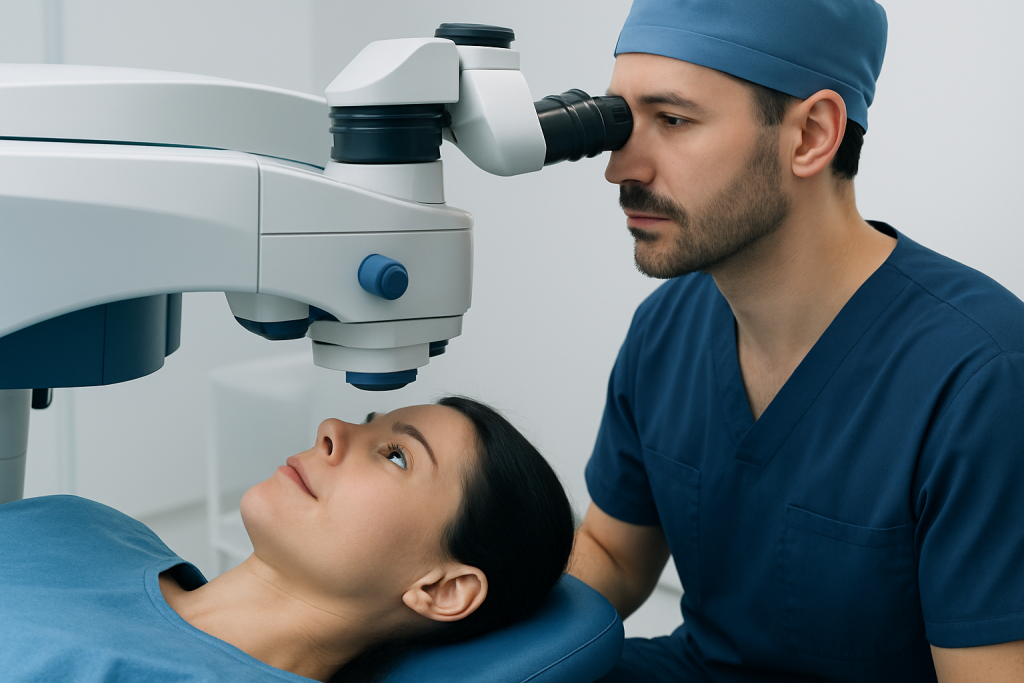
The defining feature of lenticular lenses is their structure. The center of the lens provides the necessary optical correction for clear vision. Around this central zone is a peripheral carrier area that is flatter and contributes less or no prescription power. By limiting the strong prescription mainly to the center, the lens can be made lighter than a full-power lens across the entire surface.
This design can offer cosmetic and functional advantages. High plus lenses can look less protruding, and very high minus lenses may have less edge thickness. For some patients, this can improve how the glasses sit on the face and reduce pressure on the nose and ears.
However, the design also has trade-offs. Because the strongest correction is concentrated centrally, side vision through the lens may feel different from that of standard lenses. Some people notice a ring-like boundary, image jump, or adaptation period. An experienced eye care professional can explain what to expect before prescribing them.
Lenticular lenses are usually custom-made. Lens material, frame size, pupillary alignment, and fitting height all matter. Smaller, well-centered frames often work best because they help keep the eyes looking through the intended optical zone more consistently.
Who may benefit from lenticular lenses
Lenticular lenses are generally considered for people with unusually strong prescriptions rather than routine nearsightedness or farsightedness. They are commonly associated with aphakia, a condition in which the natural lens of the eye is absent. This may happen after cataract removal in certain situations or after eye trauma. In these cases, a high plus lens may be needed to focus light properly.
They may also be useful for some people with very high hyperopia or high myopia when standard spectacles are too thick, heavy, or uncomfortable. In selected patients, lenticular lenses can improve wearability enough that glasses become a practical daily option again.
Patients with complex eye histories may need a broader evaluation. For example, reduced vision can be related not only to refractive error but also to conditions such as cataract or keratoconus. In such cases, the main issue may require disease-specific management in addition to optical correction.
Not everyone with a strong prescription is a good candidate. Some people function better with contact lenses, low-vision aids, or surgical options. The decision depends on visual needs, depth perception, balance between the two eyes, and whether the person can adapt comfortably to the optics of a lenticular design.
Possible benefits and limitations
The main benefit of lenticular lenses is that they can make an extreme prescription more manageable. Compared with conventional high-power spectacle lenses, they may be thinner, lighter, and sometimes more cosmetically acceptable. This can improve day-to-day comfort and make glasses easier to wear for longer periods.
They can also be useful when contact lenses are not tolerated or are not medically appropriate. For some patients, especially those who need strong plus correction, lenticular lenses may provide a workable spectacle solution without the same degree of magnification and bulk seen in older lens styles.
Still, they have limitations. Peripheral vision may be less natural than with standard lenses or contact lenses. Some patients experience visual distortion, awareness of the lenticular boundary, or difficulty adjusting when moving their eyes away from the center. Depth perception can also be challenging if the prescription differs significantly between the two eyes.
Because of these factors, a fitting trial and honest discussion are important. The best lens is not always the thinnest lens; it is the one that provides safe, functional vision and acceptable comfort for the individual patient.
Assessment and diagnosis before prescribing
Prescribing lenticular lenses begins with a comprehensive eye examination. The eye doctor measures refractive error carefully, checks best-corrected visual acuity, and looks for any underlying eye disease. The exam may include refraction, slit-lamp evaluation, retinal assessment, and other tests based on symptoms and medical history.
If the vision problem is linked to another eye condition, that cause should be addressed directly. For example, lens opacity may require cataract surgery, while corneal shape problems may need a separate management plan. In some cases, refractive surgery or lens-based surgery may be discussed, but only after evaluating safety and suitability.
Frame selection and lens fitting are part of the medical decision-making process for strong prescriptions. Smaller frames, good centration, and careful measurement of the distance between the pupils help optimize the lens design. The doctor or optician may also discuss lens material, anti-reflective coatings, and realistic expectations for side vision.
If a patient has sudden changes in vision, eye pain, flashes, floaters, trauma, or a rapid increase in prescription, the priority is to investigate the cause rather than simply update glasses. A new strong prescription can sometimes be a sign that another eye issue needs attention.
Alternatives and treatment options
Lenticular lenses are one of several ways to manage strong refractive error. Standard high-index eyeglass lenses may be enough for many people, particularly when the prescription is high but not extreme. Contact lenses can sometimes provide a wider field of view and less image distortion because they move with the eye and sit directly on the cornea.
For selected patients, surgical treatment may be considered. Depending on the cause of the vision problem, options can include smart lenses or other lens-based procedures, as well as corneal refractive procedures. These options require a detailed assessment of corneal thickness, lens status, retinal health, and overall eye condition.
Children and adults with aphakia or complex refractive needs may need individualized planning over time. A person’s best option can change with age, eye growth, general health, and visual goals. That is why periodic review with an ophthalmologist or optometrist is important.
In some situations, a specialist may recommend a combination approach, such as surgery in one stage and optical correction afterward. The aim is not simply to reduce prescription strength, but to improve safe, usable vision in daily life.
Living with lenticular lenses: self-care and adaptation
People who start wearing lenticular lenses often need a short adjustment period. It can help to wear the glasses consistently for gradually longer periods, move the head rather than only the eyes when looking to the side, and avoid switching back and forth repeatedly between old and new glasses during adaptation.
Comfort also depends on practical details. A well-fitted frame, regular cleaning, and prompt adjustment if the glasses slide down the nose can make a noticeable difference. If the lenses feel heavy, create dizziness, or do not seem aligned with the eyes, the fit should be checked rather than tolerated.
Routine eye follow-up remains important, especially for children, older adults, and anyone with a history of surgery or eye disease. Vision can change over time, and the prescription or lens type may need refinement. In addition, persistent blur may reflect another problem that should not be missed.
Near the end of the care pathway, some patients may benefit from a multidisciplinary review, particularly if they have prior eye surgery or more than one eye condition. Acibadem International’s multidisciplinary specialists in JCI-accredited hospitals evaluate and treat complex vision problems for international patients when advanced ophthalmic assessment is needed.
When to seek medical care
A routine appointment is appropriate when glasses feel unusually heavy, thick, or uncomfortable because of a strong prescription, or when a person wants to understand whether lenticular lenses might help. An eye doctor can explain the likely benefits, limitations, and alternatives based on the exact prescription and eye health findings.
Prompt medical care is important if there is sudden blurred vision, double vision, eye pain, redness, flashes of light, many new floaters, or reduced vision after injury. These symptoms are not typical adaptation issues and may signal a more urgent eye problem.
Medical review is also recommended if new glasses never seem clear, cause persistent headaches, or create imbalance that does not improve after a reasonable adaptation period. Children, people with only one seeing eye, and anyone with diabetes or previous eye surgery should be especially careful about regular eye examinations.
Frequently asked questions
What are lenticular lenses used for?
Lenticular lenses are used mainly for very strong eyeglass prescriptions that would otherwise create very thick or heavy lenses. They are especially known for helping some patients with aphakia, high hyperopia, or high myopia.
Are lenticular lenses the same as progressive lenses?
No. Progressive lenses are designed to correct vision at multiple distances in one lens, while lenticular lenses are designed to manage very high prescription power by concentrating it in the central area of the lens. They serve different purposes.
Do lenticular lenses look different from regular glasses?
They can. Some lenticular lenses have a visible central optical zone and a flatter surrounding area, so the lens may look different from a standard spectacle lens. Modern materials and careful frame choice can sometimes make this less noticeable.
Are lenticular lenses comfortable to wear?
Many patients do wear them comfortably, but there can be an adjustment period. Comfort depends on prescription strength, frame fit, lens alignment, and how well the person adapts to the optics.
Can lenticular lenses replace contact lenses or surgery?
Sometimes, but not always. For some people they are a good non-surgical option, while others may see better with contact lenses or may be candidates for surgery. The best choice depends on eye health, prescription, and personal needs.
How does a doctor decide if someone needs lenticular lenses?
The decision is based on a full eye examination, the type and strength of the prescription, and whether standard glasses are practical. The doctor also considers visual quality, peripheral vision, cosmetic concerns, and any underlying eye disease.
References
- American Academy of Ophthalmology
- National Eye Institute
- American Optometric Association
- Royal College of Ophthalmologists
This article is for general information only and is not a substitute for professional medical advice. Please consult a qualified doctor about your individual situation.
Explore treatments in Turkey — costs, top hospitals & a free quote
JCI-accredited · board-certified surgeons · reply within 24h
Add us as a Preferred Source to see more of our trusted health content across Google Search, AI Overviews and Discover.