Multifocal Lens Implant Patient Reviews: An Evidence-Based Patient Guide

Multifocal intraocular lenses are designed to provide functional vision at near, intermediate and distance ranges. Many patients value reduced dependence on glasses, while some notice halos, glare or reduced contrast, especially in dim light.
Key Takeaways
- Multifocal intraocular lenses are designed to provide functional vision at near, intermediate and distance ranges.
- Many patients value reduced dependence on glasses, while some notice halos, glare or reduced contrast, especially in dim light.
- A detailed eye examination and discussion of work, driving and reading needs are essential before selecting a lens.
- There is no single best multifocal lens for every person; lens choice should be individualized.
- New severe pain, worsening redness, sudden vision loss or increasing flashes and floaters after surgery need urgent medical assessment.
Multifocal lens implant patient reviews commonly describe improved ability to see at more than one distance and less reliance on glasses after cataract surgery or lens replacement. Experiences vary, however, because visual quality, night-time symptoms, eye health and personal expectations all affect satisfaction.
Overview: interpreting multifocal lens implant patient reviews
Multifocal lens implant patient reviews can be useful for understanding day-to-day experiences, but they are not a substitute for an individual eye assessment. Reviews often reflect whether a person’s expectations matched their outcome, as well as factors such as dry eye, pre-existing retinal disease, astigmatism, healing and the type of activities they do each day.
A multifocal intraocular lens (IOL) is an artificial lens placed inside the eye after the natural lens is removed. This is most commonly done during cataract surgery, although lens replacement surgery may also be considered for selected people who want to reduce dependence on glasses. Unlike a standard monofocal IOL, which is usually set for one main distance, a multifocal IOL divides incoming light to create focus at multiple distances.
The intended benefit is greater freedom from glasses for tasks such as reading, computer work, shopping and seeing across a room. The trade-off is that some people notice unwanted light effects or less crisp vision in low-contrast settings. A careful consultation helps determine whether this balance is likely to suit the individual.
How multifocal IOL surgery works
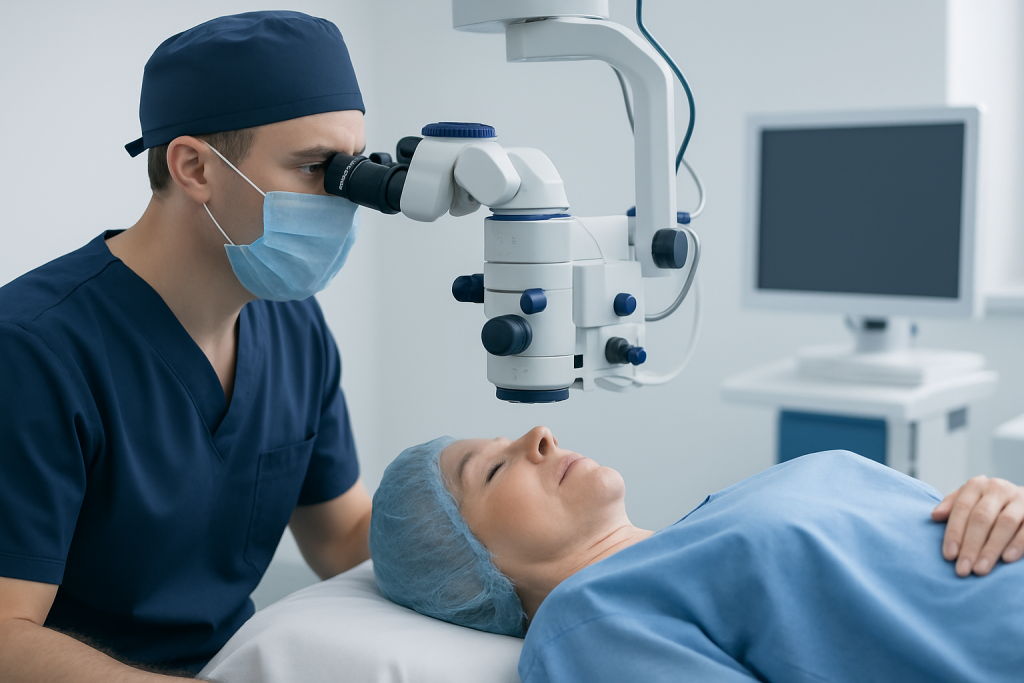
During cataract surgery, the surgeon makes very small openings in the eye, gently breaks up and removes the cloudy natural lens, and inserts a folded artificial IOL into the lens capsule. The IOL then opens and remains in position. The procedure is usually performed with local anaesthetic eye drops, sometimes with additional medication to help the person relax.
Multifocal IOLs use optical zones or diffractive designs to distribute light between focal points. Some designs emphasize near and distance vision, while others provide a broader range that includes intermediate vision, which can be useful for computer screens. Extended-depth-of-focus lenses are a related option that may provide a smoother range of distance and intermediate vision, though reading glasses may still be needed for very small print.
Astigmatism can blur vision at all distances. For suitable eyes, a toric multifocal IOL may correct both presbyopia-related focusing limitations and corneal astigmatism. Accurate measurements before surgery are central to lens planning, because an IOL cannot naturally change focus in the way a young natural lens can.
What are the patient reviews for multifocal IOL surgery?

Patient reviews for multifocal IOL surgery are generally most positive when people strongly value reduced glasses use and understand that adaptation takes time. Patients frequently report convenience when reading messages, checking labels, working at a computer or moving between indoor and outdoor settings. Many also describe satisfaction with clearer vision after cataract removal, particularly when cataracts had been limiting daily activities.
Less favorable reviews often focus on halos around lights, glare from headlights, starbursts or reduced clarity in dim environments. These effects can be more noticeable early after surgery and may lessen as the brain adapts over weeks to months. However, they can remain bothersome for some people, particularly those who drive regularly at night or need consistently high contrast for work or hobbies.
Online reviews may not explain important clinical details, such as whether the person had dry eye, macular disease, glaucoma, an inaccurate refractive target or an uncorrected residual prescription. The most useful question for an eye surgeon is not whether other patients liked a particular lens, but whether the individual’s eye measurements, ocular health, lifestyle and tolerance for visual trade-offs make it appropriate.
What is the success rate of multifocal lens implants?
Success should be defined carefully for multifocal lens implants. In clinical practice, success may mean safe surgery, improved vision after cataract removal, reaching the planned prescription, achieving functional vision at several distances, or reducing the need for glasses. These outcomes are related but not identical, so no single percentage fully represents success for every patient or lens model.
Studies and routine clinical experience show that many appropriately selected patients achieve good distance and near or intermediate function and become less dependent on glasses. Still, complete freedom from glasses cannot be promised. Some people need glasses for very small print, prolonged reading, detailed close work or demanding low-light tasks.
Successful outcomes also depend on the health of the cornea, retina and optic nerve, accurate pre-operative measurements, management of dry eye and realistic expectations. Follow-up appointments allow the ophthalmology team to monitor healing and discuss any remaining refractive error or visual symptoms.
Who may be a candidate for a multifocal lens implant?
Potential candidates include adults having cataract surgery who want more independence from glasses, as well as selected people considering refractive lens replacement. The decision begins with a full eye examination, including corneal shape measurements, eye length measurements, assessment for astigmatism and evaluation of the retina and optic nerve.
Multifocal lenses may be less suitable when another eye condition already limits image quality. Examples can include significant dry eye disease, irregular corneal shape, advanced glaucoma, diabetic retinal disease, macular degeneration or other retinal disorders. These conditions do not automatically rule out surgery, but they may change the preferred lens choice or make a monofocal lens more predictable.
Lifestyle matters as much as the examination. A person who prioritizes reading without glasses may accept some night-time halos, while a frequent night driver may prefer a lens designed for the sharpest possible distance image. Discussion should include occupation, hobbies, screen use, driving, previous eye surgery and expectations about glasses.
What is the best multifocal lens on the market?
There is no universally best multifocal lens on the market. Different IOL designs create different balances among distance, intermediate and near vision, as well as different likelihoods of glare, halos and need for reading glasses. The best choice is the one that fits the individual eye, visual goals and comfort with potential optical side effects.
An ophthalmologist may discuss multifocal, trifocal, extended-depth-of-focus and monofocal options. A monofocal IOL can provide excellent quality of vision at one chosen distance, but glasses are usually needed for other distances. Some people choose monovision, in which each eye is targeted for a somewhat different distance, although this approach is not suitable for everyone.
The lens discussion should also include astigmatism correction, the accuracy of pre-operative calculations and the possibility that a person may still need glasses after surgery. Brand names and technology alone do not determine satisfaction; careful patient selection and surgical planning remain especially important.
What is the downside of multifocal lens implants?
The principal downside of multifocal lens implants is the potential compromise in visual quality. Because light is shared among focal points, some people experience halos, glare, starbursts or reduced contrast sensitivity, particularly in darkness, fog, rain or other low-light conditions. These effects may improve with neuroadaptation, but not everyone finds them acceptable.
As with any cataract or lens replacement operation, there are surgical risks, although serious complications are uncommon. These can include infection, inflammation, bleeding, raised eye pressure, corneal swelling, retinal detachment, a remaining refractive error or displacement of the implanted lens. A cloudy membrane behind the IOL can develop months or years later and is often treated with a laser procedure when it affects vision.
Some patients need additional treatment after surgery, such as treatment for dry eye, glasses, laser vision correction in selected cases or, rarely, an IOL exchange. A surgeon should explain these possibilities before surgery and help the patient weigh them against the potential benefit of greater glasses independence.
Procedure, recovery and when to seek medical care
Before surgery, the eye team takes precise measurements, reviews medications and provides instructions for the day of the procedure. The surgery itself is commonly completed as an outpatient procedure. Vision may be blurry immediately afterward, and the eyes are often operated on separately so that the first eye can begin healing before the second procedure.
Most people notice progressive improvement over the first days and weeks, although visual stabilization and adaptation to a multifocal lens can take longer. Prescribed eye drops help prevent infection and control inflammation. Patients should use drops exactly as directed, avoid rubbing the eye, attend all follow-up visits and ask their surgeon when it is safe to resume driving, swimming, exercise and work.
Urgent medical assessment is needed for severe or increasing eye pain, sudden reduction in vision, rapidly worsening redness, marked light sensitivity, nausea with eye pain, a curtain-like shadow, or a sudden increase in flashes or floaters. These symptoms do not always indicate a serious problem, but prompt assessment is important after eye surgery.
Acibadem International’s ophthalmology teams in JCI-accredited hospitals assess cataracts, lens options and post-operative needs for international patients through a multidisciplinary approach. A qualified ophthalmologist can explain whether multifocal IOL surgery is appropriate and support an informed decision.
Frequently asked questions
Are multifocal lens implants worth it?
They may be worthwhile for people who want to reduce their dependence on glasses and are comfortable with possible visual trade-offs. Whether they are a good value for an individual depends on eye health, daily visual demands and tolerance for glare or halos. An ophthalmology consultation can clarify the expected benefits and limitations.
Do halos after multifocal lens implants go away?
Halos and glare are often more noticeable soon after surgery and may become less bothersome as the eye heals and the brain adapts. For some people, these symptoms persist, especially during night driving or in dim light. Ongoing or troubling symptoms should be discussed with the treating ophthalmologist.
Can a multifocal IOL be removed or replaced?
In uncommon circumstances, an implanted lens can be exchanged if symptoms are persistent and significantly affect daily life. Lens exchange is more complex than the original surgery and is not the first response to routine adjustment symptoms. The ophthalmologist will first look for treatable causes such as dry eye, residual prescription or other eye conditions.
Will glasses still be needed after multifocal IOL surgery?
Many patients use glasses less often, but some still need them for tiny print, extended reading, detailed crafts or certain low-light activities. The likelihood depends on the lens design, the final prescription and the person’s visual tasks. Glasses independence should be treated as a goal rather than a guarantee.
Is multifocal IOL surgery painful?
Cataract and lens implant surgery is usually performed with numbing eye drops, so significant pain during the procedure is not expected. Mild irritation, grittiness or light sensitivity can occur during early recovery. Severe pain or worsening discomfort requires prompt medical advice.
How long does it take to adjust to multifocal lenses?
Initial improvement may occur within days, but visual recovery commonly continues for several weeks. Neuroadaptation to the multifocal optics can take weeks to months, particularly for night-time visual effects. Healing time varies between individuals and between eyes.
References
- American Academy of Ophthalmology
- U.S. Food and Drug Administration
- National Eye Institute
- European Society of Cataract and Refractive Surgeons
This article is for general information only and is not a substitute for professional medical advice. Please consult a qualified doctor about your individual situation.
Multifocal Lens in Turkey — costs, top hospitals & a free quote
JCI-accredited · board-certified surgeons · reply within 24h
Add us as a Preferred Source to see more of our trusted health content across Google Search, AI Overviews and Discover.