Signs of Skin Cancer: What to Check on Your Skin

A new, changing, bleeding, or non-healing skin spot should be assessed by a doctor. The ABCDE rule can help people notice suspicious moles and pigmented lesions.
Key Takeaways
- A new, changing, bleeding, or non-healing skin spot should be assessed by a doctor.
- The ABCDE rule can help people notice suspicious moles and pigmented lesions.
- Skin cancer can appear anywhere on the body, including areas not regularly exposed to the sun.
- Regular self-checks and sun protection are important parts of early detection and prevention.
- Most suspicious lesions are diagnosed with a skin examination and, if needed, a biopsy.
Signs of skin cancer often include a new spot, a mole that changes, or a sore that does not heal. Knowing what to look for and checking the skin regularly can help people seek medical advice early.
Overview
Skin cancer develops when abnormal skin cells grow in an uncontrolled way. It can affect anyone, although risk increases with factors such as cumulative sun exposure, fair skin, a history of sunburns, or a weakened immune system. The three main types are basal cell carcinoma, squamous cell carcinoma, and melanoma.
The signs of skin cancer are not always dramatic. In many cases, the earliest clue is simply a spot that looks different from other marks on the skin or a lesion that changes over time. Some skin cancers are pigmented and resemble moles, while others look pink, red, scaly, crusted, or pearly.
Early recognition matters because treatment is usually more straightforward when skin cancer is found at an earlier stage. Self-checks do not replace a professional examination, but they can help people notice changes promptly and discuss them with a qualified doctor.
Common Signs and Symptoms to Watch For
A suspicious skin lesion may be new or may arise from an existing mole or spot. Warning signs include a lesion that grows, changes shape, changes color, becomes raised, starts itching, or bleeds easily. Another important sign is a sore that does not heal within several weeks or that repeatedly crusts and reopens.
Melanoma often follows the ABCDE rule, which is a simple way to remember key warning features:
- A – Asymmetry: one half does not match the other
- B – Border: edges are irregular, blurred, or uneven
- C – Color: more than one shade, such as brown, black, red, white, or blue
- D – Diameter: often larger than about 6 mm, although smaller melanomas can occur
- E – Evolving: any change in size, shape, color, or symptoms
It is also helpful to look for the “ugly duckling” sign. This means a mole or mark that looks noticeably different from the others on a person’s skin. That difference may be in color, size, shape, or texture. Even if a spot does not meet every ABCDE feature, it should still be checked if it stands out or continues to change.
Basal cell and squamous cell carcinomas may not resemble a mole at all. They can appear as a pearly bump, a pink patch, a rough or scaly plaque, a wart-like growth, or a tender area that bleeds or does not heal. On darker skin tones, skin cancer may be brown, black, gray, or purple rather than pink or red.
Where Skin Cancer Can Appear

Skin cancer can develop anywhere on the body. Sun-exposed areas such as the face, ears, scalp, neck, shoulders, chest, backs of the hands, and lower legs are common sites, especially for basal cell and squamous cell carcinomas. However, it is important not to limit checks to these areas.
Melanoma and other skin cancers may also appear on less obvious sites, including the back, under the breasts, between the toes, on the soles of the feet, on the palms, under the nails, and in the genital area. In men, the trunk and back are common places for melanoma. In women, melanomas are often found on the legs, but they can occur anywhere.
People with hair should remember to check the scalp, using a comb, hairdryer, or help from a partner or family member if needed. The nails and nail beds also deserve attention, especially if a dark streak is new or changing. Because some lesions are hard to see, a full-body skin examination by a clinician can be valuable for people at increased risk.
Causes and Risk Factors
The most important environmental cause of skin cancer is ultraviolet, or UV, radiation from the sun and indoor tanning devices. UV exposure can damage the DNA in skin cells over time. Repeated tanning, blistering sunburns, and long-term outdoor exposure all increase risk.
Other risk factors include fair skin, light eyes, red or blond hair, a large number of moles, atypical moles, older age, and a personal or family history of skin cancer. People with weakened immune systems, including some organ transplant recipients or those taking immunosuppressive medicines, may also have a higher risk.
Skin cancer can still occur in people with darker skin tones and in younger adults. In darker skin, it may be diagnosed later because suspicious lesions can be less noticeable or may occur in less expected places such as the palms, soles, or under the nails. For this reason, any persistent, unusual, or changing spot deserves attention regardless of skin tone.
Not every changing spot is cancer. Benign moles, seborrheic keratoses, cysts, eczema, psoriasis, infections, and other conditions can mimic some of the same features. A doctor can help distinguish harmless changes from concerning ones and decide whether further testing is needed.
How to Check Your Skin at Home
Monthly self-checks can help people become familiar with their skin and notice changes earlier. A skin check is easiest in a well-lit room with a full-length mirror and a hand mirror. Looking at the same areas in the same order each time can make the process more thorough and less overwhelming.
A practical routine is to examine the face, ears, scalp, neck, chest, torso, and under the breasts, then the arms, hands, fingers, and nails. Next, check the abdomen, sides, back, buttocks, legs, feet, soles, toes, and toenails. Taking clear photographs of moles or spots can help track changes over time, especially if someone has many moles.
During a self-check, people should look for any new lesion, any spot that changes, any sore that does not heal, or any area that bleeds, crusts, itches, or becomes painful. If there is uncertainty, it is reasonable to arrange a medical review rather than waiting for the lesion to become more obvious.
Diagnosis
If a doctor suspects skin cancer, the first step is usually a detailed skin examination. The clinician will ask when the lesion appeared, whether it has changed, and whether there are symptoms such as itching, bleeding, or tenderness. Medical history, sun exposure, family history, and previous skin cancers are also relevant.
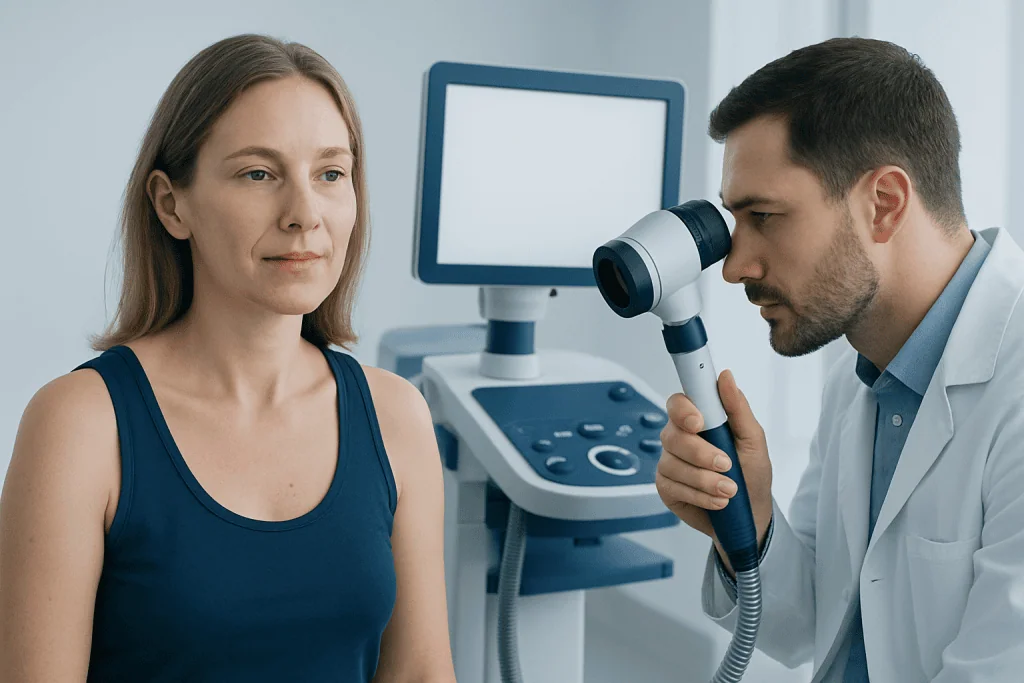
Doctors may use dermoscopy, a handheld tool that helps them view structures beneath the surface of the skin. This can improve the assessment of pigmented lesions and other suspicious spots. If the lesion remains concerning, the doctor will usually recommend a biopsy, which means removing part or all of the lesion for laboratory examination.
A biopsy is the only way to confirm a diagnosis of skin cancer. If cancer is found, further assessment depends on the type, size, depth, and location of the lesion. For melanoma or more advanced cases, additional imaging or lymph node evaluation may sometimes be needed, but many skin cancers are diagnosed and treated based on the skin examination and biopsy alone.
Treatment Options
Treatment depends on the type of skin cancer, its size, depth, location, and whether it has spread. Many skin cancers are treated successfully with surgery to remove the lesion and a margin of surrounding tissue. For some small or superficial lesions, doctors may consider other local treatments depending on the exact diagnosis.
Common approaches can include skin cancer treatment with surgical removal, curettage and cautery in selected cases, cryotherapy for some superficial lesions, topical medicines for certain pre-cancers or very superficial cancers, and radiotherapy when surgery is not the best option. Melanoma treatment may involve wider excision and, in some situations, lymph node assessment or systemic therapy.
Advanced skin cancers may require care from a multidisciplinary team. Options can include medical oncology therapies such as immunotherapy or targeted therapy, and in some situations radiation oncology to help control disease or reduce symptoms. The best plan is individualized after careful evaluation.
Near the end of the care pathway, patients may benefit from support with follow-up skin checks, scar care, and prevention of future sun damage. Acibadem International’s multidisciplinary specialists and JCI-accredited hospitals diagnose and treat skin cancer for international patients, with care tailored to the individual’s condition and overall health.
Prevention, Self-care, and When to See a Doctor
Prevention focuses mainly on reducing UV exposure. Helpful measures include seeking shade during strong midday sun, wearing protective clothing, a wide-brimmed hat, and UV-blocking sunglasses, and using a broad-spectrum sunscreen with appropriate SPF as directed on the label. Indoor tanning should be avoided.
Regular self-checks are a useful self-care habit, especially for people with many moles, previous skin cancer, or high sun exposure. It is also sensible to arrange routine skin examinations if recommended by a dermatologist or other doctor. Children and teenagers benefit from sun protection too, as skin damage can begin early in life.
A doctor should assess any lesion that is new, changing, bleeding, painful, repeatedly crusting, or not healing. Prompt review is also important for a dark streak under a nail, a sore on the lip, a changing mole, or a spot that looks very different from others. Seeking advice early does not mean the lesion is definitely cancer, but it does help ensure that important problems are not missed.
People who have already had skin cancer should keep follow-up appointments and continue monitoring their skin, because new skin cancers can develop over time. Ongoing skin awareness and sun-safe habits are practical steps that support long-term skin health.
Frequently asked questions
What does skin cancer usually look like at first?
Early skin cancer may look like a new spot, a changing mole, a scaly patch, a pearly bump, or a sore that does not heal. It does not always look dark or dramatic, so a lesion that simply seems different or keeps changing should be checked.
Does every unusual mole mean cancer?
No, many unusual-looking moles and skin lesions are benign. However, a doctor should assess any mole or spot that changes in size, shape, color, or symptoms, especially if it bleeds or does not heal.
Can skin cancer happen in people with dark skin?
Yes, skin cancer can occur in all skin tones. In darker skin, it may appear in less expected areas such as the palms, soles, or under the nails, so persistent or changing lesions in these places should not be ignored.
How often should skin be checked at home?
A monthly self-check is a practical routine for many people. Those at higher risk, such as people with many moles or a history of skin cancer, may also need regular professional skin exams based on their doctor’s advice.
Is a non-healing sore always skin cancer?
Not always. A non-healing sore can have several causes, including irritation, infection, or inflammatory skin conditions, but it is an important warning sign and should be assessed if it persists or repeatedly reopens.
How is skin cancer confirmed?
Doctors often begin with a skin examination and sometimes use dermoscopy to look more closely at the lesion. A biopsy, where part or all of the lesion is removed and examined in a laboratory, is needed to confirm the diagnosis.
References
- World Health Organization
- American Academy of Dermatology
- National Cancer Institute
- American Cancer Society
- National Health Service
This article is for general information only and is not a substitute for professional medical advice. Please consult a qualified doctor about your individual situation.
Skin Cancer in Turkey — costs, top hospitals & a free quote
JCI-accredited · board-certified surgeons · reply within 24h
Add us as a Preferred Source to see more of our trusted health content across Google Search, AI Overviews and Discover.