Smile eye surgery in Turkey: Hospitals, Safety & What to Expect

SMILE is a minimally invasive laser procedure designed to correct certain degrees of short-sightedness and astigmatism. Not everyone is a candidate; corneal thickness and shape, prescription stability, dry-eye symptoms and overall eye health must be assessed.
Key Takeaways
- SMILE is a minimally invasive laser procedure designed to correct certain degrees of short-sightedness and astigmatism.
- Not everyone is a candidate; corneal thickness and shape, prescription stability, dry-eye symptoms and overall eye health must be assessed.
- The laser part of treatment is brief, but planning, screening and postoperative monitoring are essential parts of the process.
- Most people notice improving vision within days, while visual stability and comfort can continue to develop over several weeks.
- Possible complications are uncommon but include dry eye, glare or halos, under- or over-correction, infection and rare vision-threatening problems.
- International patients should arrange sufficient time for assessment and early follow-up before travelling home.
Smile eye surgery in Turkey may be an appropriate option for adults seeking laser vision correction when a detailed eye assessment confirms that SMILE is suitable. Safety depends on more than the destination: the quality of preoperative testing, experienced refractive surgeons, accredited hospital systems and a clear follow-up plan are central to good care.
Overview: What Is SMILE Eye Surgery?
SMILE, meaning small incision lenticule extraction, is a form of laser refractive surgery that can reduce dependence on glasses or contact lenses. During the procedure, a femtosecond laser creates a small, lens-shaped piece of tissue (a lenticule) inside the cornea. The surgeon removes this tissue through a small opening, reshaping the cornea so that light focuses more accurately on the retina.
For people considering smile eye surgery in Turkey, the key question is not simply where the operation takes place, but whether the individual is a suitable candidate and whether care includes comprehensive assessment and follow-up. The procedure is usually performed as an outpatient treatment under numbing eye drops, and it does not require creation of the larger corneal flap used in LASIK.
SMILE is mainly used for myopia (short-sightedness), with or without astigmatism. It does not correct every type of refractive error, and alternatives such as LASIK, PRK, implantable lenses or lens-based surgery may be more appropriate for some eyes. A dedicated SMILE eye surgery assessment can help identify the safest option.
How SMILE Works and Its Potential Benefits
The cornea is the clear front surface of the eye. Its curvature helps bend light onto the retina, the light-sensitive tissue at the back of the eye. In myopia and astigmatism, the shape of the cornea or eye causes light to focus in the wrong place, making distant objects appear blurred. SMILE changes corneal shape by removing a precisely calculated lenticule.
Because the surgeon works through a small corneal incision, SMILE preserves more of the front corneal surface than flap-based laser procedures. Some patients may experience less early disruption of corneal nerves than with LASIK, although dry-eye symptoms can still occur after any laser vision correction procedure.
Potential benefits include reduced reliance on corrective lenses, a short procedure time and no corneal flap. Outcomes vary between individuals, however, and the goal is improved uncorrected vision rather than a guaranteed result. Reading glasses may still be needed later in life as presbyopia naturally develops, even after successful distance-vision correction.
Who May Be a Candidate?

Candidacy is determined through a detailed ophthalmic examination rather than by age or prescription alone. In general, candidates are adults with a stable glasses or contact lens prescription, healthy corneas and refractive errors within the range that the available SMILE platform can treat. The ophthalmologist will review medical history, eye symptoms, occupation and visual goals.
Testing commonly includes refraction measurements, corneal topography or tomography to map corneal shape, pachymetry to measure corneal thickness, pupil assessment and an evaluation of the tear film and retina. Contact lens wear can temporarily change corneal measurements, so patients may be asked to stop wearing lenses for a specified period before testing.
SMILE may not be recommended for people with unstable prescriptions, significant dry eye, keratoconus or suspicious corneal findings, certain corneal scars, active eye infection, uncontrolled diabetes or some autoimmune conditions. Pregnancy and breastfeeding can temporarily affect vision and corneal measurements, so surgery is commonly postponed. People with keratoconus or related corneal weakness need specialist assessment; keratoconus is not corrected with standard SMILE surgery.
- Ask whether the eye examination includes corneal tomography and retinal evaluation.
- Discuss work, driving, sports and screen-use needs, as these affect the most suitable treatment choice.
- Tell the team about all medicines, previous eye procedures and any history of herpes eye disease.
What to Expect Before, During and After the Procedure
Before surgery, the surgeon reviews the examination results, explains expected benefits and limitations, and obtains informed consent. Patients should receive practical instructions about stopping contact lenses, arranging transport after treatment and using prescribed eye drops. For international visitors, it is sensible to allow enough time in Turkey for initial assessment, surgery and the early postoperative check rather than scheduling immediate travel.
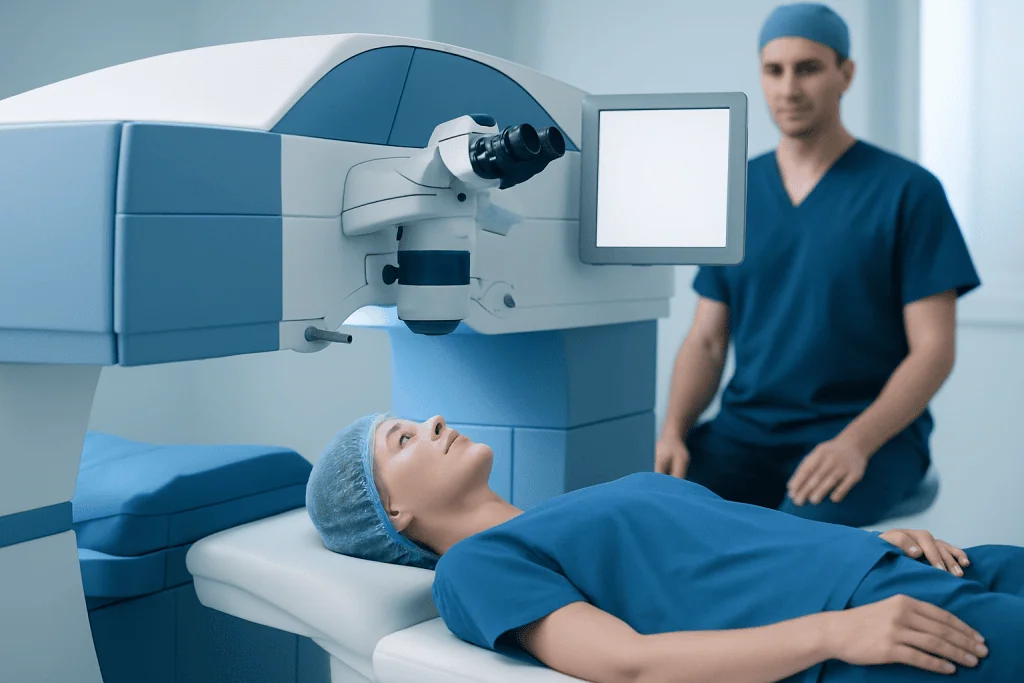
On the day of surgery, numbing drops are applied and the eyelids are gently held open. The patient looks at a fixation light while the femtosecond laser creates the lenticule and a small incision. The surgeon then removes the lenticule. The laser treatment itself is brief, although preparation and checks take longer. Both eyes are often treated during the same visit when clinically appropriate.
Vision may be hazy and the eyes may feel watery, gritty or sensitive to light for the first hours after surgery. Most patients rest on the day of treatment. They should avoid rubbing their eyes and follow the prescribed drop schedule carefully. The first review is often arranged the next day or soon afterwards, with further checks based on the surgeon’s advice and the patient’s travel plans.
Recovery Timeline and Everyday Care
Recovery varies, but many people notice functional vision within the first few days. Vision can fluctuate during early healing, and sharpness may continue to improve over several weeks. Mild dryness, glare around lights or reduced contrast in low light can occur during this period. A clinician should assess symptoms that are worsening rather than gradually improving.
Patients are usually advised to avoid eye rubbing, smoky or dusty environments and getting non-sterile water in the eyes during early recovery. Makeup, swimming, hot tubs and contact sports may need to be delayed for a period recommended by the surgeon. Sunglasses can improve comfort outdoors if light sensitivity is present.
Returning to desk-based work may be possible quickly for many patients, but timing depends on visual comfort, job demands and the individual recovery course. Driving should not resume until vision meets legal requirements and the patient feels comfortable, particularly at night. Attending all scheduled follow-up appointments is important, including after returning home if ongoing care is needed.
Safety, Risks and How to Assess Hospitals in Turkey
Laser vision correction has a well-established safety record when patients are appropriately selected and treated with modern equipment by trained ophthalmology teams. Nevertheless, no refractive procedure is risk-free. Potential effects include temporary dry eye, fluctuating vision, glare, halos, starbursts, reduced night-vision quality, residual prescription, over-correction or under-correction. Some people may still need glasses for specific tasks or may discuss enhancement treatment after healing.
Less common but more serious complications include infection, inflammation, corneal scarring, irregular corneal shape and loss of best-corrected vision. Prompt evaluation and treatment can be important if complications occur. A responsible consultation should explain both common short-term symptoms and rare serious risks without promising perfect vision.
When evaluating hospitals for smile eye surgery in Turkey, patients can ask about the ophthalmologist’s refractive surgery experience, the diagnostic tests used to assess corneal safety, laser technology, infection-control processes, informed-consent practices and written follow-up arrangements. International accreditation, such as Joint Commission International (JCI) accreditation where applicable, reflects assessment against recognised quality and patient-safety standards, but it does not replace a personalised clinical evaluation.
Patients travelling from abroad should also clarify language support, records to take home, emergency contact arrangements and coordination with a local ophthalmologist if needed. Acibadem International’s multidisciplinary specialists and JCI-accredited hospitals support the diagnosis and treatment of international patients, with care pathways tailored to clinical needs.
When to Seek Medical Care
After SMILE surgery, urgent medical advice is needed for increasing pain, a sudden reduction in vision, marked redness, thick discharge, new flashing lights, a curtain-like shadow, or severe light sensitivity. These symptoms do not always indicate a serious problem, but they should be assessed promptly rather than managed with extra drops or waiting at home.
Patients should also contact their eye team if blurred vision, dryness, glare or discomfort is not steadily improving as expected, or if prescribed drops cause a concerning reaction. Anyone who develops new eye symptoms before planned surgery should inform the clinic, as treatment may need to be delayed.
Before travelling for surgery, people with previous eye disease, diabetes, autoimmune disease, severe allergies or a history of eye trauma should seek a specialist opinion. A careful, individual assessment remains the most reliable way to decide whether SMILE, another refractive procedure or continued use of glasses or contact lenses is the best choice.
Frequently asked questions
Is SMILE eye surgery in Turkey safe?
SMILE can be safe when it is performed for an appropriate candidate after comprehensive eye testing and with structured postoperative care. Safety depends on the individual's eye health, the surgeon and clinical team, quality systems, and access to follow-up rather than location alone.
How long does SMILE eye surgery take?
The laser portion is usually very brief, while preparation, safety checks and postoperative instructions take longer. It is generally an outpatient procedure, so patients normally return to their accommodation the same day with a companion.
Is SMILE painful?
Numbing drops are used, so pain during treatment is usually minimal. Pressure, watering, grittiness or light sensitivity may occur in the first hours or days, and prescribed drops can help support comfort and healing.
How soon can a person see clearly after SMILE?
Many people experience useful vision within a few days, but clarity can fluctuate during early healing. Full visual recovery varies, and fine visual quality may continue to improve over several weeks.
Can SMILE correct astigmatism?
SMILE can treat certain ranges of myopia with astigmatism, depending on the laser platform and the individual's measurements. An ophthalmologist must confirm whether the prescription and corneal shape are suitable.
Will glasses still be needed after SMILE?
Some people may still need glasses for particular activities if a residual prescription remains. In addition, most adults eventually need reading glasses with age because of presbyopia, which SMILE does not prevent.
References
- American Academy of Ophthalmology
- U.S. Food and Drug Administration
- Royal College of Ophthalmologists
- European Society of Cataract and Refractive Surgeons
This article is for general information only and is not a substitute for professional medical advice. Please consult a qualified doctor about your individual situation.
Eye Surgery in Turkey — costs, top hospitals & a free quote
JCI-accredited · board-certified surgeons · reply within 24h
Add us as a Preferred Source to see more of our trusted health content across Google Search, AI Overviews and Discover.

Ophthalmology
Comprehensive eye care from laser vision correction to retina, cornea and cataract surgery.
75 specialists in this unit