All On 4
All On 4 is a full-arch dental implant technique that supports a fixed temporary prosthesis on four implants, helping patients with missing teeth regain function and appearance.
Quick answer
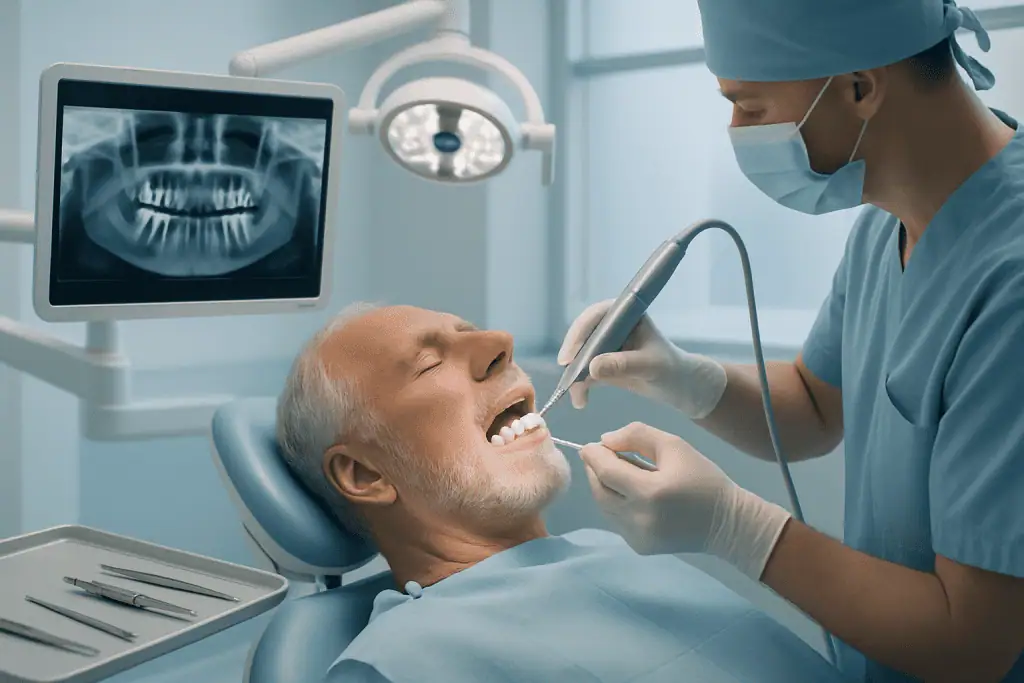
All On 4 is a full-arch dental implant technique that replaces all the teeth in one jaw with a fixed bridge supported by four implants. The two back implants are usually angled to make better use of available bone. In suitable cases, a fixed temporary bridge is attached soon after surgery; the final prosthesis is fitted once the implants have integrated with the jawbone.
What All On 4 Treatment Is
All On 4 is a full-arch dental implant technique in which a complete set of replacement teeth is supported by four dental implants placed in the jaw. It replaces every tooth in the upper or lower arch with a single fixed bridge, rather than a removable denture. It is designed for people who have lost all the teeth in one jaw, or whose remaining teeth are failing and cannot be predictably saved.
The basic concept is straightforward. Four implants are positioned at strategic points in the jawbone. The two implants toward the front are usually placed more vertically, while the two toward the back are placed at an angle. The prosthesis, a full arch of replacement teeth, is then fixed to those implants and designed to distribute chewing forces evenly across all four.
Treatment usually involves two prosthetic phases. The first is a fixed temporary bridge, sometimes attached on the day of surgery or shortly afterwards, provided the implants achieve enough initial stability. This temporary bridge lets you smile, speak and eat soft foods while the implants heal beneath it. The second phase is the final prosthesis, made months later once the implants have bonded with the jawbone and the gums have settled. The final bridge is built for long-term function, comfort and appearance, and it replaces the temporary one entirely.
All On 4 can be an efficient way to restore a full arch, but it is not a shortcut and it is not right for everyone. Some patients need additional implants, bone grafting, sinus procedures, gum treatment or a different full-arch plan altogether. The safest treatment plan follows your bone quality, medical history, bite pattern, gum condition, facial structure and expectations, not a fixed formula.
How is All On 4 different from a removable denture?
An All On 4 bridge is fixed to implants anchored in the jawbone, while a conventional denture rests on the gums and is taken out for cleaning. Because the bridge does not move during speaking or eating, it avoids the slipping, sore spots and adhesive that frustrate many denture wearers. It also transmits chewing force into the bone through the implants, which is closer to the way natural tooth roots work. The trade-off is that it is a surgical treatment: it requires healthy enough bone, a healing period and lifelong maintenance.
Why are the back implants angled?
The back implants are angled to make the most of the bone that is actually available. In the back of the upper jaw, the sinus cavities often limit how deep a vertical implant can go; in the lower jaw, a nerve runs through the bone and must be avoided. By tilting the posterior implants, the surgeon can engage longer stretches of stronger bone, keep clear of these structures and, in selected patients, reduce or avoid the need for extensive grafting.
Is All On 4 the same as ordinary dental implants?
All On 4 uses the same implant technology as single-tooth treatment, but the planning is fundamentally different. Conventional dental implants replace individual teeth one fixture at a time, often with one implant per missing tooth. All On 4 restores an entire arch on four fixtures, so implant position, angulation, bite design and prosthesis engineering all have to work together as a single system. That is why full-arch treatment is planned jointly by the surgical and prosthetic sides of the team rather than as a series of separate implants.
 Dr. Şule ErenMDBoard Commentary
Immediate fixed teeth should be viewed as the result of adequate implant stability, not simply as a faster treatment option. Research involving Assoc. Prof. Ferit Bayram, who currently practices at Acıbadem, has shown that bone–implant contact and the condition of the implant site influence primary mechanical stability, with healed sites demonstrating higher initial stability than immediate extraction sites in the studied patients. This is particularly relevant to All-on-4 treatment, where immediate loading should only be considered when sufficient primary stability is achieved. International evidence also supports the long-term predictability of the concept: a 2026 systematic review and meta-analysis of 55 studies reported pooled All-on-4 implant survival rates of 99.2% at 1 year, 99.66% at 1–5 years and 98.14% beyond 5 years. These figures represent published international evidence rather than Acıbadem-specific success rates. In practice, bone quality, implant distribution, insertion stability, bite forces and prosthetic design should all be considered before deciding whether a patient is suitable for immediate fixed loading.
When Missing Teeth Affect Daily Life
Losing most or all of your teeth changes far more than your smile. It changes how you eat, how clearly you speak, how comfortable you feel at a shared table and how confident you are meeting new people. Many people who consider All On 4 have already lived through years of loose dentures, failing teeth, advanced gum disease or repeated dental work that no longer feels sustainable. Some have quietly narrowed their diet to soft foods. Others avoid photographs or cover their mouth when they laugh.
The concerns people bring to a full-arch consultation are usually practical. Will it hurt? How many visits are needed? Is there enough bone left? What will I look like during the months of healing? These are reasonable questions, and a good consultation answers them honestly rather than glossing over them. All On 4 exists precisely for this situation: it offers a fixed, non-removable set of teeth to people who need a complete upper or lower arch replaced, and, in carefully selected cases, it lets them leave the surgical appointment with temporary teeth already in place, so they are never without a smile during healing.
Who May Need All On 4 Treatment
Patients who consider All On 4 usually have a long dental history behind them. Some have worn removable dentures for years and are tired of adhesive, sore spots, slipping and the limits it places on eating. Others still have their own teeth, but the teeth are loose, painful, infected, heavily restored or affected by advanced periodontal disease. Some seek treatment because long-term tooth loss has changed the shape of their face, or because unstable teeth make them self-conscious when speaking or smiling.
Common situations that lead to an All On 4 consultation include:
- Complete tooth loss in the upper jaw, the lower jaw or both.
- Loose, uncomfortable or poorly retained removable dentures.
- Advanced gum disease causing tooth mobility and bone loss.
- Multiple broken, decayed or infected teeth that cannot be predictably saved.
- Previous dental work that has failed or is no longer functional.
- Difficulty chewing a normal diet because of missing or unstable teeth.
- Changes in speech, facial support or smile appearance caused by tooth loss.
- A firm preference for fixed teeth over a removable denture.
Who is a good candidate for All On 4?
A good candidate needs a full arch replaced, has enough healthy bone in the right areas to anchor four implants, and is medically well enough to heal from oral surgery. Candidacy is confirmed through examination and imaging, never assumed. Your dentist or oral surgeon evaluates the teeth, gums, bite, jaw relationship, smile line, facial proportions and any signs of infection. Panoramic X-rays and three-dimensional dental imaging assess bone volume, bone density, nerve position, sinus anatomy and areas of inflammation. Digital scans or impressions help plan the shape and position of the future prosthesis before any surgery takes place.
Your medical history matters just as much as your mouth. Conditions such as uncontrolled diabetes, heavy smoking, immune suppression, recent cancer therapy, certain bone medications or severe untreated gum infection can affect healing and implant integration. These factors do not automatically rule treatment out, but they must be weighed before surgery, and sometimes they change the plan. Recent medical records, a current medication list and any relevant laboratory results all help the dental team plan safely. Decisions about any medication always rest with your treating doctors.
Can you have All On 4 if you have bone loss?
Often yes, because the angled posterior implants are specifically intended to work around moderate bone loss by engaging stronger areas of remaining bone. That is one of the technique’s main advantages. But bone loss has degrees. If the loss is severe, the team may recommend bone grafting to rebuild volume, a sinus lifting procedure to create implant space in the back of the upper jaw, or, where the upper jaw offers very little usable bone, zygomatic implants anchored in the cheekbone. Only three-dimensional imaging can show which route is realistic for you.
Conditions and Indications Addressed by All On 4
All On 4 addresses the functional and aesthetic consequences of full-arch tooth loss or severe dental failure. It is considered when the goal is to replace an entire dental arch, upper, lower or both, with a fixed, implant-supported restoration. Several distinct clinical situations lead there.
Edentulism
Edentulism means having no natural teeth in a jaw. For fully edentulous patients, the choice is usually between a conventional denture, an implant-retained overdenture and a fixed full-arch bridge. All On 4 sits at the fixed end of that spectrum: the teeth stay fixed in the mouth and are cleaned in place rather than removed at night.
Terminal dentition
Terminal dentition is the term dentists use when the remaining teeth are unlikely to stay healthy or functional over time, typically because of advanced decay, gum disease or repeated failed restorations. In these cases, trying to save individual teeth can mean an open-ended series of procedures with uncertain long-term value. Removing the failing teeth and moving to a planned full-arch restoration can sometimes be the more stable and predictable path. That judgement should be made carefully; a responsible team will tell you when teeth are still worth saving.
Denture intolerance
Denture intolerance describes the situation where removable dentures simply do not work for a patient, however well made. Some people manage dentures comfortably for decades; others experience constant movement, difficulty chewing, gagging, sore gums or a loss of confidence that never resolves. Because an All On 4 bridge is attached to implants rather than resting on the gums, it removes the instability that drives most of these problems.
Limited bone and complex anatomy
For selected patients with bone loss, All On 4 is attractive because the tilted posterior implants let the surgeon use stronger bone and steer around the sinuses and nerves. It is not correct, however, to assume four implants are always enough. If the bite is very strong, the bone is limited, the jaw anatomy is complex, or both arches need treatment at once, the team may recommend a modified plan with additional implants or staged procedures. The number four is a starting concept, not a rule.
How All On 4 Treatment Is Performed
Consultation and personalised planning
The process begins with a consultation that looks at both oral health and general health. The clinical team discusses your symptoms, previous dental treatment, medical conditions, medications, smoking status and expectations. Photographs, X-rays, three-dimensional imaging and digital scans are combined into a detailed plan that answers the key questions in advance: do any teeth need removing, does infection need treating first, can the bone support implants in the planned positions, and what type of temporary prosthesis is appropriate for you.
Preliminary records such as photographs and radiographs can help the team form an initial opinion about feasibility and sequencing. A final treatment plan, though, always requires in-person examination and imaging, because implant placement depends on precise anatomy and real-time clinical findings that records alone cannot fully capture.
Preparation before surgery
Before the procedure, your dentist or surgeon explains the surgical plan, the anaesthesia or sedation options, the expected recovery and your home-care instructions. Active infection, gum inflammation or medical conditions that need optimising are addressed first where necessary. Some patients have their remaining teeth extracted at the same appointment as implant placement; others have extractions or preliminary treatment earlier, in a separate stage.
Preparation also includes designing the temporary prosthesis before surgery ever begins. The aim is a set of teeth that supports your lips and face, lets you speak comfortably and looks natural, while protecting the implants underneath during healing. Bite planning is critical at this stage: the temporary bridge must be strong enough for daily use yet designed to keep excessive pressure off newly placed implants.
What happens during All On 4 surgery?
The surgical visit follows a planned sequence, carried out under local anaesthesia with sedation options considered case by case:
- The treatment area is numbed and, where agreed, sedation is administered.
- Any remaining teeth are removed carefully, preserving as much bone and soft tissue as possible.
- The jawbone is shaped where needed and the implant sites are prepared according to the plan, in some cases with a surgical guide made from the three-dimensional planning.
- Four implants are placed: the front pair in the region where bone is usually more available, the back pair angled to maximise contact with sound bone and to support the bridge effectively.
- The surgeon checks the stability of each implant, manages the gum tissue and attaches the components that will connect the implants to the prosthesis.
- If the implants are stable enough and conditions are suitable, a fixed temporary bridge is attached the same day or soon afterwards; the bite is checked and adjusted before you leave.
What is immediate loading?
Immediate loading means attaching a fixed temporary bridge to the implants at, or very soon after, the surgical appointment, rather than waiting for full healing first. It is possible only when the implants achieve strong initial stability in the bone. When bone quality, implant stability or other clinical factors suggest that healing would be safer without early pressure, the team recommends a delayed approach, usually with a temporary removable option in the meantime. This is a clinical judgement made at the time of surgery, and it exists to protect the implants, speed is never worth a compromised foundation.
Technology used in planning and treatment
Modern full-arch treatment relies on careful digital and radiographic planning. Three-dimensional imaging maps bone volume, nerve pathways, sinus position and the relationship between the jaws. Digital impressions and intraoral scans reduce the need for conventional impression materials and produce accurate models for prosthetic design. In selected cases, surgical guides translate the digital plan into the mouth with greater precision.
The prosthetic side benefits from the same digital workflow. The shape, length, colour and position of the teeth are planned in relation to your smile, lips and facial features, important in full-arch work, because the bridge must restore not only teeth but also facial support, speech patterns and chewing function. The technology serves a practical purpose: implants in the right positions, teeth that suit your face and bite, and less avoidable uncertainty on the day of surgery.
How long does All On 4 treatment take?
The surgical visit for one arch typically takes several hours, depending on whether extractions, bone shaping or other procedures are needed; treating both arches makes the appointment longer and the planning more complex. Allow additional time on the day for fitting, adjusting and checking the temporary bridge. After surgery, the implants need several months to bond with the jawbone through a biological process called osseointegration. Follow-up visits during this period monitor healing, adjust the bite and keep the temporary bridge comfortable. Once the implants are stable and the tissues have matured, the final prosthesis is made and fitted: the point at which treatment moves from healing to long-term function.
Recovery After All On 4 Treatment
Recovery has two overlapping layers: the visible healing of the gums and soft tissue in the first days and weeks, and the slower, invisible integration of the implants into the bone over the following months. Both need protecting, and your habits during this period genuinely influence the result.
Is All On 4 recovery painful?
Expect some swelling, bruising, soreness and mild bleeding after surgery, most noticeably in the first few days. This discomfort is normal and is managed with the medication your team prescribes, cold compresses and careful oral hygiene. It typically peaks early and then settles as the tissues heal. What recovery feels like varies between patients, and your team will tell you what pattern to expect for your specific surgery.
What can you eat after All On 4 surgery?
A liquid or very soft diet in the earliest days, then soft foods for the period your team specifies. This is not merely a comfort measure: it is part of the biology. Hard or chewy food loads the implants before they have bonded to the bone, and osseointegration needs a quiet mechanical environment to complete. As healing progresses and the team confirms stability, the diet broadens step by step, and many patients eventually return to a much wider range of foods than loose dentures ever allowed.
How do you clean an All On 4 bridge?
The bridge is cleaned in place, with particular attention to the junction between the prosthesis and the gums. Implant-supported teeth cannot decay the way natural teeth do, but the gums and bone around implants can become inflamed if plaque accumulates: a condition that can lead to bone loss if left untreated. You will be shown how to clean under and around the bridge using interdental brushes, water irrigators or other aids suited to your prosthesis. Daily hygiene plus regular professional maintenance visits is the combination that protects the implants for the long term.
The timeline below gives a general picture of what many patients experience after full-arch implant surgery. Your own course may differ, and your team’s instructions always take precedence.
| Time Period | What Patients Can Expect |
|---|---|
| Day 1 | Numbness gradually wears off. Mild bleeding, swelling and soreness are common. Patients begin prescribed medications and follow liquid or very soft-food instructions. |
| First Week | Swelling and bruising usually peak and then begin to improve. The dental team may check healing and adjust the temporary prosthesis if needed. |
| First Month | Patients continue a soft diet and careful cleaning. Speech and chewing with the temporary bridge become more familiar as the mouth adapts. |
| Healing Months | The implants integrate with the jawbone. Follow-up visits monitor gum health, bite forces and comfort of the temporary prosthesis. |
| Longer Term | After integration and tissue maturation, the final prosthesis is designed and fitted. Ongoing maintenance visits help protect implant health. |
Why Acting Early Matters
Delaying treatment for severe dental disease or complete tooth loss tends to make future care more complex, not simpler. When teeth are missing, the jawbone no longer receives normal stimulation from tooth roots and gradually shrinks. Advanced gum disease destroys supporting bone and soft tissue in its own right. Over time, this can narrow your implant options and increase the likelihood of needing grafting or staged procedures before implants become possible at all.
Untreated dental infection carries its own costs: pain, swelling, bad breath and difficulty eating, and in some cases spread beyond the tooth and gum tissues. For patients with certain medical conditions, chronic oral infection adds an avoidable burden on overall health. Nutrition suffers too, because people with unstable teeth quietly stop eating vegetables, nuts, meats and firm fruits, exactly the foods that demand stable chewing.
There is also an emotional cost to waiting. Many patients drift into avoiding photographs, social meals or professional situations, and that avoidance becomes a habit long before it becomes a decision. Early evaluation does not mean immediate surgery. What it does is clarify your options while more of them are still open: whether teeth can be saved, whether All On 4 is appropriate, or whether a different plan would serve you better.
Potential Benefits of All On 4 Treatment
For suitable patients, All On 4 can offer meaningful functional, aesthetic and lifestyle benefits compared with living without teeth or relying on unstable removable dentures. The table summarises what each benefit means in practice.
| Benefit | What It Means for You |
|---|---|
| Fixed replacement teeth | The bridge is attached to implants, so it does not move like a traditional removable denture during speaking or eating. |
| Improved chewing ability | Many patients can return to a broader diet after healing, although soft-food instructions must be followed during the early recovery phase. |
| Natural-looking smile design | The prosthesis is planned to match facial proportions, lip support, tooth shape and smile aesthetics. |
| Efficient full-arch solution | Four strategically placed implants can support a complete arch in selected patients, sometimes reducing the need for more extensive surgery. |
| Support for facial structure | Replacing missing teeth can help restore lip and cheek support that may be lost with long-term tooth loss. |
| Greater comfort than loose dentures | A fixed bridge can reduce denture movement, sore spots and the need for denture adhesive. |
Factors That Influence the Outcome
The outcome of All On 4 depends on far more than placing four implants. It is a coordinated surgical and prosthetic treatment, and every step matters. The first factor is case selection: you need enough healthy bone in the right areas to anchor the implants and withstand chewing forces. Where bone is weak, thin or affected by infection, the plan changes, and an honest team will say so rather than force the technique.
Implant stability at the time of placement matters, especially when an immediate fixed bridge is planned. Loading implants that are not stable enough raises the risk of failure, which is why immediate loading is a conditional decision, not a default. When in doubt, a staged approach is the safer road.
General health shapes healing. Well-controlled diabetes, good nutrition and avoiding tobacco all support recovery; smoking is associated with a higher risk of implant complications and gum problems. Patients who clench or grind their teeth may need special bite planning or a protective night guard after treatment, because grinding forces are among the hardest loads a full-arch bridge ever carries. Gum health must be maintained for life, since inflammation around implants can lead to bone loss if untreated.
Prosthesis quality is the factor patients see least and feel most. The temporary bridge must protect the implants during healing; the final bridge must be engineered for comfort, speech, hygiene access and balanced chewing forces. Poorly distributed bite pressure can overload implants or break prosthetic components, while a well-designed bridge lets you clean effectively around the implants and underneath the teeth.
How long does an All On 4 bridge last?
There is no fixed lifespan, because longevity depends on the factors above: bone quality, bite forces, gum health, prosthesis design and, above all, maintenance. A well-planned bridge that is cleaned daily and reviewed regularly can serve for many years, with components such as screws or the prosthetic teeth themselves occasionally needing repair or renewal along the way. Treatment does not end when the final teeth are fitted; it changes into a maintenance phase, and patients who accept that are the ones who protect their investment.
Why might an All On 4 treatment run into problems?
The recurring causes are inflammation around the implants from accumulated plaque, mechanical overload from a heavy or unbalanced bite, smoking, uncontrolled medical conditions that impair healing, and skipped maintenance visits. Most of these are influenced by planning and by daily habits, which is why candidate selection and patient commitment are discussed so openly before surgery. Any looseness, persistent discomfort or change in the bite should be assessed by a dentist rather than watched and waited on, because early problems are far easier to correct than established ones.
Alternatives to All On 4
All On 4 is one full-arch strategy among several, and a responsible consultation always sets out the alternatives. Depending on your anatomy and priorities, these may include:
- Full-arch bridges on more than four implantswhen the bite is strong, the bone allows it, or the team prefers extra support, an arch can be restored on additional fixtures.
- Implant-supported overdenturesremovable dentures that clip onto implants, offering more stability than conventional dentures at a lower surgical scope, though without the fixed feel of a bridge.
- Conventional dental implantsreplacing individual teeth or short spans where enough sound teeth remain and full clearance is not justified.
- Bone grafting or sinus lifting followed by staged implant treatmentrebuilding bone first, then placing implants once the graft has matured.
- Zygomatic implantslonger implants anchored in the cheekbone for patients whose upper jaw offers too little bone even for angled fixtures.
- Saving the remaining teethwhere the teeth are genuinely restorable, periodontal and restorative treatment may still be the better answer.
None of these options is universally superior. The right choice follows from imaging, examination and an honest conversation about what you want your teeth to do for the next decades. An overview of the wider range of dental treatments can help you place full-arch options in context.
How All On 4 Is Planned at Acibadem
Full-arch implant treatment at Acibadem is planned by dental professionals who consider the surgical, prosthetic and aesthetic aspects together. Depending on the case, oral surgeons, implant dentists, prosthodontic specialists and dental technicians contribute to the plan, and when a patient’s medical condition calls for it, physicians from other specialties can be involved. The point of this multidisciplinary structure is simple: a full-arch case touches surgery, bite mechanics, facial aesthetics and general health at the same time, and no single perspective covers all four.
Evidence-based protocols guide diagnosis, implant planning, infection control, anaesthesia decisions and follow-up. Advanced imaging and digital planning tools support the evaluation of bone anatomy and the design of the prosthesis. For patients with heart disease, diabetes, a cancer history or complex medication regimes, planning within a hospital setting means broader medical support is available around the dental treatment when it is needed.
Follow-up itself deserves early attention in any full-arch plan: treatment spans months, so a good plan states clearly when reviews take place and how the healing period and the final-prosthesis phase will be monitored, from the first days after surgery through to long-term maintenance.
What a Thorough Evaluation Should Tell You
Wherever you are treated, a proper full-arch evaluation ends with clear answers, not vague reassurance. Before agreeing to All On 4, you should understand whether you are a candidate for an immediate fixed temporary bridge or a delayed approach; whether extractions, grafting or preliminary gum treatment are required; how many visits the plan involves and over what period; what restrictions apply while the implants heal; what type of final prosthesis is recommended and why; and which alternatives were considered for your case and on what grounds they were set aside.
Aesthetic planning deserves the same clarity. The right full-arch restoration is not simply a row of white teeth: it must harmonise with your lips, gums, smile line, skin tone, age, speech and facial support. Say openly what you want in tooth shape, shade and how natural or characterised the result should look; the clinical team’s job is to balance those wishes against functional requirements and biological limits, and to tell you plainly where the limits are.
Approached this way, All On 4 is neither a miracle nor a gamble. It is a well-established full-arch technique that, in the right patient, restores fixed teeth, improves chewing and removes the daily compromises of failing teeth or loose dentures, and that, in the wrong patient, is honestly replaced by a better-suited plan. Careful evaluation is what separates the two.
Preparation
- A dental examination, panoramic X-ray or 3D imaging, and bite assessment are performed to plan implant placement. Patients should share medical history, medications, allergies, and smoking status. Any active gum infection or oral health problem may need treatment before the procedure.
Aftercare
- Mild swelling, bruising, and discomfort are common in the first few days and are managed with prescribed medication and cold compresses. Patients usually follow a soft-food diet while the implants heal and must maintain careful oral hygiene. Follow-up visits are needed to monitor healing and plan the final prosthesis.
Frequently Asked Questions
What affects the cost of All-on-Four treatment?
The final cost depends on oral health, extractions, bone volume, implant system, prosthetic material, imaging, anaesthesia needs, laboratory work and follow-up planning. A specialist assessment is needed to confirm what is clinically suitable.
How can I get a personalised quote?
You can request a free consultation and share dental X-rays, scans or photographs if available. The clinical team can then review your case and prepare a personalised treatment plan and cost estimate.
Are travel and accommodation usually included?
Some international patient packages may include care coordination, interpreter support, airport transfer guidance or accommodation assistance. Inclusions vary, so the quote should clearly state what is covered and what is separate.
Does the temporary fixed prosthesis affect the price?
Yes. The design, material, laboratory process and adjustments for the temporary prosthesis can influence the overall fee, as can the later final prosthesis that is placed after healing.
Is All-on-Four suitable for every patient with missing teeth?
No. Suitability depends on bone structure, gum health, medical history, bite forces, hygiene ability and aesthetic goals. A dentist or oral and maxillofacial specialist should decide after examination and imaging.
Medically reviewed by the Acıbadem International Medical Board August 30, 2026
See our medical review board →
Update history
- PublishedJune 8, 2026
- Medical review approvedAugust 30, 2026
- Board commentary addedAugust 27, 2026
- Board commentary updatedAugust 30, 2026
- Last content updateAugust 30, 2026
References10
- Sources reviewed for this page, including research published by Acıbadem physicians.
- 1. Güncü MB, Çakan U, Canay S. Comparison of 3 luting agents on retention of implant-supported crowns on 2 different abutments. Implant Dent. 2011;20(5):349-353. doi:10.1097/ID.0b013e318225f68e. PMID: 21811170. [Laboratory study]
- Published with an affiliation to the Department of Dentistry, Acibadem Kadikoy Hospital; the study examined prosthetic retention in implant-supported restorations.
- 2. Askin Ekinci S, Fettahzade S, Gocmen G, Bayram F, Ozkan Y. Virtual bone-implant contact surface effect on implant stability in fresh extraction and healed sites: a pilot randomised clinical trial. Sci Rep. 2026;16:17096. doi:10.1038/s41598-026-48697-8. PMID: 41974820. [Randomized clinical trial]
- The study included Assoc. Prof. Ferit Bayram, currently an Acıbadem oral and maxillofacial surgeon, and investigated bone–implant contact and primary implant stability in 30 patients. The research itself was conducted under Marmara University affiliation.
- 3. Shao WH, Chen R, Wang S, Duan SY, Zhang XD, Tang YL. All-on-4 and All-on-6 implant-supported fixed prostheses for the edentulous jaw: a systematic review and meta-analysis. Int J Oral Maxillofac Surg. 2026;55(9):1098-1112. doi:10.1016/j.ijom.2026.04.002. PMID: 42031576. [Systematic review and meta-analysis]
- Analysis of 55 studies providing contemporary evidence on implant survival, marginal bone loss and complications after All-on-4 and All-on-6 rehabilitation.
- 4. Peñarrocha-Diago M, Peñarrocha-Diago M, Zaragozí-Alonso R, Soto-Peñaloza D; Ticare Consensus. Consensus statements and clinical recommendations on treatment indications, surgical procedures, prosthetic protocols and complications following All-On-4 standard treatment. J Clin Exp Dent. 2017;9(5). doi:10.4317/jced.53759. PMID: 28512551. [Expert consensus / Review]
- my.clevelandclinic.org
- nhs.uk
Read this treatment guide in your language
Planning this treatment in Turkey
Our English guides for international patients: costs, timelines, safety and travel.
Planning tools for this treatment
Indicative figures for orientation only: your written plan and quote follow a free medical review.
Trusted care for international patients
Compare options, costs and recovery
All-on-4 costsledger-based guide ranges, or browse the full Turkey Medical Price Index.
From the Acibadem Blog

All On 4 Healing Timeline: Soft Diet Weeks, Bone Integration and the Final Bridge Switch
All-on-4 healing usually unfolds in stages. Swelling and soreness peak in the first two to three days and settle over one to two weeks,…

Is All On 4 Possible With Bone Loss? How Angled Implants Use the Bone You Still Have
Often, yes. All-on-4 with bone loss is frequently possible because the technique places four implants where bone usually remains, at the front of the…
What Happens on the Day of All On 4 Surgery: Extractions, Angled Implants and Temporary Teeth
On all on 4 surgery day, a surgeon typically removes any remaining teeth in one arch, smooths the bone, places four implants (two upright…
All-on-4 Dental Implants Cost: What Is (and Is Not) in the Price
All-on-4 dental implants generally cost EUR 3,250–8,450 per jaw in our guide range for international patients in Turkey, versus roughly GBP 10,000–18,000 in the…