Asbestosis Treatment
Asbestosis is a chronic lung disease caused by inhaled asbestos fibers. Care focuses on diagnosis, exposure prevention, symptom control, pulmonary rehabilitation, vaccination, and monitoring for complications.

Quick answer
Asbestosis is chronic scarring of the lungs caused by inhaled asbestos fibres, usually after years of occupational exposure. The scarring cannot be reversed, so treatment is a long-term plan: confirming the diagnosis with breathing tests and CT imaging, preventing further exposure, relieving breathlessness, pulmonary rehabilitation, vaccination against respiratory infections, and regular monitoring for complications such as lung cancer and mesothelioma.
Asbestosis and Asbestos: What the Diagnosis Actually Means
Asbestosis is a chronic lung disease caused by inhaled asbestos fibres. Once inside the lungs, the fibres provoke slow, persistent inflammation that leads to scarring of the lung tissue: a process called pulmonary fibrosis. Scarred lungs become stiff and less efficient at moving oxygen into the bloodstream, which is why breathlessness is usually the first symptom people notice. Asbestosis develops in people who had substantial asbestos exposure, most often through work, and it typically appears decades after that exposure took place.
A diagnosis of asbestosis can be unsettling precisely because of that delay. Many people diagnosed today worked in construction, shipbuilding, insulation fitting, manufacturing, automotive repair, demolition or heating engineering many years ago. Others were exposed second-hand, through dust carried home on a family member’s clothing, hair or tools. Because the disease develops so slowly, the shortness of breath, persistent dry cough or reduced stamina that finally prompts a medical review often feels disconnected from its cause. Surprise, frustration and anxiety are common and understandable reactions.
It helps to be clear from the start about what treatment can and cannot do. The scarring itself cannot be reversed, and no medication removes asbestos fibres from the lungs once they are there. What careful, structured care can do is confirm that the diagnosis is correct, measure how far the disease has progressed, protect the healthy lung tissue that remains, relieve symptoms where possible, reduce the risk of respiratory infections, and identify complications early, when the widest range of options is still open. This page explains asbestosis and asbestos-related disease in plain terms: what the condition is, how it is detected, what treatment involves, and what living with it over the long term realistically looks like.
What is asbestosis?
Asbestosis is permanent scarring of the lung tissue caused specifically by inhaled asbestos fibres. Its main characteristics are a long delay, often decades, between exposure and the first symptoms; scarring that usually begins at the bases of the lungs; a restrictive pattern on breathing tests, meaning the lungs cannot expand fully; fine crackling sounds that a physician may hear through a stethoscope at the lung bases; and, in some people, clubbing, a change in the shape of the fingertips associated with chronic lung disease. Asbestosis is a fibrotic, non-cancerous condition, a distinction explained further below, and its severity ranges widely, from mild scarring found incidentally on a scan to advanced fibrosis that limits everyday activity.
What is asbestos?
Asbestos is the collective name for a group of naturally occurring minerals whose crystals form long, thin, extremely durable fibres. Six mineral types fall under the name, commonly grouped into serpentine fibres, chrysotile, often called white asbestos, and amphibole fibres, which include crocidolite and amosite; amphibole fibres are generally regarded as the more biologically persistent. Because these fibres resist heat, fire, electricity and chemical corrosion, asbestos was used for much of the twentieth century in insulation, roofing, cement products, floor tiles, pipe lagging, boilers, ships, brake linings and fireproofing. You will sometimes see the word misspelled in searches, abestos and aspastus are common variants, but every spelling refers to the same group of minerals. The danger comes not from intact, sealed material but from microscopic fibres released into the air when asbestos-containing products are cut, drilled, sanded, broken up or left to deteriorate.
Is asbestos still used today?
Yes, in some parts of the world, although many countries, including the United Kingdom and the member states of the European Union, have banned it. Even where bans exist, large quantities of asbestos remain inside older buildings, ships, machinery and infrastructure, which is why new exposure still happens during renovation, demolition and maintenance work on structures built before the bans took effect. In countries where asbestos is still mined or manufactured into products, occupational exposure continues. The practical message is the same everywhere: the mineral has not disappeared from the built environment, and disturbing old material without proper controls remains the most common route to modern-day exposure. Asbestos removal should only ever be carried out by qualified professionals working under regulated safety procedures, never as a do-it-yourself project.
Asbestos Exposure: How It Affects the Body
Asbestos exposure means breathing in, or, far less commonly, swallowing, microscopic asbestos fibres that have been released into the air. The lungs clear many inhaled particles naturally, but asbestos fibres are long, thin and biologically persistent: the body’s defence cells cannot break them down. Fibres that reach the deep lung can remain there for life, and the diseases they cause reflect that persistence.
What does asbestos do to humans?
Inhaled asbestos fibres can damage both the lung tissue itself and the pleura, the thin membrane that lines the lungs and the inside of the chest wall. Over time this can produce several distinct conditions. Asbestosis is the lung scarring described on this page. Pleural plaques are patches of thickened pleura that usually cause no symptoms and act mainly as durable markers of past exposure. Diffuse pleural thickening is more extensive scarring of the lining that can restrict how far the lung expands. Pleural effusions are collections of fluid around the lung. Asbestos also increases the risk of lung cancer and of mesothelioma, a cancer of the pleural lining strongly linked to this mineral. Which of these develops, if any, depends heavily on how much asbestos a person inhaled, over how long, which fibre type was involved, and individual factors such as smoking.
Will I be OK if I breathed in asbestos?
A brief, one-off exposure carries far less risk than years of heavy occupational contact, and many people with limited exposure never develop an asbestos-related disease. That reassurance has limits, however: no level of exposure is officially regarded as completely safe, no test can remove fibres once they have been inhaled, and no scan can predict with certainty what will happen decades from now. Risk rises with the intensity and duration of exposure. If you know you have breathed in asbestos, the genuinely useful steps are practical ones: avoid any further exposure, keep a written record of when, where and how the contact happened, make sure the exposure is documented in your medical history, and, if you smoke, treat stopping as a priority, because tobacco greatly amplifies asbestos-related lung cancer risk.
Is asbestosis cancer?
No, asbestosis is not cancer. It is a benign, meaning non-cancerous, scarring disease of the lung tissue. Scar tissue does not spread the way a tumour does, does not invade other organs, and is not treated with cancer therapies such as chemotherapy or radiotherapy. Confusion is common because asbestos also causes cancers, and because asbestosis and mesothelioma are often mentioned in the same breath. They are different diseases, with different behaviour, different treatment pathways and different monitoring needs.
Does asbestosis cause cancer?
Asbestosis does not itself turn into cancer, but the two concerns are closely linked. The level of asbestos exposure heavy enough to cause asbestosis also raises the lifetime risk of lung cancer and mesothelioma, so a diagnosis of asbestosis identifies someone whose cancer risk is higher than average. This is one of the central reasons long-term monitoring matters: the same follow-up that tracks lung scarring also gives clinicians the opportunity to recognise suspicious changes early. Smoking multiplies the lung cancer risk associated with asbestos, which is why smoking cessation is treated as a core element of asbestosis care rather than an optional extra.
What Are the Symptoms of Asbestosis?
The most common symptoms of asbestosis are breathlessness on exertion, a persistent dry cough, chest tightness, fatigue and a gradual decline in exercise tolerance. Symptoms typically develop slowly, over months or years, rather than appearing suddenly. Typical features include:
- Breathlessness on exertionfirst on stairs, hills or when hurrying, later with lighter activity and, in advanced disease, at rest
- Persistent dry cough that does not settle the way an infection-related cough would
- Chest tightness or discomfort, particularly with activity
- Fatigue and reduced stamina, often mistaken for ageing or lack of fitness
- Fine crackles heard at the lung bases during examination
- Finger clubbing in some people with more established disease
Because the onset is so gradual, many people adapt without realising it. They walk more slowly, pause on inclines, avoid stairs or quietly give up activities that once felt easy. By the time the limitation becomes impossible to ignore, lung function may already have declined considerably. That pattern of silent adaptation is one of the main arguments for early evaluation in anyone with a genuine exposure history.
The other defining feature is latency. Symptoms may appear many years, often decades, after the first contact with asbestos, long after a person has left the industry involved. Some people never realised the materials they worked with contained asbestos at all, which is why a detailed occupational history is often the key that unlocks the diagnosis.
Who May Need Evaluation for Asbestosis
Evaluation is worth considering for anyone with a credible history of asbestos exposure and gradually worsening respiratory symptoms, breathlessness, dry cough, chest tightness, fatigue or falling exercise capacity. It is also relevant for people without symptoms whose chest imaging, performed for another reason, shows pleural plaques, pleural thickening or early fibrotic change, and for those enrolled in occupational health surveillance because of documented past exposure.
During clinical assessment, physicians ask in detail about the type of work performed, the number of years of exposure, whether protective equipment was used, involvement in demolition or renovation, military or shipyard service, and any known contact with asbestos in buildings, machinery, brake materials, insulation, pipes or boilers. They also ask about secondary exposure, living with someone who worked with asbestos, as well as smoking history, previous respiratory infections, family lung disease, heart symptoms and any earlier imaging or breathing tests.
This history matters because breathlessness has many possible causes. Chronic obstructive pulmonary disease, asthma, smoking-related emphysema, heart disease, anaemia, obesity and deconditioning can all produce similar complaints, alone or in combination with asbestos-related changes. A careful evaluation avoids the trap of attributing every symptom to a single finding on a scan.
How Asbestosis Is Detected and Diagnosed
How can you tell if you have been exposed to asbestos?
There is no simple blood test that measures past asbestos exposure. The main tool is history: what you worked with, where, for how long and under what conditions. Imaging can provide supporting evidence, because pleural plaques, calcified patches on the lining of the lung, are long-lasting markers of exposure that show up on CT scans even when the lungs themselves are healthy. Plaques confirm that fibres reached the chest; they do not, by themselves, mean that asbestosis or cancer is present. If you suspect past exposure, documenting it carefully is more useful than searching for a test to prove it.
How is asbestosis detected?
Asbestosis is detected by combining three things: a compatible exposure history, breathing tests that show the expected pattern, and imaging that shows fibrosis in the expected distribution. In practice, the diagnostic sequence usually runs like this:
- Clinical examinationlistening for fine crackles at the lung bases, checking for finger clubbing and measuring oxygen saturation at rest.
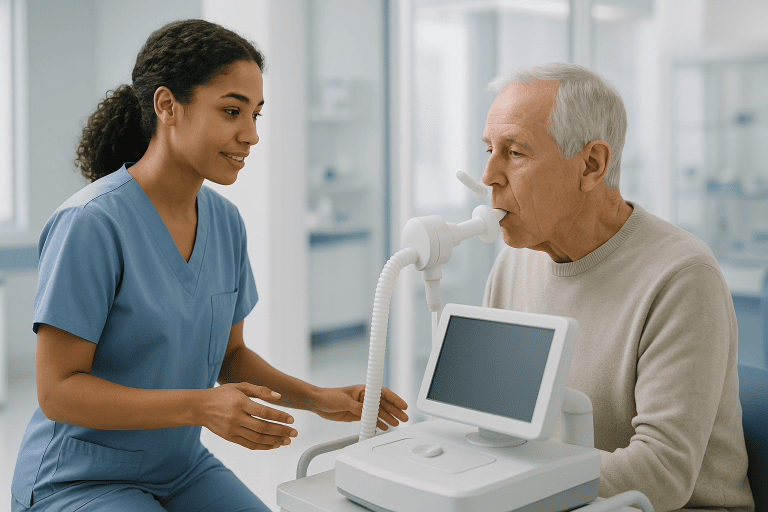
- Pulmonary function testsmeasuring how much air the lungs hold, how quickly air moves, and how well oxygen transfers into the blood. Asbestosis typically produces a restrictive pattern with reduced gas transfer.
- Chest imaginga chest X-ray may show established changes, but high-resolution computed tomography (HRCT) is the most informative test, revealing the pattern and distribution of fibrosis, pleural plaques and pleural thickening that a plain X-ray can miss.
- Exertional oxygen assessmenta supervised walking test to detect oxygen drops that are not apparent while sitting still.
- Targeted additional testsan echocardiogram if pulmonary hypertension or heart strain is suspected, blood tests to assess general health, and further imaging if a nodule, mass or fluid collection raises other concerns.
- Invasive testing only when neededmost people do not need a biopsy. Bronchoscopy or tissue sampling is reserved for cases where the imaging is atypical or another disease must be excluded.
Comparing old and new imaging is particularly valuable. Two scans taken years apart can answer the question a single scan cannot: is the disease stable, or is it progressing? This is why gathering earlier chest X-rays, CT scans, breathing test results and workplace exposure records before any specialist assessment is genuinely worthwhile.
What Asbestosis Treatment Involves
Asbestosis treatment is not a single procedure. It is a structured, long-term care plan for a chronic occupational lung disease. The main goals are to confirm the diagnosis, determine how advanced the lung involvement is, prevent any further asbestos exposure, control symptoms, reduce the risk of respiratory infections, maintain physical capacity and monitor for complications over time.
Because the scarring caused by asbestos fibres is generally permanent, treatment does not remove the fibres or restore scarred tissue to normal. Instead, care focuses on helping the lungs work as efficiently as possible, protecting the healthy tissue that remains, and recognising change early. Depending on the individual, the plan may include pulmonary function testing, high-resolution chest imaging, oxygen assessment, pulmonary rehabilitation, medication for specific symptoms or coexisting airway disease, vaccinations, smoking cessation support and scheduled surveillance.
Treatment intensity is matched to the disease. Someone with mild asbestosis discovered during an occupational review may need little more than education, vaccination, exposure prevention and periodic monitoring. Someone who becomes breathless on stairs may benefit most from exercise-based rehabilitation and closer follow-up. Someone with advanced fibrosis and low oxygen levels may need supplemental oxygen, infection prevention strategies and evaluation for pulmonary hypertension. There is no standard package: the plan follows the findings.
Specialist care matters because asbestosis rarely exists in isolation. Chronic obstructive pulmonary disease, asthma, emphysema, heart disease, pleural plaques, pleural thickening, lung cancer and mesothelioma can produce similar or additional symptoms. A careful diagnosis allows the plan to address the whole picture rather than one finding at a time.
Conditions and Indications Addressed by Asbestosis Care
The central indication is confirmed or suspected asbestosis: a credible exposure history combined with compatible clinical, functional and imaging findings. Care is also appropriate for people with asbestos-related pleural disease, pleural plaques or diffuse pleural thickening, particularly when symptoms or reduced lung function are present. Plaques themselves are usually markers of exposure rather than a direct cause of symptoms, but their discovery often prompts a broader assessment for other asbestos-related disease.
Certain findings change what the care plan needs to address: progressive shortness of breath, deteriorating breathing test results, falling oxygen levels during activity, recurrent chest infections, unexplained weight loss, chest pain or new changes on imaging. Any of these may reflect progression of the fibrosis, a coexisting lung condition, infection, pulmonary hypertension or a malignancy, and distinguishing between those possibilities determines what happens next in the plan, from adjusted monitoring intervals to entirely different treatment pathways.
Asbestosis care also extends to people with advanced chronic respiratory limitation. This can involve oxygen therapy, pulmonary rehabilitation, breathing techniques, energy conservation strategies, nutritional support and coordination with cardiology or oncology where needed. For a small number of carefully selected patients with severe, end-stage fibrosis, referral to a lung transplant centre may be discussed, although eligibility depends on age, overall health, cancer risk, smoking status and other medical factors, and most people with asbestosis will never need that conversation.
How Asbestosis Treatment Is Performed: From Diagnosis to Long-Term Management
Initial assessment and medical history
The pathway begins with a detailed consultation. The physician reviews symptoms, occupational and environmental exposure, previous diagnoses, current medications, smoking history and prior test results. Earlier chest X-rays, CT scans, breathing tests, pathology reports and workplace exposure records are all worth gathering beforehand, because comparing old and new results is one of the most reliable ways to judge whether the disease is stable or progressing. The examination itself focuses on breathing pattern, oxygen levels, signs of chronic lung disease and evidence of other contributors to breathlessness, because breathlessness can originate in the lungs, the heart, the blood, the muscles or a combination of all four.
Diagnostic testing and staging of severity
Pulmonary function tests establish a baseline: lung volume, airflow and gas transfer capacity, against which every future test will be compared. Oxygen saturation is checked at rest and during walking, since exertional drops are easy to miss in a seated consultation. High-resolution chest CT maps the fibrosis, the pleura and anything unexpected. If nodules, masses, fluid or other concerning findings appear, the case may be reviewed by a multidisciplinary board bringing together pulmonology, radiology, thoracic surgery, medical oncology, radiation oncology and pathology as appropriate. Blood tests assess general health, inflammation, infection, anaemia, and kidney and liver function; an echocardiogram is added when the heart may be under strain. In most people, no invasive procedure is required to diagnose asbestosis.
Preventing further asbestos exposure
Stopping ongoing exposure is the single most important protective step, because every additional fibre adds risk to lungs that are already scarred. People still working around older buildings, insulation, ships or industrial equipment may need occupational health guidance and properly fitted protective measures. Removal or repair of asbestos-containing materials belongs exclusively to licensed professionals operating under regulated procedures; disturbing the material personally, even briefly, releases exactly the fibres the lungs can least afford.
Smoking cessation
Smoking does not cause asbestosis, but it damages the airways and lung tissue, worsens breathlessness and sharply increases the risk of lung cancer in people with asbestos exposure. For patients who smoke, the care plan can include counselling, structured follow-up and pharmacological support prescribed by the treating physician. Stopping smoking is among the most meaningful actions available to anyone with this diagnosis: it protects the lung function that remains and reduces the risk of the most serious complications.
Symptom control and medications
No medication reliably reverses asbestos-related scarring, so drug treatment is targeted rather than routine. Some patients benefit from inhaled bronchodilators, particularly those who also have chronic obstructive pulmonary disease or asthma-like airway narrowing, with the choice guided by symptoms, examination and breathing test results rather than applied automatically. Bacterial chest infections are treated with antibiotics when indicated. Persistent cough is investigated rather than simply suppressed, because it may stem from the fibrosis itself, airway irritation, reflux, postnasal drainage, medication side effects or infection, and treating the actual contributor works better than masking it. When oxygen levels are low, supplemental oxygen may be prescribed for exertion, sleep or continuous use, depending on test results.
Pulmonary rehabilitation
Pulmonary rehabilitation is one of the most valuable non-surgical treatments for chronic lung disease. It combines supervised exercise, breathing techniques, education and energy conservation strategies. The aim is not to make scarred tissue normal, that is not possible, but to improve how the body uses the oxygen it gets: stronger muscles demand less oxygen for the same work, better pacing prevents the spiral of breathlessness and panic, and steady conditioning counteracts the weakness that comes from avoiding activity. A typical programme includes walking or cycling exercise, strength training, flexibility work, breathing control, pacing techniques and nutrition guidance, all adjusted to the individual’s oxygen levels, fitness, heart health and respiratory limits. Many patients find that carefully monitored activity is both safer and more effective than avoiding movement out of fear of getting breathless.
Vaccination and infection prevention
Respiratory infections hit scarred lungs harder, so vaccination is a standard part of asbestosis care. Depending on age, medical history and travel plans, physicians may recommend influenza vaccination, pneumococcal vaccination and COVID-19 vaccination or boosters. Good hand hygiene, prompt treatment of chest infections and sensible caution during high-risk seasons round out the infection prevention side of the plan.
Monitoring for complications
Long-term follow-up exists because asbestos exposure carries several possible late complications: progression of the fibrosis, worsening oxygen levels, pulmonary hypertension, recurrent infections, pleural effusion, lung cancer and mesothelioma. Surveillance usually combines repeat breathing tests, imaging at clinically appropriate intervals, oxygen assessment and a structured review of new symptoms. Physicians typically ask patients to mention new or worsening breathlessness, chest pain, coughing up blood, unexplained weight loss, persistent fever, increasing fatigue or new leg swelling at follow-up, not because these always signal something serious, but because they deserve evaluation rather than assumption. The frequency of follow-up is tailored to disease severity, the pace of change, imaging findings and risk factors such as smoking history.
Typical duration of visits and treatment planning
The initial evaluation often spans more than one appointment, particularly when advanced imaging, pulmonary function testing, a walking oxygen assessment or additional specialist consultations are needed. Once the results are in, the plan is explained in detail: what the findings mean, which interventions are recommended, and what follow-up is needed afterwards. Because asbestosis is chronic, “recovery” is better understood as stabilisation and functional improvement rather than a short healing period. Some interventions, adjusting inhaled medication, starting oxygen where indicated, can ease symptoms relatively quickly. Pulmonary rehabilitation usually takes several weeks of consistent participation before stamina and breathlessness control improve meaningfully. Monitoring then continues for the long term.
Why Acting Early Matters
Asbestosis can progress quietly before it becomes severe. People adapt, walking more slowly, avoiding stairs, dropping activities, without registering that lung function is declining underneath. An accurate early baseline lets physicians see genuine change when it happens and intervene at the right moment, rather than reconstructing years of decline from a single late snapshot.
Early evaluation matters most when something has shifted: new imaging findings, worsening breathlessness, falling oxygen levels, chest pain, recurrent infections or unexplained weight loss. Some complications of asbestos exposure, lung cancer and mesothelioma among them, require entirely different treatment pathways, and recognising them earlier keeps more diagnostic and therapeutic options on the table.
Delay also invites avoidable setbacks. Continued exposure adds risk. Untreated low oxygen strains the heart and shrinks exercise capacity. Avoiding activity out of fear of breathlessness weakens the muscles, which then makes breathing feel harder still: a self-reinforcing loop that rehabilitation exists to break. Missed vaccinations leave scarred lungs more vulnerable to infections they tolerate poorly. Asbestosis care works best when it is proactive rather than reactive.
Benefits of Asbestosis Treatment and Monitoring
Since the scarring cannot be undone, the benefits of care are best understood as better control, clearer information and earlier response to change.
| Benefit | What It Means for You |
|---|---|
| Accurate diagnosis | Specialist evaluation distinguishes asbestosis from other lung and heart conditions that cause similar symptoms. |
| Symptom management | Breathlessness, cough, reduced stamina and low oxygen levels are addressed through a personalised plan. |
| Better functional capacity | Pulmonary rehabilitation improves endurance, confidence with activity and day-to-day breathing control. |
| Prevention of avoidable harm | Exposure prevention, smoking cessation and vaccination take unnecessary strain off the lungs. |
| Monitoring for complications | Regular follow-up supports earlier recognition of progression, oxygen problems, pulmonary hypertension or asbestos-related malignancy. |
| A clear long-term plan | Patients and families gain a practical roadmap for treatment, follow-up, travel, activity and warning signs. |
Recovery and Long-Term Care Timeline
Asbestosis care is a continuing process. The timeline below outlines what many patients can expect once evaluation and treatment planning begin.
| Time Period | What Patients Can Expect |
|---|---|
| Day 1 | Initial consultation, review of exposure history and prior records, physical examination, oxygen measurement and planning of diagnostic tests. |
| First week | Pulmonary function testing, chest imaging, walking oxygen assessment, medication review, vaccination planning and discussion of exposure prevention. |
| First month | Start of pulmonary rehabilitation where appropriate, adjustment of inhaled medication or oxygen therapy by the treating team, smoking cessation support and review of results. |
| Longer term | Periodic follow-up with lung function tests, imaging when indicated, monitoring for complications and updates to the care plan as symptoms or needs change. |
Factors That Influence Outcomes
Outcomes vary from person to person. Some patients remain stable for years with monitoring and risk reduction alone; others experience gradual progression, particularly when the fibrosis was more advanced at diagnosis or when additional lung or heart disease is present. A good result usually means the diagnosis is clear, symptoms are managed, lung function is tracked, infections are prevented where possible and complications are caught early.
The severity of fibrosis at diagnosis is the most important starting point. Mild disease with preserved oxygen levels calls for monitoring, rehabilitation, vaccination and exposure prevention. More extensive scarring, low oxygen levels or reduced gas transfer call for more intensive support. The pace of change over time matters just as much: stable results across successive tests are reassuring, while declining function prompts further evaluation.
Smoking history strongly shapes risk, above all for lung cancer and chronic obstructive pulmonary disease. Stopping smoking improves respiratory symptoms and reduces future harm even when the asbestos exposure happened long ago. Coexisting conditions, emphysema, asthma, coronary artery disease, heart failure, obesity, anaemia, sleep apnoea, reflux, can each contribute to breathlessness and deserve identification and management in their own right.
Participation matters too. Patients who commit to an individualised exercise and breathing programme learn to pace activity, defuse the panic that breathlessness can trigger and preserve muscle strength. Nutrition, sleep quality, mental health and social support all play genuine roles in living well with a chronic lung disease. Finally, consistency of follow-up is itself a prognostic factor: keeping scheduled evaluations, reporting new symptoms, staying current with vaccinations, avoiding further exposure and carrying a clear medical summary when travelling all make long-term care safer.
How Acibadem Approaches Asbestosis Care
Asbestosis often needs more than a single consultation can provide: confirmation of a complex diagnosis, interpretation of imaging performed at different times and in different centres, assessment of occupational exposure, evaluation for asbestos-related complications, and a practical plan that can be continued long after the first appointment. At Acibadem hospitals, that work is coordinated across the specialties the disease touches, pulmonology, radiology, thoracic surgery, oncology, cardiology and rehabilitation, with occupational health perspectives brought in where relevant. When imaging or symptoms raise concern about malignancy or complex pleural disease, cases are reviewed through multidisciplinary boards, so that decisions align with evidence-based protocols and unnecessary procedures are avoided when observation is the wiser course.
The diagnostic infrastructure serves a practical purpose. High-resolution chest imaging defines the fibrosis and pleural changes. Pulmonary function laboratories measure capacity, airflow and gas transfer. Exertional oxygen testing determines whether supplemental oxygen is needed for activity or air travel. Cardiac testing is added when pulmonary hypertension or heart disease is suspected. None of this is data collection for its own sake, each test answers a concrete question: how advanced is the disease, what is actually causing the breathlessness, is oxygen needed, is a complication present, and what follow-up is safest.
Continuity is treated as part of the treatment itself. Because asbestosis is managed over years rather than weeks, findings and recommendations are consolidated into a clear written plan, diagnosis, severity, medication, oxygen requirements, rehabilitation goals and monitoring schedule: that the patient and any future treating physician can follow. Just as importantly, the clinical teams are direct about limits: established scarring cannot usually be reversed, and honest communication about what can and cannot change is part of the care. What most patients gain is a clearer diagnosis, better symptom control, improved conditioning, a prevention strategy and a structured monitoring plan, and for families, that clarity makes future decisions easier to face.
Living With Asbestosis Over the Long Term
Asbestosis is a condition people live with, not through. The most useful evaluation is one that considers exposure history, symptoms, imaging, breathing tests, oxygen levels and risk factors together rather than in isolation, and for people who already hold a diagnosis, a specialist second opinion can serve the same integrating purpose: confirming the diagnosis, clarifying severity and setting out realistic monitoring and treatment options.
Day to day, the priorities are stable and practical: no further asbestos exposure, no tobacco, vaccinations kept current, activity maintained through paced exercise rather than abandoned, and follow-up appointments kept even when nothing feels different, because stability is itself a finding worth documenting. Keeping a concise medical summary, including exposure history, latest breathing test results and current treatment, makes care safer when travelling or when a new physician joins the picture.
Ultimately, asbestosis care is about protecting the lung function you have, recognising complications early and living as fully and safely as possible with a chronic respiratory condition. The scarring set the starting point, but the plan built around it, prevention, rehabilitation, vaccination and vigilant monitoring, shapes much of what comes next.
Preparation
- Patients should bring prior chest X-rays or CT scans, pulmonary function tests, medication lists, and details of asbestos exposure. Doctors may request blood tests, imaging, oxygen assessment, or spirometry before planning care. Smoking cessation is strongly recommended to reduce further lung damage.
Aftercare
- Aftercare may include prescribed inhalers, oxygen therapy when needed, pulmonary rehabilitation, vaccinations, and regular follow-up lung tests. Patients should avoid asbestos, smoke, and respiratory infections where possible. Seek urgent care for worsening breathlessness, chest pain, fever, or sudden drops in oxygen levels.
Frequently Asked Questions
What affects the cost of asbestosis assessment and care?
The main factors are the purpose of the visit, the tests required, the need for imaging, the extent of lung function assessment, rehabilitation planning, medication review, and whether complications need investigation. Hospital category, specialist involvement, interpreter support, and follow-up needs also influence the final quote.
How can I get a personalised quote from Acibadem?
You can request a free consultation and share your medical records, previous imaging reports, lung function results, exposure history, and current symptoms. The international patient team can then help the relevant specialist review your case and prepare a personalised care plan and quote.
Does asbestosis treatment usually involve surgery?
Asbestosis itself is usually managed without surgery because it is a chronic scarring disease of the lungs. Care typically focuses on diagnosis, prevention of further exposure, symptom control, rehabilitation, vaccination, and monitoring for complications. Any additional procedure would depend on a separate finding and specialist assessment.
Will all tests be included in a package?
Package contents vary by patient need. A package may include specialist consultation, selected lung tests, imaging review, reports, and coordination support, while additional tests, medications, rehabilitation sessions, or follow-up visits may be quoted separately.
Can international patients combine diagnosis and rehabilitation planning in one trip?
In many cases, consultations, diagnostic testing, imaging review, and a rehabilitation plan can be coordinated during a planned visit, depending on appointment availability and medical suitability. The team should review records in advance to plan the visit efficiently.
Is this information medical or financial advice?
No. This is general educational information and does not replace assessment by a respiratory specialist or a formal financial quotation. A personalised recommendation and cost estimate require review of your medical history, records, and current condition.
Medically reviewed by the Acıbadem International Medical Board September 1, 2026
See our medical review board →
Update history
- PublishedJune 8, 2026
- Medical review approvedSeptember 1, 2026
- Last content updateSeptember 8, 2026
References1
- Asbestosis nhs.uk
Trusted care for international patients
From the Acibadem Blog

Living With Asbestosis: Pulmonary Rehabilitation, Vaccinations and Protecting Your Lungs
Living with asbestosis means managing permanent lung scarring rather than reversing it. The evidence supports four things most: joining a supervised pulmonary rehabilitation program,…

What Does Asbestosis Follow-Up Involve? Lung Tests, Imaging and Complication Checks
Asbestosis follow-up monitoring usually combines a clinical review, breathing tests such as spirometry and gas transfer, a check of resting and exertional oxygen levels,…
Asbestosis vs Mesothelioma: How Doctors Tell Scarring From Cancer After Asbestos Exposure
Asbestosis and mesothelioma are different diseases with the same cause. Asbestosis is non-cancerous scarring of lung tissue that stiffens the lungs and slowly reduces…