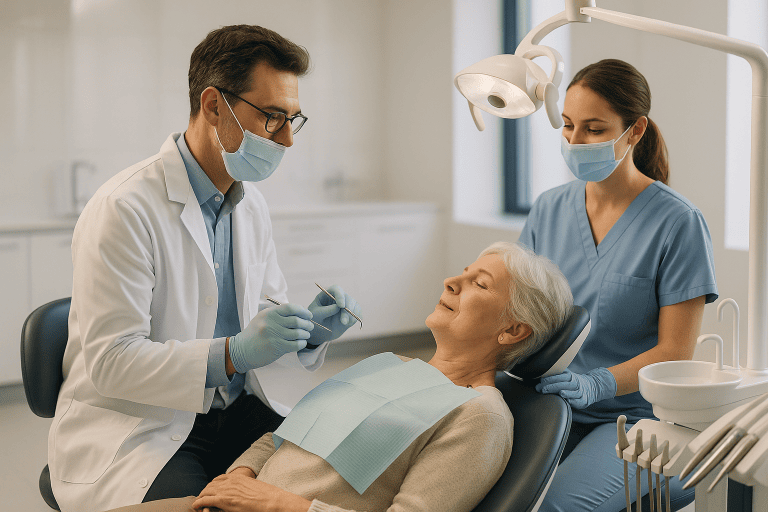
Dental Prosthetics
Dental prosthetics is the field of dentistry that replaces missing or severely damaged teeth with artificial devices, including crowns, bridges, removable dentures, and implant-supported prostheses. It is used after tooth loss from…
Quick answer
Dental prosthetics replaces missing or badly damaged teeth with artificial devices such as crowns, bridges, removable dentures, or implant-supported teeth. It is used after tooth loss from decay, gum disease, or injury. Most treatments are outpatient procedures under local anesthesia, with recovery ranging from a few days to several months for implants.
What is dental prosthetics?
Dental prosthetics is the branch of dentistry that replaces missing or badly damaged teeth with artificial devices. The word prosthesis means an artificial part made to take the place of a missing body part. In the mouth, a dental prosthesis can be a single crown that covers a weakened tooth, a bridge that fills a gap, a removable denture, or a set of teeth fixed to dental implants. The dentists who specialize in this field are called prosthodontists, although many general dentists also provide prosthetic work.
Dental prosthetics is used for a range of conditions. The most common reasons include:
- Teeth lost to advanced tooth decay (cavities that have destroyed too much of the tooth to repair with a filling).
- Teeth lost to periodontal disease, which is a long-term gum infection that damages the bone holding the teeth.
- Teeth broken or knocked out by injury.
- Teeth that are worn down, cracked, or heavily filled and need full coverage to remain functional.
- Teeth missing from birth (congenital absence), or jaw defects following surgery for tumors or other disease.
The main dental prosthetics options are:
- Crowns: caps that fit over a prepared natural tooth or an implant.
- Bridges: one or more artificial teeth attached to crowns on the neighboring teeth or to implants.
- Removable partial dentures: a plate carrying artificial teeth that clips onto remaining natural teeth and can be taken out.
- Complete dentures: a full set of upper or lower artificial teeth resting on the gums when no natural teeth remain.
- Implant-supported prostheses: crowns, bridges, or dentures anchored to dental implants, which are small titanium posts placed surgically in the jawbone to act as artificial tooth roots.
Within a hospital group such as Acibadem, this care is organized through the Dental & Oral Health department, where dentists, prosthodontists, oral surgeons, and dental technicians work together.
Who is a candidate
People often ask who needs dental prosthetics. In general, anyone who has lost one or more teeth, or whose teeth are too damaged to chew comfortably, may be a candidate. Missing teeth are not only a cosmetic concern. Gaps can allow neighboring teeth to drift, change the way the upper and lower teeth meet, make chewing less efficient, and affect speech. Over time, the jawbone in an area with no tooth root tends to shrink, a process called bone resorption.
Common indications include:
- One or several missing teeth in an otherwise healthy mouth.
- Loss of all teeth in one or both jaws.
- A tooth that has had root canal treatment (removal of the infected inner pulp) and needs a crown to protect it.
- Difficulty chewing, speaking, or smiling because of damaged or absent teeth.
- An existing denture or bridge that is worn, loose, or broken.
Dental prosthetics may not be suitable, or may need to be delayed, in some situations:
- Active gum disease or untreated decay usually must be controlled first, because a prosthesis placed in an unhealthy mouth tends to fail early.
- Implant-based options require enough healthy jawbone. When bone is thin, a bone graft (adding bone or bone-like material) may be needed first, or a non-implant option may be recommended.
- Poorly controlled diabetes, heavy smoking, certain bone medications (such as some drugs used for osteoporosis or cancer), and previous radiation to the jaw can slow healing and increase the risk of implant complications. Your dentist may weigh these factors carefully.
- Children and teenagers whose jaws are still growing are usually not candidates for implants; removable or temporary solutions are more common until growth is complete.
- People who cannot manage daily cleaning of a fixed prosthesis, or who cannot handle removable dentures, may be guided toward a different design.
The choice between options depends on how many teeth are missing, the condition of the remaining teeth and bone, general health, personal preference, and budget. The decision is made together with the dental team after an examination and imaging.
How the procedure works
The dental prosthetics procedure varies with the type of prosthesis, but most treatments follow a similar pattern of assessment, preparation, fabrication, and fitting.
Before the procedure
- The dentist examines the mouth, reviews your medical history, and takes X-rays. For implant planning, a three-dimensional scan called a cone beam CT is often used to measure bone volume and locate nerves and sinuses.
- Impressions (molds) or digital scans of your teeth and gums are taken so that a laboratory can build a model of your mouth.
- Any decay, gum disease, or teeth that cannot be saved are treated or removed first. If a tooth is extracted, the gum and bone are often allowed to heal for several weeks to months before a final prosthesis is made.
During the procedure
- Crowns and bridges: under local anesthesia (numbing injection), the dentist reshapes the supporting teeth to make room for the prosthesis. A temporary crown or bridge is placed while the permanent one is made in the laboratory, which usually takes one to a few weeks. At a second visit, the temporary is removed and the final piece is checked for fit, bite, and color, then cemented in place.
- Removable dentures: no surgery is needed unless extractions are required. Several appointments are typical: impressions, bite registration (recording how the jaws meet), a trial fitting with the teeth set in wax, and then delivery of the finished denture. Adjustments are common in the first weeks.
- Implant-supported prostheses: implant placement is a minor surgical step, most often done under local anesthesia, sometimes with sedation. The gum is opened, a small channel is prepared in the bone, and the titanium post is inserted. The bone then heals around the implant over a period that typically ranges from about two to six months, a process called osseointegration. Once healed, a connector called an abutment is attached and the final crown, bridge, or denture is fitted. In selected cases a temporary tooth can be attached on the same day, but this depends on bone quality and bite forces.
After the procedure
- The dentist checks the bite and makes small adjustments so that no single tooth takes too much pressure.
- You receive instructions on cleaning, what to eat during the adjustment period, and how to handle a removable prosthesis.
- Follow-up visits are scheduled to review comfort, gum health, and the fit of the device.
Preparation for dental prosthetics
Good preparation helps the treatment go smoothly and lowers the chance of complications.
- Bring a full list of your medications, including blood thinners, diabetes medicines, and any drugs for bone conditions. Do not stop any medication on your own; your dentist and physician will advise if changes are needed before implant surgery or extractions.
- Tell the team about allergies, especially to metals, latex, or anesthetics, and about heart conditions or artificial joints, since antibiotic advice may differ.
- Complete any recommended dental cleaning and gum treatment beforehand. Healthy gums make impressions more accurate and support the prosthesis better.
- If you smoke, reducing or stopping before and after implant surgery is usually advised because smoking slows healing and is linked with higher implant failure.
- For surgical steps under sedation, you may be asked not to eat or drink for a set number of hours and to arrange for someone to take you home.
- Plan your schedule. Some prosthetic treatments need several appointments over weeks or months, and some steps require a few days of softer food.
Recovery and aftercare
Dental prosthetics recovery time depends mainly on whether surgery was involved.
Crowns and bridges: most people return to normal activities the same day. The prepared teeth may be sensitive to hot and cold for a few days to a couple of weeks. Mild soreness of the gums around the new crown is common and usually settles quickly.
Removable dentures: the mouth typically needs several weeks to adapt. Early on, many patients notice extra saliva, sore spots, a feeling of fullness, and changes in speech. Eating soft foods cut into small pieces and chewing on both sides at once helps. Sore spots should be reported so the dentist can adjust the denture rather than leaving it out for long periods.
Implant surgery: swelling, bruising, and discomfort are usually greatest in the first two to three days and then improve. Many patients are back to work within a day or two, though strenuous exercise is often avoided for about a week. The bone-healing phase before the final teeth are fitted often lasts several months, during which the area should be kept clean and not overloaded.
General aftercare advice includes:
- Brush twice daily with a soft brush and clean between the teeth. Fixed bridges need special floss or small brushes to clean under the artificial tooth. Implants need the gum line cleaned carefully, as they can develop gum inflammation just as natural teeth do.
- Remove dentures at night unless told otherwise, clean them with a denture brush and non-abrasive cleaner, and keep them moist so they do not warp.
- Avoid very hard or sticky foods, ice chewing, and using teeth as tools; these can chip porcelain or loosen a prosthesis.
- Attend the scheduled follow-up visits. Dentures typically need periodic relining or replacement as the jaw shape changes over years, and implants and crowns are checked for wear and gum health.
Risks and side effects
When weighing dental prosthetics risks and benefits, it helps to know that serious complications are uncommon but do occur, and that some minor problems are expected during adjustment.
Common or minor
- Temporary tooth sensitivity after crown preparation.
- Gum soreness, pressure spots, and difficulty speaking or eating during the first weeks with a denture.
- Mild pain, swelling, and bruising after implant surgery or extractions.
- A feeling that the bite is slightly off, usually corrected with small adjustments.
Less common or more serious
- Infection at the surgical site or around an implant.
- Implant failure: the bone does not bond to the implant, or the bond is lost later. This may require removal and, sometimes, a second attempt after healing.
- Peri-implantitis: inflammation and bone loss around an implant, similar to gum disease, often linked with poor cleaning or smoking.
- Nerve injury in the lower jaw causing numbness or tingling of the lip, chin, or tongue; this is usually temporary but can occasionally persist.
- Sinus problems if an upper implant extends into the sinus cavity.
- Damage to supporting teeth: teeth prepared for a bridge lose enamel and can later decay or need root canal treatment.
- Fracture or loosening of crowns, bridges, or dentures, and wear of the artificial teeth over time.
- Rarely, allergic reactions to materials used in the prosthesis.
Your dental team can explain which of these risks apply most to your situation and how they are reduced, for example through imaging, careful planning, and good home care.
Results and outlook
The available evidence generally shows that well-planned dental prosthetics restore chewing ability, improve speech, support facial appearance, and help maintain the position of the remaining teeth. Fixed options such as crowns, bridges, and implant-supported teeth tend to feel more stable than removable dentures, while removable dentures are less invasive and easier to modify.
Longevity varies. Crowns and bridges commonly last many years, with the lifespan influenced by the material, the health of the supporting teeth, bite forces, and oral hygiene. Dental implants have a long track record and, in healthy patients who maintain good hygiene, often remain in function for decades, although the crown on top may need replacement earlier due to wear. Complete dentures typically need relining or remaking over time because the jawbone continues to change shape.
No prosthesis is permanent in the sense of never needing attention. Regular check-ups, professional cleaning, and prompt repair of small problems are the main factors within a patient’s control that influence how long a prosthesis lasts.
Cost considerations
The cost of dental prosthetics varies widely, and the main drivers are:
- Type of prosthesis: removable dentures are usually the least costly, followed by crowns and bridges, with implant-supported work generally the most expensive because it includes surgery and components.
- Number of teeth being replaced and the number of implants required.
- Materials: options range from acrylic and metal to porcelain and zirconia, with different costs and appearance.
- Additional procedures such as extractions, bone grafting, sinus lifts, or gum treatment before the prosthesis.
- Imaging and planning, including three-dimensional scans and surgical guides.
- Laboratory work and the number of appointments involved.
- Follow-up care, adjustments, relines, and eventual replacement of worn parts.
Most dental prosthetic treatments are performed on an outpatient basis, so hospital stay is rarely a cost factor. Insurance coverage differs greatly between plans and countries, so it is sensible to ask for a written, itemized treatment plan before starting.
Frequently asked questions
What is the dental prosthetics procedure like from start to finish?
It usually begins with an examination, X-rays or scans, and impressions of your mouth. Any decay or gum disease is treated first. Depending on the option chosen, teeth may be reshaped for crowns, implants may be placed surgically, or molds may be taken for dentures. A laboratory builds the prosthesis, which is then fitted and adjusted over one or more visits.
How long is dental prosthetics recovery time?
For crowns and bridges, most people feel normal within a few days. Adapting to new dentures often takes several weeks. After implant surgery, discomfort typically eases within a few days, but the bone usually needs a few months to heal before the final teeth are attached. Your dentist can give a timeline for your specific plan.
Who needs dental prosthetics?
Anyone missing one or more teeth, or with teeth too damaged to function, may benefit. This includes people with tooth loss from decay, gum disease, injury, or teeth absent from birth. A dental examination is needed to confirm whether treatment is advisable and which type suits you.
What are the main dental prosthetics risks and benefits?
Benefits include improved chewing, clearer speech, support for facial structures, and protection of remaining teeth. Risks include infection, implant failure, nerve irritation, sensitivity, and the possibility of breakage or wear over time. For most healthy patients the benefits are considered to outweigh the risks, but individual factors matter.
Is dental prosthetics painful?
Procedures are performed under local anesthesia, so pain during treatment is uncommon. Afterward, mild soreness or sensitivity is typical and is often managed with over-the-counter pain relief recommended by your dentist. Implant surgery can cause a few days of swelling and discomfort.
How long do dental prostheses last?
Lifespan depends on the type of prosthesis, materials, bite forces, and how well the mouth is cleaned. Crowns and bridges commonly last many years, implants often last much longer, and dentures usually need adjusting or remaking as the jaw changes. Regular check-ups help detect problems early.
Can a dental prosthesis be replaced or repaired?
In many cases, yes. Chipped porcelain can sometimes be repaired, loose crowns can often be re-cemented, and dentures can be relined or have teeth replaced. If a prosthesis has reached the end of its useful life, a new one can usually be made.
When to see a doctor
Consider being assessed by a dentist or prosthodontist if you have:
- One or more missing teeth, especially if chewing has become difficult or neighboring teeth appear to be shifting.
- A tooth that is cracked, heavily filled, or has had root canal treatment and no crown.
- A denture or bridge that feels loose, causes sores, or has broken.
- Persistent jaw discomfort, changes in your bite, or difficulty speaking that you associate with your teeth.
After a dental prosthetics procedure, seek prompt care if you notice any of these warning signs:
- Pain or swelling that worsens after the third day instead of improving.
- Fever, pus, or a bad taste coming from the treated area.
- Bleeding that does not stop with gentle pressure after about 30 minutes.
- Numbness or tingling of the lip, chin, or tongue that persists after the anesthetic should have worn off.
- An implant, crown, or bridge that feels loose or moves.
- Difficulty breathing or swallowing, or rapidly spreading facial swelling; these are emergencies and require immediate medical attention.
Early review of problems usually allows simpler solutions and helps protect the long-term success of the prosthesis.
Preparation
- Share a complete list of your medications and medical conditions with your dentist, and do not stop any medicine without advice. Complete recommended cleaning or gum treatment before the prosthesis is made. If implants or extractions are planned, follow instructions about fasting for sedation and arrange transport home. Reducing or stopping smoking is usually advised.
Aftercare
- Brush twice daily with a soft brush and clean around bridges and implants with floss or small interdental brushes. Remove and clean dentures at night unless instructed otherwise. Avoid hard or sticky foods while adjusting, and report sore spots or a loose prosthesis promptly. Keep all follow-up appointments so fit and gum health can be checked.
Medically reviewed by the Acıbadem International Medical Board September 13, 2026
See our medical review board →
Update history
- PublishedSeptember 13, 2026
- Medical review approvedSeptember 13, 2026
- Last content updateSeptember 13, 2026
References2
From the Acibadem Blog
Fixed vs Removable Dental Prosthetics: How Dentists Match the Device to Your Teeth and Bone
Fixed dental prosthetics, such as crowns, bridges and implant-supported arches, are cemented or screwed in and stay in the mouth; removable prosthetics, such as…

Reading a Dental Prosthetics Plan: Materials, Sequence of Visits and Questions Worth Asking
A dental prosthetics treatment plan sets out which teeth are being replaced, the type of prosthesis proposed (crown, bridge, denture or an implant-supported restoration),…
Which Dental Prosthetic Fits Your Situation? From a Single Missing Tooth to a Full Arch
The dental prosthetic you need depends mainly on how many teeth are missing, where they sit, the health of the neighboring teeth and jawbone,…
Caring for Dental Prosthetics Long Term: Floss Threaders, Interdental Brushes and Check-Ups
Caring for dental prosthetics long term means cleaning them twice a day like natural teeth, reaching under bridges and around implants with floss threaders…