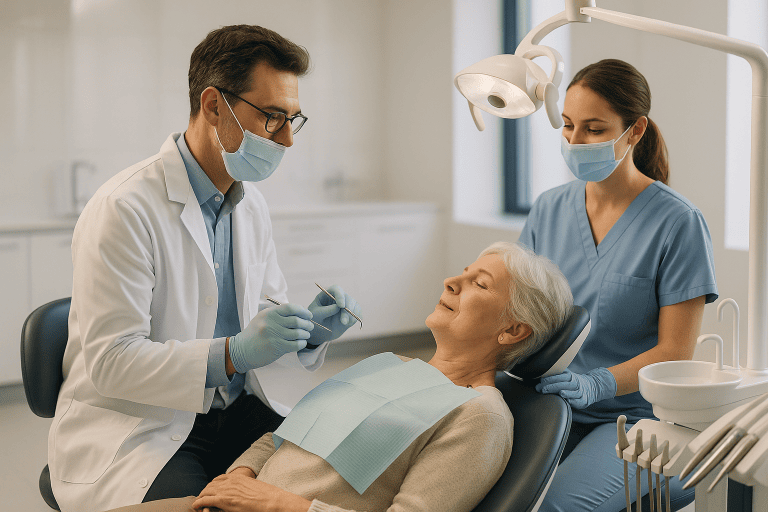
Mini Implants
Mini implants are narrow dental implants used to stabilize dentures or replace small teeth when bone volume is limited. They are placed with minimally invasive techniques after dental assessment.
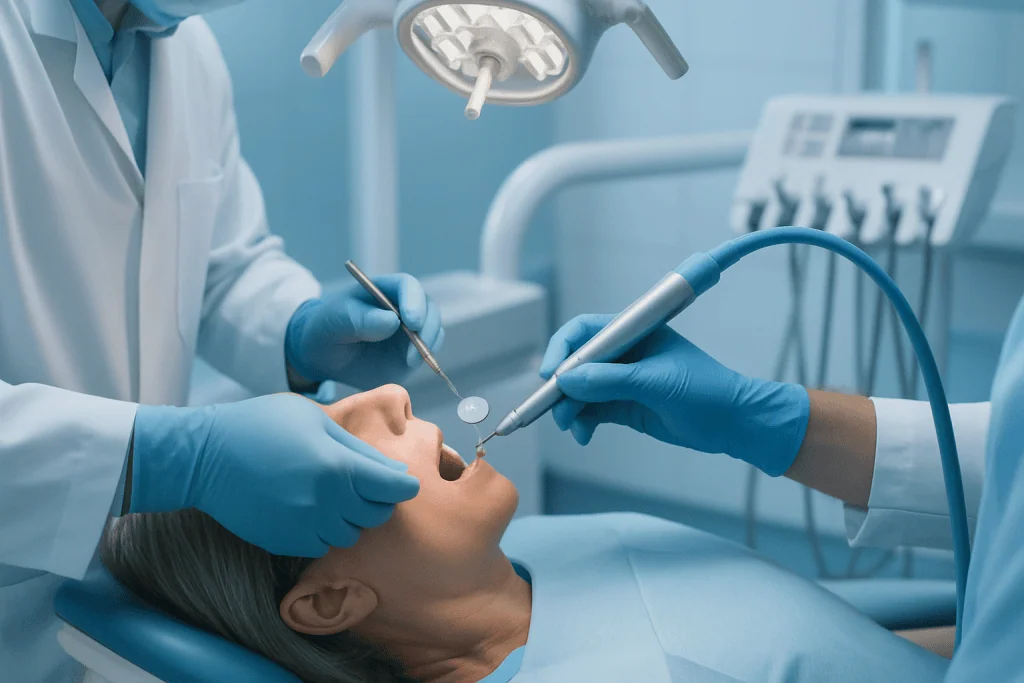
Quick answer
Mini dental implants are narrow titanium implants placed into the jawbone, most often to hold a loose denture more firmly or to replace a small tooth in a tight space. Placement is usually minimally invasive under local anaesthetic. They suit selected patients with limited bone width, but they tolerate less chewing force than standard implants, so careful case selection matters.
Mini Dental Implants: When Dentures Feel Loose or Bone Volume Is Limited
Mini dental implants are narrow titanium implants placed into the jawbone to hold a denture more firmly or to replace a small tooth. They work on the same biological principle as standard dental implantsbone gradually integrates around the implant surface and anchors it, but their smaller diameter means they can sometimes be fitted into thinner ridges and tighter spaces, often with a less invasive placement technique. They are most often considered by people whose dentures shift during eating or speech, and by people who have been told their jawbone is too narrow for a conventional implant without grafting first.
Living with missing teeth is not only a cosmetic concern. It affects how you chew, how clearly you speak, and how willing you are to smile or eat in company. For many denture wearers, the most frustrating part is the constant awareness that the denture is not secure: it may lift while eating, click during conversation, rub the gums raw, or push you towards a shrinking list of soft, safe foods. Others face a different obstacle. They want implants, but have been told that the bone has thinned too much and that grafting would be needed before a conventional implant could even be attempted.
Weighing up mini dental implants can feel confusing, because the option is presented in very different ways depending on where you read about it. Some clinics describe them as a lighter, quicker alternative to standard implants; others treat them as a narrow niche solution that should rarely be used. Both framings contain a piece of the truth, and neither is the whole of it. At Acibadem, mini implant treatment begins with a careful dental and medical assessment rather than a one-size-fits-all recommendation. The team looks at the quality and quantity of jawbone, the bite relationship, gum health, denture design, cosmetic expectations and the general health factors that affect healing, and only then discusses whether a narrow implant is the right tool for your situation.
That last point deserves emphasis, because it shapes everything on this page. Mini dental implants are valuable in selected situations, but they are not a shortcut around proper diagnosis. In many cases they provide a meaningful improvement in denture stability, or replace a small tooth with a smaller-diameter implant and less surgery. In other cases, conventional implants, bone grafting, periodontal care or a different restorative plan will give a more durable result. The most important step is matching the right treatment to the right indication. When that matching is done honestly, mini implants can offer a practical path to better function, greater comfort and more confidence for patients who have been limited by loose dentures, narrow spaces or reduced bone volume.
What Are Mini Dental Implants?
Mini dental implants are narrow dental implants placed into the jawbone to support a dental restoration, usually a denture attachment or a small crown. Like conventional implants, they are made from biocompatible titanium or titanium alloy and are designed to integrate with bone over time. Their defining feature is diameter: mini implants are the narrowest category of implant in routine use, generally slimmer than the standard implant range, which is why they can be considered where the bone ridge is thin or the tooth gap is narrow.
Mini implants are used for two main purposes. The first, and by far the most common, is denture stabilisation, particularly for lower dentures that move during chewing and speaking. Several mini implants are placed across the jaw, and the denture is modified or newly made to clip onto them through small retention components. The implants do not make the denture rigid like natural teeth, but they sharply reduce the lifting and sliding that causes sore spots and food avoidance, and they reduce or remove the reliance on adhesive.
The second use is replacement of small teeth, such as certain lower incisors or upper lateral incisors, where the gap is too narrow for a conventional implant to be placed without threatening the roots of neighbouring teeth. Here, a mini implant supports a crown, provided the bite forces, bone quality and cosmetic requirements all allow it. Not every small gap is suitable, and this indication demands careful planning, because a narrow implant in the wrong site can be overloaded within a few years.
Placement is often minimally invasive. Depending on your anatomy and the plan, the implant may be inserted through a small opening in the gum, or through a flapless approach in which the gum is not lifted at all and tissue disruption is limited. Local anaesthetic is typically all that is needed, and many patients find the appointment shorter and more comfortable than they expected. Sedation can be discussed for patients with dental anxiety, complex medical needs or several procedures planned in one visit.
One caution belongs in any honest definition: “mini” refers to size, not to importance. These implants still require precise diagnosis, sterile surgical technique, careful bite management and long-term maintenance. Their success depends on appropriate case selection, adequate bone support, healthy soft tissue, good hygiene and a restoration that does not overload them. A mini implant placed on a weak indication fails just as thoroughly as any other implant: it simply fails faster.
What is the smallest dental implant you can get?
The smallest dental implants in routine clinical use are mini implants, sometimes called narrow-diameter or small-diameter implants; exact dimensions vary between manufacturers, and there is no single universal “smallest” size. Smaller is not automatically better, however. As diameter decreases, the implant’s surface area for bone integration decreases, and its mechanical tolerance for chewing force decreases with it. Clinicians therefore choose the narrowest implant that the site genuinely requires, not the narrowest implant available. Very narrow implants also tend to be one-piece designs, meaning the implant and the attachment post are a single unit: this simplifies placement but removes some of the flexibility a two-piece standard implant offers when the angle or the restoration needs adjusting later.
Who May Benefit from Mini Implants?
Mini implants usually enter the conversation after a patient has struggled with removable dentures, missing teeth or bone loss for some time. Some people have worn dentures for years and feel that adhesive is no longer enough. Others have recently lost teeth and want a stable but conservative option. A smaller group is referred specifically because the jawbone is too narrow for a conventional implant without additional surgery.
Common concerns that lead patients to ask about mini implants include:
- A lower or upper denture that shifts, lifts or rubs against the gums
- Difficulty chewing firm foods because the denture feels unstable
- Speech changes caused by denture movement
- Gum soreness, irritation or ulcers from a loose denture
- Loss of confidence when eating in public or speaking closely with others
- A missing small tooth in a narrow gap where a bridge or conventional implant may not be ideal
- Reluctance about bone grafting, longer treatment timelines or more extensive surgery
- Previous feedback from a dentist that bone volume is limited
Diagnosis starts with a detailed dental examination. The dentist or implant specialist evaluates the gums, remaining teeth, bite, jaw relationship, denture fit and oral hygiene. Imaging is essential. Standard dental X-rays give useful information, but three-dimensional imaging is usually recommended for implant planning because it shows bone height, width and density, and the position of structures that must be protected, such as nerves and sinus spaces. Digital impressions or intraoral scanning may be used to record the mouth and plan the restoration with more accuracy than conventional moulds allow.
A medical assessment is part of responsible planning, not an optional extra. Uncontrolled diabetes, active gum disease, heavy smoking, certain immune disorders, previous radiation therapy to the jaws and some medications that affect bone metabolism can all influence implant healing or the timing of treatment. These factors do not automatically rule out implant therapy, but they must be weighed openly. Decisions about pausing or adjusting any medication belong entirely to your treating doctor, never make those changes on your own initiative before dental surgery.
Mini implants tend to suit patients who want improved denture retention but have reduced bone volume, patients who are not good candidates for extensive grafting, patients with narrow tooth gaps, and older adults who need better function through a shorter, less invasive procedure. They do not suit every case. If bite forces are high, the bone is genuinely inadequate, the gums are unhealthy, or the planned restoration would concentrate pressure on the implant, a different plan is the more responsible recommendation, even if it takes longer.
How to judge any provider of mini dental implants
If you have been comparing providers online, the results can look interchangeable, and the useful differences between providers rarely appear in an advert. Wherever you are treated, the same markers of quality apply. Ask whether the clinic uses three-dimensional imaging before committing to a plan, because a mini implant recommended from a single flat X-ray is a warning sign. Ask who designs and fits the denture or crown, since the surgical and restorative parts of treatment must be planned together. Ask what the maintenance plan looks like after placement, including attachment servicing and hygiene reviews. And ask what the clinician would recommend if mini implants were not suitable for you; a provider who can describe the alternatives clearly is usually a provider who has assessed you honestly.
Conditions and Indications Mini Implants Can Address
Mini implants are used in specific dental and restorative situations, and their role is best understood in terms of the problem they are meant to solve rather than as a general substitute for standard implants.
For patients with complete dentures, especially lower dentures, mini implants reduce the movement that occurs when the tongue, cheeks and chewing forces displace the denture. The lower jaw presents the greater challenge because the surface area supporting the denture is smaller, and because bone tends to shrink over the years after tooth loss. A mini implant-supported overdenture gives the denture something to grip, improving retention and making it feel more secure during daily function.
For partial tooth loss, mini implants may be used in carefully selected narrow gaps. A small missing tooth can leave too little room for a conventional implant to be placed without risking damage to adjacent tooth roots. In such cases, a mini implant may support a crown if the position, bone and bite are favourable. Cosmetic planning matters most in the front of the mouth, where gum contour, tooth shape and the smile line determine whether the result looks natural.
Mini implants may also be considered when the ridge has narrowed after tooth loss. Jawbone resorbs gradually once it no longer receives stimulation from tooth roots, and a narrow ridge can make standard implant placement impossible without grafting. A mini implant can sometimes fit within the bone that remains, avoiding an additional surgical stage. This is not always possible, three-dimensional imaging decides it, not optimism, but when the anatomy allows, it spares the patient a graft, a second healing period and a longer overall timeline.
Finally, in some patients mini implants serve as a transitional or interim solution within a broader treatment plan, for example, holding a provisional restoration in place while other work proceeds. When they are used for long-term restoration, however, they must be planned with the same seriousness as conventional implants: the team has to account for chewing forces, clenching or grinding habits, the opposing teeth, the denture design, hygiene access and a realistic schedule of maintenance visits.
Mini Dental Implants vs Standard Dental Implants
Mini implants and standard implants share the same material and the same biology, but they differ in diameter, construction, surgical approach and, crucially, in how much force they can safely carry. The comparison below is qualitative and general; the right choice in your case depends on your anatomy and your restoration.
| Aspect | Mini dental implants | Standard dental implants |
|---|---|---|
| Diameter | Narrowest category in routine use | Wider range of diameters for different sites |
| Construction | Often one-piece: implant and attachment head are a single unit | Usually two-piece: implant plus a separate, adjustable abutment |
| Surgical approach | Frequently flapless and minimally invasive | May require a gum flap; grafting is sometimes needed first |
| Typical uses | Denture stabilisation; small teeth in narrow gaps | Most single teeth, bridges and full-arch restorations |
| Force tolerance | Lower; less suitable for high-load areas | Higher; better suited to molars and heavy bites |
| Bone requirement | Can fit narrower ridges | Needs greater bone width, sometimes created by grafting |
Mini dental implants vs standard for aesthetics
Mini dental implants vs standard for aesthetics is a fair question whenever the gap sits in the visible zone of the smile. In general, a standard implant gives the restorative dentist more to work with aesthetically: its wider platform supports a more natural emergence profile, the way the crown appears to rise out of the gum, and its separate abutment can be angled or customised to shape the gum contour. A mini implant’s one-piece design offers less of that flexibility, and a very narrow implant can produce a crown that looks pinched at the gumline if the site is not chosen well. The honest summary is this: where bone and space allow a standard implant in the aesthetic zone, it is usually the stronger cosmetic choice; where the gap is genuinely too narrow, a small lateral incisor space is the classic example, a well-planned mini implant can still achieve a pleasing, proportionate result. Photographs, digital planning and a frank discussion of your smile line should precede either option.
What is the downside of mini dental implants?
The main downside of mini dental implants is their lower tolerance for chewing force, which restricts where they can responsibly be used. A narrow implant has less surface area anchored in bone and less mechanical bulk, so it is more vulnerable to overload in molar regions, in patients who clench or grind, or under a poorly balanced denture. There are other limitations worth knowing before you decide. The one-piece design means the angle cannot be corrected after placement with an angled abutment, so surgical precision matters even more than usual. Denture attachments and their retention parts wear with use and need periodic servicing or replacement. And because mini implants are used for narrower indications, the long-term evidence base is smaller than the very extensive record behind standard implants. None of this makes mini implants a poor treatment: it makes them a specific one, best used where their size is an advantage rather than a compromise.
How Mini Implant Treatment Is Performed
Initial Assessment and Treatment Planning
Treatment begins with a consultation focused on both function and anatomy. The clinician asks about your symptoms, dental history, denture experience, medical conditions and goals. If you already wear dentures, their fit and design are examined closely, sometimes an existing denture can be modified to connect to implants, and sometimes a new denture is the better foundation for predictable retention. Neither answer is automatic; it depends on the denture’s condition, base material and bite.
Imaging sits at the centre of planning. Dental X-rays assess remaining teeth and bone levels; three-dimensional scans map the exact shape of the jawbone and determine implant position, angle and length. In selected cases, digital planning software and surgical guides support accuracy, particularly where anatomy is tight or several implants are being placed in one visit. The purpose of these technologies is not to make the procedure more elaborate but more controlled: they let the team see what cannot be seen with the naked eye and rehearse the placement before it happens.
The finished plan states how many implants are needed, where they will go, whether the denture can be attached on the day of surgery, and whether other dental work must come first. Active gum infection, decayed teeth, poorly fitting dentures and bite problems are addressed before implants are placed, because they undermine everything built on top of them. If a failing tooth still needs removing, the sequencing questions covered in our guide to implants after tooth extraction apply to mini implants as well.
Preparation Before the Procedure
Before placement, the team reviews your medical history and current medications. Blood thinners, certain osteoporosis medications, diabetes control and allergies are all discussed, and any decision about medication timing is made by your treating doctor rather than by you. If sedation is planned, you will receive fasting instructions and may need someone to accompany you afterwards. On the day itself, the mouth is cleaned, the surgical field is prepared under sterile conditions, and local anaesthetic numbs the gum and jawbone. Many mini implant procedures are completed comfortably under local anaesthetic alone.
Placement of the Mini Implants
The exact technique depends on your bone anatomy and the plan, but a typical denture-stabilisation appointment follows a recognisable sequence:
- Step 1: Anaesthesia and verification. The area is numbed and the planned positions are checked against the imaging or surgical guide.
- Step 2: Access. The surgeon creates a small opening in the gum, or uses a flapless approach in which the implant passes through the gum with minimal tissue disruption.
- Step 3: Site preparation. The bone is prepared conservatively to receive the narrow implant.
- Step 4: Insertion. Each mini implant is placed into its planned position and its initial stability is measured.
- Step 5: Connection or protection. If stability is adequate, the denture is fitted with retention housings and connected the same day; if not, the implants are left to heal before firm attachment.
For denture stabilisation, several implants are distributed strategically across the jaw so that forces are shared rather than concentrated. Whether the denture is connected immediately is a clinical judgement based on bone quality, insertion stability, implant number, bite forces and the state of the denture itself, not a promise made in advance.
For single-tooth replacement, the implant is positioned to support a crown. A temporary restoration is sometimes placed, but it must be shaped to avoid pressure during healing. The final crown is usually made once the gum has matured and the implant is stable enough to carry it. Digital impressions, shade selection and bite analysis help the laboratory produce a crown that fits both functionally and visually alongside the neighbouring teeth.
Technology Used in Mini Implant Care
Modern implant dentistry leans on diagnostic and planning technology precisely because mini implants are used where space and bone are limited, and small differences in angle or position have outsized effects. Three-dimensional imaging maps bone volume and flags anatomical structures to avoid. Digital scanning captures teeth, gums and dentures without conventional impression material in many cases. Computer-guided planning informs implant position and supports the design of surgical guides. Laboratory workflows produce attachments, crowns and prosthetic components with a precise fit. All of this supports the clinician’s judgement; none of it replaces it.
Typical Duration and Immediate Recovery
The placement appointment is often shorter than patients expect, especially for denture stabilisation without added procedures. Duration depends on the number of implants, whether extractions are needed, whether a denture is being modified and whether sedation is used. Most patients return to their accommodation the same day with written aftercare instructions.
Mild swelling, tenderness or minor bleeding can occur afterwards and is usually managed with recommended medication, cold compresses and careful eating. Soft foods come first, chewing directly on the surgical area is avoided, and oral hygiene continues gently from day one. If a denture has been connected, the bite and attachment pressure are checked carefully to prevent irritation and overload. Bone integration then continues over weeks to months, at a pace shaped by bone quality, general health, implant stability and whether the implants were loaded immediately. Follow-up matters: small adjustments to a denture or crown in the early weeks make a disproportionate difference to comfort and to the implant’s long-term prospects.
Why Acting Early Matters
When teeth are missing, the jawbone changes. Resorption reduces its height and width, most noticeably in areas where teeth have been absent for years. Dentures loosen as the ridge shrinks, which produces movement, sore spots and further difficulty chewing: a cycle that tends to accelerate. Waiting does not always make implant treatment impossible, but it narrows the options and can raise the need for more complex procedures later.
Loose dentures also affect nutrition in ways patients often underestimate. Vegetables, fruit, meat and nuts quietly drop off the menu because they demand too much chewing, and over time that influences digestion, energy and general wellbeing. Some people compensate by chewing on one side only, straining the jaw joints and the remaining teeth. Others rely on increasing amounts of adhesive, which masks a fit problem without correcting it.
Where a mini implant is being considered for a small missing tooth, early assessment protects the space itself. Adjacent teeth drift, opposing teeth over-erupt, and the bite becomes progressively harder to restore well. A timely evaluation lets the dental team judge whether a mini implant, a conventional implant, a bridge, orthodontic movement or another approach fits best, while the anatomy is still favourable. Acting early does not mean rushing into surgery. It means obtaining a proper diagnosis before the situation becomes more complicated, and before gum disease, decay or denture trauma erodes the very foundation implant treatment depends on.
Benefits of Mini Implant Treatment
For appropriately selected patients, mini implants offer practical functional gains through a minimally invasive route. The benefits below are realistic expectations for well-chosen cases, not universal promises.
| Benefit | What It Means for You |
|---|---|
| Improved denture stability | A denture attached to mini implants moves less during eating and speaking, reducing reliance on adhesives and improving daily comfort. |
| Less invasive placement in selected cases | Because the implants are narrow, placement may involve less tissue disruption and may be possible in areas of limited bone width. |
| An option when bone volume is reduced | Some patients who would otherwise need grafting before conventional implants can be considered for mini implants after careful imaging. |
| Potentially faster functional improvement | In suitable denture cases, implants may be connected to the denture soon after placement if stability and bite conditions allow. |
| Support for small tooth replacement | In narrow gaps, a mini implant can carry a crown where anatomy and bite forces permit, avoiding the preparation of healthy neighbouring teeth for a bridge. |
| Greater social confidence | When a denture feels secure, patients typically feel freer to speak, smile and eat with other people. |
Recovery Timeline After Mini Implant Placement
Recovery varies by patient and by plan, but most people experience a short initial healing period followed by steady adaptation and routine maintenance.
| Time Period | What Patients Can Expect |
|---|---|
| Day 1 | Local numbness wears off gradually. Mild tenderness, swelling or minor bleeding may occur. Soft foods, gentle cleaning and the written instructions matter most today. |
| First week | Early discomfort settles. The denture or temporary restoration may need adjustment to relieve pressure points. Hard and sticky foods are avoided. |
| First month | Gum tissue continues healing. Chewing comfort improves, but the implants are still protected from heavy force, particularly if newly loaded. |
| Healing phase | Bone integration progresses over weeks to months. Follow-up visits check stability, hygiene, bite forces and attachment fit. |
| Longer term | Regular maintenance continues. Denture attachments require periodic servicing or replacement, and professional cleaning protects the tissue around the implants. |
Two practical questions come up constantly during this phase, and each has its own detailed guide. Diet progresses in stages rather than overnight, see how long after dental implants you can eat normally for a realistic sequence. Smoking is one of the clearest modifiable risks to implant healing, and the timelines in smoking after dental implants apply just as firmly to mini implants. Whatever your circumstances, plan your calendar around the early adjustment visits as well as the placement itself: the first weeks are when small refinements to the denture or crown protect the implants most effectively.
Mini Dental Implants Cost: What Shapes the Price
Mini dental implants cost varies so widely between countries, clinics and individual mouths that any single figure quoted without an examination should be treated with caution. What can be explained honestly is what drives the price, so that the quotations you do receive make sense and can be compared fairly.
How much do mini dental implants cost?
There is no meaningful universal answer, because the total depends on the shape of your treatment plan rather than on the implant alone. The main drivers are: the number of implants placed; whether your existing denture can be modified or a new denture must be made; whether any extractions, gum treatment or other preparatory work comes first; the imaging and planning technology used; the attachment system and prosthetic components chosen; the experience and setting of the surgical team; and the follow-up and maintenance schedule included in the plan. Per implant, mini implants often involve fewer components and less surgery than standard implants, which is one reason they are sometimes positioned as the economical option, but a plan built on the wrong indication is never economical, because remedial treatment costs more than doing it correctly the first time.
What is the average cost of mini dental implants?
Averages published online are of limited use, because they blend different countries, different numbers of implants, and plans that do or do not include the denture itself. When you compare quotations, the reliable method is to compare like with like: confirm exactly what each price includes, imaging, the implants, the attachments, the denture or crown, adjustments, and aftercare, and what would be charged separately. A lower headline price that excludes the restoration or the follow-up visits is not a lower price; it is an incomplete one. A written, itemised plan issued after examination and imaging is the only cost figure worth acting on.
What Influences Outcomes and a Good Result?
The outcome of mini implant treatment depends on several interacting factors, and it is worth understanding them before you commit, because most of them are visible at the planning stage.
Case selection comes first. Mini implants perform best when the indication matches their size and mechanical limits. A narrow implant can be excellent for stabilising a denture yet inappropriate in a high-force area where a wider implant or a different restoration would last longer. Bone quality and quantity follow closely: even though mini implants tolerate narrower ridges, they still need enough healthy bone to carry functional load, and three-dimensional imaging is what establishes whether that bone exists.
Oral hygiene and gum health shape the long term. Implants do not decay, but the tissue around them can become inflamed, and peri-implant inflammation progresses if plaque accumulates around the implant and its attachment components. You will need clear instructions for cleaning around the implants, the denture and the prosthetic parts, plus professional maintenance visits: this is not optional housekeeping, it is part of the treatment.
Bite forces must be controlled. Clenching, grinding, uneven denture pressure or an unbalanced bite concentrates stress on individual implants. For denture patients, the fit of the denture matters as much as the placement of the implants: a denture that rocks overloads whichever implant it rocks against. Adjustment visits after placement are not a sign something has gone wrong: they are how the fit is refined as tissues heal and function changes.
General health matters too. Diabetes control, smoking status, immune function, certain medications and nutrition all influence healing, and smokers carry a higher risk of implant complications and gum problems. Finally, restorative design ties everything together: denture attachments must retain without straining, crowns must be shaped and spaced to share force sensibly, and the surgical and prosthetic stages must be planned as one project rather than two.
How long does a mini dental implant last?
A well-selected, well-maintained mini dental implant can function for many years, but no fixed lifespan can honestly be promised, because longevity depends on the factors above, bone support, bite forces, hygiene, general health and maintenance, more than on the implant itself. Two points deserve realism. First, the retention components that connect a denture to the implants are wearing parts: they lose grip with use and need periodic servicing or replacement, which is routine rather than a failure. Second, the denture itself continues to age; the mouth changes shape over time, so relines or eventual replacement remain part of long-term care even when the implants themselves are stable. Patients who attend maintenance visits and protect the implants from overload give them the best conditions to last; patients who treat placement as the end of the process shorten the odds considerably. Mini implants improve dentures substantially for many people, but they do not make a denture identical to natural teeth, and a clear understanding of that distinction is the best predictor of satisfaction.
How Acibadem Approaches Mini Implant Treatment
Mini implant care at Acibadem sits within the Dental & Oral Health unit and follows the same structure as any implant treatment: assessment first, plan second, surgery third, never in the reverse order. Patients often arrive with earlier X-rays, denture complaints or a recommendation from another clinic; clinicians review what exists and obtain updated imaging where needed before confirming whether mini implants are actually suitable. If they are not, the alternatives, conventional implants, implant-supported overdentures, fixed bridges, denture renewal, bone augmentation or periodontal treatment, are explained on their merits, because the aim is a plan that works, not a particular product.
The hospital-based setting adds a layer of value for patients whose dental needs overlap with wider health considerations. Complex medical histories, diabetes, cardiovascular conditions, oncology history or medication-related bone concerns can all require additional review, and within a hospital group that review can be coordinated with the relevant medical specialties. This does not make every dental case complex; it provides a safer framework for the cases that are.
Planning runs from diagnosis through restoration and follow-up as a single sequence. Three-dimensional imaging, digital impressions and modern laboratory workflows support the fit of dentures, attachments and crowns, while the surgical placement is coordinated with the restoration the patient will actually use every day, because a technically well-placed implant still disappoints if the denture rocks, the attachments are poorly adjusted or the bite is unbalanced. Scheduling is discussed candidly at the planning stage: some plans can be completed across a small number of appointments, while others need staged visits with healing time between them, and the realistic answer depends on the procedure and the restoration rather than on the calendar anyone hopes for. Follow-up appointments are built into the plan from the beginning, because attachment adjustment, bite refinement and hygiene review are part of the treatment itself rather than an afterthought.
Making an Informed Decision
If you are living with loose dentures, a missing small tooth or limited bone volume, mini implants belong on your list of options to understand, alongside conventional implants, bridges and denture renewal, rather than at the top of it by default. They are a genuinely useful treatment for selected patients, particularly where the goal is better denture retention or the restoration of a narrow gap with less surgery. They are a poor treatment where the indication is stretched to avoid a graft that the anatomy actually requires.
The decisive step is the same wherever you are treated: a careful, imaging-based assessment that confirms whether a narrow implant can safely meet your functional and cosmetic needs, an itemised plan that states what is included, and a maintenance schedule you are willing to keep. Previous X-rays, scans, photographs of your smile, details of your current denture and an accurate medical history all make that assessment faster and more precise. A recommendation made before an in-person examination and appropriate imaging is a preliminary opinion, not a plan, and knowing the difference is what allows you to weigh mini dental implants with confidence rather than hope.
Preparation
- Preparation includes a dental examination, medical history review, and imaging to assess bone structure and implant suitability. Existing gum disease or dental infection should be treated before placement. Patients may be advised to stop smoking and follow medication instructions before the procedure.
Aftercare
- Mild swelling, soreness, or minor bleeding can occur and is usually managed with prescribed medication and cold compresses. Patients should maintain careful oral hygiene, eat soft foods initially, and avoid pressure on the implant area. Follow-up visits are needed to check healing and implant stability.
Frequently Asked Questions
What affects the cost of mini implants?
Cost depends on the clinical indication, implant system, denture or crown design, imaging, any preparatory dental treatment, anaesthesia needs, clinic setting and follow-up plan. Travel and accommodation can also affect the total budget for international patients.
How can I get a personalised quote?
A personalised quote usually requires dental photographs, recent imaging if available, medical history and a specialist assessment. Acibadem International can arrange a free consultation to review your case and outline a treatment plan.
Are mini implants always cheaper than conventional implants?
Not always. Mini implants may involve a less extensive surgical approach in selected cases, but the final cost also depends on the prosthetic work, number of implants, attachments, diagnostics and whether additional dental treatment is needed.
Does the quoted cost usually include the denture or crown?
This varies by provider and treatment plan. Some packages include certain prosthetic steps, while others quote implant placement, attachments, dentures, crowns and follow-up separately. Patients should ask for a written breakdown.
Will I need follow-up after mini implant treatment?
Yes. Follow-up is important to check healing, fit the prosthetic parts, adjust the bite and monitor hygiene around the implants. International patients should discuss which visits are needed in Turkey and which checks can be coordinated locally.
Medically reviewed by the Acıbadem International Medical Board September 13, 2026
See our medical review board →
Update history
- PublishedJune 8, 2026
- Medical review approvedSeptember 13, 2026
- Last content updateSeptember 12, 2026
References1
- Dental Implants my.clevelandclinic.org
Trusted care for international patients
From the Acibadem Blog
How Mini Implants Are Placed: Flapless Insertion, Same-Day Denture Fitting and What to Expect
A mini implant procedure places one or more narrow titanium posts into the jawbone, usually through a small pierce in the gum rather than…

Mini Implant Problems Explained: Loosening, Wear of Denture Attachments and When to Call
Mini implant problems most often fall into three groups: the implant itself loosening because bone has not bonded to it or has later receded,…

Mini Implants vs Standard Implants: Diameter, Bone Requirements and Where Each Makes Sense
Mini implants are narrow, usually one-piece titanium posts commonly described as under about 3 mm wide, while standard implants are wider, two-piece posts of…