Syndactyly
Syndactyly is webbing or fusion of fingers or toes. Learn symptoms, causes, diagnosis, treatment options and when to see a specialist.

Quick answer
Syndactyly is a congenital condition in which two or more fingers or toes are joined by skin, soft tissue, or sometimes bone, and treatment depends on how the digits are connected and how function is affected. At Acibadem in Turkey, evaluation includes detailed examination and imaging when needed, and management typically involves planned surgical separation followed by appropriate postoperative care…
Syndactyly is a congenital condition in which two or more fingers or toes are joined by skin, soft tissue, or sometimes bone. It is usually present at birth and can often be treated successfully when function, growth, or appearance is affected.
Overview
Syndactyly is a condition in which two or more fingers or toes are joined together. The joining may be a thin web of skin between the digits, or it may involve deeper structures such as soft tissue, tendons, blood vessels, nerves, joints, or bones. Syndactyly is present from birth and is considered a congenital limb difference.
The condition can affect the hands, the feet, or both. It may involve only part of the length of the digits, called incomplete syndactyly, or extend to the fingertips or toe tips, called complete syndactyly. When the joined digits share bone or other deep structures, it is often described as complex syndactyly. When the connection is mainly skin and soft tissue, it is called simple syndactyly.
Syndactyly varies widely in its effect. Webbed toes may cause little or no functional problem, while joined fingers can interfere with grasping, fine motor skills, growth of the digits, and nail development. Because hands are important for childhood development, early specialist assessment is helpful even when the appearance seems mild.
Symptoms
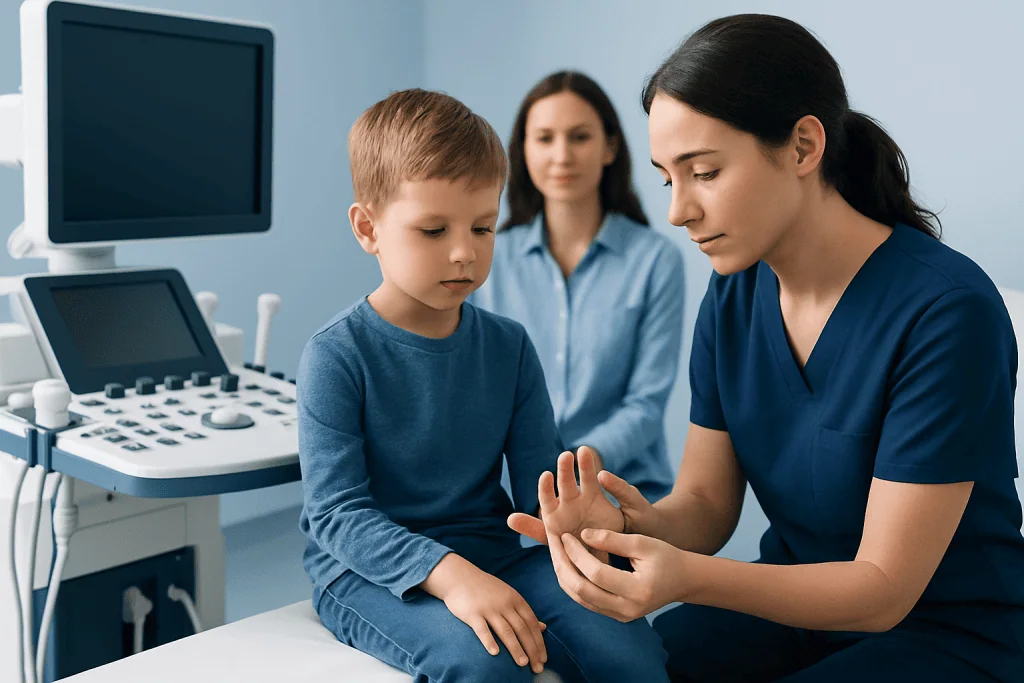
The main symptom of syndactyly is visible fusion or webbing between two or more digits. In the hand, the middle and ring fingers are commonly involved, although any fingers can be affected. In the foot, the second and third toes are a frequent location. The webbing may be soft and flexible, or the digits may appear more firmly joined.
Syndactyly is not usually painful in a newborn. Concerns often relate to function, growth, nail shape, hygiene, and appearance. In the hand, a child may have difficulty spreading the fingers, grasping objects, or developing certain fine movements if the joined digits have different lengths or if the fusion is tight.
Possible features include:
- Skin webbing between fingers or toes
- Digits that move together rather than separately
- Different finger lengths pulling on each other during growth
- Joined or unusually shaped nails in complete syndactyly
- Associated extra fingers or toes in some children
- Other hand, foot, craniofacial, or body differences when syndactyly is part of a syndrome
The appearance alone does not always show how deep the fusion is. A specialist examination and, in some cases, imaging help determine whether deeper tissues or bones are involved.
Causes & Risk Factors
Syndactyly develops before birth during the formation of the hands and feet. In early fetal development, fingers and toes begin as paddle-like structures. The digits normally separate as the tissue between them breaks down in a controlled way. Syndactyly occurs when this separation is incomplete.
Many cases are isolated, meaning the child has syndactyly without other health problems. Isolated syndactyly can sometimes run in families, and genetic factors may contribute. In other children, syndactyly is one feature of a broader genetic syndrome or is associated with other limb differences, such as extra digits, shortened digits, or differences in bone development.
Risk factors and related considerations include:
- A family history of syndactyly or congenital limb differences
- Known genetic syndromes that include hand or foot findings
- Syndactyly affecting several digits, both hands, or both feet
- Complex fusion involving bone, joints, or nails
- Additional differences in growth, facial features, heart, skull, or other organs
In most families, syndactyly is not caused by anything the parents did or did not do during pregnancy. When syndactyly is severe, bilateral, or accompanied by other findings, doctors may recommend genetic counseling or further evaluation to understand the cause and guide family planning.
Diagnosis
Syndactyly is usually diagnosed by physical examination soon after birth, and sometimes it is suspected during prenatal ultrasound. The doctor looks at which digits are involved, how far the webbing extends, whether the nails are separate or joined, and how the fingers or toes move. The child is also examined for any other limb or body findings that could suggest a related syndrome.
X-rays may be requested, especially when the digits appear completely joined, unusually shaped, or stiff. Imaging helps show whether bones are fused, whether joints are separate, and whether there are extra or missing bones. This information is important for planning treatment and for discussing what results are realistic.
In selected cases, additional tests may be recommended. These can include assessment by a pediatrician, clinical geneticist, orthopedic or plastic reconstructive surgeon, hand therapist, or other specialists. Genetic testing is not required for every child, but it may be useful when syndactyly is part of a pattern of multiple findings or when there is a strong family history.
Treatment Options
Treatment for syndactyly depends on the child’s age, the digits involved, the depth of fusion, expected growth, hand or foot function, and family goals. The right approach is decided by a specialist after careful assessment. Some mild webbed toes that do not affect shoes, walking, hygiene, or comfort may not need surgery, while many hand cases are considered for surgical separation to support function and growth.
Surgery is the main treatment when separation is recommended. The aim is to create safe, separate digits with durable skin coverage, protected blood supply, good movement, and an appearance that supports the child’s confidence. Surgery may involve designing skin flaps to create the web space between the digits. In some cases, a skin graft or other reconstructive technique is needed to cover areas where there is not enough local skin.
Timing is individualized. Some cases are treated earlier, particularly when joined fingers have very different lengths, because unequal growth can pull on the digits and cause deformity. Other cases may be planned later in infancy or early childhood. If several digits are joined, surgery may be staged in more than one procedure to reduce risk and allow healing between operations.
After surgery, children may need a dressing, splint, and follow-up visits to monitor healing. Hand therapy or guided exercises may be recommended to support motion, scar care, and use of the hand. As the child grows, the specialist checks for scar tightening, web creep, nail problems, or movement limitations that may occasionally require further treatment.
Living With / Prognosis
Many children with syndactyly grow, play, and learn normally. The outlook is especially good when the condition is isolated and the digits have normal bones, joints, nerves, and blood vessels. Even when surgery is needed, the goal is to improve practical function as well as appearance, and care is planned around the child’s growth and development.
Families can support a child by encouraging normal use of the hands and feet while following specialist guidance. Before surgery, children often adapt well to their hand or foot shape. After surgery, temporary protection of the area is important, followed by gradual return to age-appropriate activity as advised by the care team.
Long-term follow-up may be needed because a child’s hand or foot continues to grow. Scars can mature over months, and the web space between separated digits may change with growth. Regular review allows the team to identify stiffness, scar tightness, or web recurrence early and manage these issues appropriately.
Emotional support also matters. Parents may feel concern when a baby is born with a visible difference, but syndactyly is a recognized and treatable condition. Clear information, realistic expectations, and access to experienced pediatric reconstructive care can help families make confident decisions.
When to See a Doctor
A baby or child with suspected syndactyly should be assessed by a qualified doctor, ideally with referral to a pediatric hand, plastic reconstructive, or orthopedic specialist. Early evaluation does not always mean immediate surgery. It allows the team to understand the anatomy, explain options, and choose the safest timing if treatment is needed.
Families should seek specialist advice promptly if the joined digits are different lengths, if the fusion extends to the fingertips or toe tips, if the nails are joined, or if the fingers seem to bend, rotate, or move poorly. Medical evaluation is also important when syndactyly affects several digits, occurs on both hands or feet, or appears together with other physical differences.
Urgent care is rarely needed for syndactyly itself, but medical attention should be sought if there are signs of injury, infection, poor circulation, swelling, color change, or significant pain in the affected digits. These concerns are separate from the congenital webbing and should be assessed without delay.
Acibadem International’s multidisciplinary specialists and JCI-accredited hospitals provide diagnosis and treatment planning for syndactyly in children and adults, including international patients. Care is tailored after individual assessment by the appropriate specialist team.
Frequently asked questions
What is syndactyly?
Syndactyly is a congenital condition in which two or more fingers or toes are joined together. The joining may involve only skin or may include deeper tissues such as bone, tendons, nerves, or blood vessels. It is present at birth and varies from mild webbing to complex fusion.
Is syndactyly dangerous?
Syndactyly is usually not dangerous and is often not painful. The main concerns are function, growth of the digits, hygiene, footwear in some toe cases, and appearance. A specialist can determine whether observation or treatment is the best approach.
Does every child with syndactyly need surgery?
No. Some mild cases, especially webbed toes that do not cause problems, may not need surgery. Surgery is more often considered for fingers, complex fusion, or cases that may affect growth, hand function, or nail development. The decision should be made after examination by a specialist.
When is syndactyly surgery usually performed?
Timing depends on which digits are involved, how deep the fusion is, and whether growth could be affected. Some cases are treated earlier, while others can be planned later in infancy or early childhood. The surgeon decides timing after assessing anatomy, function, and the child’s overall health.
Can syndactyly come back after surgery?
A separated web space can sometimes tighten or move forward with growth, a change often called web creep. This is one reason follow-up is important after surgery. If a problem develops, the specialist may recommend scar care, therapy, observation, or occasionally another procedure.
Is syndactyly inherited?
Syndactyly can be inherited in some families, but it can also occur in a child with no family history. It may appear alone or as part of a genetic syndrome. Genetic counseling may be recommended when syndactyly is complex, affects several areas, or occurs with other medical or physical findings.
Can adults have syndactyly treated?
Yes, adults with untreated syndactyly can be assessed for treatment, particularly if function, comfort, hygiene, or appearance is a concern. The anatomy, skin quality, joint movement, and expectations are reviewed carefully. A specialist can explain whether surgery or non-surgical support is appropriate.
References
- American Society for Surgery of the Hand
- American Academy of Orthopaedic Surgeons
- British Society for Surgery of the Hand
- National Organization for Rare Disorders
- MedlinePlus
This article is for general information only and is not a substitute for professional medical advice. Please consult a qualified doctor about your individual situation.
Treatments for This Condition
Doctors Who Treat This Condition

Prof. Dr. Bülent Saçak
Aesthetic Plastic & Reconstructive Surgery
Prof. Dr. Ersin Ülkür
Aesthetic Plastic & Reconstructive Surgery
Prof. Dr. Hakan Ağır
Aesthetic Plastic & Reconstructive Surgery
Prof. Dr. Mehmet Veli Karaaltın
Aesthetic Plastic & Reconstructive Surgery
Prof. Dr. Çiğdem Ünal Gülmeden
Aesthetic Plastic & Reconstructive Surgery
Prof. Dr. Şükrü Yazar
Aesthetic Plastic and Reconstructive Surgery
Dr. Burak Sercan Erçin
Aesthetic Plastic & Reconstructive Surgery
Dr. Cem Öz
Aesthetic Plastic & Reconstructive Surgery
Dr. Mahmut Özyilmaz
Aesthetic Plastic & Reconstructive Surgery
Dr. Mehmet Severcan
Aesthetic Plastic & Reconstructive Surgery
Dr. Mithat Ulay
Aesthetic Plastic & Reconstructive Surgery
Dr. Mutluhan Temizsoy
Aesthetic Plastic & Reconstructive SurgeryRelated Articles

Aesthetic Foot Surgery Scars: Where Incisions Are Placed and What to Expect

Brow Lift Results: How Long They Last and What Affects Longevity

What Is Aesthetic Breast Surgery Recovery Really Like?

Breast Reconstruction: How to Prepare Physically and Emotionally for Surgery
Congenital Nevi: How Dermatologists and Surgeons Assess Size, Location, and Risk
Congenital Nevi: Causes, Types, and How They Can Change Over Time

Breast Prosthesis Removal: What Results Are Realistic Without Replacement?

Knee Surgery Price: Costs by Procedure and Treatment Plan

Cosmetic Surgery Cost: Common Procedures and Price Factors

How Much Does Bariatric Surgery Cost?

Cost of Plastic Surgery: What Affects the Total Price?