Inflammatory Granulomatous Mastitis
Inflammatory granulomatous mastitis is a rare, non-cancerous breast inflammation. Learn about its symptoms, possible causes, how it is diagnosed and treatment options.

Quick answer
Inflammatory granulomatous mastitis is a rare, benign, chronic inflammation of the breast that causes a firm painful lump, skin redness, abscesses and sometimes draining openings. It mostly affects women of childbearing age, often after pregnancy or breastfeeding. Its cause is unclear, diagnosis requires a biopsy, and treatment ranges from observation to steroids or surgery.
What is inflammatory granulomatous mastitis?
Inflammatory granulomatous mastitis is a rare, long-lasting (chronic) inflammation of the breast that is not caused by cancer. The word mastitis simply means inflammation of breast tissue. Granulomatous refers to what doctors see under the microscope: small clusters of immune cells called granulomas, which the body forms when it is trying to wall off something it sees as a threat. In most cases no infection, cancer or other clear trigger can be found, which is why the condition is also called idiopathic granulomatous mastitis (idiopathic means the cause is unknown).
The condition mainly affects women of childbearing age, most often in their twenties to forties. It is frequently seen within a few years after a pregnancy or after breastfeeding has stopped, although it can occur in women who have never been pregnant. It is very uncommon in men and in women after menopause. Because it can cause a firm lump, skin changes and swollen lymph nodes, inflammatory granulomatous mastitis is often mistaken at first for a breast infection or for breast cancer. Careful testing is therefore essential to reach the correct diagnosis.
Although the condition can be painful, slow to settle and prone to coming back, it is considered benign, meaning it is not cancer and does not turn into cancer. Many people improve over months to a couple of years, with or without treatment, but the course varies from person to person.
Inflammatory granulomatous mastitis symptoms
Inflammatory granulomatous mastitis symptoms usually develop in one breast, although both breasts can occasionally be affected over time. Common features include:
- A firm, often tender lump in the breast, sometimes large and irregular
- Breast pain or aching that may be constant or come and go
- Redness, warmth and swelling of the overlying skin
- Thickened or dimpled skin over the affected area
- Collections of pus (abscesses) under the skin
- Small openings in the skin that leak fluid or pus (sinus tracts or fistulas)
- Pulling inward of the nipple (nipple retraction)
- Nipple discharge, which may be clear, milky or pus-like
- Enlarged, tender lymph nodes in the armpit
Symptoms often change with the stage of the condition. In the early phase, the main finding is usually a painful lump with little or no skin change, which can be hard to tell apart from other breast lumps. As inflammation progresses, the skin over the lump may become red and swollen, and abscesses may form. In later or more severe stages, abscesses can break through the skin and create draining openings that heal slowly and may leave scars. Some people go through repeated cycles of flare-up and partial healing.
Less commonly, inflammatory granulomatous mastitis is accompanied by symptoms outside the breast, such as painful red lumps on the shins (a skin reaction called erythema nodosum) or joint pain. Fever is uncommon unless a true bacterial infection has developed on top of the inflammation. If you notice any of these changes, they should be assessed by a doctor, because the same signs can be caused by other conditions, including breast cancer.
Causes and risk factors
The exact inflammatory granulomatous mastitis causes are not fully understood. The leading view is that it is an overreaction of the immune system within the milk-producing parts of the breast (the lobules), rather than a straightforward infection. Several possible contributing factors have been proposed:
- Milk leakage into breast tissue. After pregnancy or breastfeeding, milk proteins may escape from the milk ducts into surrounding tissue, where the immune system may react against them.
- Hormonal influences. Raised levels of prolactin (the hormone that drives milk production) have been linked with the condition. This can occur with certain medications, some pituitary gland conditions or the use of hormonal contraception in some people.
- Bacteria. A group of bacteria called Corynebacterium has been found in a proportion of cases, particularly a form sometimes called cystic neutrophilic granulomatous mastitis. It is not yet clear whether these bacteria cause the disease or take advantage of already inflamed tissue.
- Autoimmune tendency. Because the condition often responds to medicines that calm the immune system, an autoimmune process is thought to play a role in many cases.
- Injury or trauma to the breast, which has been reported before some cases, though a clear link is not established.
Risk factors that appear more common among people with inflammatory granulomatous mastitis include a recent pregnancy or breastfeeding (usually within the previous few years), being of childbearing age, use of oral contraceptives, high prolactin levels, smoking, and certain genetic or ethnic backgrounds. Importantly, having a risk factor does not mean you will develop the condition, and many people who develop it have none of these factors.
Inflammatory granulomatous mastitis diagnosis
There is no single test that confirms inflammatory granulomatous mastitis. Diagnosis is made by combining your history, an examination, imaging and, most importantly, a tissue sample, while ruling out other conditions that cause similar changes. Steps your doctor may take include:
- Clinical examination of the breast, skin and lymph nodes, along with questions about pregnancies, breastfeeding, medications and other health conditions.
- Breast ultrasound, which uses sound waves to show the lump, any fluid collections and the extent of inflammation. Findings are often irregular and can overlap with those of cancer.
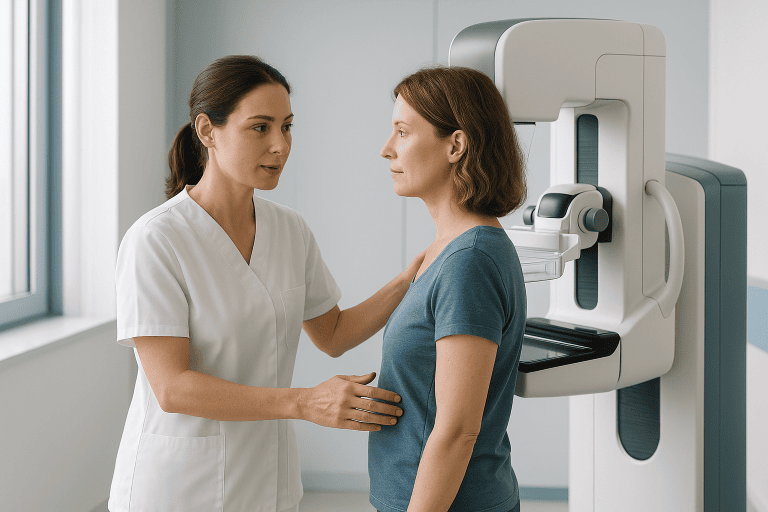
- Mammography (a breast X-ray), especially in women over 35 or 40, to look at the density and shape of the affected area and to check the rest of the breast.
- Breast MRI in selected cases, to map how far the inflammation extends or when other tests are unclear.
- Core needle biopsy, in which a small sample of tissue is removed under local anesthetic and examined under the microscope. This is the key test. In inflammatory granulomatous mastitis the pathologist typically sees non-caseating granulomas (granulomas without a central area of dead tissue) centered on the breast lobules.
- Cultures and special stains of biopsy tissue or pus to look for bacteria, tuberculosis and fungal infection, which can also cause granulomas in the breast.
- Blood tests, which may include prolactin levels and markers of inflammation, and sometimes tests for other granulomatous or autoimmune diseases.
Because granulomas can be caused by several other conditions, the diagnosis is partly one of exclusion. Doctors will usually want to rule out breast cancer (particularly inflammatory breast cancer, which can look very similar), tuberculosis of the breast, fungal infection, sarcoidosis (an inflammatory disease that forms granulomas in various organs), granulomatosis with polyangiitis (an inflammatory blood-vessel disease) and reactions to foreign material such as previous injections or implants. Only after these possibilities have been reasonably excluded is a diagnosis of idiopathic granulomatous mastitis made. In many hospitals this process is coordinated by a specialist breast team, such as the Breast Health Department at Acibadem, working together with radiology and pathology.
Inflammatory granulomatous mastitis treatment options
There is no universally agreed best treatment, and inflammatory granulomatous mastitis treatment is usually tailored to how severe the symptoms are, how much of the breast is involved and how the condition responds over time. Your doctor may suggest one or a combination of the following approaches.
Observation and supportive care
In milder cases, the condition may settle on its own over many months. Doctors may recommend watchful waiting with regular check-ups, simple pain relief such as acetaminophen or non-steroidal anti-inflammatory drugs, warm compresses and a supportive bra. This approach avoids medication side effects but requires patience, as improvement can be slow.
Antibiotics
Antibiotics do not treat the underlying inflammation, but they are often used when there are signs of a bacterial infection alongside it, or when Corynebacterium is identified. Certain antibiotics that penetrate fatty tissue well may be chosen in that situation. Many people receive antibiotics early on before the diagnosis is clear, and a lack of response to antibiotics is one clue that points toward granulomatous mastitis rather than an ordinary breast infection.
Corticosteroids
Corticosteroids (steroid medicines that reduce inflammation) are one of the most commonly used treatments. They may be given as tablets, applied as a cream to the skin, or injected directly into the affected area. Steroids often reduce pain and swelling within weeks, but the dose usually needs to be tapered slowly, and symptoms can return when the medicine is stopped. Longer courses carry side effects such as weight gain, raised blood sugar, mood changes and bone thinning, so doctors aim to use the lowest effective dose for the shortest necessary time.
Other immune-modifying medicines
For people who do not respond to steroids, cannot tolerate them, or relapse repeatedly, a steroid-sparing medicine such as methotrexate may be considered. These medicines require regular blood monitoring and are prescribed by doctors experienced in their use. If a high prolactin level is found, treating that underlying issue, for example by adjusting a medication, may also help.
Drainage procedures
Abscesses can be drained with a needle under ultrasound guidance or, if large, through a small incision. Drainage relieves pressure and pain but does not by itself cure the inflammation, so it is usually combined with other treatment. Repeated drainage may be needed.
Surgery
Surgical removal of the affected tissue (excision) is generally reserved for cases that do not respond to medication, or for persistent draining openings and abscesses. Surgery can be effective, but because the inflammation is often widespread and poorly defined, wounds may heal slowly and the condition can recur at the edges of the removed area. Cosmetic changes to the breast are possible. Most specialists prefer to try medical treatment first and to operate on tissue that has already been calmed by medication, if surgery is needed at all.
Whichever approach is used, follow-up over months is typically recommended, both to monitor response and to make sure that nothing more serious has been missed.
Living with inflammatory granulomatous mastitis and outlook
Inflammatory granulomatous mastitis is a benign condition, and for most people the long-term outlook is good in the sense that it does not threaten life and does not turn into cancer. However, the day-to-day reality can be difficult. Pain, draining wounds, repeated appointments and uncertainty about when the condition will settle can take an emotional as well as a physical toll. It is reasonable to ask your care team about pain management, wound care and support resources.
The condition often runs a course of months to a few years, with periods of improvement and flare-up. Recurrence after apparent healing is not unusual, whether treatment was medical or surgical, so some people need more than one course of treatment. Scarring, changes in breast shape and nipple retraction can remain after the inflammation has resolved. Keeping a simple record of symptoms and taking photographs of skin changes can help you and your doctor track progress.
Future pregnancy and breastfeeding are usually possible, but it is sensible to discuss them with your doctor, since hormonal changes may influence the condition and some medicines used to treat it must be stopped before conception. Because the appearance of the breast can change, routine breast awareness and any recommended screening should continue as advised, since having granulomatous mastitis does not protect against other breast conditions.
Frequently asked questions
Is inflammatory granulomatous mastitis a type of breast cancer?
No. Inflammatory granulomatous mastitis is a benign inflammatory condition, not cancer, and it is not known to develop into cancer. The difficulty is that its symptoms, including a firm lump, skin redness and swollen lymph nodes, can closely resemble breast cancer, particularly inflammatory breast cancer. This is why a biopsy is usually recommended before the diagnosis is accepted.
What are the first inflammatory granulomatous mastitis symptoms people notice?
The earliest sign is most often a firm, tender lump in one breast, sometimes with mild aching. Skin redness, swelling, abscesses and draining openings tend to develop later. Because the early stage looks like many other breast lumps, any new lump that does not settle within a short time should be checked.
What causes inflammatory granulomatous mastitis?
The cause is not fully known. It is thought to involve an immune reaction within the milk-producing parts of the breast, possibly triggered by leaked milk proteins, hormonal changes such as raised prolactin, or certain bacteria. It occurs most often in women within a few years of pregnancy or breastfeeding, but it can also affect women who have never been pregnant.
How is inflammatory granulomatous mastitis diagnosis confirmed?
Diagnosis relies on a core needle biopsy that shows characteristic granulomas in the breast lobules, together with tests that rule out infection (including tuberculosis and fungi), cancer and other granuloma-forming diseases. Ultrasound and mammography help assess the extent of the problem but cannot by themselves confirm the condition.
Which inflammatory granulomatous mastitis treatment works best?
There is no single best treatment. Options range from observation and pain relief to corticosteroids, other immune-modifying medicines, drainage of abscesses and, in resistant cases, surgery. Many doctors begin with medical treatment and reserve surgery for cases that do not respond. The choice depends on symptom severity, extent of disease and your personal circumstances.
Can inflammatory granulomatous mastitis come back after treatment?
Yes, recurrence is fairly common with all forms of treatment, and some people experience several flare-ups over a few years before the condition finally settles. Regular follow-up allows treatment to be adjusted if symptoms return.
Can I breastfeed if I have had inflammatory granulomatous mastitis?
Many women are able to breastfeed after the condition has resolved, but scarring or nipple retraction can sometimes make it more difficult, and some medications used for treatment are not compatible with pregnancy or breastfeeding. Your doctor can advise you based on your treatment history and the current state of the breast.
When to see a doctor
Any new breast lump, area of thickening or skin change should be assessed by a doctor, even if it is painful, because pain does not rule out serious disease. If you have already been diagnosed with inflammatory granulomatous mastitis, keep your scheduled follow-up appointments and report new or worsening symptoms.
Seek urgent medical attention if you notice any of the following red-flag signs:
- High fever, chills or feeling generally very unwell, which may indicate a spreading infection
- Rapidly increasing redness, swelling or pain in the breast
- A large, tense or fluctuating swelling that suggests an abscess needing drainage
- Skin that turns dark, purple or breaks down over a wide area
- Heavy or foul-smelling discharge from the breast or from a skin opening
- Bloody nipple discharge
- A lump that continues to grow despite treatment, or new lumps in the breast or armpit
- Side effects from medication such as severe stomach pain, unusual bruising, jaundice or signs of infection while taking steroids or methotrexate
Prompt assessment allows infections to be treated, abscesses to be drained and, when necessary, the diagnosis to be reviewed so that other conditions are not overlooked.
Medically reviewed by the Acıbadem International Medical Board September 13, 2026
See our medical review board →
Update history
- PublishedSeptember 13, 2026
- Medical review approvedSeptember 13, 2026
- Last content updateSeptember 13, 2026