What Does OD Mean in Eye Care? Eye Doctor Titles Explained

OD stands for Doctor of Optometry. Optometrists examine eyes, test vision, and prescribe glasses or contact lenses.
Key Takeaways
- OD stands for Doctor of Optometry.
- Optometrists examine eyes, test vision, and prescribe glasses or contact lenses.
- Ophthalmologists are medical doctors who diagnose eye disease and perform eye surgery.
- Some eye problems can be managed by an OD, while others need referral to an ophthalmologist.
- Eye doctor titles describe training and scope of practice, not quality of care.
- Choosing the right eye specialist depends on symptoms, diagnosis, and treatment needs.
OD in eye care usually means Doctor of Optometry, an eye care professional who performs eye exams, prescribes glasses or contact lenses, and helps manage many common vision and eye health concerns. Understanding titles such as OD, MD, and ophthalmologist can help patients choose the right professional for routine care, treatment, or surgery.
Overview: What does OD mean in eye care?
In eye care, OD stands for Doctor of Optometry. An optometrist is a healthcare professional trained to examine the eyes, assess vision, prescribe glasses and contact lenses, and detect many common eye conditions. For many people, an OD is the eye doctor they see for regular vision checks and ongoing routine eye care.
The term can be confusing because several different professionals provide eye care. Patients may also see the titles MD, DO, ophthalmologist, or optician. These titles reflect differences in education, medical training, and the kinds of services each professional provides.
Knowing what OD means can make it easier to book the right appointment. A person needing a routine eye exam, an updated prescription, or advice about contact lenses will often start with an optometrist. If surgery or advanced medical treatment is needed, the optometrist may refer the patient to an ophthalmologist.
What an OD does
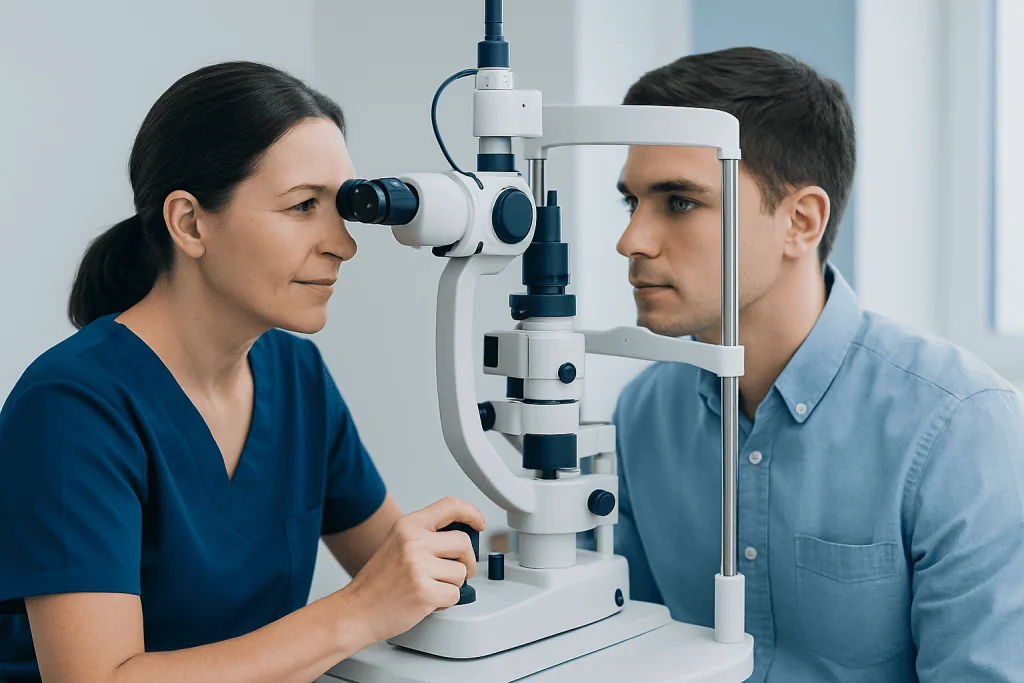
A Doctor of Optometry focuses on vision care and many aspects of eye health. During an eye exam, an OD checks how clearly a person sees, whether the eyes work together properly, and whether there are signs of disease affecting the eye or, sometimes, general health.
Optometrists commonly diagnose and manage refractive errors such as nearsightedness, farsightedness, astigmatism, and age-related focusing changes. They prescribe eyeglasses and contact lenses and may offer advice on options such as astigmatism correction or presbyopia treatment depending on a patient’s visual needs and eye health.
In many settings, ODs also help monitor and treat certain eye conditions, especially common or chronic problems. These may include dry eye, eye allergies, some infections, and long-term follow-up for stable eye disease. If the condition is complex, severe, or requires a procedure, the OD usually coordinates referral to an ophthalmologist.
- Performs routine eye exams
- Tests vision and prescribes glasses
- Fits and monitors contact lenses
- Detects signs of common eye disease
- Provides follow-up care and referrals when needed
OD, ophthalmologist, optician, MD, and DO: what is the difference?

The most important distinction is between an optometrist and an ophthalmologist. An optometrist (OD) is trained in primary vision and eye care. An ophthalmologist is a medical doctor who specializes in eye disease, medical treatment, and eye surgery. Ophthalmologists may use the title MD or, in some countries, DO if they are osteopathic physicians.
An optician is different from both. Opticians are trained to fit and dispense eyeglasses and, in some places, contact lenses based on a prescription written by an optometrist or ophthalmologist. They do not diagnose eye disease or perform full medical eye examinations.
Patients may hear these titles used together because eye care often involves a team approach. For example, an OD may identify a cataract during a routine exam and refer the patient to an ophthalmologist for cataract surgery. After treatment, the patient may continue regular vision care with the OD and have glasses fitted by an optician.
- OD: Doctor of Optometry
- Ophthalmologist: physician specializing in medical and surgical eye care
- MD/DO: medical doctor degree held by many ophthalmologists
- Optician: professional who fits eyewear from an existing prescription
When to see an OD and when to see an ophthalmologist
An OD is usually the right starting point for routine eye care. This includes annual or periodic eye exams, blurred vision, headaches related to focusing, a need for new glasses, or questions about contact lens wear. Optometrists also play an important role in eye screening for children, adults, and older people.
An ophthalmologist is often needed when there is a serious eye disease, sudden vision change, eye injury, or concern that surgery may be required. Conditions such as advanced cataracts, retinal disease, glaucoma with complications, or corneal disorders may need specialist medical or surgical treatment. Some people with complex visual symptoms may also be referred for neuro-ophthalmology care when the eyes and nervous system are both involved.
In practice, many patients see both professionals at different times. An optometrist may detect a problem such as diabetic retinopathy during a regular exam and refer the patient for further evaluation and treatment. This shared-care approach helps patients receive the right level of expertise for their particular condition.
Common eye doctor abbreviations patients may see
Eye care can involve several abbreviations that appear on prescriptions, appointment letters, and clinic signs. Understanding them can make healthcare less confusing. While OD refers to Doctor of Optometry, other abbreviations may relate to the clinician’s degree, the part of the eye being described, or the type of test performed.
For example, OS means the left eye and OD can also mean the right eye on some prescriptions, from the Latin term oculus dexter. In that setting, OD does not mean Doctor of Optometry. This is one reason it is useful to look at the context: if OD appears after a clinician’s name, it usually means optometrist; if it appears on a prescription line beside OS and OU, it usually refers to the right eye.
Some common terms include:
- OD: Doctor of Optometry, or right eye depending on context
- OS: left eye
- OU: both eyes
- MD/DO: medical doctor
- IOP: intraocular pressure
- VA: visual acuity, or clarity of vision
If any title or abbreviation is unclear, patients should feel comfortable asking the clinic to explain it. Clear communication is an important part of safe and effective eye care.
How eye doctors diagnose vision and eye health problems
Whether a person sees an OD or an ophthalmologist, the diagnostic process often begins with a detailed history. The clinician may ask about blurred vision, eye pain, dryness, flashing lights, headaches, diabetes, medication use, family history, or previous eye surgery. These details help guide the examination and identify risk factors.
A standard eye exam may include visual acuity testing, refraction for glasses, eye movement assessment, pupil evaluation, slit-lamp examination, and measurement of eye pressure. The doctor may also examine the retina and optic nerve, sometimes after dilating the pupils. These tests can identify not only refractive errors but also signs of cataracts, glaucoma, retinal disease, and other conditions.
Some patients need more specialized testing. Depending on symptoms, this may include imaging, corneal mapping, visual field testing, or retinal studies such as eye angiography. If the exam suggests a condition affecting the cornea, lens, retina, or optic nerve, the patient may be referred to the appropriate specialist for further treatment planning.
Treatment options after an eye diagnosis
Treatment depends on the specific problem found during the exam. Many common vision issues are managed with glasses, contact lenses, or changes in lens prescription. Some eye surface problems improve with lubricating drops, allergy care, eyelid hygiene, or short-term medication prescribed by a qualified clinician.
Medical treatment may be needed for infections, inflammation, elevated eye pressure, or chronic eye disease. More advanced conditions can require laser procedures or surgery by an ophthalmologist. Examples include laser treatments for selected eye conditions, surgery for cataracts, and specialist care for retinal or corneal disease.
Patients considering refractive surgery, such as LASIK or PRK, should have a full eye assessment to determine whether they are suitable candidates. A doctor will consider corneal thickness, prescription stability, dry eye symptoms, and overall eye health before recommending surgery or other alternatives.
Near the end of the care pathway, some patients benefit from coordinated multidisciplinary support. Acibadem International’s specialists in JCI-accredited hospitals diagnose and treat a wide range of eye conditions for international patients, from routine refractive concerns to complex medical and surgical eye problems.
When to seek prompt eye care
Many eye concerns are not emergencies, but some symptoms need prompt medical attention. A person should seek urgent assessment if there is sudden vision loss, severe eye pain, a curtain-like shadow in vision, a new shower of floaters, flashing lights, chemical exposure, or significant trauma to the eye. These symptoms can signal conditions that need quick treatment to protect vision.
It is also wise to book an appointment sooner rather than later for persistent redness, worsening blurred vision, double vision, ongoing discharge, or discomfort that does not improve. Children should have timely evaluation if they squint, sit very close to screens, complain of headaches, or seem to have one eye turning in or out.
Regular preventive eye exams remain important even without symptoms. This is especially true for people with diabetes, high blood pressure, a family history of glaucoma, previous eye disease, or advancing age. Early detection gives the best chance of managing problems before they affect daily life.
Frequently asked questions
Does OD always mean Doctor of Optometry?
Not always. In eye care, OD can mean Doctor of Optometry after a clinician’s name, but on some prescriptions it can also mean the right eye. The meaning depends on where and how the abbreviation is used.
Is an OD a real doctor?
An OD is a licensed healthcare professional with advanced training in optometry. Optometrists are experts in vision care and eye examinations, but they are not the same as medical doctors who perform eye surgery. Their role is different, and both are important in eye care.
Should a person see an optometrist or an ophthalmologist first?
For routine eye exams, glasses prescriptions, and many common vision concerns, an optometrist is often the right first step. If there is severe pain, sudden vision loss, injury, or a suspected need for surgery, an ophthalmologist may be more appropriate. An optometrist can also refer when specialist treatment is needed.
Can an OD diagnose eye diseases?
Yes. Optometrists are trained to detect and diagnose many common eye conditions and monitor eye health over time. Depending on local regulations and the condition involved, they may also provide treatment or refer to an ophthalmologist for advanced care.
What is the difference between an OD and an optician?
An OD examines the eyes, tests vision, and diagnoses many eye problems. An optician fits and dispenses glasses or other eyewear based on a prescription from an optometrist or ophthalmologist. Opticians do not usually perform full medical eye examinations.
Can an OD prescribe contact lenses and glasses?
Yes. Prescribing glasses and contact lenses is one of the central parts of optometric care. An OD can also help monitor comfort, fit, and vision quality over time.
References
- American Academy of Ophthalmology
- American Optometric Association
- National Eye Institute
- World Health Organization
- Royal College of Ophthalmologists
This article is for general information only and is not a substitute for professional medical advice. Please consult a qualified doctor about your individual situation.
Explore treatments in Turkey — costs, top hospitals & a free quote
JCI-accredited · board-certified surgeons · reply within 24h
Add us as a Preferred Source to see more of our trusted health content across Google Search, AI Overviews and Discover.