

Dental Implants in Turkey vs At Home: Key Differences for Patients
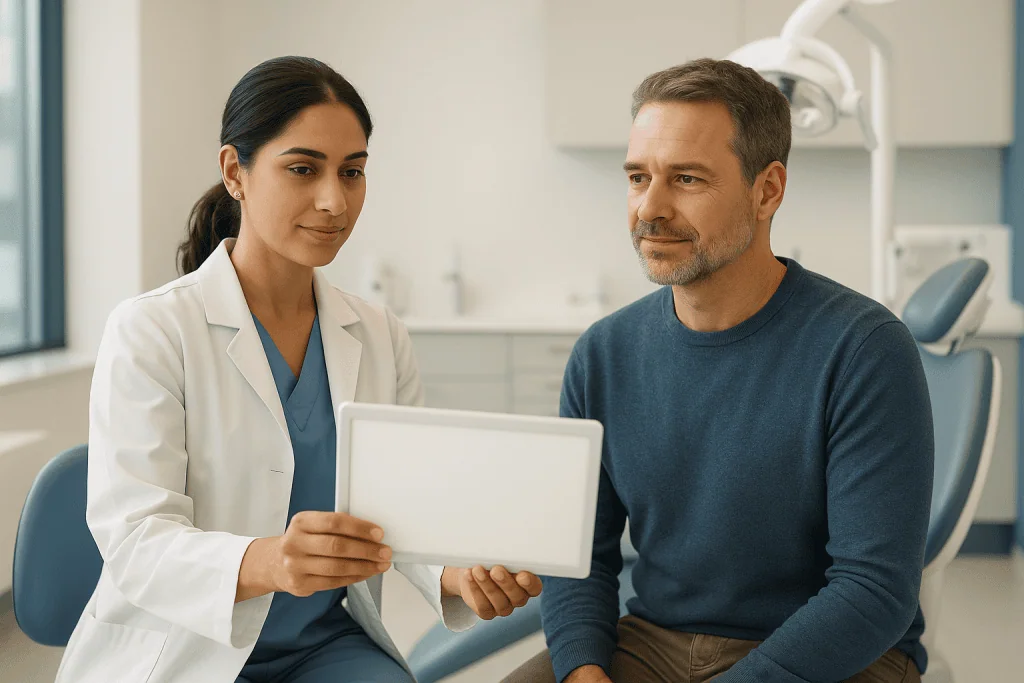
The clinical steps of implant treatment are broadly the same in Turkey and at home: assessment, placement, healing, restoration. What differs is how the pathway is organised, how quickly imaging and consultations are coordinated, how treatment is staged around travel, and how follow-up is shared between the clinic in Turkey and a dentist near you. Comparing those pathways, not just headline quotes, is what matters.
This guide compares dental implants in Turkey with having the same treatment at home. It covers what actually differs, planning, timelines, staging, travel, aftercare and how quotes are built, and what stays the same wherever you are treated. If you want the broader picture beyond dentistry, our guide to treatment in Turkey vs your home country covers the general differences for international patients.
At a glance
- Procedure type: Restorative dental treatment using titanium or similar implant fixtures to replace missing tooth roots
- Purpose: To restore missing teeth, chewing function, smile appearance and long-term support for the jaw and bite
- Anaesthesia: Usually local anaesthesia; sedation may be considered in selected cases
- Hospital stay: Typically not required; most implant placement is done in a clinic setting with same-day discharge
- Estimated recovery: Initial soreness usually settles within days; bone integration takes weeks to months
- Return to daily life: Many patients resume light daily activities within one to three days, depending on the extent of treatment
- Final result timeline: Often several months, depending on healing, any grafting and when the final crown or bridge is fitted
- Suitable department: Dentistry / Oral and Maxillofacial Surgery / Prosthodontics
- International patient support: Interpreter services, transfer coordination, accommodation guidance and remote follow-up support
Dental implants in Turkey vs at home: what actually differs
Start with what does not differ. A dental implant replaces a missing tooth root with a biocompatible fixture placed into the jawbone. Once it has integrated with the bone, it supports a crown, a bridge or a full-arch restoration. The biology is the same in Istanbul as it is in London or Berlin. Bone heals at its own pace, and no clinic in any country can shorten that.
When people weigh up dental implants in Turkey vs at home, the real differences sit around the treatment, not inside it. They involve how quickly imaging and specialist consultations can be arranged, whether surgery and prosthetic planning happen under one roof or across separate providers, how the treatment is staged around your travel dates, and, most importantly, how aftercare is organised once you fly home.
In Turkey, the typical international pathway is compressed: an online review before travel, imaging and examination on arrival, treatment by a coordinated dental team, then early review before departure. At home, the same treatment may be spread over more appointments with different providers, which makes local follow-up simpler but can make the overall timeline longer. Neither model is automatically better. The right comparison is between two complete pathways, not two headline quotes. Our dental implants in Turkey treatment guide walks through the Turkish pathway step by step.
When is implant treatment considered?
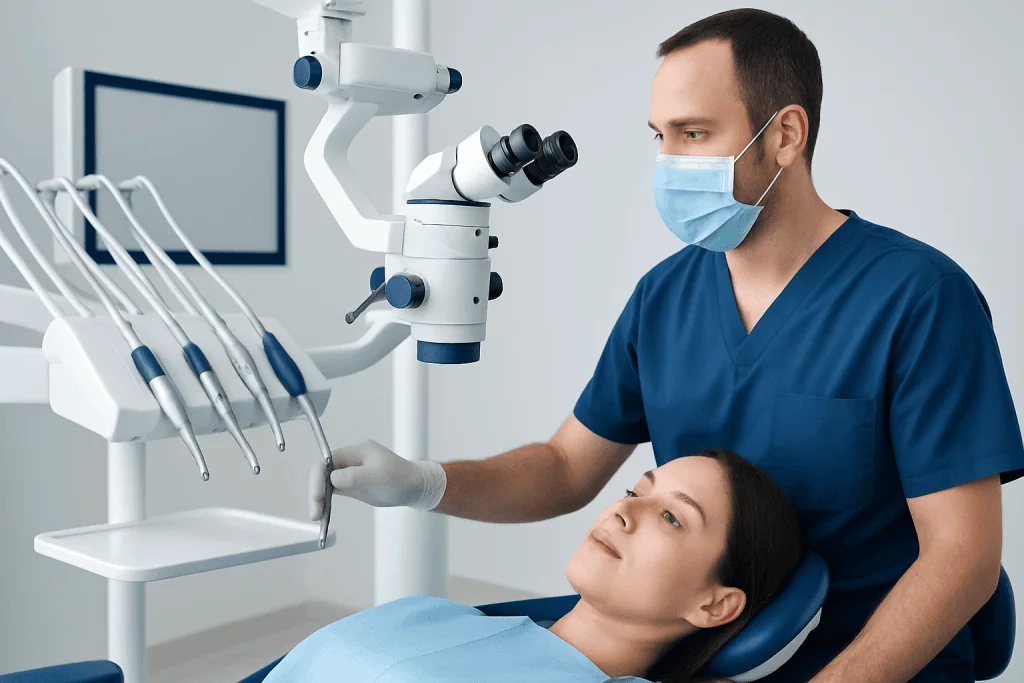
Dentists consider implants when one or more teeth are missing and a fixed replacement is wanted. An implant can carry a single crown, several implants can support a bridge, and a set of implants can anchor a full-arch restoration when most or all teeth in a jaw are missing.
Implants are also discussed when removable dentures are unstable, uncomfortable or undermine chewing confidence. In some patients, implants help maintain jawbone volume over time, although this depends on anatomy, oral health and the overall plan.
They are not always the first or only answer. A conventional bridge, a removable denture, periodontal treatment or staged rehabilitation is sometimes more appropriate. This holds true wherever you are treated: gum disease, significant bone loss, poorly controlled medical conditions, heavy smoking or complex bite problems all change what a responsible plan looks like, and a full assessment comes before any decision about geography.
Who is a good candidate?
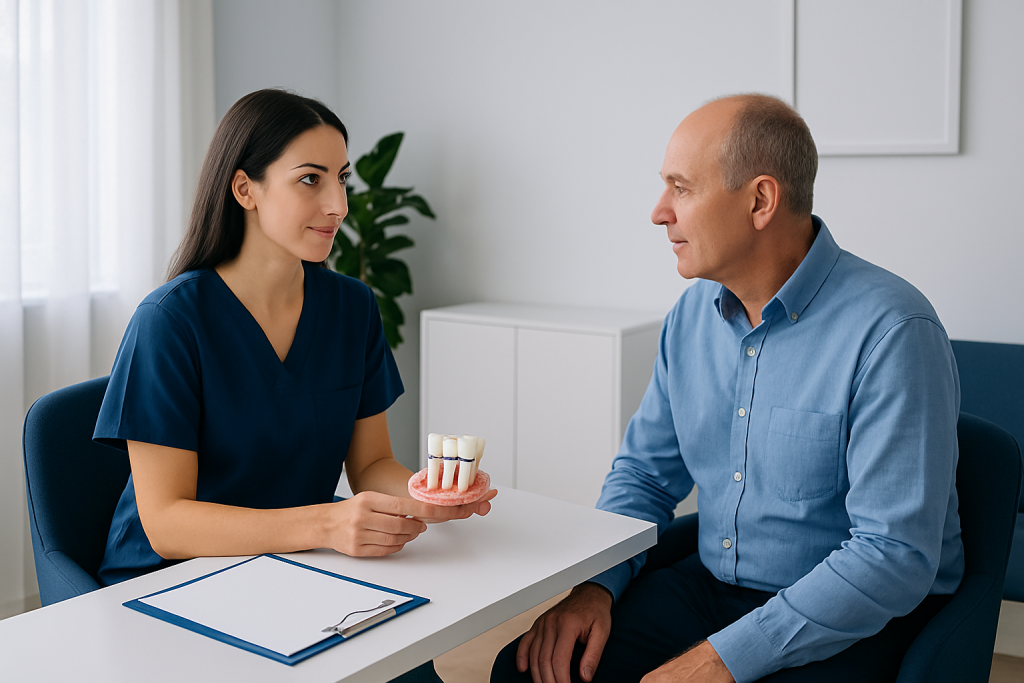
Broadly, suitability rests on healthy or treatable gums, enough jawbone to support an implant (or suitability for bone-building procedures), reasonable general health and a genuine commitment to oral hygiene and follow-up visits.
Age on its own matters less than bone quality, healing capacity and general medical status. Diabetes, certain osteoporosis medications, smoking, teeth grinding, active infection and immune-related conditions do not automatically rule implants out, but each needs careful evaluation before a plan is confirmed.
Travelling for treatment adds one more requirement: the ability to follow a realistic timeline. Some cases can be completed within a single trip; many need staged care across more than one visit, with a healing gap between implant placement and the final restoration. A candid team explains early whether you are likely to need extractions, grafting, a sinus lift, temporary teeth or a second trip. Our candidate checklist lists the factors dentists weigh before confirming suitability.
Treatment options: the same menu, differently organised
The technical options do not change with the country. What may change is how efficiently they are coordinated. Depending on how many teeth are missing and the condition of your bone and gums, the plan may involve:
- A single implant with a crown
- Multiple implants supporting a bridge
- An implant-supported overdenture for better denture stability
- Full-arch implant rehabilitation for extensive tooth loss
- Immediate implant placement after extraction, in selected cases
- Delayed placement after the extraction site has healed
- Bone grafting or a sinus lift where extra support is needed
- Temporary restorations worn while the implant integrates
In a centre where imaging, oral surgery and prosthodontics work together, these steps can be scheduled tightly, which suits a travel-based plan. At home, the same steps may be split between a general dentist, a surgeon and a laboratory, each with their own diary. That is slower but keeps everything local.
One caution applies everywhere, and it matters more when travel dates create pressure: if a plan sounds unusually fast, ask whether that speed fits your bone condition. Not every implant is suitable for immediate loading, and not every case fits one trip. Sound implant care balances efficiency against safe healing: a compressed itinerary should never compress biology.
Online evaluation before travel
Before travelling, an online evaluation helps establish whether implant treatment is likely to be appropriate and how many visits the plan may need. This usually means sharing your dental history, current symptoms, recent panoramic X-rays or 3D imaging if you have them, and photographs of your teeth and smile.
Treat the remote review as planning, not diagnosis. The confirmed plan depends on an in-person examination: updated imaging, gum assessment, bite analysis and the condition of any teeth that may need extraction or repair. A preliminary plan that changes after examination is not a red flag: it is how honest planning works. What should not change without explanation is the logic behind it.
At Acibadem, the international pathway includes help with document collection, a preliminary review by the relevant dental team and practical guidance on travel timing, so you arrive knowing the likely shape of the process while leaving room for adjustment after the clinical examination.
Before the treatment
Preparation looks the same in both settings: consultation, imaging and a full oral examination, plus a review of your medical history, medications, allergies, smoking status and previous dental work. Where treatment abroad differs is that this phase carries more weight: the better the preparation, the fewer surprises on arrival.
You may need professional cleaning, gum treatment, extractions or decay management before implants can be placed. Some patients need separate planning for grafting, a sinus lift or temporary teeth. If you grind your teeth, protective measures may be discussed.
Ask the practical questions before committing, whichever country you choose: Will treatment be completed in one stage or across visits? How long should I stay? When can I fly? What aftercare is needed locally? What happens if healing is slower than expected? Clear answers make the comparison fair; vague answers are themselves useful information.
What happens during the treatment
On the day, the area is numbed with local anaesthesia; sedation may be considered where clinically appropriate. The implant site is prepared in the jawbone and the fixture placed. Depending on the case, the gum is closed over the implant or a healing component is attached at the same visit.
If a tooth is being removed, the surgeon assesses whether immediate placement is suitable. Graft material or a membrane may be used to support the site. A temporary restoration is possible for selected patients, depending on implant stability, bite forces and location in the mouth.
These clinical principles are identical at home and abroad. The travel version simply concentrates the surrounding steps, imaging, surgery, prosthetic records, into a shorter window, while still leaving enough time for a safe early review before departure.
Clinic stay and discharge
Implant placement usually needs no hospital admission. Most patients are treated in a clinic setting and return to their accommodation the same day; longer or more complex sessions may involve a period of observation first.
Before you leave, the team should confirm you are comfortable, that you understand your medications and oral care instructions, and that you know when your next review is. For international patients, written guidance in a language you understand matters more than it sounds: it is what you will rely on at home, and what a local dentist may ask to see.
Acibadem’s patient support services assist with transfers, interpreters and practical discharge arrangements, which helps particularly after longer treatment sessions or when travelling with a companion.
Recovery timeline
Recovery happens in two layers. Surface symptoms, soreness, swelling, tenderness, usually improve within days. The deeper process, osseointegration, in which the implant bonds with bone, takes weeks to months and cannot be rushed. If extractions, grafting or full-arch work were involved, timelines lengthen.
For travelling patients, the key question is which parts of recovery must happen in Turkey and which can be monitored after you return. Getting a clear answer to that question before booking flights is one of the most practical differences between a well-planned trip and a stressful one.
| Timeframe | What to expect |
|---|---|
| First 24 hours | Mild bleeding or oozing, numbness wearing off, soreness; rest, soft foods and careful oral care. |
| First week | Swelling and tenderness settle gradually. An early review may take place; stitches are checked or removed depending on the type used. |
| Weeks 2–4 | Daily comfort improves noticeably. Gum tissue heals while the implant continues integrating beneath the surface. |
| Months 1–3 | Bone healing progresses. Many patients are reviewed clinically or with imaging before the next restorative stage. |
| Final result | Once healing is judged adequate, the final crown, bridge or arch restoration is fitted. Timing varies case by case and often spans several months. |
Feeling well early does not mean the implant has finished healing. Following diet advice, cleaning instructions and review appointments protects the result during the quiet phase you cannot see.
What to avoid after treatment
Smoking interferes with healing and raises the risk of complications around implants; the timelines and reasons are explained in our guide to smoking after dental implants. Hard chewing on the treated side should wait until your dentist confirms it is safe, especially with a temporary restoration in place.
For the first days, avoid vigorous rinsing, very hot or sharp foods, and heavy exercise if it increases bleeding or throbbing. Follow the specific brushing and mouth-care instructions you were given: they vary by case, and the written version you take home is the one that counts.
Timing your flight is part of aftercare, not an afterthought. Many patients can travel after straightforward implant placement, but the advice shifts with swelling, grafting, sinus involvement and the extent of surgery. The considerations are set out in our guide to flying after dental surgery and implantsand the final word on your travel date belongs to your treating team.
Risks and possible complications
Implants carry risks wherever they are placed: pain, swelling, bruising, bleeding, delayed healing, infection, failure of the implant to integrate, damage to neighbouring teeth or restorations, bite problems, or the need for corrective treatment. Some risks follow anatomy, sinus involvement in the upper jaw, nerve irritation in the lower jaw, which is precisely why detailed imaging and careful planning come first.
Travel itself is rarely the main clinical risk. The larger question is whether the plan is realistic and the follow-up properly organised. Before treatment abroad, a good plan states in writing who reviews your healing, how a loose temporary restoration would be handled, and how concerns after your return home are managed, remotely, locally, or with a further visit. Complications such as persistent bleeding, worsening swelling after the first days, signs of infection or altered sensation are the kinds of findings clinicians want identified and assessed early, which is why that follow-up structure matters more than any brochure.
Balanced expectations are part of safety: not every implant suits immediate loading, not every case fits one trip, and aesthetic outcomes have limits set by gum, bone and bite. Some patients need revision or additional treatment over time.
Results and expectations
The aim is stable tooth replacement that supports chewing, speech and confidence. Well-planned implants can serve for many years, but longevity is earned rather than promised: it depends on case selection, gum health, bone support, daily hygiene and regular maintenance, none of which depend on the country where the implant was placed.
Results vary between patients. Some need preparatory procedures before the final restoration is possible; some will need adjustment, repair or replacement of prosthetic components over time. Implants are not natural teeth, and they need ongoing care from a dentist, wherever that dentist happens to be.
Travel planning for international patients
The single most useful planning question is: how many visits will my case realistically need? Straightforward cases may be assessed and treated within one trip; cases with extractions, grafting or full-arch work often require staged treatment with a return visit after healing.
Build your stay around consultation, imaging, the procedure, early review and your dentist’s flying advice, and leave slack. A return flight booked hard against the last appointment removes the flexibility that healing occasionally demands.
Acibadem supports patients with interpreters, airport–hotel–hospital transfers and accommodation guidance. This smooths logistics; it does not replace medical planning. Travel dates should always follow the clinical needs of the case, not the other way round. Before departure, make sure you know what will be handled in Turkey, what can be followed remotely and what may need a local dentist at home: that shared plan is the clearest marker of a well-organised overseas pathway.
How cost comparisons actually work
Cost is usually part of weighing dental implants in Turkey vs at home, and the honest way to compare is structural. An implant quote reflects the number of implants, the implant system used, imaging requirements, any extractions, grafting or sinus procedures, temporary teeth, the final crowns or bridges, laboratory work and the complexity of the bite and aesthetic planning. Two quotes that look different may simply describe different scopes of work.
For international patients, the full picture also includes non-clinical elements: transfers, interpreter support, accommodation, scheduling efficiency and remote follow-up. A low headline figure that excludes key steps is not a saving; it is an incomplete description.
Items typically included are the consultation, treatment planning, standard imaging, the surgical procedure, routine reviews during your stay and defined patient support services. Items often excluded unless clearly stated: flights, hotels, advanced grafting materials, treatment of unrelated dental problems, long-term maintenance items and local follow-up care after you return home.
Ask any provider, at home or abroad, for a written plan that separates what is confirmed, what can only be finalised after in-person examination, and what circumstances would change the scope. That document is what makes a fair comparison possible.
Implant care at Acibadem
Acibadem’s dental teams bring oral surgery, prosthodontics and imaging together within one organisation, alongside broader medical review where a patient’s general health requires it. For implant cases that cross specialties, extractions plus grafting plus full-arch restoration, for example, that coordination shapes both the quality of planning and the practicality of a travel-based schedule.
International patients are supported with interpreters, transfer arrangements, accommodation guidance and remote follow-up coordination. These services reduce friction around treatment; the treatment plan itself is always built from your oral findings, imaging and general health, confirmed at in-person examination.
Medical review and disclaimer
This guide has been medically reviewed by the Acibadem International medical team. It provides general information about dental implants and the practical differences between treatment in Turkey and at home.
It does not replace consultation, examination or diagnostic imaging. Suitability, timing, risks, expected results and travel readiness differ from patient to patient and are matters for a qualified dentist or physician. Any final treatment plan rests on your oral findings, general health, imaging results and the judgement of your treating team.
Step by step
- Initial contact. You contact the international patient team with your request and basic treatment goals.
- Medical record / photo submission. You share your medical history, dental information, previous X-rays or scans if available, and relevant photos.
- Preliminary medical review. The dental team performs an initial remote review to assess whether implant treatment may be suitable.
- Treatment plan and quotation. You receive a preliminary plan outlining likely treatment stages, expected stay and the factors affecting the quotation.
- Travel planning. Dates are coordinated around consultation, imaging, treatment and review appointments, with guidance on accommodation and transfers.
- Arrival. After arriving in Turkey, you are supported with practical logistics and prepared for your in-person evaluation.
- In-person consultation. Your dentist or oral surgeon examines you, reviews imaging and confirms whether the preliminary plan should be adjusted.
- Pre-operative tests. If needed, you undergo dental imaging and any relevant pre-treatment assessments before the procedure.
- Treatment. Implant placement and any associated dental procedures are carried out according to your confirmed treatment plan.
- Clinic stay. Most implant patients do not need admission and are monitored briefly before returning to their accommodation the same day.
- First control. You attend an early review so the team can check healing, reinforce care instructions and answer questions.
- Discharge / travel clearance. When your team confirms you are fit to travel, you receive discharge guidance and a follow-up plan.
- Remote follow-up. After you return home, your progress can be reviewed remotely, with advice on ongoing dental follow-up and the next treatment stage if needed.
Your checklist
- Valid passport
- Medical history summary
- Current medication list
- Known allergies
- Details of previous surgeries or major dental treatments
- Description of current dental symptoms or missing teeth
- Recent dental X-rays or CBCT scans if available
- Photos of your teeth and smile if requested
- List of chronic health conditions
- Smoking status and any history of teeth grinding
- Contact details for your local dentist if relevant
Key takeaways
- The clinical steps of implant treatment are the same in Turkey and at home; the pathway around them, coordination, staging and follow-up, is where the real differences lie.
- Many implant cases need staged care; whether yours fits one trip or two is a clinical question answered by examination and imaging, not by the itinerary.
- Healing timelines are biological and cannot be compressed to suit travel dates; a responsible plan builds the schedule around them.
- Fair cost comparison means comparing full written scopes, diagnostics, implant system, grafting, prosthetics, support services and aftercare, never headline figures alone.
- The clearest marker of a well-organised overseas pathway is a follow-up plan agreed before travel: what happens in Turkey, what is monitored remotely, and what a local dentist handles at home.
Frequently asked questions
What is the best country to have dental implants done?
There is no single best country. Implant outcomes depend on planning quality, the surgeon’s assessment, imaging, hygiene standards and long-term maintenance, all of which vary between clinics within every country. The more useful comparison is between specific providers and their complete pathways, including follow-up, rather than between flags on a map.
Is it worth going to Turkey for dental implants?
It can be, when your case suits the travel format: a realistic staged plan, enough time in-country for early review, and a clear arrangement for follow-up at home. It is less suitable when a plan compresses healing to fit a short trip. The decision rests on your oral findings and how well the whole pathway, not just the procedure, is organised.
How long do Turkish dental implants last?
Longevity is not determined by the country of placement. Clinics in Turkey use internationally distributed implant systems, and how long any implant serves depends on bone support, gum health, daily hygiene, smoking status and regular dental maintenance. No honest provider anywhere can promise a fixed lifespan, and prosthetic components may need repair or replacement over time.
What is the best place to get dental implants in Turkey?
Rather than looking for a single best place, look for verifiable markers: imaging-based planning, oral surgery and prosthodontics working together, a written treatment plan that states what is and is not included, honest staging rather than one-size-fits-all speed, and a defined follow-up arrangement for after you return home.
How long do I need to stay in Turkey for dental implants?
It depends on complexity. A straightforward single implant may fit a shorter stay, while extractions, grafting, full-arch work or staged restoration usually require more time or a second trip after healing. Your team should state the expected stay in the preliminary plan and confirm it after examination.
Can I fly home soon after implant placement?
Many patients can travel after straightforward treatment, but timing should be confirmed by the treating team. The extent of surgery, swelling, any grafting or sinus involvement and your overall comfort all influence when flying is sensible, so avoid booking a return flight hard against your last appointment.
Will I get my final teeth immediately?
Not always. Some patients receive temporary or immediate provisional restorations, but many cases need a healing period before the final crown, bridge or arch is fitted. Whether immediate loading is appropriate depends on implant stability, bite forces and location: it is a clinical judgement, not a scheduling preference.
How is follow-up handled if I return home before treatment is fully complete?
A well-organised centre agrees the follow-up plan before you travel: written instructions, remote review arrangements, timing for the next visit and clarity about what a local dentist can monitor in the meantime. Having this in writing before treatment is one of the most reliable ways to compare providers.
Add us as a Preferred Source to see more of our trusted health content across Google Search, AI Overviews and Discover.

Update history
- PublishedJune 22, 2026
- Medical review approvedAugust 31, 2026
- Last content updateAugust 31, 2026
References2
- Dental Implants: Cleveland Clinic my.clevelandclinic.org
- Medical Tourism: CDC Travelers' Health wwwnc.cdc.gov
More Patient Guides

HoLEP in Turkey: How It Compares With TURP and What Recovery Involves
HoLEP in Turkey treats enlarged prostate tissue with laser enucleation; learn how it compares with TURP, recovery, travel and follow-up.
Porcelain Veneers in Turkey: Who Is Suitable and How Many Visits Are Needed?
Porcelain veneers in Turkey can enhance tooth shape and colour in two visits for suitable patients after a personalised dental assessment.

How to Prepare for a Sedation Procedure in Turkey
Prepare safely for a sedation procedure in Turkey with guidance on fasting, medicines, travel, recovery and follow-up.
Treatment Delays in Turkey: What Happens If Tests or Recovery Change Your Schedule
Treatment delays in Turkey can happen if tests or recovery change your plan. Learn how to manage appointments, travel, accommodation and follow-up.