Beard Transplant
Beard transplant restores or enhances facial hair density by transferring healthy hair follicles, usually from the scalp, to the beard, mustache, or sideburn areas for natural-looking results.
Quick answer
A beard transplant moves healthy hair follicles, usually from the back or sides of the scalp, to areas of the face where beard, moustache or sideburn hair is thin, patchy or absent. It is typically performed under local anaesthesia using follicular unit extraction. Transplanted hairs shed in the early weeks, then regrow gradually over the following months as permanent facial hair.
What Is a Beard Transplant?
A beard transplant is a procedure that moves healthy hair follicles from a donor area, usually the back or sides of your scalp, to parts of the face where beard, moustache, goatee or sideburn hair is thin, patchy or absent. Because the follicles are your own tissue, your body does not reject them. Once they establish a blood supply in the new site, they behave as facial hair: they grow, they can be trimmed, and once fully healed they can be shaved and styled like the rest of your beard. The procedure is used both to build a beard where little hair exists and to refine one that already grows, and Turkey has become one of the most common destinations for men who travel abroad to have it done.
For many men, facial hair is more than a cosmetic preference. A beard, moustache or well-defined set of sideburns changes how the face is framed, how mature or masculine a man feels, and how comfortable he is with his appearance in social and professional settings. When facial hair grows in patches, is absent in certain zones, or has been lost after scarring, burns, surgery or skin disease, the concern can be deeply personal. Some men spend years experimenting with grooming techniques, beard fillers, topical products or styling changes to disguise thin areas before they consider a medical option.
If you are researching a beard transplant, you probably have both practical and emotional questions. Will the result look natural? Will people notice you had a procedure? How long do you need to stay near the clinic? Can transplanted beard hair be shaved? Is it sensible to travel for treatment? This page answers those questions as directly as the evidence allows, and it is equally direct about the limits: the outcome develops over months, not days, and donor hair is a finite resource that has to be planned carefully.
Done well, a beard transplant is not simply about adding hair. It is about designing a cheek line, jawline, moustache and sideburn pattern that suits your face, your ethnicity, your hair type and the way you actually groom. The design stage matters as much as the surgery itself.
Can you get a beard transplant?
Most healthy adult men with stable donor hair on the scalp can have a beard transplant, but suitability is a medical judgement, not a given. A physician needs to confirm that your donor area holds enough good-quality follicles, that the skin of your face is healthy and stable, and that your density goals are achievable with the hair available. Men with active skin disease in the beard area, a progressing hair loss condition, uncontrolled medical problems or a strong tendency to form raised scars may need treatment first, a modified plan, or in some cases advice against the procedure altogether. Age matters less than stability: what the physician is looking for is a settled facial hair pattern and a donor area that can spare grafts without looking thinned.
Are beard implants the same as a beard transplant?
Beard implants is simply another name people use for a beard transplant, nothing artificial is implanted. The “implants” are your own living follicular units, extracted from your donor area and placed into the face. This distinction matters when you compare clinics: no reputable provider inserts synthetic hair into facial skin, and you should treat any offer of artificial beard fibres with caution. When you see the terms beard implants, facial hair transplant or beard restoration, they almost always describe the same follicular unit procedure explained on this page.
How a Beard Hair Transplant Differs From a Scalp Procedure
A beard hair transplant follows the same biological principle as scalp restoration, relocating living follicles, but the technical demands on the face are stricter. Natural beard hairs lie at low angles against the skin and follow distinct regional patterns: moustache hairs angle downward and outward, cheek hairs run diagonally, chin hairs vary in direction, and sideburns must blend with both scalp hair and beard. A graft placed too upright, too densely at a border, or in the wrong direction looks artificial in a way that is hard to hide, because the face is examined at conversation distance every day.
For this reason, single-hair grafts are usually preferred along visible borders, the cheek line, the moustache edge, the outline of a goatee, where a soft, irregular transition reads as natural. Multi-hair grafts may be used selectively in central zones to build density, depending on your hair calibre and the plan. Each follicular unit contains one or more hairs, and sorting them correctly under magnification is one of the quiet skills that separates a natural beard from an obvious one. Facial skin is also thinner and more vascular than scalp in places, which changes how recipient sites are made and how densely grafts can safely be packed in one session.
Who Is a Good Candidate?
Men consider beard transplantation for different reasons. Some have genetically sparse facial hair and have never been able to grow the beard they want. Others have patchy development, strong growth on the chin, gaps on the cheeks, or one sideburn noticeably weaker than the other. Some have lost facial hair after trauma, burns, acne scarring, previous surgery, cleft repair, skin grafting or inflammatory skin conditions. Transplantation may also be considered after stable hair loss conditions affecting the face, provided the underlying condition has been evaluated and is no longer active.
Typical concerns include thin cheeks, absent sideburns, an incomplete moustache, a weak goatee, gaps along the jawline, or visible scars where hair no longer grows. Some men want a subtle increase in density so an existing beard looks fuller at stubble length. Others want a defined shape they can trim or shave according to preference. A good candidate has realistic expectations, sufficient donor hair, stable skin in the recipient area, and a clear understanding that the result takes months to mature.
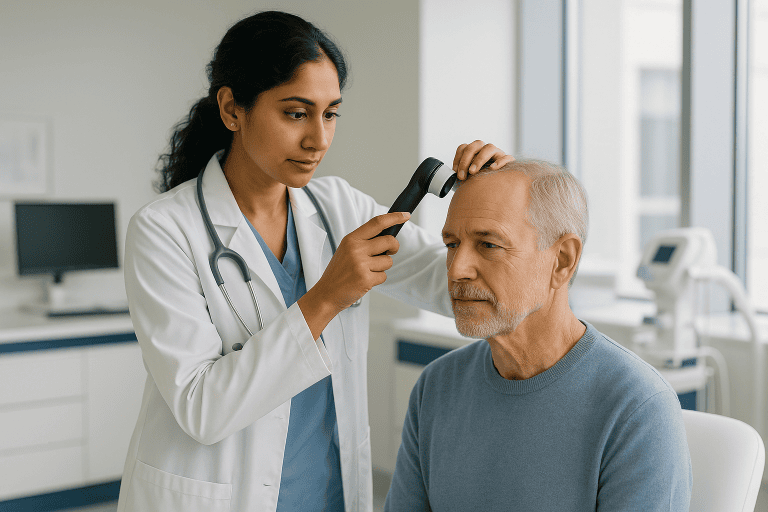
Planning begins with a medical consultation. The physician examines your face, your existing beard pattern, your donor hair quality, your skin, any scarring, and your history of dermatological disease. The assessment also covers general health, current medication, smoking, allergies and any previous hair restoration procedures. Where there is active inflammation, alopecia areata, folliculitis, a keloid tendency or unexplained hair loss, a dermatology review usually comes first, placing grafts into unstable skin wastes donor hair and can worsen irritation.
For international patients, the first stage often happens remotely. Clear photographs taken from the front, both sides, oblique angles, under the chin and of the donor scalp allow the medical team to estimate feasibility and a likely graft range before you travel. The final graft number, design and plan are confirmed only after in-person examination, because hair calibre, skin elasticity, scar quality and true donor density have to be assessed directly. Any clinic that fixes a definitive graft count and design from photographs alone is guessing.
Not everyone is an ideal candidate, and a responsible consultation says so. Men with limited donor supply, unrealistic density goals, uncontrolled medical conditions or active skin disease may be offered a staged plan, a smaller procedure, or a recommendation to wait. The most natural results begin with careful selection, not with the largest possible graft number.
What a Beard Transplant Can Address
The most common indication is naturally sparse or patchy facial hair, usually genetic. Here the procedure improves density and creates a more continuous beard pattern, with careful transitions between treated and untreated zones so that nothing looks stamped on. A subtle fill-in may need relatively few grafts and a soft design; building a fuller beard from a weak base needs broader planning and disciplined donor management.
Asymmetry is another frequent reason. Some men grow noticeably more hair on one cheek or sideburn than the other. Transplantation can rebalance the appearance, though perfect symmetry is not the goal, because natural faces and natural beards are never identical side to side. The objective is a balanced result that looks normal during expression, grooming and at different beard lengths.
Scarred areas can often be treated. Scars from burns, injuries, surgical incisions, acne or prior dermatological procedures interrupt beard growth and can be conspicuous precisely because the surrounding hair frames them. If the scar tissue is stable and has adequate blood supply, grafts can sometimes be placed into and around it to camouflage the area. Scar work demands judgement: scarred skin accepts grafts less predictably than healthy skin, density often has to be built gradually, and more than one session may be needed.
Men who have had facial surgery may want restoration of moustache, sideburn or beard zones crossed by incision lines. Men with cleft lip repair scars sometimes consider moustache transplantation to restore continuity. In these cases the plan must respect skin thickness, scar direction, the previous surgical anatomy and how you actually groom day to day.
Finally, the procedure can refine specific zones of an existing beard: a stronger moustache, a fuller goatee, a sharper cheek line, a denser chin, or a cleaner connection between sideburns and jawline. The indication drives the technique, which is why two beard transplants can look like entirely different operations in scope, duration and graft count.
How the Procedure Is Performed
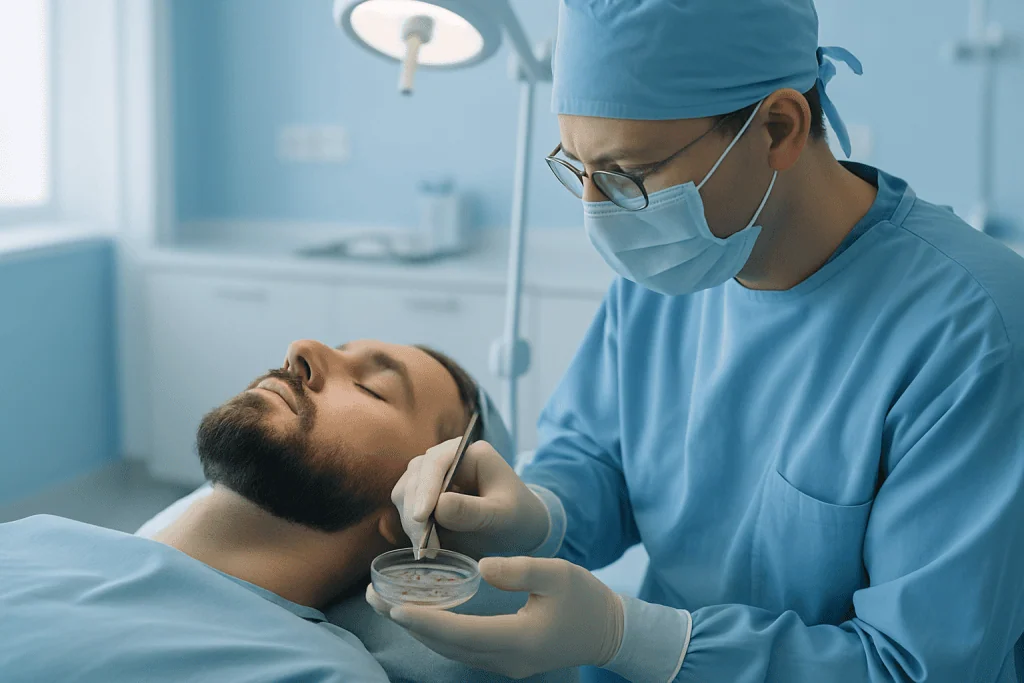
A beard transplant is usually an outpatient procedure under local anaesthesia, sometimes with additional comfort measures depending on your medical suitability and preference. The day runs through a defined sequence: final design confirmation, donor preparation, follicle extraction, graft preparation, recipient site creation, implantation and early aftercare instruction. Each step affects graft survival and how natural the final beard looks.
Preparation and design
Preparation begins with a detailed medical review and a planning session. The physician discusses your goals, examines the donor area and maps the facial zones to be treated. You will be asked about medication, supplements, bleeding history, allergies, smoking, prior procedures and skin conditions. Some medicines or supplements that increase bleeding risk may need to be adjusted beforehand: a decision that belongs entirely to your treating doctor, never to you alone or to a clinic checklist.
The beard design is drawn with your input: the cheek line, jawline, moustache borders, goatee shape and sideburn connections. A well-planned design respects your facial proportions and thinks ahead, to how you will age, how you style your hair, your ethnic hair characteristics, and whether you prefer stubble, a shaped beard or a longer style. Overly sharp or overly dense borders are difficult to soften later, so experienced planning tends toward restraint and natural transitions. Photographs are taken for documentation, the donor area is prepared, and the plan is confirmed before any extraction begins.
Donor hair harvesting
Most beard transplants use donor hair from the back or sides of the scalp, because follicles there are typically durable. Donor hair is assessed for thickness, colour, curl and how well it will blend with your native beard, in some men scalp hair is finer or straighter than beard hair, in others it matches closely, and the physician plans density and placement accordingly.
During follicular unit extraction, individual units are removed with very small circular instruments. The aim is healthy grafts and a donor area that still looks even afterwards. Harvesting is distributed deliberately so the scalp is not over-thinned: an important point if you may want scalp restoration in the future, because donor hair used for the beard is no longer available for the head. After extraction, grafts are examined and sorted under magnification by hair count and quality, kept hydrated and temperature-controlled while outside the body.
FUE or DHI for the beard?
Both techniques you will see advertised are variations of follicular unit extraction; they differ mainly in how grafts are placed. In classic FUE hair transplant technique, recipient sites are opened first and grafts inserted afterwards, which gives the surgeon full control over site angle before implantation. In DHI hair transplant technique, an implanter pen opens the site and places the graft in one motion, which some teams prefer for low-angle facial work. Neither method is universally superior for the beard. What matters is the team’s experience with facial angles, the sorting of single-hair grafts for borders, and the discipline of graft handling, not the name of the instrument.
Creating recipient sites
Recipient sites are the tiny openings in the skin where grafts will sit. This step fixes the direction, angle and distribution of your future beard, so it is where much of the artistry lives. Facial hair lies flatter against the skin than scalp hair, so sites are made at low angles that change zone by zone. Density is planned against both your goals and the safe capacity of the skin: very high density in a single session is not always advisable, particularly in scar tissue or delicate areas. A natural result usually depends on strategic distribution rather than the maximum possible graft count.
Implanting the grafts
Grafts are then inserted according to the planned map, finer single-hair grafts at the edges, selected grafts for density in central zones. The work is meticulous and can take several hours depending on the size of the area and the number of grafts. You remain awake for most procedures; the treated areas are numbed with local anaesthesia, so you may feel pressure or movement but should not feel sharp pain during the main part of the work. Breaks are provided where appropriate. A small moustache or scar correction may take part of a morning; an extensive beard construction can occupy much of the day.
Technology used during the procedure
Technology in beard transplantation serves planning, precision, graft protection and comfort. High-resolution clinical photography supports design and later comparison. Magnification systems let the team evaluate follicles, separate graft types and place them accurately. Fine extraction and implantation instruments allow work in small facial zones where spacing and angle are critical, and controlled storage solutions protect follicles while they are outside the body. Digital planning tools may support documentation of the intended shape. But no device produces a natural beard on its own: the decisive factors remain the physician’s judgement, the team’s experience with hair direction and density, and disciplined handling of every graft from extraction to implantation.
Immediately after the procedure
Straight after the transplant, the treated areas typically look red and dotted with tiny crusts around each graft, and the donor area may feel tender or tight. You receive written instructions on washing, sleeping position, medication, sun avoidance and activity limits. The first days matter most: the grafts must not be rubbed, scratched, shaved or exposed to friction while they anchor. Mild swelling can appear around the face and sometimes under the eyes, depending on the treated zone, and usually settles gradually. Crusts begin to shed with proper washing; picking at them can dislodge grafts, so follow the clinic’s washing routine exactly rather than improvising.
Recovery After a Beard Transplant
Recovery varies with skin type, graft number, treated area and individual healing, but most men follow a broadly predictable pattern. Many return to desk-based work within several days, though visible redness or crusting may persist a little longer, and social downtime depends on skin tone, graft number and personal comfort. Exercise, swimming, saunas, sun exposure and shaving are restricted for a period your medical team defines. The practical routines, washing technique, product use, activity limits, are covered in detail in our guide to hair transplant aftercare, and the same principles of graft protection apply to the face.
| Time Period | What to Expect |
|---|---|
| Day 1 | Redness and tiny crusts around the grafts; possible mild swelling, tightness or tenderness. You receive detailed washing and sleeping instructions. |
| First week | Crusting loosens with correct washing; swelling and redness usually improve. Avoid rubbing, shaving, strenuous exercise, sun and swimming unless cleared by your team. |
| First month | Many transplanted hairs shed: a normal part of the growth cycle. The skin settles and the beard may temporarily look thinner than expected. |
| Three to six months | New growth begins to appear gradually. Early hairs may be fine or uneven before becoming more visible. |
| Six to twelve months | Density, texture and styling potential continue to improve; the final pattern becomes clearer during this period. |
| Longer term | Transplanted beard hair can usually be groomed like natural facial hair. A second session may be considered for extra density or complex scarring. |
Why does transplanted beard hair shed?
Shedding in the early weeks is expected, not a sign of failure. When a follicle is moved, the hair shaft it carries usually falls out while the follicle itself remains alive under the skin and resets its growth cycle. New hairs then emerge over the following months. The temporary gap between shedding and regrowth is the phase men find hardest, precisely because the face looks much as it did before the procedure. Judging the result during this window tells you nothing; the follicles are working, not visible.
When can you shave after a beard transplant?
Not until your medical team confirms the grafts are securely anchored, typically once the crusts have fully cleared and the skin has settled, which for most men means a matter of weeks rather than days. Early shaving risks traction on grafts that have not yet established. Trimming with scissors or a guard usually returns before a blade against the skin does, and the exact sequence should come from your clinic, not a forum. Sleeping position matters in the same early window: the treated cheeks and chin should not press into a pillow, and our guide on how to sleep after a hair transplant explains the positions and the timeline for returning to normal sleep.
Beard Transplant Before and After: How to Judge Results
Beard transplant before and after photographs are the main evidence most men use when choosing a clinic, so it is worth knowing how to read them critically. Insist on matched conditions: the same lighting, the same angle, the same beard length and ideally the same camera distance in both images. A “before” shot taken clean-shaven under harsh light against an “after” at two weeks of growth in soft light flatters any result. Ask to see outcomes at least several months after surgery, early photographs show swelling and stubble, not the mature pattern. Look specifically at the borders: the cheek line and moustache edge reveal graft angle and softness far more honestly than the dense central zones. And ask to see cases that resemble yours, the same hair colour contrast, the same curl, a similar starting density, because a result on coarse dark hair against pale skin says little about what fine fair hair will achieve.
What Makes a Good Result
Donor hair quality is one of the most important factors. Hair calibre, colour contrast with the skin, curl, density and growth characteristics all determine how much visual coverage a given number of grafts can create. Thick, coarse hair builds apparent density with fewer grafts but must be placed carefully to avoid harshness; fine hair needs more strategic distribution and gives a softer result.
The recipient skin matters equally. Healthy facial skin with good blood supply supports graft growth better than scarred, inflamed or previously damaged tissue. Scar tissue can be treated in selected cases, but growth there is less predictable and density often has to be built across more than one session. Active acne, folliculitis, dermatitis or autoimmune hair loss should be evaluated and brought under control before transplantation is considered.
Design is the factor patients underestimate most. A beard that suits one face does not suit another. The cheek line, jawline, moustache shape, chin density and sideburn transition should be planned around your bone structure, ethnicity, age, grooming preference and existing hair. The most natural outcomes usually come from restraint: soft borders, irregular micro-patterns, and density that imitates nature rather than a drawn outline.
Graft handling affects survival directly. Follicles are living tissue; excessive trauma, drying, heat or prolonged time outside the body reduce growth. A trained team follows strict protocols from extraction through storage to implantation, and this is one of the least visible but most consequential differences between providers.
Your own behaviour during recovery carries real weight. Rubbing the face, sleeping on the treated area, picking crusts, smoking, returning to intense exercise too early, or exposing healing skin to sun and sweat can all interfere with graft establishment. Longer term, sun protection and sensible skin care protect the appearance of the transplanted zones. One point worth knowing: unlike scalp restoration, transplanted beard hair does not usually depend on ongoing medication to persist, though men who are also managing scalp hair loss sometimes ask about it: our guide on finasteride and minoxidil after a hair transplant explains where those medicines fit, and any decision about them belongs with your treating doctor.
Finally, expectations must be realistic. A beard transplant improves density and shape; it cannot manufacture unlimited hair from a limited donor supply, and it cannot deliver its result quickly. Some men are satisfied after one session. Others, with extensive goals, scarring, or very low starting density, do better with staged treatment. A responsible consultation makes these possibilities explicit before you commit, not after.
Benefits of a Beard Transplant
The realistic benefits depend on your starting point, donor quality and plan, but for well-selected candidates the procedure can offer meaningful, lasting improvement.
| Benefit | What It Means for You |
|---|---|
| Improved facial hair density | Patchy or thin areas can be filled to create a fuller beard, moustache, goatee or sideburn pattern that matches your goals. |
| Natural-looking design | Grafts placed with careful attention to angle, direction and spacing blend with your existing facial hair and facial proportions. |
| Your own hair follicles | The procedure transfers living follicles from your donor area, so transplanted hairs grow as part of your own facial hair. |
| Ability to shave and style | Once healed and matured, transplanted beard hair can generally be trimmed, shaved and groomed like the rest of your beard. |
| Scar camouflage in selected cases | Stable scars from injury, burns, acne or surgery may be visually softened by placing hair into and around the affected area. |
| Long-term improvement | Once follicles establish and mature, the improvement is intended to be durable, though ageing, health and hair characteristics influence appearance over time. |
Why Timing and Early Evaluation Matter
A beard transplant is never an emergency, but early evaluation still has value. If your patchy or absent facial hair is genetic, waiting carries no medical risk, yet an early consultation tells you what is realistically achievable, roughly how many grafts you would need, and how to protect your donor area for whatever matters most to you long term.
When facial hair loss relates to scarring, inflammation, burns, trauma or a skin condition, assessment matters more. Active disease should be diagnosed and controlled before any transplantation; placing grafts into inflamed or unstable skin reduces the chance of good growth and can worsen irritation, and an untreated dermatological problem may progress and cause further loss or scarring in the meantime.
Timing also interacts with your wider hair restoration plans. Donor hair is finite. A man who may later need scalp restoration should balance today’s beard goals against tomorrow’s scalp needs, using too many grafts too early, or harvesting without careful distribution, narrows later options. Acibadem’s hair transplant unit plans beard and scalp work as one donor strategy rather than two unrelated procedures.
There is one more risk of drifting: frustration pushes some men toward unregulated alternatives. Products marketed aggressively for beard growth can irritate the skin or give uneven results, and non-medical procedures performed outside proper standards raise the risk of scarring, infection and unnatural appearance. A medical consultation separates safe options, conditions that need treatment first, and cases where transplantation genuinely fits.
Beard Transplant Cost: What Determines the Price
Beard transplant cost is not a single number, because the procedure is not a single product. A small moustache scar repair and a full beard construction are entirely different operations in graft count, duration and team time, and their prices differ accordingly. Understanding what drives the figure protects you far better than hunting for the lowest one.
The main cost drivers are consistent everywhere:
- Graft number and area treatedthe largest single factor; a cheek-line refinement needs far fewer grafts than building coverage across cheeks, chin and jawline.
- Complexityscar tissue, previous surgery, repair of earlier work and staged plans all add clinical time and skill.
- Technique and teamwho actually performs the extraction and implantation, and how experienced they are with facial angles, matters more than the technique’s brand name.
- Clinical settinga hospital-based environment with proper sterile technique, monitoring and documentation is priced differently from a walk-in shop.
- What is includedconsultation, medication, the first wash, aftercare products and follow-up reviews are bundled by some providers and billed separately by others.
How much does a beard transplant cost?
No provider can honestly answer this before examining your face and donor hair, which is why credible clinics quote after an assessment rather than from a menu. Quotes are usually structured per graft or per case, and a figure attached to a round graft number, 3,000 grafts, say, means little on its own: a moustache correction may need a fraction of that, while an ambitious full-beard goal on fine hair may need staged sessions. When you compare offers, look past the headline and check what the beard hair transplant cost actually covers, anaesthesia, medication, aftercare, follow-up, and whether the graft count quoted was set by a doctor who examined you or by a sales conversation.
How much is a beard transplant in Turkey?
In Turkey, the beard transplant price follows exactly the same logic: graft number, complexity, team and facility set the figure. The market ranges widely, from hospital-based programmes to high-volume commercial clinics, which is why headline quotes vary so much and why a fixed package price offered without any medical review deserves scepticism. The useful questions are the same ones you would ask anywhere: who performs each stage of the procedure, how the graft count was determined, what the quote includes, and what follow-up looks like once you fly home. A structured cost comparison between countries sits in its own section on this page, separate from the clinical information here.
Coming to Turkey for a Beard Transplant: How the Pathway Works
If you are travelling internationally, the process usually begins before you book a flight. A remote pre-assessment, photographs from set angles plus a medical history, lets the team judge feasibility, estimate a graft range and flag anything that needs attention first, such as an active skin condition or a medication question. This stage also sets expectations honestly: if photographs suggest you are not a good candidate, it is better to learn that at home than in a clinic corridor abroad.
A typical care pathway for a visiting patient covers an in-person consultation and examination, confirmation of the design and graft plan, the procedure day itself, a supervised first wash with hands-on instruction, written aftercare guidance, and a discharge review before travel. Most men plan several days in Turkey so that the procedure, the first wash and an early check can all happen before departure; your team will tell you when it is sensible to fly, since cabin dryness, luggage handling and headrests all involve the healing areas in small ways worth planning around.
Think practically about the trip itself. Istanbul’s climate and sunshine are relevant to a healing face, sun avoidance is part of aftercare, so a wide-brimmed approach to sightseeing beats an ambitious one. Bring loose, front-opening shirts so nothing drags across your face when dressing, and expect to sleep on your back with your head elevated in the first nights. Redness and crusting are visible for a while, so if discretion matters to you, plan your return to work and social commitments accordingly rather than optimistically.
Follow-up continues after you leave. Progress is monitored remotely through photographs at agreed intervals, which works well for this procedure because the milestones, crust clearance, shedding, early regrowth, maturing density, are visual. Keep your own dated photo record in consistent lighting; it is the most useful thing you can send your clinical team, and the most reassuring thing you can look back on during the slow middle months when the mirror seems to show nothing changing.
Beard Transplantation at Acibadem
At Acibadem, beard transplantation is treated as a medical procedure as much as an aesthetic one. Evaluation, planning, donor management, follicle handling and aftercare are all part of one clinical process rather than a production line, and the plan is built around the individual patient rather than a fixed template. Where a patient has dermatological concerns, scarring, prior facial surgery or other medical issues, the hospital setting allows relevant specialists, dermatology, plastic surgery and others, to contribute to the decision before anyone commits to a graft count.
The hospital environment matters in unglamorous, practical ways: appropriate patient assessment, sterile technique, medication safety, documentation, infection prevention and clear discharge instructions. A beard transplant may look straightforward from the outside, but the direction of each graft, the density of each zone, the softness of each border and the preservation of your donor area are decisions that show on your face every day, and they are better made inside a structured medical system.
For international patients, Acibadem International supports communication in more than 20 languages and coordinates scheduling, medical documentation, hospital navigation and the practical arrangements around a treatment journey, including remote pre-assessment before travel and structured follow-up communication after returning home.
Making the Decision
The most useful first step is a proper medical assessment, one that examines your donor hair, your skin and your goals before naming a graft number or a date. From there, the questions worth settling are concrete: whether your goals are achievable with your donor supply, whether any skin condition needs treatment first, whether one session is likely to be enough or a staged approach is wiser, and how recovery fits your work and travel plans.
For most men, a beard transplant is not about becoming someone else. It is about aligning appearance with how you already prefer to present yourself. With careful selection, honest planning, sound technique and patience through the months of regrowth, the procedure can improve facial hair density and shape in a way that looks natural, holds up at conversation distance, and is maintained through nothing more exotic than ordinary grooming.
Preparation
- A specialist evaluates beard pattern, donor hair quality, skin condition, and expectations before planning graft numbers and placement. Patients may be asked to stop blood-thinning medicines, alcohol, and smoking before the procedure. The face and donor area should be clean on the day of treatment, and local anesthesia is typically used.
Aftercare
- Mild redness, swelling, scabbing, and tenderness are common in the first days and are managed with the care instructions provided. Patients should avoid touching, shaving, strenuous exercise, sun exposure, and swimming until cleared by the medical team. Transplanted hairs may shed before new growth begins gradually over the following months.
Frequently Asked Questions
What affects the cost of a beard transplant?
The main factors are the size of the area, desired density, donor hair quality, technique, surgeon experience, facility standards and what is included in the care package. Travel, accommodation, interpreter support, medications and follow-up may also affect the total.
How can I get a personalised quote?
A personalised quote usually requires photos, medical history, facial hair goals and an assessment of the donor area. Acibadem International can arrange a free consultation to help determine a suitable plan and provide a tailored estimate.
Are beard transplant packages in Turkey usually all inclusive?
Some packages may include consultation, treatment planning, the procedure, local anaesthesia, postoperative checks, medications, hotel coordination, transfers and language support. Inclusions vary, so each quote should be reviewed carefully.
Why can quotes differ between clinics?
Quotes may differ because clinics use different staffing models, facility standards, techniques, follow-up protocols and package inclusions. The experience of the surgeon and the complexity of the beard design can also influence cost.
Is the cheapest quote the best option?
Not necessarily. A beard transplant is an aesthetic medical procedure, so planning, graft handling, natural direction of growth, hygiene standards and follow-up care are important. Patients should compare what is included and discuss expectations with a qualified specialist.
Is a beard transplant quote medical or financial advice?
No. General cost information is educational and does not replace specialist medical assessment or personal financial advice. A free consultation can help clarify suitability, expected inclusions and the personalised treatment plan.
Medically reviewed by the Acıbadem International Medical Board August 31, 2026
See our medical review board →
Update history
- PublishedJune 8, 2026
- Medical review approvedAugust 31, 2026
- Last content updateAugust 31, 2026
References1
- Hair Transplantation ncbi.nlm.nih.gov
Planning this treatment in Turkey
Our English guides for international patients: costs, timelines, safety and travel.
Planning tools for this treatment
Indicative figures for orientation only: your written plan and quote follow a free medical review.
Trusted care for international patients
Compare options, costs and recovery
From the Acibadem Blog
Beard Transplant vs Beard Micropigmentation: Real Growth vs Shading and Who Each Approach Suits
A beard transplant moves living hair follicles, usually from the back of the scalp, into the beard so real hair grows and can be…

When Can You Shave After a Beard Transplant? Trimming, Razors and Grooming in the First Months
Most surgical teams ask patients not to shave the transplanted beard area for at least two weeks, and many prefer around four weeks before…

Beard Transplants Before and After: How Results Mature Over a Year
A beard transplant's final look takes about twelve months to emerge. Transplanted hairs typically shed within two to six weeks, the follicles rest for…

Beard Transplant Cost: Graft Counts by Beard Zone and What Pricing Includes
Based on published market data reviewed in August 2026, a beard transplant for international patients treated in Turkey typically falls between EUR 2,600 and…