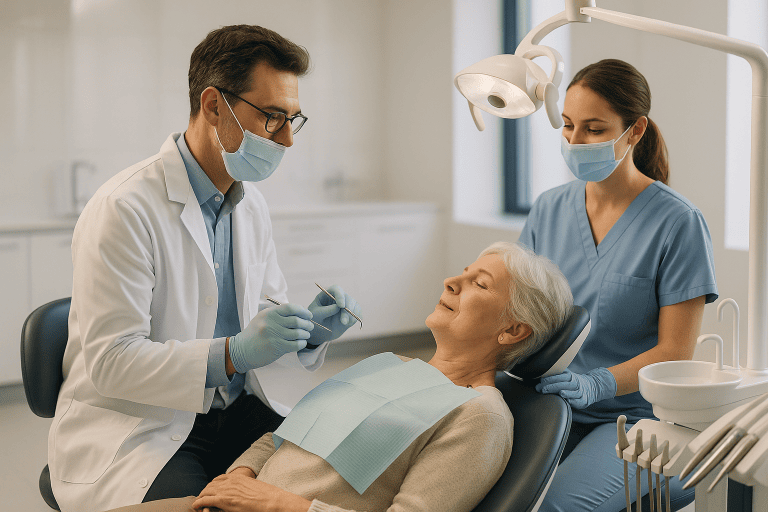
Dental Bridge
A dental bridge replaces one or more missing teeth with a fixed prosthetic supported by natural teeth or implants, restoring chewing function, speech, and smile appearance.
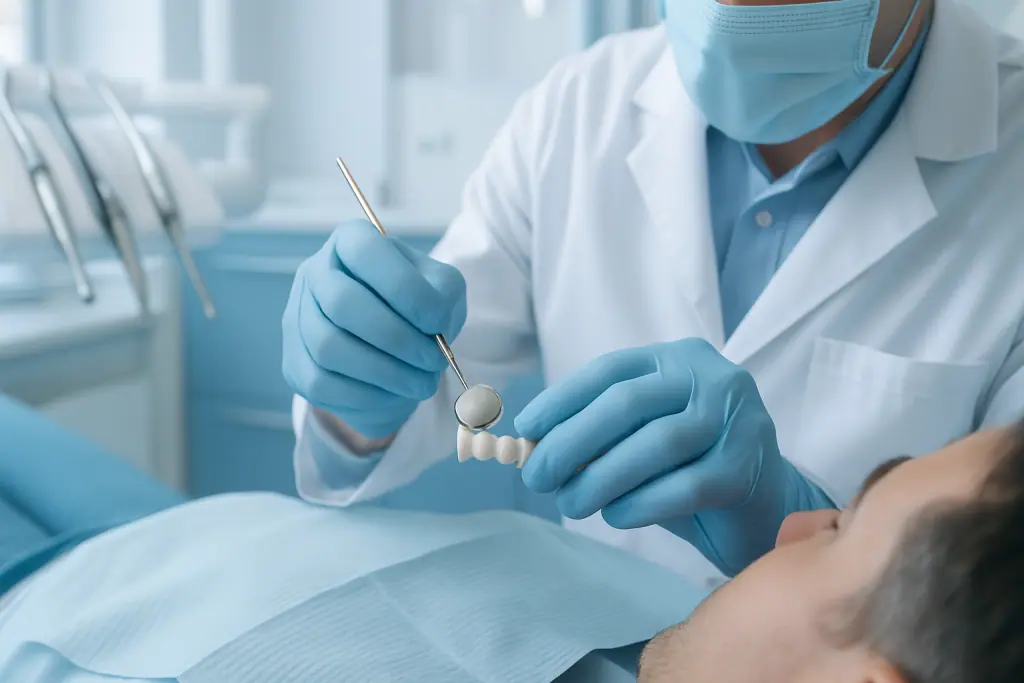
Quick answer
A dental bridge is a fixed restoration that replaces one or more missing teeth by anchoring artificial teeth to the natural teeth or dental implants either side of the gap. Treatment usually takes several visits: examination and planning, preparation of the supporting teeth or implants, a temporary bridge, laboratory fabrication, and final fitting. Once cemented or attached, the bridge stays in place for eating and speaking.
Dental Bridge Treatment When a Tooth Is Missing
A dental bridge is a fixed restoration that replaces one or more missing teeth by anchoring artificial teeth to the natural teeth or dental implants on either side of the gap. It is cemented or screwed into place, stays in your mouth at all times, and is designed to restore chewing, support clear speech and rebuild the appearance of your smile. It suits people who want a fixed alternative to a removable denture and who have healthy support, teeth or implants, on which the bridge can rest.
Losing a tooth affects more than a photograph. It can change how you pronounce certain words, which foods feel comfortable to chew, and how freely you smile in social or professional settings. If you are weighing up treatment from abroad, practical questions arrive alongside the clinical ones: which option fits your mouth, how many visits it takes, whether the result will look natural, and how to organise care around travel. This page answers those questions in order, plainly.
Many international patients plan a dental bridge in Turkey precisely because the treatment can be organised as a defined pathway: diagnostics reviewed before travel, preparation and laboratory work coordinated during the stay, and follow-up arranged before departure. That structure works only when the clinical planning comes first, so this page begins with the clinical facts and covers travel practicalities towards the end.
Timing matters more than most people expect. A missing tooth is not only a cosmetic issue. Over time, neighbouring teeth can begin to tilt into the space, the opposing tooth can over-erupt because it no longer meets a partner, and chewing forces become uneven across the arch. These slow changes can lead to jaw discomfort, gum problems, food trapping, and more complicated treatment later. A carefully planned bridge helps protect the remaining teeth and restores a more balanced, functional bite.
At Acibadem, dental bridge treatment is approached as both a functional and an aesthetic procedure. Planning considers not only the missing tooth but also gum health, bite alignment, tooth colour, facial features, speech and long-term oral stability. For patients travelling from abroad, the aim is a clear diagnostic and treatment pathway before arrival wherever possible, so that appointments, laboratory stages and follow-up run efficiently rather than being improvised on the day.
What Is a Dental Bridge?
A dental bridge is a fixed dental prosthesis that replaces one or more missing teeth by spanning, bridging, the gap they leave behind. The replacement tooth or teeth attach to supporting structures on one or both sides of the space. Those supports may be natural teeth, dental implants, or a combination, depending on your clinical situation. Unlike a removable partial denture, a bridge is not taken out at night. You brush with it in place, eat with it in place, and clean around and under it using specific techniques your dentist demonstrates.
What are the parts of a dental bridge?
Every bridge has two kinds of components: the replacement tooth and its supports. The artificial replacement tooth is called a pontic. The teeth or implants that carry the bridge are called abutments. When natural teeth serve as abutments, they are reshaped and covered with crowns that hold the pontic between them; when implants are used, the bridge attaches to implant components rather than to neighbouring teeth. The bridge teeth on either side of the gap, the abutments, carry the chewing load for the whole restoration, which is why their root length, bone support and structural condition are examined so carefully during planning.
What types of dental bridges are available?
Dental bridges come in four main designs, and the right one depends on where the gap sits, what supports it, and how strong the bite forces are in that part of the mouth.
- Traditional tooth-supported bridge: the most common form. Crowns are placed on the natural teeth either side of the missing tooth space, and the pontic is joined between them as a single fixed unit. It works well when the neighbouring teeth already need crowns or carry large restorations.
- Implant-supported bridge: dental implants placed in the jawbone carry the replacement teeth instead of natural teeth. This design is often considered when several teeth in a row are missing, or when the neighbouring teeth are completely healthy and reshaping them would sacrifice sound tooth structure.
- Cantilever bridge: supported from one side only, in selected cases where the anatomy and bite forces allow it, typically shorter spans in areas of lighter load. It is not suitable for every position in the mouth.
- Resin-bonded bridge: sometimes called a Maryland bridge, used mainly for front teeth in carefully selected situations. A wing bonded to the back of a neighbouring tooth holds the pontic, with minimal or no drilling of the support tooth. It is the least invasive design but also the least resistant to heavy forces.
Not every type suits every patient. The choice depends on the number and location of missing teeth, the health of nearby teeth, bone volume, gum condition, bite pattern, aesthetic expectations and whether implants are part of the wider plan.
How do bridges for teeth stay in place?
Bridges for teeth stay in place through one of two mechanisms: dental cement bonding the bridge to crowned abutment teeth, or a screw or cement connection to implant components fixed in the jawbone. In both cases the restoration is made as a single rigid structure, so the pontic cannot move independently of its supports. That rigidity is what lets you chew on a tooth that has no root of its own: the load transfers through the framework into the abutments. It is also why the fit at the margins matters so much: a well-fitting bridge seals closely against the prepared teeth or implant platforms, leaving less room for plaque and decay to develop underneath.
What materials are used for a dental bridge?
Bridges can be made from several restorative materials, including all-ceramic systems, zirconia-based materials and porcelain fused to metal. The selection balances strength, location, bite force and appearance. Front-tooth bridges demand careful attention to translucency, contour, gum-line harmony and overall smile design, because they sit in the most visible part of the mouth and are judged in daylight, in photographs and in conversation. Back-tooth bridges must above all tolerate chewing pressure while fitting precisely against the opposing teeth; strength takes priority, though modern high-strength ceramics can offer good aesthetics there too. Your dentist and the laboratory choose the material together, weighing the span length, the space available, your bite pattern and any grinding habit.
Who May Need a Dental Bridge?
A dental bridge may be recommended if you have lost one or more teeth and want a fixed replacement that restores appearance and function. The tooth may have been removed because of deep decay, fracture, gum disease, a failed root canal treatment or trauma, or it may never have developed at all, since some people are congenitally missing certain teeth. In other cases a tooth is still present but has a poor prognosis, and the plan involves extraction followed by replacement in a controlled sequence rather than an emergency later.
People usually seek treatment because daily comfort has changed. You may find yourself chewing only on one side, feeling self-conscious when speaking or smiling, or noticing food collecting in the gap after every meal. Some patients develop sensitivity or pressure in neighbouring teeth as the bite adapts to the missing space. Others are told by their dentist that the gap has started to affect tooth alignment and that waiting will make correction harder.
Typical reasons for a dental bridge evaluation include:
- A visible gap after tooth loss, especially in the smile zone
- Difficulty chewing certain foods, or chewing mostly on one side
- Speech changes caused by missing front teeth or altered tongue position
- Movement or tilting of the teeth next to the empty space
- Over-eruption of the opposing tooth into the missing tooth area
- A preference for a fixed alternative to a removable denture
- Planned replacement after a tooth extraction
- Replacement of an older bridge that is loose, worn, fractured or no longer fits well
How is a dental bridge planned and diagnosed?
Planning begins with a comprehensive dental examination, not with a decision about the bridge itself. The dentist evaluates the missing space, the condition of the neighbouring teeth, gum health, the bite relationship, jaw movement, the smile line and your oral hygiene. Dental X-rays assess the roots, supporting bone, old restorations and any hidden infection or decay. When implants are being considered, three-dimensional imaging measures bone height, width and anatomy to guide surgical planning. Digital scans or conventional impressions create accurate models of your teeth, and photographs help evaluate tooth shade, shape and the relationship between teeth, lips and face. In more complex cases the team may prepare a diagnostic wax-up or a digital smile plan, so you can preview the intended tooth proportions before any drilling begins.
Is a dental bridge or an implant better for a missing tooth?
Neither is universally better; the honest answer depends on the teeth next to the gap. If the adjacent teeth already need crowns or carry large failing restorations, a tooth-supported bridge can protect them and replace the missing tooth in one restoration. If the neighbouring teeth are completely healthy, an implant-supported option is often considered instead, because it avoids reshaping sound teeth: you can read more about that route on our dental implants page. Bone volume, healing time, medical history, treatment timeline and personal preference all enter the decision. If gum disease, untreated decay or unstable bite problems are present, those need addressing before either option is finalised.
Conditions and Indications Dental Bridges Address
Dental bridges treat tooth loss and the functional, aesthetic and structural problems that follow it. Their purpose is not simply to fill a space, but to restore a stable relationship between teeth, gums and bite forces so the rest of the mouth stops compensating.
Common indications include:
- A single missing tooth: a bridge can replace one tooth when the adjacent teeth can provide support, or when an implant is not preferred or not immediately possible.
- Multiple missing teeth in a row: a longer bridge or an implant-supported design can replace several adjacent teeth, provided the supports and bite forces allow it.
- A missing front tooth or teeth: a bridge restores smile appearance, speech, lip support and confidence in the most visible zone of the mouth.
- Missing back teeth: replacement improves chewing efficiency and helps distribute pressure more evenly across the arch.
- Tooth loss after extraction: a bridge may be planned after healing or, in selected cases, as part of a staged extraction and temporary restoration plan.
- A failed older bridge: replacement becomes necessary when decay develops around the supporting teeth, porcelain fractures, gum recession exposes the margins, or the fit is compromised.
- Congenitally missing teeth: bridge treatment may be considered once growth is complete and any orthodontic positioning is stable.
- Implant-supported rehabilitation: when several teeth are missing, implants can carry a fixed bridge that restores a whole section of the dental arch.
What is a full mouth bridge?
A full mouth bridge is a fixed, implant-supported restoration that replaces all the teeth in one jaw, or both jaws, on a set of strategically placed implants. It is considered when most or all teeth in an arch are missing or failing, and it belongs to a broader category of staged, multidisciplinary treatment described on our full mouth reconstruction page. Planning is more involved than for a short-span bridge: bone volume, implant positions, bite height and facial support all have to be designed together, and treatment is delivered in stages with healing periods between them.
A bridge is not always the best answer. In some situations dental implants alone, orthodontic treatment, removable prosthetics, periodontal therapy or a combination will serve you better. The most durable result comes from matching the treatment to your biology, anatomy, expectations and ability to maintain it, not from choosing a restoration first and fitting the diagnosis around it.
How Dental Bridge Treatment Is Performed
Dental bridge treatment runs in stages. The exact sequence depends on whether the bridge rests on natural teeth or implants, whether extractions are needed, and whether gum or bone treatment must come first. For international patients, planning can begin before travel: dental records, X-rays, photographs and previous treatment history are shared securely with the clinical team so that the visit itself is spent treating rather than discovering.
The typical pathway looks like this:
- Consultation, imaging and diagnostic planning
- Treatment of any underlying dental problems
- Preparation of the supporting teeth, or implant placement and healing
- A temporary bridge while the final restoration is made
- Laboratory design and fabrication
- Trial fitting and final placement
- Adaptation, review and long-term maintenance
Step 1: Consultation and diagnostic planning
The first stage is a detailed examination. The dentist reviews your medical history, dental history, medications, allergies and previous dental work. Conditions such as diabetes, smoking, gum disease, teeth grinding and dry mouth can influence healing and long-term results, so they are discussed openly rather than glossed over. Imaging examines the roots, bone and supporting tissues; digital scans or impressions capture the shape of your teeth and bite; in the aesthetic zone, photographs and shade analysis guide the appearance of the final restoration. Where there are multiple missing teeth, bite problems, jaw joint symptoms or complex restorative needs, planning may involve restorative dentists, oral surgeons, periodontists, endodontists, orthodontists and laboratory specialists working from the same records. The outcome is a personalised treatment plan that states the recommended bridge type, whether teeth or implants will support it, how many visits to expect, whether temporary teeth are needed, which materials are proposed, and what maintenance the bridge will demand afterwards.
Step 2: Treating any underlying dental problems
A bridge should sit on a healthy foundation. If the supporting teeth have decay, failing fillings, root canal problems or gum inflammation, these are treated before the final bridge is made. Active gum disease calls for periodontal care first, to reduce infection and stabilise the tissues. If a tooth must be extracted, the timing of bridge fabrication depends on healing, gum contour and the type of replacement planned. For implant-supported bridges, additional preparation may be needed: bone volume must be sufficient to place implants in the right positions, and some patients require bone grafting or sinus-related procedures beforehand. Healing time is an integral part of implant treatment and should be understood clearly before any travel arrangements are fixed.
Step 3: Tooth preparation or implant preparation
For a traditional tooth-supported bridge, the abutment teeth are reshaped so that crowns can fit securely over them: the same preparation principle described on our dental crowns page. The procedure is carried out under local anaesthetic. The dentist removes a controlled amount of tooth structure, creating enough space for the restorative material while preserving as much healthy tooth as possible; over-reduction weakens the abutment, under-reduction leaves the bridge bulky or thin. After preparation, a digital scan or impression records the prepared teeth, the dentist registers your bite, and the shade is selected against the surrounding teeth and your facial features. For an implant-supported bridge, the implants are placed surgically into the jawbone first. After a healing period during which the implant integrates with the bone, scans or impressions are taken to design the bridge. Depending on stability, aesthetics and clinical safety, a temporary fixed or removable restoration may cover the gap during healing.
Step 4: The temporary bridge
When natural teeth are prepared, a temporary bridge is usually placed while the final one is fabricated. It protects the prepared teeth, preserves your appearance and lets you chew gently. It is deliberately weaker and less precise than the final restoration, so you will be advised to avoid sticky, hard or very chewy foods during this stage. The temporary phase is also a rehearsal: if a tooth shape feels too long, a bite contact feels high, or a sound is harder to pronounce, that feedback refines the final design before it is milled or layered in the laboratory. Treat the temporary stage as information-gathering, not just waiting.
Step 5: Laboratory design and fabrication
The dental laboratory carries a large share of the outcome. Working from the dentist’s prescription, scans or impressions, bite records, photographs and shade information, the technicians design a restoration that fits the prepared teeth or implant components accurately. Modern workflows may include digital design, computer-guided milling, ceramic layering, sintering, staining and polishing, depending on the material chosen. Technology supports precision, but clinical judgement remains essential: a bridge must fit closely at the margins, allow proper cleaning underneath, contact the neighbouring teeth correctly and meet the opposing teeth in a balanced way. For front teeth, the ceramist customises colour, translucency, surface texture and edge shape so the restoration reads as a natural part of your smile rather than an addition to it.
Step 6: Trial fitting and final placement
At the fitting appointment the dentist checks the bridge before it is fixed permanently. Fit, margins, bite, contact points, colour, shape and the relationship with the gum are all evaluated. You will be asked to bite, speak, smile and move your jaw in different directions; small adjustments are often made at the chair. Only when the bridge meets both the clinical and the aesthetic requirements is it fixed in place. Tooth-supported bridges are generally cemented; implant-supported bridges are screwed or cemented depending on their design. The dentist removes any excess cement, checks the bite once more, and demonstrates the cleaning technique specific to your bridge design: this last step matters as much as any of the others.
Step 7: Recovery and adaptation
Most patients return to normal daily activities soon after a tooth-supported bridge appointment. Mild gum tenderness, temperature sensitivity or simple awareness of a new bite shape can occur temporarily. With implant-supported bridges, recovery depends on the extent of surgery: swelling, bruising and tenderness may follow implant placement for several days, and a longer healing phase precedes the definitive bridge. Adapting to the finished bridge usually takes a short period. Speech may feel slightly different at first, particularly with front teeth, and chewing should build up gradually, softer foods first, heavier loads only once the dentist confirms the bite is stable.
What technology is used in dental bridge care?
Dental bridge treatment may involve digital imaging, intraoral scanning, three-dimensional radiology for implant planning, digital smile analysis, computer-aided design and manufacturing, and high-strength dental ceramics. These tools help the team evaluate anatomy, improve the fit of the restoration, position implants more accurately and communicate the intended shape and colour to the laboratory without ambiguity. For you, the practical benefits can include fewer conventional impressions, more precise records, clearer planning and a more predictable match between the proposed design and the finished bridge. Technology does not replace careful diagnosis or skilled hands; it makes each stage more accurate when it is used with judgement.
Why Acting Early Matters
When a tooth is missing, the mouth begins to adapt around the gap. The changes are slow, but they steadily narrow your options. Neighbouring teeth lean into the open space. The tooth above or below the gap drifts because it no longer meets an opposing contact. Gum and bone in the area shrink over time, especially after extraction. Food traps against the adjacent teeth, raising the risk of decay and gum inflammation exactly where future bridge supports need to be healthiest.
Delay also affects the bite as a whole. When chewing pressure is no longer distributed evenly, some teeth carry more force than they were designed to tolerate, which can contribute to cracks, wear, sensitivity, muscle fatigue or jaw discomfort. Patients who avoid chewing on one side develop functional imbalance, and the remaining teeth wear unevenly.
In the front of the mouth, delay complicates aesthetics. Gum contours change after tooth loss, and recreating a natural emergence profile becomes harder once tissue volume is gone. If an implant-supported bridge is planned, bone loss may increase the need for grafting; if a tooth-supported bridge is planned, drifted neighbours may need orthodontic or restorative correction first.
Early evaluation does not always mean immediate bridge placement. Sometimes the right decision is to monitor healing, complete gum therapy, align teeth or stage implants over time. But a timely assessment lets the dental team protect the space, guide healing and choose a path that avoids unnecessary complexity, which is different from rushing into a restoration.
Benefits of Dental Bridge Treatment
A well-planned dental bridge supports both everyday function and long-term oral stability. The gains are practical rather than abstract:
| Benefit | What It Means for You |
|---|---|
| Restored chewing function | You can chew more comfortably and distribute biting forces more evenly across the mouth. |
| Improved smile appearance | The bridge fills the visible gap with teeth designed to match your smile, facial features and surrounding teeth. |
| Clearer speech | Replacing missing front teeth helps the tongue and lips form sounds more naturally. |
| Stabilisation of neighbouring teeth | A bridge maintains the space and may reduce unwanted drifting of adjacent teeth. |
| Fixed solution | The restoration stays in place during eating and speaking, without the daily removal some dentures require. |
| Support for bite balance | Restoring missing teeth reduces strain on the teeth that have been compensating during chewing. |
Recovery Timeline After a Dental Bridge
Recovery varies with the specifics, natural teeth or implants, whether extractions or gum procedures were involved, but most patients follow a recognisable pattern of adaptation.
| Time Period | What Patients Can Expect |
|---|---|
| Day 1 | After a tooth-supported bridge appointment, mild numbness, gum tenderness or sensitivity may occur. Avoid chewing until the local anaesthetic has fully worn off. |
| First week | The bite begins to feel familiar and temporary sensitivity usually settles. If a temporary bridge is in place, softer foods and careful cleaning matter. |
| First month | Most patients adapt to the shape and function of the final bridge. The dentist may adjust the bite if any high contact or discomfort remains. |
| After implant surgery | Swelling and tenderness may last several days, followed by a healing period before the definitive bridge is attached. |
| Longer term | Regular hygiene visits, daily cleaning under the bridge and monitoring of gums and bite protect the restoration and its supports. |
How long does it take to get used to a dental bridge?
Most people adapt within days to a few weeks. Front-tooth bridges may briefly change how certain sounds feel; reading aloud speeds up the adjustment. Chewing confidence builds gradually: a sensible sequence is soft foods first, then normal texture, keeping very hard or sticky items for later. If a specific bite contact still feels high or a spot stays tender beyond the early adjustment period, that is worth mentioning at your review appointment, because a small bite refinement at the chair usually resolves it.
What Influences a Good Result?
The quality and longevity of a dental bridge depend on several factors, some biological, some technical, some down to daily habits. A successful bridge is not merely one that looks attractive on placement day. It should be comfortable, cleanable, stable in the bite and compatible with the surrounding tissues for years.
Gum health is the foundation. Inflamed gums bleed easily, change shape and cannot support a stable result. Periodontal disease weakens the teeth supporting a bridge and affects the bone around implants. Treating gum disease first improves the environment for everything that follows.
The condition of the supporting teeth matters equally. Natural abutments need enough healthy structure and root support. If a tooth has extensive decay, a fracture or an uncertain root canal prognosis, the plan may change: in some cases the tooth can be strengthened with root canal treatment and a post, in others extraction and an implant-supported option is the sounder route.
Bite forces and grinding influence both material and design. If you clench or grind, the bridge takes heavy loads, especially at night, and a protective night guard may be recommended after treatment. Careful bite adjustment and framework design reduce the stress the restoration has to absorb.
Material selection should match the clinical need. A front-tooth bridge prioritises lifelike translucency and gum-line aesthetics; a back-tooth bridge prioritises strength under chewing loads. Location, span length, available space and bite pattern all feed into the choice.
Precision of fit is non-negotiable. Well-fitting margins reduce plaque accumulation and lower the risk of decay around the supporting teeth. Correct contact points stop food packing between teeth. A balanced bite prevents discomfort, chipping and loosening.
Your maintenance has a major effect on the outcome. A bridge must be cleaned under the pontic and around its supports, floss threaders, interdental brushes, water irrigation devices or specialised bridge floss, depending on the design. Regular professional cleaning lets the team catch early problems while they are still small.
Medical and lifestyle factors also play a part. Smoking, uncontrolled diabetes, dry mouth and reduced saliva flow can increase the risk of gum disease, decay or implant complications. These factors rarely rule treatment out, but they belong in the planning and follow-up conversation rather than being discovered afterwards.
For international patients, one further factor: realistic scheduling. Some bridges can be completed within a fairly short treatment window; implant-supported bridges usually require staged care with healing time between visits. Aligning the clinical sequence with travel dates before booking flights avoids compromises that neither you nor the dentist wants.
How Much Does a Dental Bridge Cost?
There is no single figure, because a bridge is a made-to-measure restoration and its cost reflects your specific clinical situation. What can be said plainly is what moves the number: any honest quotation follows an examination and imaging, not a guess over email, and it should itemise what is and is not included.
What drives the bridge work cost?
The main factors behind the bridge work cost are structural, not cosmetic extras. The price of dental bridge work typically reflects:
- The number of units: a three-unit bridge replacing one tooth involves less material and laboratory time than a long-span restoration replacing several.
- The type of support: implant-supported bridges include surgical stages, implant components and healing reviews that tooth-supported bridges do not.
- The material: zirconia, layered ceramics and porcelain fused to metal carry different laboratory workflows.
- Preparatory treatment: gum therapy, root canal treatment, extractions or bone grafting add stages before the bridge itself can be made.
- Diagnostics and laboratory quality: three-dimensional imaging, digital design and skilled ceramic work sit inside the final fee.
- Temporaries and follow-up: whether the quote covers the temporary bridge, adjustments and review visits.
When comparing quotations from any provider, check that they cover the same scope, the same number of units, the same material, the same preparatory work, otherwise you are comparing different treatments, not different prices. Our guide on what affects the final price of treatment in Turkey explains how to read a treatment plan line by line.
How much does a dental bridge cost with insurance?
That depends entirely on your policy, not on the bridge. Dental insurance schemes differ in whether they classify a bridge as major restorative work, what share they reimburse, whether waiting periods apply, and whether treatment received abroad is eligible at all. Before committing, ask your insurer in writing what your plan covers for fixed prosthodontics and what documentation they require. A detailed, itemised treatment plan from the clinic makes that conversation with your insurer much easier.
Coming to Turkey for a Dental Bridge: Planning as an International Patient
International patients often choose to have a dental bridge in Turkey because the treatment can be organised as a coordinated pathway rather than a series of disconnected appointments. Getting that pathway right starts before you travel. Sharing current X-rays, photographs, scans where available and a clear history of previous dental work lets the clinical team assess whether a bridge is appropriate, which type suits your mouth, and how many visits the plan realistically needs, before you book anything.
At Acibadem, dental care sits within the Dental & Oral Health unit of a hospital-based healthcare group. The clinical approach begins with diagnosis rather than a preselected solution: a missing tooth can be replaced in more than one way, and the recommendation follows the examination, not the other way round. Where a case is complex, gum disease, bone loss, multiple missing teeth, old crowns, a history of dental trauma: it can be discussed across specialities: oral surgery, periodontology, endodontics, orthodontics, prosthodontics and, where relevant, the medical disciplines connected to your health history. For patients with systemic disease, a cancer history or other medical considerations, dental planning can be aligned with those broader safety considerations inside the same organisation.
A typical care pathway for a visiting patient covers: remote review of records, an in-person examination and imaging on arrival, treatment of any underlying problems, tooth preparation or implant surgery, the temporary phase, laboratory fabrication, final fitting, and a documented handover for your dentist at home. Tooth-supported bridges can often be completed within one planned stay, with laboratory stages scheduled around your dates. Implant-supported bridges usually require two stays separated by a healing period: a fact worth building into travel plans from the outset rather than discovering mid-treatment. Acibadem’s international patient services assist with appointment coordination, medical record transfer, language support and communication between you and the clinical team, which matters most when discussing options, consent, recovery instructions and follow-up.
Follow-up after you fly home deserves as much attention as the treatment itself. Before departure, you should receive your records, imaging and a description of the restoration, information your local dentist needs for ongoing reviews and hygiene care. If you are combining dental work with other planned treatment or surgery, make sure every team involved knows the full picture, because sequencing and disclosure matter. A well-run treatment abroad never feels rushed: the number of visits, the healing stages, the role of temporaries and the maintenance you take home should all be explained before the first tooth is touched.
Living With a Dental Bridge: Care and Maintenance
A bridge is fixed, but it is not maintenance-free. Because the pontic sits over the gum rather than growing from it, plaque and food debris collect underneath in a way natural teeth do not experience. The supports, crowned teeth or implants, remain vulnerable to the same problems as the rest of your mouth: decay at the margins, gum inflammation, bone changes. Daily cleaning and regular professional review are what separate long-serving bridges from short-lived ones.
How do you clean under a dental bridge?
You clean under a bridge with tools that pass beneath the pontic: floss threaders that carry ordinary floss under the framework, superfloss with a stiffened end, interdental brushes sized to the spaces, or a water irrigation device. Brushing alone does not reach under the pontic. Your dentist will show you which method suits your bridge design, and a hygienist can refine your technique at review visits, daily habits are covered in more detail on our dental hygiene page. Ten minutes of demonstration at the fitting appointment saves years of trouble afterwards.
How long does a dental bridge last?
There is no fixed lifespan, and any specific promise would be dishonest. A bridge’s working life depends on the health of its supports, the accuracy of its fit, the forces it carries, whether a grinding habit is managed, and how consistently it is cleaned. Bridges fail most often not through the framework breaking but through problems at the supports, decay at a crown margin, gum disease around an abutment, changes in the bone around an implant. That is why review appointments focus on the supports rather than the visible teeth, and why the same restoration can serve one patient far longer than another.
Moving Forward
A missing tooth affects far more than the look of a smile: chewing patterns, speech, tooth alignment and long-term oral health all shift around the gap. A dental bridge is a fixed, carefully engineered way to replace missing teeth and restore everyday comfort, when it is planned for the right patient and built on healthy teeth, gums or implants. The most useful first step is a thorough evaluation with current X-rays, photographs and a clear treatment history, so that the recommendation reflects your mouth rather than a template. Understand the type of bridge proposed, why it was chosen over the alternatives, how many visits it needs, and what maintenance it will ask of you. A bridge decided on those terms tends to be a decision you stop thinking about, which is exactly what a good restoration should be.
Preparation
- Your dentist examines the mouth, reviews X-rays, and checks gum health and supporting teeth before planning the bridge. Existing decay or gum disease may need treatment first. Patients are advised to share medical history, medications, and any allergies before local anesthesia is used.
Aftercare
- Mild sensitivity or gum tenderness can occur for a few days after tooth preparation or fitting. Brush and floss carefully, using special floss or interdental brushes under the bridge as instructed. Avoid very hard or sticky foods at first, and attend follow-up visits to check bite and fit.
Frequently Asked Questions
What affects the cost of a dental bridge?
The main factors are the type of bridge, material, number and location of missing teeth, condition of the supporting teeth or bone, need for implants or gum treatment, laboratory work and the experience of the dental team. A specialist examination is needed before a reliable quote can be prepared.
How can I get a personalised quote for a dental bridge in Turkey?
You can request a free consultation by sharing dental photos, recent X-rays if available and details of your symptoms or previous treatment. The dental team can then advise what further imaging or in-person assessment is needed before confirming a treatment plan and quote.
Does a dental bridge package usually include everything?
Packages vary by clinic and case. They may include consultation, imaging, temporary restoration, final bridge production and placement, but extra procedures such as extraction, root canal treatment, gum therapy, implants or bone grafting may be quoted separately.
Is an implant-supported bridge more expensive than a tooth-supported bridge?
It can be more complex because it may involve implant surgery, healing stages, additional imaging and specialist planning. However, the most appropriate option depends on your oral health, bone condition, neighbouring teeth and long-term goals.
Will I need to travel more than once for a dental bridge?
Travel needs depend on the treatment plan. A straightforward tooth-supported bridge may require fewer visits than an implant-supported bridge, which can involve healing time and staged appointments. Your care team can explain the expected schedule after assessment.
Is this information medical or financial advice?
No. This is general educational information only. A dentist or prosthodontic specialist should assess your mouth, imaging and health history to recommend suitable options and provide a personalised cost estimate.
Medically reviewed by the Acıbadem International Medical Board September 13, 2026
See our medical review board →
Update history
- PublishedJune 8, 2026
- Medical review approvedSeptember 13, 2026
- Last content updateSeptember 12, 2026
References1
- Dental Bridges my.clevelandclinic.org
Trusted care for international patients
From the Acibadem Blog
Dental Bridge Problems Explained: Decay Under the Support Teeth, Loosening and Gum Irritation
Most dental bridge problems trace back to three things: decay creeping under the crowns on the support teeth, cement or tooth failure that lets…
Dental Bridge Cost: Pricing by Type, and When an Implant Beats a Bridge
A three-unit dental bridge costs EUR 650–2,100 in our international guide range (reviewed August 2026), compared with typical prices of GBP 1,500–3,500 in the…
How a Dental Bridge Is Placed: Shaping Support Teeth, Impressions and the Cementing Visit
A dental bridge procedure usually takes two or more visits spread over a few weeks. At the first, the dentist numbs the area, reshapes…