Time-Lapse Embryo Monitoring in IVF: Benefits, Limits, and Patient Selection

Time-lapse embryo monitoring uses built-in cameras to observe embryos without repeatedly removing them from the incubator. The technology can provide additional information about embryo division patterns, but it does not guarantee pregnancy or live birth.
Key Takeaways
- Time-lapse embryo monitoring uses built-in cameras to observe embryos without repeatedly removing them from the incubator.
- The technology can provide additional information about embryo division patterns, but it does not guarantee pregnancy or live birth.
- It may be most useful when there are several embryos to compare, previous IVF attempts, or a need for careful embryo selection.
- Embryo quality is only one part of IVF success; age, ovarian response, sperm factors, uterine health, genetics, and transfer strategy also matter.
- Patients should ask how their clinic uses time-lapse data, whether it changes treatment decisions, and whether it adds cost.
Time-lapse embryo monitoring is an IVF laboratory technology that records embryo development continuously inside a specialized incubator. It may support embryo assessment and reduce handling, but its value depends on the patient, embryo number, clinic practice, and overall treatment plan.
Overview
Time-lapse embryo monitoring is a laboratory method used during in vitro fertilization, or IVF, to observe embryos as they grow during the first days after fertilization. Instead of removing embryos from the incubator at selected times for microscope checks, a time-lapse system takes frequent images while embryos remain in a stable culture environment. These images are combined into a short video that allows embryologists to review developmental patterns in detail.
In standard IVF laboratory practice, embryos are assessed by their appearance at specific time points, such as the number and symmetry of cells or the quality of a blastocyst. Time-lapse monitoring adds dynamic information, including when cells divide and whether division happens in a typical sequence. This can help the laboratory team compare embryos when choosing which embryo to transfer or freeze.
Time-lapse monitoring is not a separate fertility treatment. It is an optional laboratory tool that may be used as part of IVF treatment or related assisted reproductive techniques. It should be understood as one element of embryo assessment, not as a technology that can overcome all causes of infertility or ensure a successful pregnancy.
How Time-Lapse Embryo Monitoring Works

After eggs are fertilized with sperm in the IVF laboratory, the resulting embryos are placed in culture dishes inside a specialized incubator. In a time-lapse incubator, a small camera system captures images at regular intervals. These images are taken without opening the incubator or moving the embryos to a separate microscope, helping maintain a controlled environment for temperature, gas concentration, and humidity.
Embryologists review the time-lapse video and assess the timing and pattern of key developmental events. Examples include the time from fertilization to the first cell division, progression from two cells to four and eight cells, compaction into a morula, and development into a blastocyst. Some clinics also use decision-support algorithms, sometimes called morphokinetic scoring systems, to help rank embryos based on observed development.
It is important to note that time-lapse systems do not test an embryo’s chromosomes or guarantee genetic normality. If genetic testing is recommended, such as preimplantation genetic testing in selected cases, it is a separate procedure. Time-lapse images provide visual and timing-based information, while genetic testing provides chromosome or gene-related information depending on the test used.
Potential Benefits
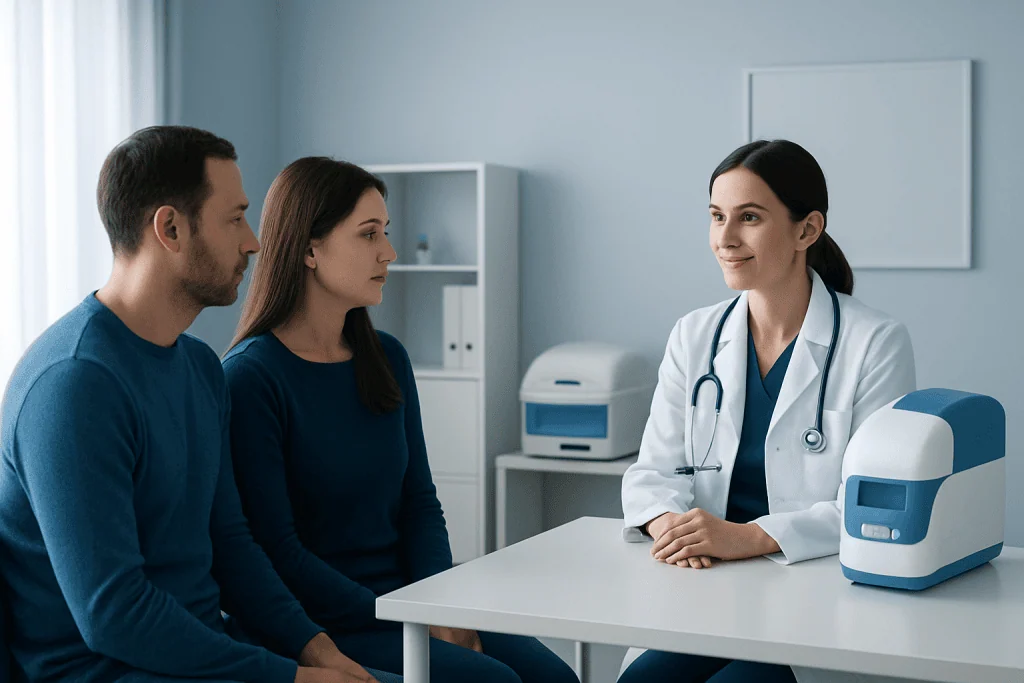
One practical advantage of time-lapse embryo monitoring is reduced embryo handling. Because images are captured inside the incubator, embryos do not need to be removed as often for routine checks. A stable culture environment is considered beneficial in IVF laboratories, although the degree to which reduced handling changes outcomes can vary between clinics and patient groups.
Another potential benefit is more detailed embryo selection. A still image at one point in time may miss abnormal division patterns, such as very rapid division or irregular cell splitting. Time-lapse videos can show whether an embryo followed a more typical developmental pathway. This may help embryologists distinguish between embryos that look similar during a single observation.
Time-lapse monitoring can also improve communication between the laboratory and the clinical team. The video record allows embryologists to review development more precisely and document events consistently. For patients, seeing embryo development may also provide a clearer explanation of why one embryo was chosen over another, although emotional responses vary and not every patient wishes to view these images.
- May reduce the need to remove embryos from the incubator.
- Provides a continuous record of early embryo development.
- May assist embryo ranking when several embryos are available.
- Can support consistent documentation in the IVF laboratory.
Limits and What the Evidence Means
Although time-lapse monitoring is promising and widely used in some IVF centers, research findings are not uniform. Some studies suggest improvements in embryo selection or clinical pregnancy rates in certain settings, while others do not show a clear advantage over high-quality conventional incubation and embryo assessment. Outcomes can depend on laboratory expertise, patient characteristics, embryo number, and how the information is used.
The most important outcome for patients is a healthy live birth, not simply a good-looking embryo or a positive pregnancy test. Time-lapse technology may help select embryos, but it cannot correct problems such as severe egg quality decline related to age, major sperm DNA issues, uterine factors, or chromosomal abnormalities in embryos. It also cannot replace careful evaluation of infertility causes before and during treatment.
Patients should be cautious about any claim that time-lapse monitoring guarantees success. It is best viewed as a supportive laboratory tool. A clinic’s overall IVF success depends on many factors, including stimulation protocols, egg retrieval technique, sperm preparation, fertilization method, embryo culture conditions, transfer planning, and individualized medical care.
Who May Benefit Most
Time-lapse embryo monitoring may be particularly useful when there are several embryos to compare. In these cases, additional information about developmental timing may help the embryology team choose the embryo with the most favorable growth pattern for transfer or freezing. It may also be considered when a previous IVF cycle produced embryos that looked similar by standard assessment, making selection more difficult.
Some patients with previous unsuccessful IVF attempts may ask whether time-lapse monitoring could help. It may provide more detailed embryo development data, but it is not always the main missing factor. A careful review may also consider ovarian reserve, egg and sperm quality, fertilization method, embryo stage at transfer, uterine lining, thyroid or metabolic health, and whether genetic testing is appropriate.
Couples using intracytoplasmic sperm injection, or ICSI, may also have embryos monitored by time-lapse systems if the laboratory offers this approach. In ICSI, a single sperm is injected into an egg, and embryo development afterward can be observed in the same way as embryos created by conventional insemination. The decision should be based on clinical need, laboratory practice, and patient preference.
- Patients with multiple embryos available for selection.
- Patients with previous IVF cycles where embryo choice was challenging.
- Cases where the clinic’s laboratory protocol integrates time-lapse data into embryo ranking.
- Patients who understand the added information is supportive, not a guarantee.
Patient Selection and Questions to Ask
Patient selection for time-lapse embryo monitoring should be individualized. A young patient with a small number of embryos may receive limited additional benefit, while another patient with many embryos may find the extra developmental information helpful. Similarly, if only one embryo develops, time-lapse monitoring may still provide documentation, but it may not change the transfer decision.
Patients should ask how the clinic uses time-lapse information in practice. Some laboratories use it mainly to maintain stable culture conditions, while others use structured scoring systems to support embryo ranking. It is reasonable to ask whether the technology has changed embryo selection in the clinic, whether there are additional costs, and how it fits with options such as blastocyst culture, embryo freezing, or genetic testing.
Helpful questions include: Will time-lapse monitoring be used for all embryos or only selected cases? Does the clinic use validated scoring criteria? Could the results change which embryo is transferred? Are there situations where conventional incubation is equally appropriate? Clear answers can help patients make informed decisions without feeling pressured to choose every available add-on.
Risks, Safety, and Emotional Considerations
Time-lapse monitoring is generally considered a low-risk laboratory technology because it observes embryos rather than treating the patient directly. The embryos remain in culture dishes inside an incubator, and the camera captures images without direct manipulation. As with all IVF laboratory procedures, safety depends on appropriate equipment maintenance, quality control, staff training, and strict laboratory standards.
The main concerns are not physical risks to the patient, but cost, expectations, and interpretation. Patients may feel that choosing time-lapse monitoring should increase their chances substantially, even when the evidence is more nuanced. Others may find embryo videos emotionally meaningful, while some may prefer not to focus on each developmental detail. Both responses are normal.
Fertility treatment can be emotionally demanding. Patients should feel comfortable asking for explanations in plain language and taking time to consider optional laboratory add-ons. Acibadem International’s multidisciplinary fertility specialists and JCI-accredited hospitals diagnose and treat fertility conditions for international patients, including care pathways for female infertility, with individualized counseling on IVF laboratory options.
When to Discuss Time-Lapse Monitoring With a Doctor
Patients considering IVF can discuss time-lapse embryo monitoring during the treatment planning stage, before ovarian stimulation begins. This allows the clinical team to explain whether the laboratory routinely offers the technology, whether it is recommended in the patient’s situation, and how it may affect embryo selection or freezing decisions.
It is especially useful to raise the topic if there have been previous IVF cycles, poor embryo development, repeated implantation failure, advanced reproductive age, male factor infertility, or a desire to understand embryo selection in more detail. However, the doctor and embryology team may recommend other evaluations first if they suspect that non-embryo factors are more important.
Patients should seek care from a qualified fertility specialist if they have been trying to conceive without success, have irregular or absent periods, known endometriosis, recurrent pregnancy loss, previous pelvic surgery, or concerns about sperm quality. Time-lapse monitoring can be part of the conversation, but a complete fertility assessment remains the foundation of safe and effective care.
Frequently asked questions
Does time-lapse embryo monitoring improve IVF success rates?
Time-lapse monitoring may help embryo assessment in some patients and clinics, but it does not guarantee higher IVF success. Research results are mixed, and outcomes depend on many factors, including age, embryo quality, uterine health, sperm factors, and laboratory expertise.
Is time-lapse monitoring safe for embryos?
Time-lapse monitoring is generally considered safe when performed in a well-controlled IVF laboratory. It observes embryos through built-in imaging while they remain inside the incubator, which may reduce repeated handling for microscope checks.
Can time-lapse monitoring detect genetic problems in embryos?
No. Time-lapse monitoring shows how embryos develop over time, but it cannot confirm whether chromosomes or genes are normal. If genetic information is needed, the fertility specialist may discuss preimplantation genetic testing in appropriate cases.
Who is most likely to benefit from time-lapse embryo monitoring?
It may be most helpful when there are several embryos to compare or when previous IVF cycles raised questions about embryo development. It may be less likely to change decisions if only one embryo is available or if other medical factors are the main concern.
Is time-lapse monitoring the same as embryo grading?
It is related but not identical. Traditional embryo grading evaluates how embryos look at specific time points, while time-lapse monitoring adds information about the timing and pattern of development between those points.
Should every IVF patient choose time-lapse embryo monitoring?
Not necessarily. It is an optional laboratory tool, and its usefulness varies by patient and clinic. Patients should ask whether it is likely to change embryo selection in their specific case and whether there are added costs.
References
- European Society of Human Reproduction and Embryology
- American Society for Reproductive Medicine
- National Institute for Health and Care Excellence
- World Health Organization
- Human Fertilisation and Embryology Authority
This article is for general information only and is not a substitute for professional medical advice. Please consult a qualified doctor about your individual situation.
IVF & fertility treatment in Turkey — success rates and costs
JCI-accredited · board-certified surgeons · reply within 24h
Add us as a Preferred Source to see more of our trusted health content across Google Search, AI Overviews and Discover.

Related Treatments
Related Conditions
More from the Health Library



Related Specialists

Prof. Dr. Bülent Tıraş
Gynecology & Obstetrics
Prof. Dr. Mete Güngör
Gynecology & Obstetrics
Prof. Dr. Faruk Suat Dede
Gynecology & Obstetrics
Prof. Dr. Tansu Küçük
Gynecology & Obstetrics