ICSI vs IVF: Which Fertilisation Option May Be Better?

IVF and ICSI both involve fertilising eggs in a laboratory, but they do so in different ways. Standard IVF allows sperm to fertilise the egg naturally in a culture dish, while ICSI injects one sperm directly into the egg.
Key Takeaways
- IVF and ICSI both involve fertilising eggs in a laboratory, but they do so in different ways.
- Standard IVF allows sperm to fertilise the egg naturally in a culture dish, while ICSI injects one sperm directly into the egg.
- ICSI is often considered when there is male factor infertility or previous fertilisation failure.
- Neither method is automatically better for everyone; the best choice depends on the medical cause of infertility.
- A full fertility evaluation helps guide treatment and improve the chance of choosing the most suitable approach.
ICSI and IVF are both assisted reproduction techniques used to help fertilisation happen outside the body. The better option depends on the couple’s fertility history, sperm and egg factors, and the advice of a fertility specialist.
Overview: what is the difference between ICSI and IVF?
IVF and ICSI are both forms of assisted reproductive technology designed to help a sperm and an egg come together outside the body. In standard in vitro fertilisation, several prepared sperm are placed around each mature egg in a laboratory dish, and one sperm is expected to fertilise the egg on its own. In intracytoplasmic sperm injection, an embryologist selects a single sperm and injects it directly into the egg.
Both techniques usually follow similar early steps. These often include ovarian stimulation, monitoring with ultrasound and blood tests, egg collection, sperm collection or preparation, embryo culture, and embryo transfer. Because much of the process is shared, the main difference is how fertilisation is attempted in the laboratory.
One option is not universally better than the other. Standard IVF remains effective for many couples, especially when sperm number and movement are within an acceptable range. ICSI may be especially helpful when fertilisation is less likely to happen naturally because of sperm-related issues or certain previous treatment outcomes.
How IVF works
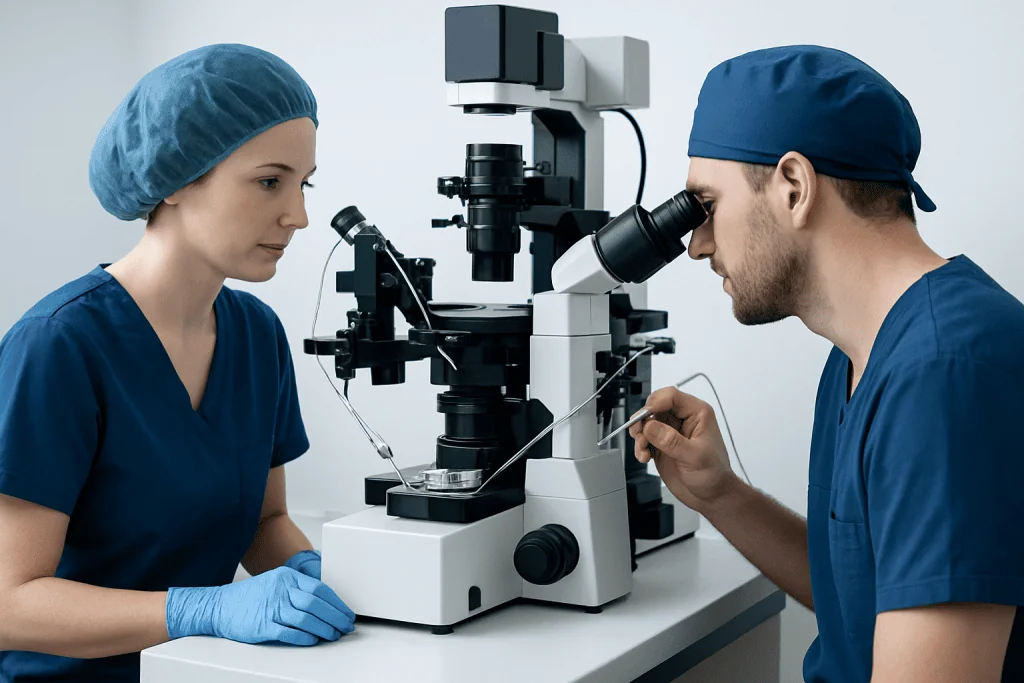
In standard IVF, the ovaries are stimulated to produce multiple eggs during one treatment cycle. When the eggs are ready, they are collected using a minor procedure, usually under sedation. A semen sample is also collected, and the healthiest sperm are separated in the laboratory.
The prepared sperm are then placed with the eggs in a controlled laboratory environment. Fertilisation is allowed to occur without directly injecting the sperm into the egg. If fertilisation happens successfully, the resulting embryos are observed as they develop over several days before one or more may be considered for transfer to the uterus.
This method can work well when there is no major barrier to sperm reaching and penetrating the egg. It is commonly used for unexplained infertility, tubal factor infertility, ovulation disorders, or some cases related to female infertility. For many patients, IVF treatment offers a well-established path that can be tailored to age, ovarian reserve, and reproductive history.
How ICSI works

ICSI follows the same general treatment steps as IVF until the moment of fertilisation. After eggs are collected and sperm are prepared, an embryologist uses a microscope and highly specialised tools to inject one sperm directly into each mature egg. This bypasses several natural steps that sperm would usually need to complete on their own.
Because only one sperm is used per egg, ICSI can be helpful when sperm are very low in number, have poor movement, or have difficulty penetrating the egg. It may also be considered when sperm are obtained surgically, when previously collected eggs had low fertilisation with standard IVF, or when frozen eggs are being used in certain settings.
ICSI does not guarantee fertilisation, and it is not needed in every case. However, it can increase the chance that fertilisation is attempted successfully when there is a clear laboratory indication. Patients who are comparing options may discuss whether ICSI is being recommended because of sperm quality, prior cycle history, or another specific reason.
When may IVF be preferred, and when may ICSI be better?
Standard IVF may be preferred when sperm parameters are normal or only mildly reduced, and there is no history suggesting a fertilisation problem. It can also be appropriate when infertility is mainly related to blocked fallopian tubes, ovulation problems, endometriosis, or unexplained infertility. In these situations, sperm may still be able to fertilise the egg successfully in the laboratory dish without direct injection.
ICSI may be better suited to male factor infertility. This includes low sperm count, poor sperm movement, abnormal sperm shape, or situations in which sperm must be retrieved directly from the testicle or epididymis. It may also be recommended after previous poor or failed fertilisation with conventional IVF, or when preimplantation genetic testing is planned in some centres.
The decision is not based on sperm results alone. A fertility specialist also considers age, egg quality, ovarian reserve, the number of eggs expected, previous pregnancies, previous IVF outcomes, and any known reproductive conditions. For example, treatment planning may also take account of issues such as premature ovarian insufficiency, uterine septum, or ovarian cysts when they affect the broader fertility picture.
In some clinics, ICSI is used routinely, while in others it is used more selectively. A personalised recommendation is often the most helpful approach. The aim is to use the least invasive method that still offers a good chance of fertilisation and embryo development.
Success rates, benefits, and limitations
Success with IVF or ICSI depends on many factors, especially the age of the woman, egg quality, embryo quality, uterine health, and the cause of infertility. It is important to understand that fertilisation is only one step in a larger process. A cycle may achieve fertilisation but still not lead to implantation or pregnancy.
ICSI can improve fertilisation rates in couples with clear male factor infertility, but it does not always improve live birth outcomes for people who do not have a sperm-related issue. For that reason, many specialists recommend ICSI when there is a specific indication rather than assuming it is better in every case. Standard IVF remains an important and effective option.
Both methods have benefits and limitations. IVF allows a more natural selection process among sperm in the laboratory dish, while ICSI overcomes some important barriers to fertilisation. On the other hand, ICSI is a more technically involved procedure and may not add value when sperm function is already adequate.
Patients may also hear about broader artificial fertilisation options, but not every technique is suitable for every couple. A good discussion with the fertility team helps place IVF and ICSI in context and clarifies which option matches the medical need most closely.
How doctors decide between ICSI and IVF
Choosing between IVF and ICSI usually starts with a complete fertility assessment for both partners. This commonly includes a medical history, hormone testing, ultrasound evaluation of the ovaries and uterus, and semen analysis. Depending on the findings, further tests may be recommended to look for tubal problems, ovulation disorders, uterine abnormalities, or genetic factors.
The semen analysis is especially important when deciding whether ICSI may be beneficial. Doctors review sperm concentration, movement, and shape, but they also consider the whole clinical picture rather than one number in isolation. Even with borderline sperm results, some couples may still do well with standard IVF, while others may benefit from ICSI.
Female reproductive health also matters. Conditions that affect egg supply, ovulation, or the uterine environment may influence the overall strategy, even if they do not directly determine the fertilisation method. For example, women with hormone-related ovulation problems such as polycystic ovary syndrome may need a carefully tailored stimulation plan before fertilisation choices are made.
The final treatment plan should be individualised and clearly explained. Patients should feel comfortable asking why one method is being recommended, whether there are alternatives, and how the decision may affect embryo development, timing, and cost. The goal is informed, shared decision-making based on evidence and clinical experience.
Risks, safety, and emotional considerations
Both IVF and ICSI are widely used and are generally considered safe when performed by experienced fertility teams. As with any fertility treatment, however, there are possible risks. These can include side effects from ovarian stimulation medications, ovarian hyperstimulation syndrome in some patients, procedure-related discomfort after egg collection, and the possibility of multiple pregnancy depending on the embryo transfer plan.
ICSI adds a laboratory micromanipulation step, but serious complications from the injection itself are uncommon in experienced hands. Not every injected egg will fertilise or continue developing, just as not every egg in standard IVF will fertilise naturally. A specialist can explain expected outcomes in a way that reflects the patient’s own situation rather than general assumptions.
The emotional side of treatment is also important. Deciding between IVF and ICSI can feel stressful, especially after a long period of trying to conceive or after previous unsuccessful cycles. Clear communication, realistic expectations, and psychological support can make the process more manageable.
Near the end of the treatment journey, some patients also value care coordination for international travel and follow-up. Acibadem International’s multidisciplinary specialists and JCI-accredited hospitals diagnose and treat fertility conditions for international patients, with treatment plans based on individual reproductive needs.
When to speak with a fertility specialist
A fertility specialist can help when pregnancy has not occurred after a reasonable period of trying, or sooner if there are known reproductive concerns. Earlier assessment may be especially helpful for women over 35, couples with irregular periods, known sperm problems, a history of pelvic infection or surgery, recurrent miscarriage, or previous cancer treatment affecting fertility.
Medical advice should also be sought when there is a known diagnosis such as severe male factor infertility, blocked fallopian tubes, very low ovarian reserve, or repeated failed insemination cycles. In these cases, assisted reproduction may be discussed earlier rather than waiting longer. Evaluation can also clarify whether another option, such as infertility treatment, should come before IVF or ICSI.
Before starting treatment, patients may wish to ask practical questions about the number of visits, how fertilisation method affects the plan, whether embryos may be frozen, and what steps are taken if fertilisation does not occur. Understanding the process often makes decisions feel less overwhelming. A careful consultation helps determine whether IVF or ICSI is likely to be the more suitable option for that individual couple.
Frequently asked questions
Is ICSI more successful than IVF?
Not always. ICSI may improve fertilisation in cases of male factor infertility or previous failed fertilisation, but it is not automatically more effective for everyone. Overall success depends on age, egg quality, embryo development, and the underlying cause of infertility.
Why would a doctor recommend ICSI instead of standard IVF?
A doctor may recommend ICSI when there is low sperm count, poor sperm movement, abnormal sperm shape, or a history of poor fertilisation with conventional IVF. It may also be used when sperm are surgically retrieved or when there are other laboratory reasons to support direct sperm injection.
Can IVF work if sperm count is low?
In some cases, yes. Mild sperm problems may still allow standard IVF to work, but more significant sperm issues often make ICSI a more suitable option. The decision usually depends on the semen analysis and the couple’s full fertility history.
Do IVF and ICSI use the same medications and procedures?
Most of the treatment steps are the same. Both usually involve ovarian stimulation, egg collection, sperm preparation, embryo culture, and embryo transfer. The main difference is the laboratory fertilisation step.
Is ICSI only used for male infertility?
No. Although it is commonly used for male factor infertility, ICSI may also be recommended after previous failed fertilisation, when frozen eggs are used in some situations, or when there are specific laboratory considerations. The decision is based on individual clinical need.
Which is less invasive, IVF or ICSI?
For the patient, the overall treatment experience is very similar because the same egg collection and embryo transfer steps are usually involved. ICSI is more invasive at the laboratory level because a sperm is injected directly into the egg, but patients do not usually feel that difference physically.
This article is for general information only and is not a substitute for professional medical advice. Please consult a qualified doctor about your individual situation.
ICSI in Turkey — costs, top hospitals & a free quote
JCI-accredited · board-certified surgeons · reply within 24h
Add us as a Preferred Source to see more of our trusted health content across Google Search, AI Overviews and Discover.
Check your numbers in seconds
BMI, calories, due date, blood pressure and 30+ more clinical calculators — free, instant, doctor-reviewed ranges.

Related Treatments
Related Conditions
More from the Health Library

PGT in IVF: Embryo Genetic Testing, Benefits, and Limits

IVF With Adenomyosis: How It Can Affect Fertility Treatment

Mini-IVF: Lower-Dose Stimulation, Candidates, and Trade-Offs

Insemination Treatment in Turkey: What International Patients Should Know

IVF After Miscarriage: When to Try Again and What to Review

Why Am I Not Getting Pregnant? Common Infertility Causes in Women and Men
Gynecology & Obstetrics Specialists at Acibadem

Prof. Dr. Ahmet Cem Batukan
Gynecology & Obstetrics
Prof. Dr. Ahmet Tayyar
Gynecology & Obstetrics
Dr. Ahmet Varolan
Gynecology & Obstetrics
Dr. Albert Kazado
Gynecology & Obstetrics