Rectal Prolapse
Rectal Prolapse is when the rectum slips through the anus. Learn symptoms, causes, diagnosis and treatment options from specialists.
Quick answer
Rectal prolapse is a condition in which the rectum slips down and may protrude through the anus, often causing discomfort, mucus leakage, bleeding, or difficulty controlling bowel movements. Treatment depends on the severity and the patient’s overall health, and at Acibadem it may include evaluation by colorectal specialists, pelvic floor assessment, and surgical repair using abdominal or perineal techniques when…
What is rectal prolapse?
Rectal prolapse is a condition in which the rectum, the last section of the large intestine, just above the anus, slips out of its normal position and pushes down through the anal opening. In a full (complete) rectal prolapse, the entire wall of the rectum turns partly inside out and protrudes visibly outside the body. In milder forms, only the inner lining of the rectum (the mucosa) slips down, or the rectum folds in on itself internally without emerging through the anus. This internal form is sometimes called an internal prolapse or rectal intussusception.
Understanding what is rectal prolapse begins with understanding the muscles and ligaments of the pelvic floor. These structures normally hold the rectum in place. When they weaken or stretch, often after many years of straining, childbirth, or age-related change, the rectum can gradually lose its support and begin to slide downward.
Rectal prolapse can affect people of any age, but it is most common in adults over 50, and women are affected considerably more often than men. It also occurs occasionally in young children, usually in a milder form that often improves as the child grows and as any underlying cause (such as chronic constipation) is treated. Although rectal prolapse is not usually life-threatening, it tends to worsen over time if left untreated, and it can significantly affect comfort, bowel control, and quality of life.
Rectal prolapse is classified under the code K62.3 in the ICD-10 system, the international catalog doctors use to record diagnoses. It is sometimes confused with hemorrhoids (swollen blood vessels in and around the anus), because both can cause tissue to protrude from the anus. However, the two conditions are different and are treated differently, which is one reason a proper medical evaluation matters.
Symptoms of rectal prolapse
Rectal prolapse symptoms usually develop gradually. In the early stages, many people notice the prolapse only during bowel movements, when straining pushes the rectal tissue downward. At first, the tissue may slide back inside on its own. As the condition progresses, the prolapse may need to be pushed back in by hand, and eventually it may protrude during everyday activities such as walking, coughing, or standing for long periods.
Common rectal prolapse symptoms include:
- A visible bulge or mass protruding from the anus, especially during or after a bowel movement. It often looks like a reddish, moist tube or ring of tissue.
- A feeling of something “coming out” or falling down in the anal area, or a sensation of sitting on a lump.
- Difficulty controlling bowel movements (fecal incontinence), ranging from leakage of mucus or liquid stool to loss of control over solid stool. This affects a large proportion of people with long-standing prolapse, because the stretched anal muscles weaken over time.
- Constipation or a sense of incomplete emptying, sometimes with a need to strain repeatedly. Some people alternate between constipation and leakage.
- Mucus discharge from the anus, which can cause dampness, itching, and irritation of the surrounding skin.
- Bleeding from the exposed rectal lining, usually small amounts of bright red blood noticed on toilet paper or underwear.
- Discomfort, pressure, or a dull ache in the rectum or pelvis. Severe pain is less common and can be a warning sign (see the final section of this article).
Symptoms often differ by stage and type. With an internal prolapse (intussusception), there is no visible bulge; instead, people typically describe a blocked feeling during bowel movements, straining, incomplete emptying, and sometimes pelvic pressure. With a mucosal prolapse, only a small ring of lining protrudes, and symptoms may be limited to mild discharge, irritation, and minor bleeding. With a complete (full-thickness) prolapse, the protruding tissue is larger, sometimes several centimeters, and incontinence, mucus, and bleeding are more common. In advanced cases the prolapse may remain outside most of the time.
Because these symptoms overlap with hemorrhoids, anal fissures, and other conditions, a visible lump or bleeding should always be evaluated by a doctor rather than self-diagnosed.
Causes and risk factors
There is usually no single cause of rectal prolapse. Instead, several factors combine to weaken the pelvic floor: the sling of muscles and connective tissue that supports the rectum, bladder, and, in women, the uterus. Common rectal prolapse causes and contributing factors include:
- Chronic constipation and straining. Years of pushing hard during bowel movements place repeated downward pressure on the rectum and its supports. This is one of the most frequently associated factors.
- Chronic diarrhea. Frequent urgent bowel movements can also strain the pelvic floor over time.
- Pregnancy and vaginal childbirth. These can stretch and weaken pelvic floor muscles and nerves, which helps explain why rectal prolapse is more common in women, particularly later in life. However, the condition also occurs in women who have never given birth and in men.
- Aging. Muscles and ligaments naturally lose strength and elasticity with age, and the supporting structures of the rectum are no exception.
- Weak anal sphincter muscles or nerve damage. Injury to the nerves that control the pelvic floor, for example, from childbirth, pelvic surgery, spinal problems, or long-standing diabetes, can reduce muscle support.
- Chronic coughing or heavy lifting. Any condition or activity that repeatedly raises pressure inside the abdomen, such as chronic lung disease with persistent cough, can contribute.
- Previous pelvic surgery. In some people, earlier operations in the pelvic area alter the normal supports of the rectum.
- Anatomical factors. Some people have a naturally deep pelvic pouch, a loosely attached rectum, or lax pelvic ligaments, which makes prolapse more likely.
- In children: rectal prolapse is often linked to constipation and straining, prolonged diarrheal illness, malnutrition, or, less commonly, conditions such as cystic fibrosis. A child with prolapse should always be medically evaluated to look for an underlying cause.
It is worth stressing that rectal prolapse is not caused by anything shameful and is not a sign of poor hygiene. It is a mechanical problem of tissue support, and it is common enough that colorectal specialists treat it routinely.
Diagnosis
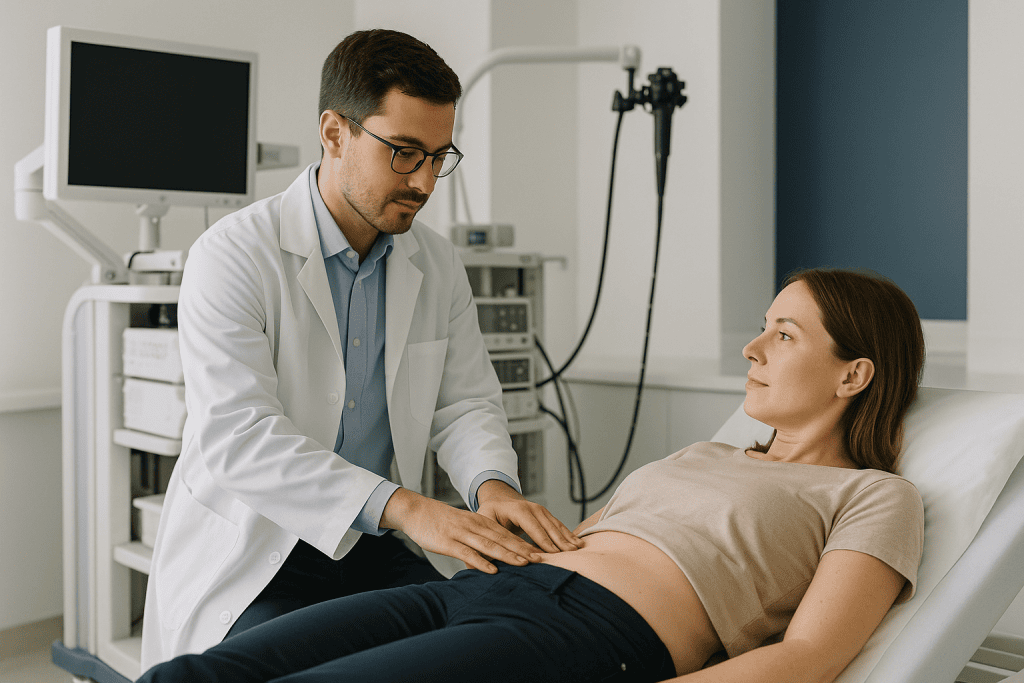
Rectal prolapse diagnosis usually starts with a careful conversation about your symptoms, when the bulge appears, whether it goes back in on its own, and how your bowel habits and continence have changed, followed by a physical examination.
Steps and tests your doctor may use include:
- Visual and digital rectal examination. The doctor examines the anal area and gently inserts a gloved finger into the rectum to assess muscle tone and check for other problems. A full-thickness prolapse typically shows concentric (circular) folds of tissue, which helps distinguish it from prolapsed hemorrhoids, where the folds run outward like spokes.
- Examination while straining. Because the prolapse may not be visible at rest, the doctor may ask you to bear down as if having a bowel movement, sometimes while sitting on a commode. This often reveals the prolapse and is a routine, expected part of the assessment.
- Anoscopy or sigmoidoscopy/colonoscopy. A short lighted tube (anoscope) or a flexible camera (sigmoidoscope or colonoscope) lets the doctor look inside the rectum and lower colon. These tests help rule out other causes of bleeding or a mass, such as polyps, inflammation, or, rarely, cancer. A colonoscopy is often recommended before surgery, particularly in older adults.
- Defecography. This is a specialized imaging study, using X-ray or MRI, performed while you attempt to empty the rectum. It is especially useful for detecting internal prolapse (intussusception) and for showing whether other pelvic organs, such as the bladder or vagina, are also descending. Combined prolapse of several pelvic organs is not unusual, especially in women.
- Anorectal manometry. A thin pressure-measuring tube assesses how well the anal sphincter muscles squeeze and relax. This information can help predict continence after treatment and guide the choice of operation.
- Additional tests as needed. Depending on your symptoms, your doctor may suggest tests of colon transit (how quickly stool moves through the bowel), pelvic floor ultrasound, or urodynamic studies if urinary symptoms are also present.
Not everyone needs every test. For a clearly visible external prolapse, the diagnosis is often made from the examination alone, and further tests are used mainly for planning treatment. Depending on the hospital, evaluation may involve a colorectal surgeon, a gastroenterologist, or both; at institutions such as Acibadem, initial digestive evaluation is typically handled through the gastroenterology department, with surgical colleagues involved when an operation is being considered.
Treatment options
Rectal prolapse treatment depends on the type of prolapse, its severity, your symptoms, your age, and your overall health. Broadly, options range from supportive measures to surgery. It is important to understand from the outset that in adults, an established full-thickness rectal prolapse rarely resolves on its own, and surgery is the only treatment that can durably correct it. Non-surgical measures still play an important role in relieving symptoms and preparing for or, in selected cases, avoiding an operation.
Conservative (non-surgical) measures
- Treating constipation. A higher-fiber diet, adequate fluid intake, and, when needed, fiber supplements or stool softeners can reduce straining. Since straining drives the prolapse downward, this is a foundation of care for almost everyone with the condition.
- Bowel habit changes. Avoiding prolonged sitting and pushing on the toilet, and responding promptly to the urge to have a bowel movement, can lessen daily stress on the pelvic floor.
- Pelvic floor exercises and physical therapy. Exercises that strengthen the pelvic floor, sometimes guided by a specialized physiotherapist and biofeedback (a technique that helps you learn to use these muscles correctly), may improve continence and symptoms, particularly in milder or internal prolapse. They do not reverse a full external prolapse.
- Manual reduction. If the prolapse comes out, gently pushing it back inside, usually with a lubricated, gloved or cloth-covered hand while lying down, is often possible and is something your doctor can teach you. A prolapse that cannot be pushed back is an urgent problem (see the final section).
- Watchful waiting. In people with very mild symptoms, or in those too frail for surgery, careful monitoring combined with the measures above may be reasonable. In children, conservative treatment of the underlying cause, most often constipation, is usually the first approach, and many childhood prolapses improve without surgery.
Medication
There is no medication that cures rectal prolapse itself. Medicines are used to support the bowel: laxatives or stool softeners for constipation, anti-diarrheal medicines when chronic diarrhea contributes, and barrier creams to protect irritated skin around the anus. Your doctor may adjust these over time based on your symptoms.
Surgery
For most adults with a complete rectal prolapse, surgical repair is the definitive treatment. The goals are to fix the rectum back in place, relieve the protrusion, and improve bowel function. Operations fall into two broad groups:
- Abdominal approaches. The surgeon works through the abdomen, often using laparoscopic (keyhole) or robot-assisted techniques, to lift the rectum and secure it to the sacrum, the bone at the back of the pelvis. This is called rectopexy. Sometimes a supportive mesh is used (for example, in ventral mesh rectopexy), and in some patients a short segment of redundant colon is also removed (resection rectopexy), particularly when severe constipation is a major problem. Abdominal repairs generally offer durable results and are often preferred in patients fit enough for the procedure.
- Perineal approaches. The surgeon operates entirely through the anus, without opening the abdomen. Common examples include removing the prolapsed segment of rectum through the anus (a perineal rectosigmoidectomy, often called the Altemeier procedure) or removing the loose inner lining and pleating the muscle wall (the Delorme procedure). These operations avoid abdominal surgery and general anesthesia can sometimes be avoided, so they are often chosen for older or medically frail patients, although the prolapse may be somewhat more likely to return than after abdominal repair.
Your surgical team will weigh your age, health, anatomy, bowel function, and any coexisting pelvic organ prolapse when recommending an approach. Recovery times vary with the operation and the individual; minimally invasive abdominal and perineal procedures often allow a relatively short hospital stay, but full recovery and lifting restrictions typically extend over several weeks. Continence and constipation often improve after successful repair, though improvement can be gradual and is not guaranteed in every case, especially when the sphincter muscles have been stretched for many years.
Living with rectal prolapse and outlook
Living with rectal prolapse can be physically uncomfortable and emotionally difficult. Many people delay seeking help out of embarrassment, but earlier evaluation generally means simpler treatment and a better chance of preserving bowel control. The condition itself is rarely dangerous in the short term, but without treatment it usually progresses: the prolapse tends to come out more easily and more often, and continence tends to worsen as the anal muscles stretch.
Practical steps that help many people day to day include keeping stools soft and regular, avoiding straining and heavy lifting where possible, using absorbent pads and gentle skin care if leakage or discharge is a problem, and learning how to reduce the prolapse safely if it comes out. Pelvic floor exercises, when taught correctly, can support continence before and after treatment.
After surgical repair, the outlook is generally favorable. Most people experience relief of the protrusion, and bowel symptoms often improve over the following months, although some degree of constipation or incontinence can persist in a minority of patients. Recurrence, the prolapse coming back, is possible after any type of repair, which is why long-term attention to bowel habits and avoiding chronic straining remains important. In children, the outlook is usually good, with most cases improving once constipation or another underlying cause is addressed. Your own outcome depends on your specific situation, and your doctor can give you a more individualized picture.
Frequently asked questions
What is rectal prolapse in simple terms?
Rectal prolapse means the rectum, the final part of the large bowel, has slipped down from its normal position and, in the complete form, pokes out through the anus. It happens because the muscles and ligaments that normally hold the rectum in place have weakened or stretched, often after years of straining, childbirth, or age-related change. It is a mechanical support problem, not an infection or a tumor, although a doctor should confirm the diagnosis and rule out other causes.
Can rectal prolapse heal on its own?
In adults, a full-thickness rectal prolapse very rarely resolves without surgery; conservative measures can ease symptoms but do not restore the rectum’s support. In young children, the situation is different, prolapse often improves as the child grows and once constipation or another underlying cause is treated. If you or your child has a prolapse, a medical evaluation is the safest way to find out which approach is appropriate.
How serious is rectal prolapse?
Rectal prolapse is usually not life-threatening, but it is a progressive condition that tends to worsen without treatment, and it can lead to loss of bowel control, bleeding, and skin irritation. Rarely, a prolapse that cannot be pushed back inside can become swollen and lose its blood supply, which is an emergency. For most people, timely evaluation and treatment lead to good results.
What is the difference between rectal prolapse and hemorrhoids?
Hemorrhoids are swollen blood vessel cushions in or around the anus, while rectal prolapse involves the wall of the rectum itself slipping down. Both can cause a lump, bleeding, and irritation, so they are easy to confuse. On examination, a full rectal prolapse shows circular rings of tissue, whereas prolapsed hemorrhoids form separate lobes with radiating folds. The treatments differ substantially, so an accurate diagnosis by a doctor matters.
What does rectal prolapse treatment involve, and will I need surgery?
Rectal prolapse treatment usually starts with managing constipation, avoiding straining, and sometimes pelvic floor therapy. For most adults with a complete prolapse, however, surgery is the only definitive fix. Options include abdominal operations that secure the rectum in place (rectopexy, often done laparoscopically) and perineal operations performed through the anus, which are often chosen for older or frail patients. Your surgeon will recommend an approach based on your health, anatomy, and symptoms.
How long is recovery after rectal prolapse surgery?
Recovery varies with the type of operation and your overall health. Hospital stays after minimally invasive or perineal procedures are often short, but most people need several weeks before returning to normal activity, and heavy lifting is usually restricted for longer to protect the repair. Bowel function, including continence, may continue to improve for months. Your surgical team will give you a plan tailored to your procedure.
Can rectal prolapse come back after treatment?
Yes, recurrence is possible after any type of repair, although rates differ between techniques and individuals. Continuing to manage constipation, avoiding chronic straining, and maintaining pelvic floor strength may help reduce that risk, though nothing eliminates it entirely. If a bulge or your original symptoms return after surgery, tell your doctor: a recurrent prolapse can usually still be treated.
When to see a doctor
Any persistent lump protruding from the anus, ongoing rectal bleeding, or new loss of bowel control deserves a medical evaluation, even if the symptoms seem mild or intermittent. Rectal bleeding in particular should never be assumed to be harmless, because it can also signal other conditions that need to be excluded.
Seek urgent medical care, go to an emergency department or contact emergency services, if you experience any of the following red flags:
- A prolapse that cannot be pushed back inside (an incarcerated prolapse), especially if it is becoming more swollen or painful.
- The protruding tissue turning dark red, purple, blue, or black, which can mean the blood supply is cut off (strangulation): this is an emergency.
- Severe or rapidly worsening pain in the rectum, anus, or lower abdomen.
- Heavy or continuous rectal bleeding, or bleeding with dizziness or weakness.
- Fever and chills together with a prolapse, which may indicate infection or tissue damage.
- Inability to pass stool or gas along with abdominal swelling, which can indicate a bowel obstruction.
For non-urgent but persistent symptoms: a bulge during bowel movements, straining, mucus discharge, or gradual changes in bowel control, arrange a routine appointment with your primary care doctor or a digestive specialist. Early assessment generally means more treatment options and a better chance of protecting long-term bowel function.
Medically reviewed by the Acıbadem International Medical Board September 2, 2026
See our medical review board →
Update history
- PublishedJune 8, 2026
- Medical review approvedSeptember 2, 2026
- Last content updateSeptember 2, 2026