

Can African American Hair Be Used for Hair Transplantation?

African American hair transplantation is feasible and often produces natural-looking results. Curly hair follicles curve beneath the skin, so surgical technique must be adapted.
Key Takeaways
- African American hair transplantation is feasible and often produces natural-looking results.
- Curly hair follicles curve beneath the skin, so surgical technique must be adapted.
- Donor-area assessment is essential to reduce the risk of visible thinning or scarring.
- Both FUE and FUT may be options, depending on hair characteristics and goals.
- A consultation should include discussion of traction alopecia, scarring disorders, and styling habits.
African American hair can be used very successfully for hair transplantation. The key is careful planning by an experienced surgeon who understands curly follicles, scalp characteristics, and styling needs.
Overview
African American hair can be used for hair transplantation, and in many patients it can provide excellent coverage and a very natural appearance. Because tightly curled or coiled hair creates more visual fullness, fewer transplanted grafts may sometimes achieve a fuller-looking result than straighter hair types. However, success depends on individualized planning rather than a one-size-fits-all approach.
The main difference is not whether transplantation is possible, but how the procedure is performed. In people with tightly curled hair, the follicle often curves under the skin as well as above it. This makes graft harvesting and implantation more technically demanding, because the surgeon must follow the natural direction of the follicle to avoid damaging it.
Another important factor is scalp and scar behavior. Some patients of African descent may have a higher tendency toward certain forms of scarring, including raised scars or keloid scars. Not every patient has this risk, but it is an important part of the preoperative evaluation. A careful consultation helps identify the safest technique and the most realistic cosmetic goals.
What makes African American hair transplantation unique?
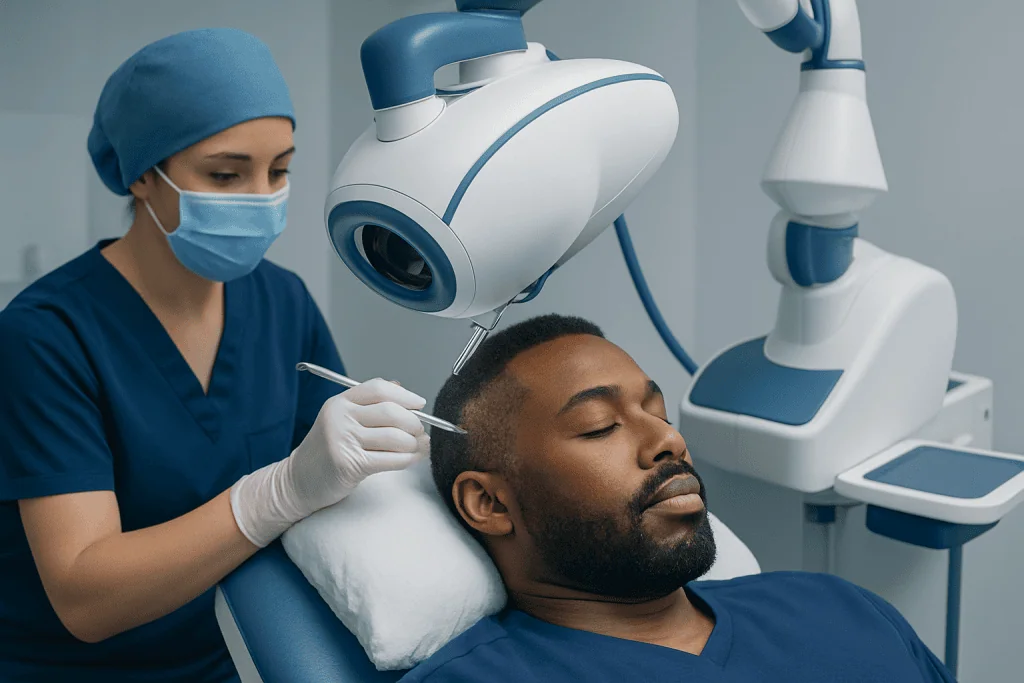
The distinctive feature of African American hair is curl pattern. Hair may be tightly coiled, curly, or kinked, and the follicle beneath the scalp often mirrors this shape. During transplantation, this curved root structure can increase the chance of graft transection, meaning accidental cutting or damage to follicles if standard techniques are used without modification.
Hair shaft characteristics also matter. Curly or coily hair can create strong visual density because each strand occupies more space. This can be an advantage when restoring the hairline, temples, crown, or areas of thinning. At the same time, the surgeon must plan hairline design carefully so that the direction, angle, and distribution of grafts match the patient’s natural growth pattern.
Scalp conditions and grooming history are also especially relevant. Some patients seek transplantation because of traction alopecia related to tight braids, weaves, locs, or frequent tension styling. Others may have central centrifugal cicatricial alopecia or thinning from genetic pattern hair loss. These causes need to be distinguished before surgery, because active inflammatory or scarring hair loss may require medical treatment first.
For patients considering broader cosmetic scalp procedures, a specialist may also discuss options related to aesthetic scalp surgery when appropriate. The goal is always to preserve healthy donor hair, protect the scalp, and create a restoration plan suited to the individual rather than just the hair type.
Who may be a good candidate?

A good candidate for African American hair transplantation is someone with stable hair loss, enough healthy donor hair, and realistic expectations about what surgery can achieve. The most common candidates are people with androgenetic alopecia, also called male or female pattern hair loss, or those with stable traction alopecia after the damaging hairstyle has been stopped.
During evaluation, the surgeon looks at the donor area, usually the back and sides of the scalp, to assess density, follicle quality, and the pattern of curl. The scalp is also checked for signs of inflammation, tenderness, scaling, or scar tissue. If there is concern about active scarring alopecia, the patient may be referred to a dermatologist before surgery is considered.
Patients with a personal or family history of problematic scars should mention this clearly. A history of raised scars after ear piercing, surgery, acne, or injury may affect the choice between harvesting methods. The surgeon will also ask about chemical processing, heat damage, relaxers, and grooming practices, since these can influence scalp health and hair breakage.
People are usually advised to delay surgery if hair loss is rapidly changing, if the cause is uncertain, or if there is untreated scalp disease. A transplant works best when the area being restored and the donor reserve are both understood well, allowing a long-term plan rather than a temporary cosmetic fix.
How the procedure is planned and performed
Hair transplantation typically uses one of two main harvesting approaches: follicular unit extraction (FUE) or follicular unit transplantation (FUT), also called strip surgery. In FUE, individual follicular units are removed one by one. In FUT, a narrow strip of scalp is removed from the donor area and then divided into grafts under magnification. Both techniques can be used in patients with African American hair, but each has advantages and limitations.
FUE can avoid a linear scar, which appeals to patients who wear their hair very short. However, because curly follicles bend beneath the skin, FUE may be technically more challenging and may carry a greater risk of follicle injury if the surgeon is not experienced with textured hair. Specialized punches, careful angling, and slower extraction may help improve graft quality.
FUT may allow more controlled graft dissection in some patients because the follicles can be viewed more clearly under the microscope after the strip is removed. The tradeoff is a linear donor scar. For some people, especially those with a tendency to raised scarring, this is an important point to discuss in advance. The best technique depends on scalp laxity, hairstyle preferences, donor density, and scar risk rather than trend alone.
Implantation is just as important as harvesting. The surgeon creates recipient sites that match the natural angle and curl orientation of the existing hair. In many cases, only a conservative number of grafts is placed in the first session to protect blood supply and ensure a natural look. A carefully staged approach can be safer and more effective than trying to create dramatic density in one sitting.
Benefits, limitations, and possible risks
The main benefit of African American hair transplantation is that it can restore areas of thinning or baldness using the patient’s own hair. Because coily or curly hair provides good visual volume, the result can look full and soft when planned well. It may also improve confidence and reduce the need to camouflage hair loss with styling.
Still, transplantation has limitations. It does not create unlimited density, and it cannot replace donor hair that is not available. If hair loss is extensive, the surgeon may need to prioritize the front hairline, temples, or crown rather than treat every area fully. Results also develop gradually, usually over several months, as transplanted follicles enter a new growth cycle.
As with any procedure, risks are possible. These may include swelling, temporary shedding, infection, uneven growth, visible thinning in the donor area, or scarring. In patients prone to abnormal scar formation, this concern deserves special attention. People with previous scalp trauma, surgery, or burns may require more tailored planning because blood supply and tissue quality can differ from untreated scalp.
One less obvious risk is transplanting into an area where the true cause of hair loss has not been controlled. For example, if traction styling continues after surgery, or if a scarring alopecia remains active, transplanted hair may not thrive as expected. This is why diagnosis and long-term scalp care are just as important as the operation itself.
Recovery and aftercare
Recovery after hair transplantation is usually straightforward, but good aftercare supports the best outcome. Small crusts or scabs may form around grafts for several days, and the scalp can feel tender or tight. Patients are usually advised to avoid scratching, rubbing, or putting pressure on the treated areas while the grafts settle.
Hair washing instructions vary by clinic, but gentle cleansing is generally introduced early to keep the scalp clean and help crusts loosen naturally. Patients may also be asked to avoid intense exercise, heavy sweating, swimming, and direct sun exposure for a period after surgery. Following these instructions can help reduce irritation and protect healing grafts.
Transplanted hair often sheds before growing again, which can be surprising but is commonly part of the normal cycle. New growth usually appears gradually, and texture may initially feel different before becoming more consistent over time. People with tightly coiled hair should ask when they can safely resume braids, extensions, relaxers, coloring, or heat styling, since premature tension or processing may interfere with healing.
Long-term care may include medical treatment to help preserve non-transplanted hair. Some patients benefit from a broader hair-restoration plan that combines surgery with scalp treatment, styling changes, and follow-up monitoring. In selected reconstructive cases involving scarring or shape changes of the scalp, related approaches within cosmetic surgery may also be discussed on an individualized basis.
How to choose a surgeon and when to seek advice
Choosing a surgeon with specific experience in textured and tightly curled hair is one of the most important decisions. Patients should ask how often the surgeon treats African American hair, which harvesting methods are used, and how donor scarring is assessed. It is also reasonable to ask about the approach to traction alopecia, scarring alopecia, and prior scar history.
A thorough consultation should include scalp examination, medical history, and a discussion of realistic coverage goals. Good planning is especially important when the patient prefers short hairstyles or has concern about visible donor changes. If there is uncertainty about the diagnosis, a dermatologist may be involved before surgery is scheduled.
Medical advice should be sought promptly for hair loss that is painful, itchy, rapidly spreading, or associated with redness, scaling, pustules, or smooth shiny patches. These signs may suggest inflammation or scarring disease rather than simple pattern hair loss. Early treatment can sometimes prevent further permanent loss and may change whether surgery is appropriate.
For international patients seeking evaluation, Acibadem International’s multidisciplinary specialists and JCI-accredited hospitals diagnose and treat hair and scalp concerns with individualized planning. In carefully selected cases involving scar-related scalp changes after injury or facial trauma, reconstructive and aesthetic teams may coordinate care alongside options such as scarring treatment when relevant to the broader cosmetic plan.
Frequently asked questions
Can African American hair really be transplanted successfully?
Yes. African American hair can be transplanted successfully, often with very natural-looking coverage because curly hair adds visual fullness. The most important factor is choosing a surgeon who understands the curved shape of the follicles beneath the scalp.
Is FUE or FUT better for Black hair?
Neither method is automatically best for everyone. FUE may avoid a linear scar, while FUT may allow more controlled graft preparation in some patients with tightly curled follicles. The right choice depends on donor hair, scalp features, hairstyle preferences, and scar tendency.
Does curly hair make the procedure more difficult?
Yes, it can make the procedure more technically demanding. Curly follicles often curve below the skin, which means harvesting and placing grafts requires extra precision. This is one reason experience with textured hair matters so much.
Can a hair transplant help traction alopecia?
It can help in some people, but only after the traction cause has been stopped and the hair loss is stable. If the area is still inflamed or the styling practice continues, surgery may not give a durable result. A doctor may recommend medical treatment and scalp recovery first.
Is there a higher risk of scarring?
Some patients may have a greater tendency toward raised or noticeable scars, including keloid-type scars. This does not mean transplantation is impossible, but it should be discussed carefully before surgery. A surgeon may adjust the technique or advise caution based on personal scar history.
How long does it take to see results?
Initial healing happens over days to weeks, but visible hair growth takes longer. Transplanted hairs often shed first, and new growth usually appears gradually over several months. Final maturation typically takes time, so patience is an important part of the process.
References
- American Academy of Dermatology
- International Society of Hair Restoration Surgery
- British Association of Dermatologists
- National Institute for Health and Care Excellence
- DermNet
This article is for general information only and is not a substitute for professional medical advice. Please consult a qualified doctor about your individual situation.
Hair transplant in Turkey — costs, graft counts & a free assessment
JCI-accredited · board-certified surgeons · reply within 24h
Add us as a Preferred Source to see more of our trusted health content across Google Search, AI Overviews and Discover.

Related Treatments
Related Conditions
More from the Health Library



Related Specialists

Assoc. Prof. Dr. Erdem Güven (m)
Aesthetic Plastic & Reconstructive Surgery
Prof. Dr. Şükrü Yazar
Aesthetic Plastic & Reconstructive Surgery
Prof. Dr. Hakan Ağır
Aesthetic Plastic & Reconstructive Surgery
Prof. Dr. Bülent Saçak
Aesthetic Plastic & Reconstructive Surgery