Eyelid surgery blepharoplasty Before & After: What Realistic Results Look Like

Blepharoplasty typically produces subtle changes: a less heavy upper lid, smoother contours, or reduced under-eye puffiness, in keeping with the rest of the face. Final results appear gradually as swelling settles over weeks to months. Before-and-after photos show possible outcomes but cannot predict an individual result; a surgical consultation is needed to assess suitability.
Key Takeaways
- Blepharoplasty can remove or reposition excess skin and fat from the upper and/or lower eyelids.
- Early postoperative swelling and bruising do not represent the final result.
- A realistic outcome is a more open, rested appearance rather than a different eye shape or a perfectly symmetrical face.
- Recovery varies, but many people return to social activities within about two weeks while refinement continues for several months.
- A qualified surgeon assesses eye health, eyelid position, brow position, dry-eye symptoms, and medical history before recommending surgery.
Have you ever been told you look tired when you feel perfectly fine? For many people, that impression starts with the eyelids.
Here’s what to expect from eyelid surgery (blepharoplasty): the changes before and after are usually subtle rather than dramatic. The goal is a rested, balanced eye area that still looks like you — your natural features stay intact. Results also take their time. They develop gradually as swelling settles, and what you end up with depends on your anatomy, your skin quality, how you heal, and the type of correction performed.
What eyelid surgery blepharoplasty before and after results can look like
Eyelid surgery blepharoplasty before and after results commonly show a less heavy upper eyelid, smoother contour around the eyes, or reduced lower-lid puffiness. The most successful-looking change is usually one that appears in harmony with the rest of the face: friends may notice that the person looks more rested without immediately identifying surgery.
Before-and-after photographs give you a sense of what is possible, but they cannot tell you what your own result will be. Lighting, facial expression, camera angle, makeup, swelling, and the length of time since surgery can all affect photographs. Images are most informative when they are taken in consistent conditions and when the “after” image is taken after healing has progressed.
Blepharoplasty may be performed on the upper eyelids, lower eyelids, or both. In some people, excess upper-lid skin can interfere with the upper field of vision; in others, the concern is mainly cosmetic. For a fuller explanation of the procedure and its planning, see eyelid surgery (blepharoplasty).
How blepharoplasty works
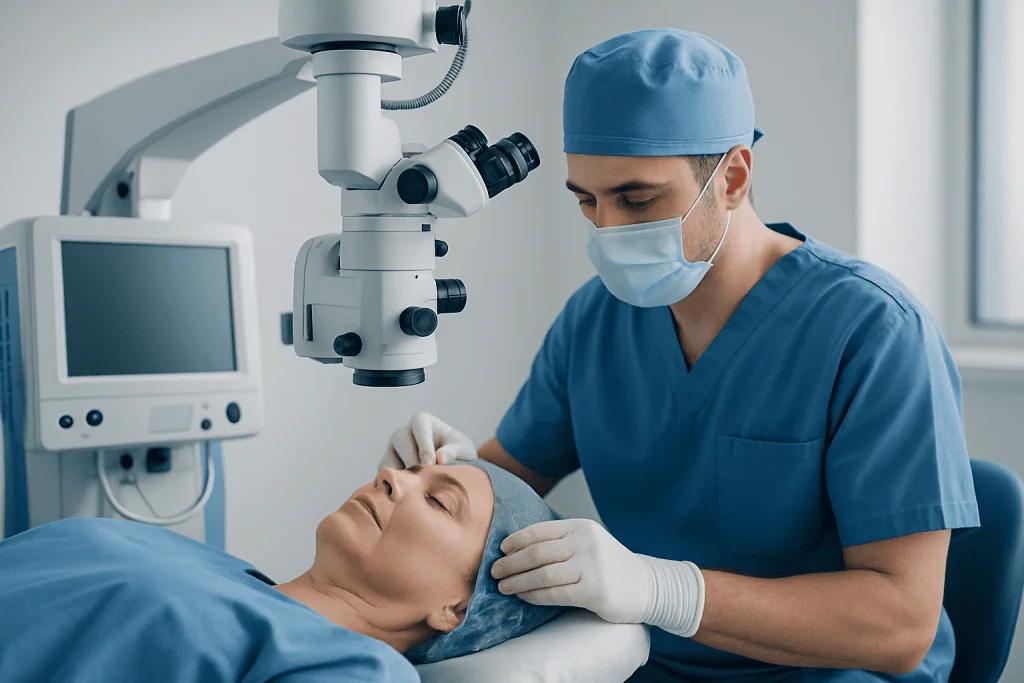
Blepharoplasty reshapes selected tissues around the eyelids. Depending on the person’s needs, the surgeon may remove a small amount of loose skin, reduce or reposition fatty tissue, and adjust supporting structures. The aim is not to remove as much tissue as possible; preserving appropriate support is important for eyelid comfort, closure, and a natural contour.
For upper eyelid surgery, the incision is commonly placed within the natural upper-lid crease, where the resulting scar generally becomes less noticeable over time. Lower eyelid surgery may use an incision just below the lashes or an incision inside the lower lid. The approach depends on whether skin tightening, fat repositioning, or treatment of under-eye bags is needed.
Blepharoplasty is distinct from brow lifting, ptosis repair, and procedures for facial skin laxity, although some people may benefit from a combined approach. A low brow can contribute to upper-lid heaviness, while ptosis involves a drooping eyelid margin rather than simply excess skin. Careful assessment helps identify which structure is responsible for the concern.
Who may be a candidate and what to expect at consultation

You may be a candidate if you are an adult bothered by loose upper-lid skin, a tired look caused by eyelid changes, or lower-lid bags and contour irregularities. Good candidates generally have stable overall health, realistic expectations, and an understanding that surgery improves selected features but does not stop normal aging.
At consultation, the clinician reviews medical history, medications, allergies, smoking or nicotine use, prior eye surgery, and any history of dry eyes, thyroid eye disease, glaucoma, bleeding problems, or difficulty closing the eyes. An eye and facial examination may include checking eyelid position, tear production, brow location, skin quality, and visual function. If upper-lid skin may be affecting vision, formal visual field testing may sometimes be considered.
People should discuss what they would like to change in clear, practical terms. For example, they may want less upper-lid hooding or a smoother transition between the lower eyelid and cheek. A responsible consultation also addresses what surgery cannot reliably change, such as dark circles caused mainly by pigmentation, fine wrinkles throughout the face, or marked facial asymmetry.
The procedure: what happens step by step
Blepharoplasty is usually performed as an outpatient procedure. The surgical plan, incision placement, and type of anesthesia are tailored to the extent of surgery, the person’s health, and the clinician’s recommendation. The area is carefully marked before the procedure, often while the person is sitting upright, because eyelid tissues can look different when lying down.
During upper-lid surgery, the surgeon makes a planned incision in the crease and addresses excess skin and, when appropriate, underlying fat or muscle. During lower-lid surgery, the surgeon may access fat through an external or internal incision and may reposition rather than remove fat to avoid a hollowed appearance. Incisions are then closed with fine sutures or another suitable method.
After surgery, the patient is monitored briefly and normally goes home with written aftercare instructions. Vision may be temporarily blurred by ointment, tears, or swelling, so arranging a responsible adult to accompany the patient home is important. Follow-up appointments allow the clinical team to assess healing and remove sutures if needed.
Recovery timeline and the gradual ‘after’ result
Immediately after surgery, swelling, bruising, tightness, watering eyes, temporary sensitivity to light, and mild discomfort are common. Cool compresses, head elevation, rest, and prescribed or recommended medicines can support comfort. Patients should follow their surgeon’s instructions closely, particularly regarding eye drops or ointment, wound care, contact lenses, exercise, and makeup.
During the first one to two weeks, bruising and swelling typically improve substantially, although the pace differs from person to person. Many people feel ready for routine social activities during this period, sometimes using makeup once their clinician confirms it is appropriate. Strenuous activity, heavy lifting, swimming, and activities that increase eye irritation may need to be avoided for a period advised by the surgical team.
Over the following weeks and months, residual swelling continues to settle and scars mature. The eyelids may look uneven at first because each side can heal at a different rate. So try not to judge the final look too early. Protecting healing scars from sun exposure and attending follow-up care can help support recovery.
Benefits, limitations, and possible risks
Potential benefits of blepharoplasty include a more open upper eyelid, reduced lower-lid puffiness, improved contour, and, in selected cases, better peripheral vision when excess upper-lid skin obstructs it. Results can be long-lasting, particularly for upper eyelids, but facial aging continues and future changes in skin, brows, and cheeks are expected.
Every operation involves risks. Possible complications include bleeding, infection, prolonged swelling, scarring, asymmetry, temporary dry-eye symptoms, changes in eyelid position, difficulty closing the eyes, blurred vision, or an unsatisfactory cosmetic outcome. Serious vision-related complications are uncommon but require urgent assessment. Choosing an appropriately qualified surgeon and following aftercare guidance can help reduce risk, though no procedure is risk-free.
Aim for improvement, not perfection. Human faces naturally have small differences between sides, and surgery may not fully correct asymmetry, pigmentation-related dark circles, crow’s feet, or changes caused by cheek descent. A clinician can explain whether additional nonsurgical or surgical options may be relevant to an individual concern.
When to seek medical care
Following eyelid surgery, patients should contact their surgical team promptly for increasing rather than improving pain, marked swelling on one side, persistent bleeding, fever, wound discharge, worsening redness, or concerns about healing. New or worsening vision changes should always be taken seriously.
Urgent medical assessment is needed for sudden loss of vision, severe eye pain, rapidly increasing swelling, shortness of breath, chest pain, or symptoms of a severe allergic reaction. These symptoms are not expected parts of routine recovery and should not be managed by waiting at home.
Before considering surgery, people with unexplained drooping of one eyelid, double vision, new changes in vision, eye pain, or a sudden change in eyelid appearance should seek medical evaluation rather than assuming the issue is cosmetic. At Acibadem International, our specialists work together across our JCI-accredited hospitals to assess and treat eyelid concerns for patients from abroad, building each care plan around your own eye and facial examination.
Frequently asked questions
How long does it take to see final blepharoplasty results?
Initial improvement is often visible as bruising and swelling settle during the first few weeks. However, subtle swelling and scar maturation can continue for several months, so the final result should be assessed gradually rather than in the first days after surgery.
Will blepharoplasty make the eyes look different?
The aim of well-planned blepharoplasty is usually to preserve the person’s natural eye shape while reducing excess tissue or puffiness. The visible change depends on the starting anatomy and the surgical plan, and an experienced clinician discusses the expected degree of change before surgery.
Can eyelid surgery remove dark circles?
Blepharoplasty may improve shadows caused by lower-lid bags or changes in fat contour. It may not correct dark circles caused mainly by skin pigmentation, thin skin, prominent blood vessels, or hollowing in the cheek area.
Is upper eyelid surgery the same as ptosis surgery?
No. Upper blepharoplasty removes or reshapes excess eyelid tissue, whereas ptosis surgery corrects a drooping eyelid margin caused by weakness or stretching of the eyelid-lifting mechanism. Some people need one procedure, while others may benefit from a combined plan.
What should patients avoid during blepharoplasty recovery?
Patients are commonly advised to avoid rubbing the eyes, strenuous exercise, heavy lifting, smoking or nicotine exposure, and activities that may introduce dirt or irritation while incisions heal. Exact restrictions vary, so the operating clinician’s aftercare instructions should take priority.
Are blepharoplasty results permanent?
Tissue removed or repositioned during surgery does not simply return, so the improvement can be long-lasting. Nevertheless, the skin, brows, cheeks, and eyelids continue to age naturally, and future laxity or volume changes may occur.
This article is for general information only and is not a substitute for professional medical advice. Please consult a qualified doctor about your individual situation.
Explore treatments in Turkey — costs, top hospitals & a free quote
7 JCI-accredited hospitals · board-certified surgeons · reply within 24h
Add us as a Preferred Source to see more of our trusted health content across Google Search, AI Overviews and Discover.

Medically reviewed by the Acıbadem International Medical Board — August 24, 2026
See our medical review board →
Update history
- PublishedAugust 21, 2026
- Medical review approvedAugust 24, 2026
- Last content updateAugust 24, 2026
References2
- Eyelid surgery – NHS — nhs.uk
- Eyelid lift – MedlinePlus — medlineplus.gov
Aesthetic Plastic & Reconstructive Surgery Specialists at Acibadem

Dr. Uğur Öner
Aesthetic Plastic & Reconstructive Surgery
Dr. Umut Özbebit (m)
Aesthetic Plastic & Reconstructive Surgery
Dr. Abdullah Etöz
Aesthetic Plastic & Reconstructive Surgery
Assoc. Prof. Dr. Ahmet Küçükçelebi
Aesthetic Plastic & Reconstructive Surgery
Dr. Ayşe İrem İskenderoğlu
Aesthetic Plastic & Reconstructive SurgeryRelated Treatments
Related Conditions
More from the Health Library

Liposuction Removes Localized Fat, Not Excess Weight

How Surgeons Rebuild the Outer Ear After Injury or Microtia

Eye Bag Treatment Ranges From Self-Care to Eyelid Surgery

Best Hair Transplant in Turkey Price: What Patients Really Pay

What Breast Reduction Surgery Involves and How Recovery Goes