Astigmatism Treatment
Astigmatism is a common refractive error causing blurred or distorted vision. Treatment may include prescription glasses, contact lenses, or laser eye surgery after a detailed eye examination.
Quick answer
Astigmatism is a common refractive error in which an unevenly curved cornea or lens causes blurred or distorted vision at different distances. At Acibadem in Turkey, treatment begins with a detailed eye examination and may include prescription glasses, contact lenses, or laser eye surgery depending on the eye structure and visual needs.
What Is Astigmatism?
Astigmatism is a refractive error: the eye does not bend incoming light evenly, so an image never lands as a single sharp point on the retina. Instead of one focal point there are two or more, and vision looks blurred, stretched, shadowed or doubled, at distance, up close, or both. Astigmatism is not a disease, and it is not an eye that is failing. It is a description of shape, and shape can be measured and, in most eyes, corrected well.
In an eye without astigmatism, the cornea, the clear front window of the eye, is curved almost equally in every direction, like the surface of a basketball. In an eye with astigmatism, the cornea is steeper in one direction than another, more like the side of a rugby ball or an American football. Light passing through the steep direction comes to focus in a different place from light passing through the flat direction. The retina receives a smeared image rather than a crisp one, and no amount of blinking, squinting or effort brings it fully into focus. Less commonly, the natural lens inside the eye contributes the uneven curvature instead of, or in addition to, the cornea.
You will see astigmatism written into a spectacle prescription as three values: sphere, cylinder and axis. The sphere records nearsightedness or farsightedness. The cylinder records how much astigmatism there is. The axis records the direction it sits in, measured in degrees. Two people can carry the same cylinder at a different axis and need entirely different lenses, one reason ready-made reading glasses rarely satisfy anyone with meaningful astigmatism, and one reason a careful refraction matters more than the numbers on an old prescription.
Is “stigmatism” the same thing?
“Stigmatism” is an everyday mishearing of astigmatism; there is no separate eye condition by that name. If an optician told you that you have “a stigmatism”, they meant astigmatism: an uneven curvature of the cornea or lens. The mispronunciation is harmless in itself, but it sometimes sends people searching for a condition that does not exist while missing reliable information about the one that does.
What is astigmatism of the eye, cornea or lens?
Astigmatism of the eye takes two anatomical forms. Corneal astigmatism, by far the more common, arises from uneven curvature of the cornea itself. Lenticular astigmatism arises from the natural lens inside the eye, which can be tilted, decentred or unevenly shaped, something that becomes more relevant as the lens changes with age or develops a cataract. Many eyes carry a little of both. The distinction matters for treatment: glasses and contact lenses correct the combined total, while surgical planning, particularly around cataract surgery, needs to know precisely where the astigmatism lives before deciding how to address it.
What Does Astigmatism Look Like?
Astigmatism looks like blur with a direction to it: letters that ghost or shadow to one side, edges that smear, thin lines that appear doubled or slightly tilted, and text that stays stubbornly soft however hard you squint. Many people describe their vision as “not quite sharp” rather than obviously poor, and some can still read a fair way down an eye chart. That is part of what makes astigmatism easy to live with unknowingly: the brain compensates, and you assume everyone sees the world this way.
The pattern differs from simple nearsightedness. Myopia blurs distant objects fairly evenly; astigmatism smears the image along a particular orientation, so the numerals on a clock face may look sharper along one axis than another, or vertical strokes of letters may read more clearly than horizontal ones. Reading tends to feel effortful rather than impossible. Concentration-heavy tasks, long documents, spreadsheets, driving in unfamiliar places, often produce headaches or aching around the eyes because the visual system is quietly working overtime to sharpen an image that cannot be sharpened by effort alone.
Astigmatism lights: why headlights streak and starburst at night
The streaks, starbursts and long smears that people describe as astigmatism lights are what happens when a small, bright point source, a headlight, a streetlamp, a traffic signal, is spread out by an eye that focuses unevenly. In daylight the pupil is small, so light passes mainly through the central cornea and the distortion is partly masked. At night the pupil widens, light travels through more of the cornea’s periphery, and the uneven curvature stamps its signature on every bright point in view. Lights stretch into lines or fans oriented along the axis of the astigmatism, oncoming traffic can look doubled or haloed, and wet roads at night become genuinely tiring to drive.
Be careful about self-diagnosis here. Not every night-vision symptom is astigmatism. Dry eye, early cataract, naturally large pupils and even scratched or smeared spectacle lenses can all produce glare, halos and streaking around lights. An examination distinguishes between these causes, and the distinction matters: correcting astigmatism will not fix glare that is coming from a drying tear film or a clouding lens.
What Causes Astigmatism?
Astigmatism is caused by the physical shape of the cornea or the lens, not by anything you did to your eyes. For most people it is simply the shape they were born with or developed during childhood, in the same way that facial features vary from person to person. Small amounts of astigmatism are extremely common and often need no correction at all; larger amounts produce the blur, distortion and strain described above.
What is the main cause of astigmatism?
The main cause of astigmatism is an inherited corneal shape: the cornea grows with slightly different curvatures in different directions, and this tendency often runs in families. It is usually present from birth or early childhood, may change gradually as the eye grows, and frequently coexists with myopia or hyperopia. It is worth stating plainly what does not cause it: reading in dim light, sitting close to a television, using screens, or wearing glasses does not create astigmatism, and refusing to wear glasses does not make it go away. These are persistent myths that lead to guilt in parents and delay in treatment.
Beyond inherited shape, several conditions and events can produce or change astigmatism. Keratoconus, a condition in which the cornea gradually thins and steepens into a cone-like shape, is a significant cause of high and irregular astigmatism, particularly in younger patients. Corneal scarring after injury or infection can distort the surface. Previous eye surgery, including corneal transplantation and, occasionally, cataract surgery, can alter corneal curvature. Even an eyelid lesion such as a chalazion pressing on the cornea can induce a temporary astigmatic shift. This is why a new or rapidly changing astigmatism deserves a proper examination rather than just a stronger pair of glasses: the prescription is sometimes a messenger carrying news about the cornea itself.
Astigmatism can also change slowly across life. The cornea and lens both evolve with age, and a prescription that was accurate a decade ago may no longer describe your eyes. Gradual drift is normal; sudden change is a reason to look more closely.
Types of Astigmatism and Related Conditions
Regular astigmatism and astigmatism that is irregular behave very differently, and this single distinction drives most of the treatment plan. Getting it right at the diagnostic stage is what separates a straightforward correction from a misdirected one.
Regular astigmatism means the two principal focusing directions of the eye sit at right angles to each other in a predictable pattern. It is by far the more common form, it usually measures cleanly, and it can generally be corrected with glasses, toric contact lenses or, in suitable adults, laser vision correction. Regular astigmatism may occur alone or combined with other refractive errors.
Myopic astigmatism combines nearsightedness and astigmatism. Distant objects blur most, but the astigmatic smear affects near vision too, so nothing looks entirely clean. Hyperopic astigmatism combines farsightedness and astigmatism; reading and computer work tend to produce the most strain, although distance vision is often affected as well. Mixed astigmatism means one focusing direction of the eye is nearsighted while the other is farsighted: a configuration that typically blurs vision at multiple distances and can be the most confusing to live with, because no single working distance feels comfortable.
Irregular astigmatism is the more complex form. The corneal surface is not smoothly curved in any predictable pattern, most often because of keratoconus, corneal scarring, previous infection, trauma, prior surgery or corneal degenerations. Glasses cannot fully correct irregular astigmatism, because a spectacle lens can only compensate for a regular pattern; it cannot smooth an uneven surface. Rigid gas-permeable or specialty contact lenses often perform better here, because the lens itself creates a new, smooth refractive surface over the irregular cornea, with the tear film filling the gaps. Depending on the underlying diagnosis, corneal procedures may also be discussed, sometimes to stabilise the cornea, sometimes to improve its shape.
Cataract-related astigmatism becomes relevant when the natural lens clouds with age. If you need cataract surgery and also carry corneal astigmatism, both can be addressed within the same surgical plan, through the choice of an astigmatism-correcting intraocular lens, the placement of incisions, or additional corrective steps, depending on measurements and your visual goals.
Paediatric astigmatism deserves its own mention. Children with significant astigmatism need timely assessment, because sustained blur during the years of visual development can contribute to amblyopia, often called lazy eye, in which the brain never learns to process a sharp image from one or both eyes. Glasses, and sometimes patching or other paediatric eye care, may be needed to protect visual development while there is still time to shape it.
Symptoms: Who May Need Astigmatism Treatment
You may need astigmatism treatment when symptoms start to interfere with comfort, clarity or daily function, or when an examination finds significant astigmatism you had not noticed. Both routes into treatment are common. Some people are diagnosed at a routine eye test before they realise anything is wrong; others arrive because reading, driving or screen work has quietly become harder than it should be.
Typical symptoms include blurred vision at distance or near, distortion, ghosting or shadowing around letters, difficulty with small print, headaches after concentration, eye fatigue, habitual squinting, and poor night vision with glare, halos or streaks around headlights and streetlamps. The pattern is often gradual enough that you adapt around it, holding text at a particular angle, avoiding night driving, blaming tiredness, until an examination reveals how much effort your visual system has been spending.
Children rarely complain, because they have no comparison; they assume their vision is normal. Instead they show behaviour: sitting close to screens, avoiding reading, rubbing their eyes, complaining of headaches, or slipping in school performance. Screening and formal eye examinations catch what children cannot report, and they matter most in the years when the visual system is still developing.
Adults come to treatment along several recognisable paths. A young adult wants freedom from glasses for sport or professional reasons. A student struggles with screen-based learning and afternoon headaches. A driver no longer feels confident at night because lights smear and double. A patient facing cataract surgery wants pre-existing astigmatism corrected in the same plan. Someone with irregular astigmatism has tried standard soft lenses and still sees a fluctuating, distorted world. Each of these situations calls for a different depth of evaluation and a different plan, which is precisely why astigmatism treatment is not one procedure applied to everyone.
Anyone with previous eye surgery or trauma also belongs on this list, because the corneal shape may no longer be regular. Correction in these eyes can be more complex, sometimes involving specialty lenses, advanced imaging or staged treatment. The objective is broader than improving a line on an eye chart: it is stable, comfortable, usable vision through a working day.
What should you avoid with astigmatism?
Honestly, there is little you must avoid: astigmatism is a focusing problem, not a fragile eye, and no food, screen or reading habit will worsen it. The exceptions are practical. Avoid habitual, vigorous eye rubbing, particularly if keratoconus has been mentioned or runs in your family, because rubbing is associated with corneal weakening in susceptible eyes. Avoid living with an outdated or inaccurate prescription, which trades avoidable strain for no benefit. Avoid poor contact lens hygiene, over-wearing lenses, sleeping in lenses not designed for it, or stretching replacement schedules, because the infection risk falls on the same cornea you are trying to keep healthy. And avoid skipping examinations when your vision changes, since a shifting prescription is occasionally the first sign of something that deserves monitoring.
How Astigmatism Is Diagnosed
Astigmatism is diagnosed through a comprehensive eye examination, not a quick automated reading, but a structured assessment of how your eye focuses and why. The clinician measures visual acuity, performs a refraction to determine the sphere, cylinder and axis your eyes actually need, and examines the health of the structures behind the numbers. Automated measurements are a useful starting point; the refined prescription comes from careful refraction, because instruments estimate and people confirm.
Corneal topography and tomography deserve particular emphasis. These imaging tests build detailed maps of the corneal surface and structure: its shape, symmetry and thickness point by point. They answer the questions a prescription alone cannot: Is the astigmatism regular or irregular? Is the cornea thick and stable enough to consider laser correction? Are there early signs of keratoconus, old injury, subtle scarring or another condition that changes the plan? It is entirely possible to walk in expecting laser surgery and walk out with a recommendation for specialty lenses and corneal monitoring instead, and that outcome, though disappointing, is the examination doing its job.
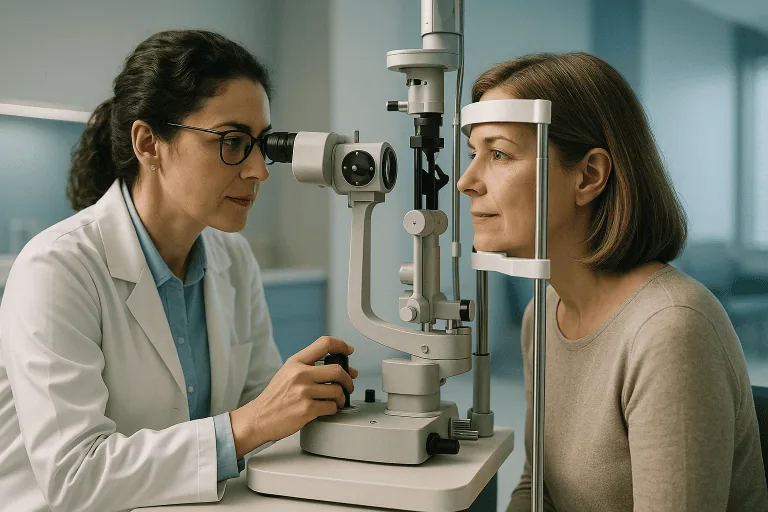
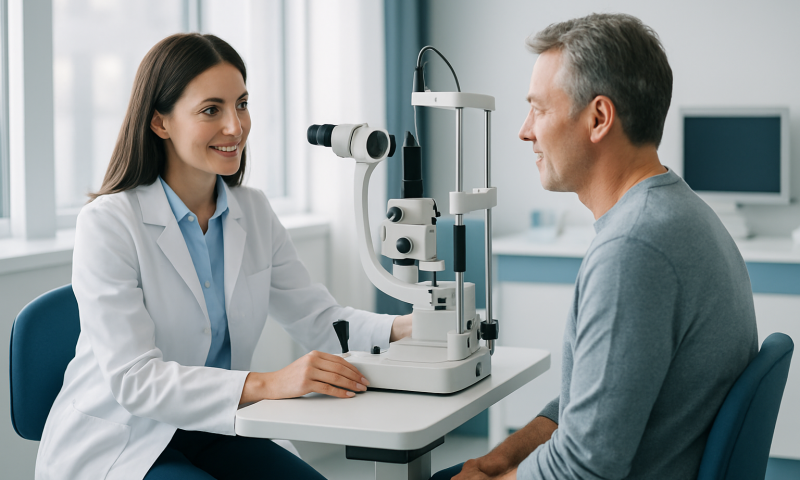
The examination may also include slit-lamp evaluation of the front of the eye, intraocular pressure measurement, tear film assessment for dry eye, pupil measurements and retinal examination where indicated. Each element either supports a treatment option or rules one out, and together they turn “blurred vision” into a specific, named problem with a specific answer.
One practical detail: if you wear contact lenses, you may be asked to leave them out for a period before measurements, because lenses temporarily mould the corneal surface and can distort the maps. The exact interval depends on the lens type and your individual findings, and your examining clinician will set it. Building this pause into your schedule prevents wasted visits and unreliable measurements.
How Do You Fix Astigmatism?
You fix astigmatism by redirecting light so it focuses evenly on the retina, externally with glasses, on the eye’s surface with contact lenses, or surgically by reshaping the cornea or correcting at the level of the lens. Which route suits you depends on the type and degree of astigmatism, whether it is regular or irregular, whether it travels with myopia, hyperopia or presbyopia, the health of your cornea and tear film, your age, and what you actually want your vision to do, read without glasses, drive at night, work at screens, play sport. There is no single best treatment; there is a best treatment for a particular pair of eyes.
Prescription glasses
Prescription glasses are the simplest and lowest-risk option, and for many people they are also the complete answer. The lens carries a cylindrical power set at your measured axis, cancelling the eye’s uneven focus. Glasses suit children, mild to moderate regular astigmatism, anyone who prefers non-invasive care, and anyone whose prescription is still changing. Expect a short adjustment period with a first astigmatism prescription or a significant change: floors and stairs can look subtly tilted for a few days as your brain adapts to the new optics. Consistent wear is what settles it, swapping back to old glasses prolongs the adaptation.
Toric contact lenses
Toric contact lenses correct astigmatism from the surface of the eye and offer a wider field of view than spectacles, which appeals to people who are active, play sport or simply prefer life without frames. A toric soft lens is engineered to hold a stable orientation on the eye so its correction stays aligned with your axis; the fitting therefore involves more than choosing a power. The clinician checks lens movement, rotation, comfort, tear exchange and vision stability, and teaches safe insertion, removal, cleaning and replacement. If standard soft torics cannot deliver stable vision, common with higher or irregular astigmatism, rigid gas-permeable or specialty lenses are the next step. They demand more fitting visits but can transform vision over an irregular cornea by creating a smooth optical surface where the eye lacks one.
Laser vision correction
Laser vision correction reshapes the cornea itself so that incoming light focuses evenly: a durable correction rather than a worn one, available to adults with stable prescriptions and healthy corneas. Eligibility is established through the full diagnostic workup: corneal thickness, corneal mapping, tear film evaluation, pupil measurements and retinal examination. This bears repeating, because it is where honest clinics differ from salesrooms: not every person with astigmatism is a candidate for laser surgery, and a responsible evaluation is as much about identifying who should not have surgery as who can benefit. Thin corneas, suspicious topography, unstable prescriptions and untreated ocular surface disease are all legitimate reasons to choose another path.
Can LASIK fix astigmatism?
Yes: LASIK and related laser procedures can correct regular astigmatism in suitable adult eyes, usually alongside any accompanying nearsightedness or farsightedness in the same treatment. The laser removes microscopic amounts of tissue in a pattern calculated from your corneal map, flattening the steep meridian relative to the flat one so the cornea focuses evenly. The important qualifiers are the ones already described: the astigmatism should be regular, the prescription stable, and the cornea thick and healthy enough to treat with margin to spare. Irregular astigmatism, keratoconus above all, is generally not treated with standard LASIK, because reshaping an already weakened cornea can make matters worse. That is exactly the situation corneal mapping exists to detect before anyone commits to surgery.
Astigmatism correction during cataract or lens surgery
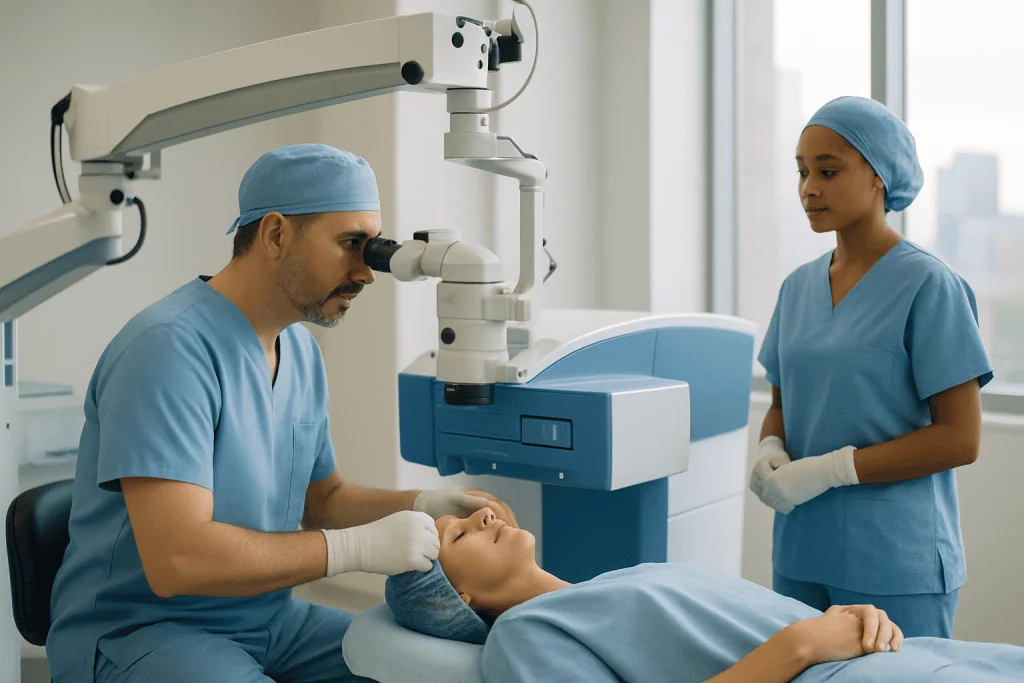
If you have cataracts and astigmatism, both can be addressed within one surgical plan. During cataract surgery the clouded natural lens is removed and replaced with an artificial intraocular lens; when corneal astigmatism is significant, the surgeon may propose an astigmatism-correcting (toric) intraocular lens, plan incision placement to reduce astigmatism, or combine approaches. Precise biometry, measuring the eye to calculate lens power and alignment, underpins the result, and careful alignment of a toric lens is essential to its function. Similar principles apply to refractive lens surgery considered for significant presbyopia or age-related lens change. These are planning-intensive decisions, made around your measurements and your visual priorities rather than off a menu.
How Astigmatism Treatment Is Performed, Step by Step
Whatever the eventual correction, the pathway follows a consistent sequence. Understanding it helps you plan realistically around appointments, measurements and recovery.
- Consultation. The physician reviews your symptoms, previous prescriptions, contact lens history, general health, medications, any eye surgery, family history of corneal disease, and what you want your vision to do. Lifestyle detail matters here: a night-shift driver and a jeweller need different things from the same prescription.
- Contact lens pause, if needed. Lens wearers may be asked to stop wearing lenses for a period before measurement, because lenses temporarily reshape the corneal surface. The interval depends on lens type and findings.
- Diagnostic testing. Refraction establishes the exact correction. Topography and tomography map the cornea’s shape, symmetry and thickness. Tear film testing identifies dry eye, which distorts measurements and affects post-treatment comfort. Pupil measurement and retinal examination follow where indicated, especially for surgical candidates.
- Treatment selection. The findings, not the request, determine the options: glasses, toric or specialty contact lenses, laser correction, or lens-based surgery, alone or staged.
- Treatment and follow-up. Each option carries its own delivery and review schedule, described below.
If glasses are chosen, delivery is straightforward: a prescription written with sphere, cylinder and axis, an adjustment period of days, and a review if vision does not settle. If contact lenses are chosen, fitting visits confirm that a toric lens sits stably at the correct orientation and that your handling and hygiene routine is sound; specialty lenses for irregular corneas take more visits and more precision.
For laser candidates, preparation confirms a stable prescription, a healthy cornea and realistic expectations, and addresses dryness beforehand where needed. On the day, numbing drops are used and the laser reshapes corneal tissue according to your individual refractive map and treatment plan. Different techniques exist: some create a thin corneal flap before reshaping, others treat the surface without a flap. Surface-based procedures typically involve a longer initial healing period; flap-based procedures often allow faster early visual recovery. Which is more appropriate for your eye depends on corneal thickness, surface health, occupation and the surgeon’s assessment, and the surgeon should be able to explain the reasoning, not just the recommendation. The laser portion itself is brief, but plan to spend considerably longer at the clinic for preparation, verification and initial recovery checks. Both eyes may be treated the same day in suitable cases, or treatment may be staged. Afterwards you use prescribed drops to reduce inflammation and infection risk and manage dryness, you avoid rubbing the eyes, and protective eyewear may be advised during sleep for the first period, depending on the procedure.
For cataract surgery with astigmatism correction, the sequence adds optical biometry and lens calculations before surgery. The cataract is removed, the chosen intraocular lens is implanted, and, where a toric lens is used, aligned precisely to your astigmatic axis. Recovery is progressive over days to weeks, supported by medicated drops and scheduled follow-up visits.
Technology runs through every stage: corneal imaging to detect irregularity, digital refraction systems to refine measurements, optical biometry for lens planning, and eye-tracking with treatment-planning software during laser delivery to keep the correction on target. None of it replaces clinical judgement. Its value is more reliable information feeding better-selected treatment, including, sometimes, the judgement that surgery is the wrong choice for a particular eye.
Why Acting Early Matters
Astigmatism rarely demands urgent treatment, but delaying evaluation carries two costs. The first is the obvious one: months or years of avoidable strain, headaches, tiring screen work and uncomfortable night driving, all in service of a problem that is usually straightforward to correct. The second is subtler: blurred or distorted vision is usually simple refractive error, but it can also be the presenting sign of keratoconus, cataract, corneal scarring, retinal disease or uncontrolled dry eye. A comprehensive examination is what separates these possibilities.
For children, timing matters most of all. Significant uncorrected astigmatism during the years of visual development can contribute to amblyopia, and the opportunity to support normal development narrows as those years pass. Do not wait for a child to complain; children assume their vision is normal because they have never seen anything else. Screening and routine examinations exist precisely because self-report fails in childhood.
For adults interested in laser surgery, earlier assessment has a practical advantage: the evaluation can surface dry eye, an unstable prescription or corneal findings that need treating or monitoring before any procedure could be considered. Discovering these early means addressing them on your own timetable rather than at the point of decision.
With irregular astigmatism, delay can be more consequential. Keratoconus, in particular, may progress over time, especially in younger patients, and early diagnosis allows the cornea to be monitored and stabilising treatment considered when indicated. Not all irregular astigmatism progresses, but identifying the cause shapes long-term vision planning in a way that a stronger pair of glasses never can.
Acting early does not mean choosing surgery early. Often it means nothing more dramatic than obtaining the right diagnosis, wearing the correct prescription, treating the ocular surface, or putting the cornea under observation. The safest care starts with understanding the eye completely before deciding how to correct the vision.
Benefits of Astigmatism Treatment
What treatment can honestly deliver depends on the correction method, the degree and type of astigmatism, and the overall health of the eye. The table below sets out the realistic gains.
| Benefit | What It Means for You |
|---|---|
| Sharper vision | Correcting the uneven focus can make letters, faces, road signs, screens, and fine details appear clearer at distance and near. |
| Less eye strain | When the eyes do not need to work as hard to compensate for blur, headaches, squinting, and fatigue may improve. |
| Better night vision comfort | Appropriate correction can reduce shadowing, glare, and streaking around lights, although some symptoms may also relate to dry eye, pupil size, or cataracts. |
| Improved daily function | Reading, computer work, driving, sports, and professional tasks may become easier and more comfortable with accurate correction. |
| More personalised visual options | Depending on eye health and goals, treatment may include glasses, contact lenses, laser correction, or astigmatism management during cataract surgery. |
| Early detection of related conditions | A detailed examination can identify corneal disease, cataract, dry eye, or retinal problems that may affect treatment planning and long-term vision. |
Recovery Timeline After Astigmatism Treatment
Recovery depends entirely on which correction you have. Glasses involve visual adaptation rather than medical recovery; contact lenses involve learning and hygiene; laser and lens surgery involve healing. The timeline below covers all four routes.
| Time Period | What You Can Expect |
|---|---|
| Day 1 | With glasses, vision may feel clearer immediately, though adaptation can be noticeable. With contact lenses, comfort and handling are assessed. After laser treatment, mild burning, watering, light sensitivity, or blurred vision may occur. After cataract surgery, the eye may feel scratchy and vision may be hazy at first. |
| First Week | Glasses adaptation usually improves. Contact lens wear becomes easier with practice and proper hygiene. Laser patients often notice functional improvement, although dryness and fluctuations are common. Cataract patients use prescribed drops and attend early follow-up visits. |
| First Month | Vision typically becomes more stable. Dry eye treatment may continue after laser correction. Contact lens prescriptions may be refined if vision rotates or fluctuates. Cataract-related correction continues to settle as the eye heals. |
| Longer Term | Regular eye examinations help monitor prescription stability, corneal health, ocular surface comfort, and age-related changes. Some patients may still need glasses for certain tasks, especially reading or night driving, depending on age and treatment type. |
Two honest caveats belong alongside any timeline. First, fluctuation during healing is normal after laser and lens surgery, vision that varies through the day, dryness, glare around lights and mild discomfort can all occur while the eye settles, and surface-based laser procedures generally take longer to reach comfortable functional vision than flap-based ones. Second, adaptation is individual: two people with identical prescriptions can settle at different speeds, and the brain’s adjustment to a new optical system is part of the recovery, not a sign that something has gone wrong.
Factors That Influence Outcomes
A good result depends on more than the size of the cylinder in your prescription. The single most important factor is diagnostic accuracy. When the cornea is healthy and the astigmatism regular, treatment is generally more predictable. When the astigmatism is irregular, fluctuating or driven by another condition, the plan may need to secure stability and eye health first and pursue sharper vision second: a sequencing decision that only a thorough examination can make.
Prescription stability matters especially for laser correction. If your prescription is still moving, surgery cannot deliver a durable result, however well it is performed. Younger patients, people with progressive myopia and those with certain corneal findings may need a period of monitoring before any surgical decision is sound. For cataract patients, the equivalent factor is measurement quality: accurate biometry and careful lens selection determine how much astigmatism the surgery can address.
Corneal thickness and shape sit at the centre of surgical planning. Laser treatment removes microscopic amounts of tissue to reshape the eye; if the cornea is too thin or its maps show suspicious patterns, laser correction may simply not be advisable, and glasses, contact lenses or alternative approaches become the responsible recommendation. Declining to operate on an unsuitable eye is not caution for its own sake: it is the main reason detailed testing exists.
Ocular surface health shapes both the measurements and the experience. Dry eye blurs the numbers before treatment and causes fluctuating vision afterwards. Dry eye, allergy, eyelid inflammation or contact lens intolerance may need treating before final measurements are trusted. A well-managed tear film improves comfort and makes every downstream decision more reliable.
Age and visual goals shape the plan too. A patient in their twenties with stable astigmatism faces different options from a patient in their fifties developing presbyopia or early cataract. Laser correction improves the eye’s focus, but it does not stop the natural, age-related loss of near focusing, some patients will still need reading glasses later, whatever was done earlier. Others may weigh strategies that balance distance and near vision, where suitability and tolerance allow. These trade-offs should be discussed before treatment, not discovered after it.
Expectations deserve the same honesty. Treatment usually improves clarity, but no correction makes every eye perfect in every lighting condition. Some people notice halos, dryness or night-vision symptoms during healing, particularly after surgery; some need a fine adjustment to glasses or lenses afterwards. A careful consultation covers the limitations of each option with the same weight as the benefits.
Finally, aftercare is a genuine outcome factor, not an afterthought. Contact lens wearers who follow hygiene and replacement schedules protect themselves against infection. Surgical patients who use their prescribed drops, attend follow-up visits and avoid activities that interfere with healing give the correction its best chance. None of this is difficult, but all of it matters.
How Astigmatism Care Is Organised at Acibadem
Astigmatism care at Acibadem is built around the principle that the diagnosis comes before the treatment, not the other way around. Ophthalmology teams evaluate the prescription, but also corneal structure, ocular surface health, lens clarity, retinal status and your stated visual priorities, because the best correction for a given pair of eyes cannot be chosen from the prescription alone.
Depending on findings, care may involve optometrists, ophthalmologists, cornea specialists, refractive surgeons, cataract surgeons or paediatric eye specialists. Complex cases are discussed across disciplines: a laser-correction candidate whose topography hints at early keratoconus is reviewed by a cornea specialist; a cataract patient with significant astigmatism gets detailed lens planning; a child with high astigmatism is assessed with visual development in mind. Evidence-based protocols guide the sequence, which is particularly relevant if you have received conflicting recommendations elsewhere or are weighing a second opinion before deciding on laser surgery.
The technology supports the judgement rather than replacing it: corneal imaging distinguishes regular astigmatism from irregular, refraction systems refine the prescription, biometry supports cataract and lens planning, and treatment-planning software with modern laser platforms applies a customised correction when surgery is appropriate. The emphasis throughout is on using the right information to reach the right decision, including the decision that a particular eye should not have surgery.
The resulting plans differ deliberately. Some patients are best served by well-made prescription glasses. Others benefit from toric or specialty contact lenses. Some are suitable candidates for laser correction; others are steered away from it for safety reasons; cataract patients may have astigmatism correction folded into their cataract plan. Whatever the route, the plan includes clear guidance on how many visits the pathway involves and which symptoms are normal during healing.
Preparing for an Eye Examination
Whether astigmatism is affecting your reading, your night driving, your screen work or simply your comfort, a detailed eye examination is the step that turns guesswork into a plan. You may need nothing more than an updated glasses prescription; you may be a candidate for toric lenses, laser correction or astigmatism management during cataract surgery. The answer comes from measurements and a physician’s assessment of your eye health, and from nowhere else.
A few things make any consultation, first opinion or second, more productive. Bring prior prescriptions, corneal scans, surgical records and details of any contact lenses you use, so findings can be compared across time and clinics. Write down what your vision actually stops you doing, because concrete goals shape better recommendations than “I want to see better”. And treat a previous “not suitable for laser surgery” verdict as information worth understanding rather than a door slammed shut: sometimes the reason is permanent and protective, sometimes it is a treatable finding such as dry eye or an unstable prescription, and a thorough evaluation will tell you which. Realistic expectations, honestly set before treatment, are the quiet foundation of every good result in astigmatism care.
Preparation
- A comprehensive eye examination measures corneal shape, refraction, and eye health to determine the best correction method. Contact lenses may need to be stopped for a period before laser evaluation. Patients should share previous eye prescriptions, medications, and any history of dry eye or eye surgery.
Aftercare
- After laser correction, prescribed eye drops should be used as directed and rubbing the eyes should be avoided. Mild dryness, glare, or fluctuating vision can occur temporarily. Follow-up visits are important to monitor healing and confirm visual improvement.
Frequently Asked Questions
What affects the cost of astigmatism treatment?
The final cost depends on the correction method, the complexity of the prescription, diagnostic testing, clinic or hospital standards, surgeon experience, and what is included in aftercare. Travel, accommodation, and translation support may also affect the overall budget for international patients.
How can I get a personalised quote?
A personalised quote usually requires recent eye test information or an in-person examination. You can request a free consultation so the ophthalmology team can review your needs, confirm suitability, and explain what is included in the care plan.
Is laser surgery always the most cost-effective option for astigmatism?
Not always. Glasses or contact lenses may be more appropriate for some patients, while laser surgery may suit others who meet medical criteria and want a longer-term correction option. A specialist should compare the clinical suitability, expected benefits, and total care requirements.
What is usually included in an international patient package?
Packages may include eye examinations, specialist consultation, treatment planning, the procedure if suitable, follow-up guidance, translation assistance, transfers, and coordination support. Inclusions vary, so it is important to request a written explanation before travelling.
Will insurance cover astigmatism treatment?
Coverage depends on the insurer, country, and whether the treatment is considered medically necessary or elective. Glasses and contact lenses may be handled differently from laser or lens-based procedures, so patients should check directly with their insurer.
Medically reviewed by the Acıbadem International Medical Board August 31, 2026
See our medical review board →
Update history
- PublishedJune 8, 2026
- Medical review approvedAugust 31, 2026
- Last content updateSeptember 8, 2026
References1
- Astigmatism nhs.uk
Trusted care for international patients
From the Acibadem Blog

Before Astigmatism Laser Treatment: Contact Lens Breaks and Repeat Corneal Measurements
Preparing for astigmatism laser surgery usually means stopping contact lenses for a set period before the consultation and the procedure, so the cornea returns…

Why Astigmatism Blurs and Stretches Vision at Every Distance and How Care Is Planned
Astigmatism blurs vision at every distance because the cornea or lens is curved more steeply in one direction than the other, so light focuses…
Can Laser Surgery Correct Astigmatism? Who Qualifies and Which Corneas Should Wait
Yes, laser surgery, including LASIK, can correct most regular astigmatism by reshaping the cornea so light focuses at a single point. Candidacy depends on a…