Porcelain Crowns
Porcelain crowns are custom ceramic caps placed over prepared teeth to restore strength, shape and appearance. They are commonly used for damaged, discolored, weakened or heavily filled teeth.
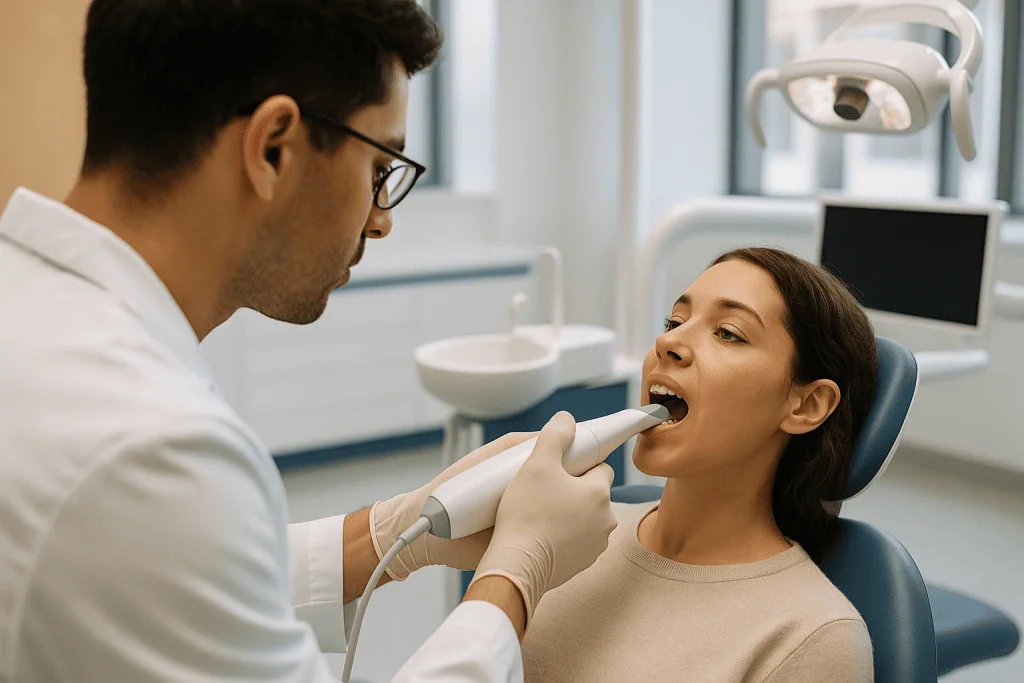
Quick answer
A porcelain crown is a custom-made ceramic dental crown that covers the whole visible part of a prepared tooth, restoring its shape, strength and appearance. Treatment typically takes two or more visits: the tooth is shaped under local anaesthesia, an impression or digital scan is taken, a temporary crown protects the tooth, and the final porcelain crown is fitted, adjusted and cemented or bonded in place.
Porcelain Crowns: When a Tooth Needs a Dental Crown
A porcelain crown is a custom-made ceramic restoration that covers the entire visible part of a prepared tooth, restoring its shape, strength, size and appearance. A dental crown of this kind is usually recommended when a tooth is too damaged, worn or heavily filled to be repaired reliably with a standard filling, or when its colour and shape need a more complete change than whitening or bonding can achieve. It protects the remaining tooth structure, restores comfortable chewing and blends with the surrounding teeth.
People usually begin researching porcelain crowns after something specific happens: a tooth fractures, a large filling fails, a root canal-treated tooth needs protection, or a front tooth darkens and no longer matches its neighbours. Others are weighing up a broader cosmetic change and comparing crowns against veneers or orthodontics. A growing number are also researching porcelain crowns in Turkey, where dental treatment is often combined with travel: a decision that deserves the same careful planning as the dentistry itself.
It is sensible to be cautious. A dental crown is not simply a cap glued over a problem. It is a precision restoration that must fit the prepared tooth exactly, meet the opposing teeth correctly, sit cleanly at the gumline and hold up to years of chewing. A well-planned crown can preserve a tooth that would otherwise continue to weaken. A poorly planned one can trap plaque, irritate the gum, overload the bite or hide decay that continues underneath. The difference lies in diagnosis, preparation, laboratory quality and honest case selection, not in the material alone.
This page explains what porcelain crowns are, who genuinely needs them, how treatment is performed step by step, what recovery involves, what determines how long a crown lasts, what drives the cost, and what international patients should think about before travelling to Turkey for this treatment. At Acibadem, planning for a dental crown focuses on accurate diagnosis, conservative preparation where clinically possible, precise laboratory work and a personalised approach to each patient’s dental structure, facial features, expectations and travel schedule.
What Are Porcelain Crowns?
Porcelain crowns are tooth-coloured ceramic restorations designed to cover a prepared tooth completely, from the chewing surface down to the gumline. The word “porcelain” is used broadly in everyday language to describe any ceramic crown. In practice, several different dental ceramics sit under that umbrella, and the right one depends on where the tooth is, how much force it takes and how visible it is when you smile.
What is a dental crown?
What is a dental crown, in plain terms? It is a full-coverage restoration that surrounds and protects the part of the tooth above the gum. The dentist shapes the tooth to create room for the crown, records its exact form with a digital scan or conventional impression, and has the restoration made to fit that preparation precisely. The finished crown is then cemented or bonded onto the tooth. Once in place, it takes over the tooth’s role in chewing: biting forces pass through the crown and are distributed across the remaining tooth structure rather than concentrating on weakened walls. A well-made crown should feel stable, allow comfortable chewing and be difficult to distinguish from a natural tooth.
Is a porcelain crown the same as a ceramic teeth cap?
A ceramic teeth cap is an informal name for the same restoration, patients often say “cap” where dentists say “crown”, and the two words describe one thing. The older term “cap” dates from a time when crowns were mostly metal or metal covered with porcelain. Modern ceramic crowns can be made entirely from tooth-coloured material, which avoids the grey line that sometimes appeared at the gumline of older metal-based crowns as gums receded. Whichever word you use, the clinical questions are identical: does the tooth need full coverage, is enough healthy structure left to support it, and which material suits the position and the bite?
Crown or veneer, which is right?
A crown covers the whole tooth; a veneer covers mainly the front surface. Veneers are usually chosen for cosmetic enhancement when the underlying tooth is structurally healthy, minor discolouration, small gaps, slightly irregular shapes. Crowns are chosen when there is significant damage: large or failing fillings, cracks, heavy wear, deep discolouration, or a tooth weakened by root canal treatment. Because a crown requires more of the natural tooth to be reshaped, it should not be used where a veneer, whitening or orthodontics could achieve the goal more conservatively. Equally, a veneer bonded to a structurally compromised tooth will not protect it. The honest answer depends on how much sound tooth structure remains and what the bite demands of it, which is why this decision follows examination, not preference alone.
Crown, dental bridge or implant?
These three restorations solve different problems. A crown restores a damaged tooth that is still present and restorable. A dental bridge replaces a missing tooth by anchoring an artificial tooth to crowns on the neighbouring teeth. A dental implant replaces a missing tooth with a titanium post in the jawbone, which then carries its own crown. Porcelain crowns are used in all three situations, on natural teeth, as bridge anchors and on implants, but the planning differs considerably. An implant crown, for example, attaches to an abutment rather than covering a prepared tooth, and requires specific attention to bite forces and gum contour.
Who May Need a Tooth Crown?
A tooth crown may be appropriate when one or more teeth are weakened, damaged, heavily restored or aesthetically compromised beyond what simpler treatment can fix. Some patients arrive with clear symptoms: pain on chewing, lingering sensitivity to hot or cold, a tooth that flexes or catches under pressure. Others feel nothing at all and only learn during a routine examination that a filling is leaking, a crack is spreading or the remaining tooth walls are too thin to survive another repair.
Common findings that lead to crown treatment include a tooth that breaks or chips repeatedly, a cusp that has sheared off, or a large existing restoration that has begun to fail. When a filling occupies most of a tooth, there is often too little healthy structure left for yet another filling. Teeth that have had root canal treatment tend to become more brittle over time, and back teeth in particular are commonly crowned after root canal therapy to reduce the risk of fracture. Crowns are also considered when teeth are severely discoloured, misshapen, worn down or noticeably out of proportion with the rest of the smile.
Diagnosis begins with a detailed dental examination. The dentist evaluates the tooth structure, gum health, bite relationship, previous dental work and overall oral hygiene. X-rays reveal what the eye cannot: the condition of the roots, the bone support, decay hidden under old fillings and any infection around the tooth. In selected cases, particularly when crowns are being planned alongside root canal treatment, implants or a larger rehabilitation, three-dimensional imaging may be used to understand the anatomy more fully.
For cosmetic cases, diagnosis extends to smile analysis: tooth colour, facial proportions, lip movement, gum display, tooth length and symmetry. Photographs, digital scans and mock-ups can show you the planned result before any tooth is prepared. This is especially useful for international patients who want clarity about the plan, the timeline and the expected appearance before committing to travel.
One point deserves emphasis: not every tooth that looks unattractive needs a crown. Whitening, bonding, orthodontic treatment, veneers or a smaller restoration may be more appropriate. A careful treatment plan starts with the least invasive option that can safely achieve the functional and aesthetic goal, and moves to a crown only when the tooth genuinely needs that level of coverage.
Conditions Dental Crowns Can Address
Dental crowns are used across restorative and cosmetic dentistry, and their purpose may be protective, aesthetic, functional or all three at once. The recommendation always comes back to three questions: how much tooth structure remains, how the tooth responds to chewing forces, and whether the restoration must also change the appearance of the smile.
Large or failing fillings. This is one of the most common indications. When a filling occupies much of the tooth, the remaining walls flex under load and eventually crack. A crown holds the tooth together and spreads biting forces across the whole restoration instead of concentrating them on thin enamel.
Root canal-treated teeth. After root canal therapy, a tooth loses internal structure and often becomes more fracture-prone, particularly molars and premolars that take heavy chewing loads. A crown reinforces what remains and protects the investment already made in saving the tooth.
Cracked teeth. Some cracks can be stabilised with a crown if the tooth is still restorable and the crack has not extended too deeply towards the root. Others need further treatment first, and some cracked teeth cannot be saved predictably at all. This is an area where honest diagnosis matters more than optimism: crowning an unrestorable crack postpones a problem rather than solving it.
Severe wear and erosion. Grinding, clenching, acid erosion and long-term bite imbalance can flatten and shorten teeth. Restoring worn teeth often involves more than a single crown: the dentist may need to assess the full bite, jaw function and wear pattern so that new restorations are not simply ground down or fractured by the same forces that damaged the natural teeth. A night guard is frequently recommended afterwards for patients who grind or clench.
Aesthetic concerns. Crowns can transform teeth that are deeply discoloured, irregularly shaped, rotated, short or poorly proportioned, and they are commonly used to replace old metal-based crowns with more natural-looking ceramic ones. They may also form part of a coordinated smile design across several teeth, where colour, length, contour and alignment are planned together.
Implant restoration. Porcelain crowns are also placed on dental implants. Here the crown does not cover a natural tooth; it attaches to an abutment connected to the implant in the jawbone, and requires its own careful planning of bite forces, gum contour and aesthetics.
Types of Porcelain and Ceramic Crown Materials
Porcelain and ceramic crown materials differ mainly in two properties that pull against each other: translucency, which creates a lifelike appearance, and strength, which resists chewing forces. No single material is best for every tooth, and the honest recommendation depends on where the crown will sit and what it must withstand.
- Layered porcelain over a substructure. In some crowns, aesthetic porcelain is layered over a stronger core. This approach combines strength underneath with fine surface characterisation on top, and remains useful in selected cases.
- Lithium disilicate ceramics. Often known by the brand name E-max, these glass ceramics are valued for their translucency and natural light behaviour, which makes them a frequent choice for visible front teeth. You can read more about this option on our E-Max crowns page.
- Zirconia-based ceramics. These are selected primarily for strength, particularly on molars where chewing forces are highest or in patients with heavy bites. Modern zirconia has become more aesthetic than early versions, though it is generally less translucent than glass ceramics.
- Full-contour monolithic crowns. Some crowns are milled from a single block of ceramic with no layering, which removes the risk of the surface layer chipping away from the core. This design is often favoured where durability is the priority.
Material selection should be individualised rather than standardised. A highly aesthetic ceramic on a molar that takes heavy grinding forces may chip; an ultra-strong opaque material on a front tooth may look flat next to natural enamel. Tooth position, functional load, the amount of remaining tooth structure, the colour of the underlying tooth and the patient’s aesthetic expectations all feed into the choice, which is why a dentist should be able to explain not just which material is recommended, but why.
How Porcelain Crown Treatment Is Performed
Porcelain crown treatment follows a defined sequence. A single crown is usually completed over two or more appointments; larger cases take longer. The steps below describe a typical pathway.
- Consultation and diagnosis. The dentist reviews your dental history, current symptoms, medical background, medications, allergies and previous dental work, then examines the teeth clinically and with X-rays. For international patients, this stage often begins remotely with photographs and records, followed by an in-person evaluation after arrival. A preliminary plan can be discussed beforehand, but the final plan is only confirmed after clinical examination, anything promised sight-unseen should be treated as provisional.
- Preparatory treatment. The tooth must be healthy enough to support a crown. Decay, infection, gum inflammation or a failing old restoration are addressed first. A tooth with deep decay or nerve involvement may need root canal treatment before the crown. Gum disease must be managed too, because healthy gums are essential for accurate impressions, stable crown margins and a natural-looking result.
- Shade selection and smile planning. For visible teeth, the dentist considers the colour of neighbouring teeth, skin tone, lip line and how bright the patient wants the result to be. The aim is a crown that looks right in daylight and conversation, not only under clinical lighting. When several crowns are planned, digital smile design, photographic analysis and temporary mock-ups can preview shape and proportion before anything irreversible is done.
- Tooth preparation. Local anaesthesia is typically used so the tooth can be shaped comfortably. The dentist removes decay and old filling material where necessary, then reduces a controlled amount of tooth structure to create space for the ceramic. How much is removed depends on the material chosen, the condition of the tooth and the aesthetic change required; conservative preparation is preferred whenever it is clinically suitable.
- Impression or digital scan. Many practices now use intraoral scanners, which build a precise three-dimensional image of the prepared tooth and its neighbours and can be more comfortable than conventional impression trays. Conventional impression materials are still used in some cases. Bite records are taken at the same stage so the crown can be shaped to meet the opposing teeth correctly.
- Temporary crown. A temporary restoration protects the prepared tooth while the final crown is made, supports the gum shape and lets you smile and chew carefully in the meantime. Temporaries are weaker than final crowns, so hard, sticky and very chewy foods should be avoided until the definitive restoration is fitted.
- Laboratory fabrication. The crown is designed and made, by a technician, a digital milling workflow or a combination of the two, to match the planned shape, shade and bite. Good ceramic work accounts for strength, thickness, translucency, surface texture and how light passes through the restoration. For front teeth, small details such as edge translucency, natural colour gradients and surface anatomy separate a convincing crown from an obviously artificial one.
- Fitting and cementation. At the placement appointment, the temporary is removed and the final crown is checked for fit, contact with neighbouring teeth, bite, shade and adaptation at the gumline. Minor adjustments are made before final cementation or bonding. Once the crown is secured, excess cement is cleaned away and the bite is checked again: you will be asked to bite together, slide your jaw side to side and report any high spots.
How long does the whole process take?
A single crown usually requires two visits over one to two weeks, while larger or more complex cases take longer. The timeline stretches when other treatment is needed first, root canal therapy, gum treatment, extractions, or when many crowns must be sequenced so that the bite is rebuilt in a stable order. Some digital workflows can shorten the laboratory stage in suitable cases, but speed should never be the deciding factor: a crown fitted onto an untreated problem fails regardless of how quickly it was made.
Does getting a porcelain crown hurt?
Tooth preparation is carried out under local anaesthesia, so the tooth is numbed while it is shaped. Afterwards, mild sensitivity or gum tenderness is common for a short period, especially if the gum tissue was adjusted, and it typically settles as the tooth and tissues calm down. If sensitivity persists, the bite feels high or pain develops on chewing, the crown should be reassessed: a small bite adjustment often resolves discomfort caused by uneven contact. Discomfort that appears weeks or months later is a separate matter and needs examination rather than patience.
Recovery After Porcelain Crowns
Recovery is usually manageable, though the exact experience depends on the number of crowns, the condition of the teeth underneath and whether additional procedures were performed at the same time.
| Time Period | What Patients Can Expect |
|---|---|
| Day 1 | Numbness from local anaesthesia wears off over several hours. Mild gum tenderness or tooth sensitivity may occur. Avoid chewing on the treated side until full sensation returns. |
| First Week | The tooth and gums begin to settle. Temporary crowns need extra care: avoid hard or sticky foods. A high bite or persistent discomfort should be reported for adjustment. |
| After Final Placement | The crown is checked for fit, shade and bite before being cemented or bonded. It may take a few days to become fully accustomed to the new shape and contacts. |
| First Month | Most patients return to normal eating and speaking. Careful cleaning around the crown margin protects the tooth and gum tissue. |
| Longer Term | Regular check-ups, professional cleanings, daily brushing and flossing, and bite protection when needed help maintain the crown and the surrounding teeth. |
How Long Do Porcelain Crowns Last?
Porcelain crowns can serve for many years, but there is no fixed expiry date, longevity depends far more on the foundation, the bite and daily care than on the ceramic itself. A crown on a well-prepared tooth with healthy gums, a balanced bite and good hygiene tends to outlast an identical crown placed over untreated gum disease, a heavy grinding habit or a marginal preparation. The material matters, but it is rarely the weakest link.
The most common reasons crowns eventually need replacement are decay developing at the margin where the crown meets the tooth, gum recession exposing the crown edge, fracture or chipping under heavy forces, and changes in the surrounding teeth that leave the crown mismatched in colour or contact. Most of these are influenced by things within your control: cleaning carefully along the gumline, attending regular check-ups so small problems are caught early, and wearing a night guard if you grind or clench.
How long should a porcelain crown last?
A properly made crown on a sound tooth should be a long-term restoration, not a short-term fix, and if a crown fails within a short time, something in the diagnosis, preparation, fit or bite usually explains it. Rather than asking for a number, it is more useful to ask a dentist three things: is the tooth underneath healthy enough to justify the crown, has the bite been assessed for grinding or overload, and how will the margin be kept clean? Strong answers to those questions do more for longevity than any material brochure.
How Much Does a Porcelain Crown Cost?
The cost of a porcelain crown varies widely because it reflects several independent factors, which is why responsible clinics quote after examination rather than from a price list alone. Understanding the drivers helps you compare quotes meaningfully:
- The material and fabrication method. Different ceramics and workflows carry different laboratory costs, and highly characterised front-tooth work involves more technician time than a standard molar crown.
- The condition of the tooth. A crown on a healthy prepared tooth is one procedure; a crown that first requires root canal treatment, a post and core build-up, or gum treatment is a larger course of care.
- The number of teeth. Multiple crowns planned together involve bite analysis, smile design and coordinated laboratory work, not simply single-crown work multiplied.
- Diagnostic and planning steps. Imaging, digital scanning, mock-ups and trial smiles add value and cost, particularly in aesthetic cases.
- What the quote includes. Examination, X-rays, temporaries, adjustments and follow-up visits may be bundled or itemised. The cheapest headline figure often excludes steps that a complete plan requires.
When comparing offers, at home or abroad, ask what happens if the examination reveals more work than the remote assessment suggested, whether preparatory treatment is included, and how adjustments after fitting are handled. A quote that answers those questions clearly is worth more than a lower one that does not.
Benefits of Porcelain Crowns
When planned and maintained appropriately, porcelain crowns offer functional and aesthetic advantages that simpler restorations cannot match in a compromised tooth.
| Benefit | What It Means for You |
|---|---|
| Restores weakened teeth | A crown can protect a tooth with large fillings, fractures or structural loss so it can function more comfortably during chewing. |
| Improves appearance | Porcelain can be shaped and shaded to blend with natural teeth, or to create a more balanced smile when several crowns are planned together. |
| Supports normal bite function | A well-designed crown restores proper contact with neighbouring and opposing teeth, improving chewing comfort and stability. |
| Protects root canal-treated teeth | Teeth that have had root canal therapy may be more vulnerable to fracture, and a crown helps reinforce the remaining structure. |
| Replaces failing older restorations | Old crowns or large fillings with leakage, discolouration or poor fit can be replaced with restorations designed for better adaptation and aesthetics. |
| Fits into a larger smile plan | Crowns can be combined with whitening, veneers, implants, orthodontics or gum treatment when a broader rehabilitation is needed. |
What Influences the Outcome of Porcelain Crown Treatment?
A successful crown depends on far more than the ceramic. The foundation comes first: the tooth must have enough healthy structure to support the restoration, and any decay, infection or gum disease must be treated before final placement. If a tooth is fractured deep below the gumline or lacks adequate support, honesty may point to a different plan, extraction and implant replacement, for instance, rather than a crown destined to fail.
The quality of diagnosis is central. X-rays, clinical examination, bite assessment and periodontal evaluation determine whether a crown is the right treatment at all. For front teeth, aesthetic planning carries equal weight: a natural-looking crown must match not only colour but translucency, shape, surface texture and the way it emerges from the gumline.
Bite forces shape long-term performance more than most patients expect. Grinding and clenching place high stress on ceramics. This does not necessarily rule out treatment, but it influences material selection, crown design and the case for a night guard. Where several teeth are worn or broken, the dentist may need to rebuild the bite in a planned sequence rather than crowning one tooth at a time, placing beautiful restorations into an unstable bite is a reliable way to break them.
Gum health affects both appearance and durability. Inflamed gums bleed during impressions and make it harder to capture the crown margin accurately. Recession can expose crown edges over time, particularly with aggressive brushing or untreated periodontal disease. Settling the gums before crown placement creates the conditions for a precise, attractive and stable result.
Your own habits matter too. Crowns are strong but not indestructible: chewing ice, biting fingernails, opening packages with the teeth and repeatedly attacking very hard foods damage restorations and natural teeth alike. Daily brushing, flossing around the crown margins and regular check-ups protect against decay at the crown edge: the most common quiet failure route.
Finally, communication shapes the result. Say clearly whether you want a subtle natural look or a noticeably brighter smile. Photographs of a smile you admire can help, but the plan must be adapted to your facial anatomy, gum position and dental health. A thoughtful dentist will tell you what is realistic, what is advisable and where a more conservative option would serve you better, and that honesty is itself a quality marker worth looking for.
Why Acting Early Matters
Delaying treatment for a damaged or weakened tooth allows the problem to progress on its own schedule, not yours. A crack deepens. Decay spreads under an old filling. A tooth that could have been restored with a crown eventually needs root canal treatment, or cannot be saved at all. Each stage of delay tends to make treatment more complex, less conservative and harder to plan.
Early evaluation is particularly worthwhile if you notice pain on biting, sensitivity that lingers after hot or cold, a broken cusp, swelling, a dark line around an old crown or a filling that feels loose. These signs can indicate structural damage, leakage, decay or nerve involvement, and identifying them before they become urgent preserves more treatment options.
Cosmetic concerns deserve timely assessment for a different reason. If discolouration, wear or uneven tooth shape stems from grinding, acid erosion or bite imbalance, covering the teeth without treating the cause simply transfers the destructive forces onto new porcelain. Early diagnosis lets the dentist work out why the teeth changed and design a plan that supports appearance and durability together.
For patients travelling from abroad, acting early has a practical dimension as well. Records can be reviewed in advance, the likely number of visits estimated, and any additional treatment identified before flights are booked. A tooth assessed while it is stable can be treated on a planned schedule; a tooth that fractures the week before travel forces decisions under pressure.
Porcelain Crowns in Turkey: Planning as an International Patient
Turkey has become a well-established destination for dental treatment, and porcelain crowns are among the procedures international patients most commonly plan there. Done well, treatment abroad follows the same clinical logic as treatment at home: the geography changes, the dentistry should not. What differs is the planning burden, which falls more heavily on the patient, and the importance of choosing a provider whose process you can verify rather than one whose marketing you must trust.
A typical care pathway for an international patient looks like this. Before travel, you share recent X-rays, photographs and a summary of your dental history for preliminary review, and receive a provisional plan with an estimated number of visits. After arrival, a full clinical examination confirms or revises that plan: this step is non-negotiable, because remote assessment cannot detect everything. Treatment then proceeds through preparation, temporaries and final fitting, with the schedule built around laboratory turnaround. Before departure, the bite is checked and adjusted, records of the treatment are provided for your local dentist, and aftercare instructions are explained. Long-term maintenance, check-ups, cleanings, any future adjustments, usually continues at home, which is why written documentation of materials and procedures matters.
Timing deserves realism. A single straightforward crown can often be completed within one stay. Multiple crowns, preparatory root canal or gum treatment, or implant-supported work may require staged visits with healing time between them. Be cautious of any plan that compresses biologically staged treatment into one short trip; the calendar should bend to the dentistry, not the reverse.
Are Turkey teeth a good idea?
“Turkey teeth” is a media shorthand for full sets of crowns placed quickly, often on young, healthy teeth that were aggressively cut down for purely cosmetic reasons, and in that specific sense, no, it is not a good idea. Cutting healthy teeth into pegs for crowns they never needed sacrifices irreplaceable tooth structure and commits the patient to a lifetime of maintenance and eventual replacement. But the phrase describes a practice, not a country. Well-indicated crowns, conservatively prepared, on teeth that genuinely need them, are legitimate dentistry wherever they are performed. The question to ask is not “is Turkey safe?” but “does each of my teeth actually need a crown, and would a veneer, whitening or no treatment at all serve some of them better?” A provider who answers that question tooth by tooth, and sometimes recommends less treatment, is showing you the standard you want.
How long do crowns from Turkey last?
Crowns made in Turkey last as long as crowns made anywhere else with the same quality of diagnosis, preparation, laboratory work and aftercare: the passport of the crown matters far less than the process behind it. What genuinely affects longevity for travelling patients is continuity: making sure the bite is properly adjusted before you fly home, keeping records so your local dentist knows what was placed, and maintaining check-ups afterwards. A crown that is never reviewed can fail quietly regardless of where it was made.
Is it a good idea to go to Turkey for dental implants?
Implant treatment in Turkey follows the same principle as crowns: the outcome depends on planning, surgical quality and follow-up rather than location, but implants add a biological timetable that travel plans must respect. Implants typically need healing time between placement and the final crown, which often means more than one trip or coordination with a dentist at home. If an extraction is involved, the sequence matters too: our guide on dental implants after tooth extraction explains the timing in detail.
How Acibadem Approaches Porcelain Crown Treatment
Dental treatment at Acibadem takes place within a broader hospital environment, under the Dental & Oral Health unit, where care can be coordinated with other specialties when a patient’s health picture requires it. For dental patients with diabetes, heart conditions, a cancer history, bleeding disorders or complex medication considerations, that setting allows medical consultation to be arranged alongside dental planning when appropriate: the treating doctors decide together how dental work fits into the wider clinical picture.
Porcelain crown treatment is planned individually. The dentist evaluates each tooth’s condition, the bite, gum health, aesthetic goals and the patient’s timeline. Where the case calls for it, planning draws in other specialists: endodontists for root canal concerns, periodontists for gum health, oral surgeons for extractions or implant placement, and orthodontic specialists when alignment affects the final restoration. This collaborative model is most valuable in complex restorative cases, full smile rehabilitation, or treatment combining natural teeth and implants, situations where treating teeth in isolation risks missing the problem that caused the damage.
Modern diagnostic tools support the process where the case warrants them: digital imaging, intraoral scanning, photographic records and computer-aided design help visualise tooth structure, plan crown contours, assess bite contacts and communicate precisely with the laboratory. For patients, these tools also make the plan easier to understand: you can see what is proposed before it happens.
For international patients, the practical side of care is structured around the pathway described above: preliminary review of records where available, confirmation of the plan after in-person examination, a clear explanation of the recommended approach, alternatives, timeline and limitations, and interpretation support so that aesthetic preferences and small details are not lost in translation. Follow-up guidance covers caring for temporaries, what to expect after final placement, cleaning around crown margins and the reasoning behind any night guard recommendation, with treatment records prepared so maintenance can continue with your local dentist after you return home.
Caring for a Porcelain Crown Day to Day
A crowned tooth still needs everything a natural tooth needs: the crown protects the structure above the gum, but the margin where crown meets tooth remains vulnerable to decay, and the gum around it remains vulnerable to inflammation. Daily care is straightforward but non-negotiable: brush twice daily with attention to the gumline, clean between the teeth with floss or interdental brushes around the crown margins, and keep up regular professional cleanings. Practical guidance on technique is covered on our dental hygiene page.
Beyond cleaning, protect the crown from forces it was not designed for. Avoid chewing ice and biting non-food objects, be sensible with very hard foods, and wear a night guard if one has been recommended for grinding or clenching: this single habit does more to protect ceramic restorations in bruxers than any material upgrade. At check-ups, the dentist reviews the crown’s margins, the bite contacts and the surrounding gum, catching small issues while they are still small. If you ever notice the crown feeling loose or high, a rough or chipped edge, bleeding around the margin, or new sensitivity in the tooth, have it examined promptly rather than waiting for the next routine visit.
Weighing Up Porcelain Crowns
Porcelain crowns are an effective way to restore teeth that are damaged, weakened, deeply discoloured or heavily filled, while improving the harmony of the smile, provided the crown is genuinely indicated and the case is properly planned. The best results rest on careful diagnosis, honest case selection, appropriate material choice, accurate preparation, healthy gums, a stable bite and clear communication about aesthetic goals. The weakest results come from the opposite: crowns placed quickly, on teeth that needed either more preparatory treatment or less intervention altogether.
An individual examination and diagnostic assessment determine whether a crown is the right treatment for a particular tooth, or whether a more conservative option would serve it better. For international patients, the same principle extends to planning: a preliminary review of records, a realistic visit schedule and a plan confirmed in person are what separate well-organised treatment abroad from a gamble. A dental crown done for the right reason, on the right tooth, with the right follow-up, is one of dentistry’s most dependable restorations, and understanding the process is the first step towards getting exactly that.
Preparation
- A dentist evaluates the tooth, gums and bite, often using dental X-rays or digital scans. Any decay or infection should be treated before crown placement. The tooth is reshaped, impressions are taken and a temporary crown may be fitted until the porcelain crown is ready.
Aftercare
- Mild sensitivity or gum tenderness can occur for a few days after placement. Patients should maintain careful brushing, flossing and regular dental check-ups, and avoid biting very hard objects with the crown. Contact the dentist if the bite feels uneven or the crown becomes loose.
Frequently Asked Questions
What affects the cost of porcelain crowns?
The final cost depends on the number of crowns, the tooth location, the selected ceramic material, the condition of the tooth and gums, any need for root canal treatment or build-up, laboratory work, imaging and follow-up requirements.
How can I get a personalised quote for porcelain crowns in Turkey?
A personalised quote usually requires a dental examination or review of recent dental images, photographs and medical history. Acibadem International can arrange a free consultation to help estimate the treatment plan and what may be included.
Are porcelain crown packages all-inclusive?
Package content varies by provider. A package may include consultation, imaging, tooth preparation, temporary crowns, final crowns and coordination support, but items such as additional dental treatments, travel or accommodation should always be confirmed in writing.
Can I choose the type of porcelain crown myself?
Your preferences are important, especially for appearance, but the final choice should be made with a dental specialist. Tooth strength, bite forces, gum health, smile line and the amount of remaining tooth structure all affect the safest option.
Will I need additional treatment before a crown?
Some patients need root canal treatment, gum care, replacement of old fillings or a core build-up before a crown can be placed. These steps can affect both the treatment schedule and the final quote.
Is travelling abroad for porcelain crowns suitable for everyone?
Not always. Suitability depends on oral health, general health, treatment complexity and the ability to attend planned appointments and aftercare. A specialist consultation is recommended before making travel decisions.
Medically reviewed by the Acıbadem International Medical Board September 13, 2026
See our medical review board →
Update history
- PublishedJune 8, 2026
- Medical review approvedSeptember 13, 2026
- Last content updateSeptember 12, 2026
References1
- Dental Crowns my.clevelandclinic.org
Trusted care for international patients
From the Acibadem Blog

Porcelain Crowns for People Who Grind Their Teeth: Night Guards, Materials and Bite Checks
People who grind their teeth can have porcelain crowns, but material choice, design and follow-up matter more than usual. Dentists often favor tougher ceramics…

When a Porcelain Crown Chips or Loosens: Repair, Recementing or Replacement Explained
A chipped porcelain crown can often be repaired without replacing it. Small rough edges are usually smoothed and polished, moderate chips can be bonded…