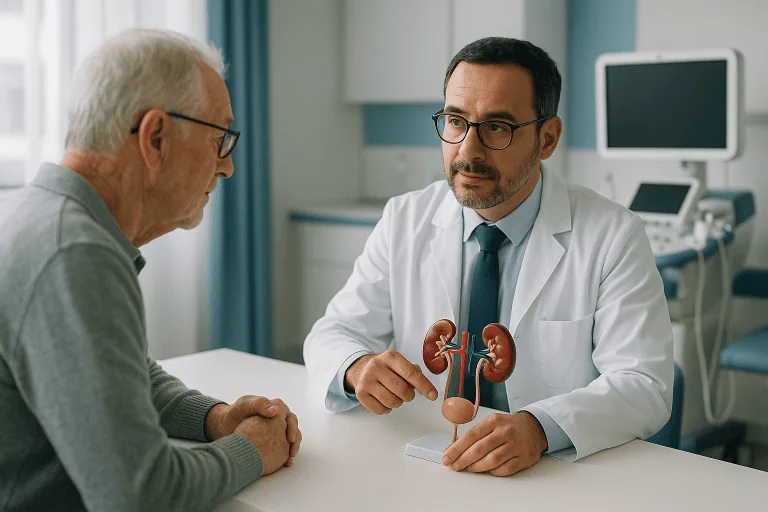
Urinary Biomarkers
Urinary biomarkers are noninvasive urine tests that measure specific molecules linked to urologic disease, helping assess cancer risk, support diagnosis, and monitor patients alongside imaging and specialist evaluation.

Quick answer
Urinary biomarkers are measurable substances in urine, proteins, genetic changes, abnormal cells or inflammatory signals, that indicate disease activity in the urinary tract. Testing involves providing a urine sample under specific collection instructions; the laboratory then analyses it for markers linked to bladder cancer, kidney injury or other urologic conditions. Results support risk assessment, diagnosis and surveillance alongside imaging, cystoscopy and specialist review.
What Are Urinary Biomarkers?
Urinary biomarkers are measurable substances in a urine sample, proteins, DNA changes, RNA expression patterns, abnormal cells, enzymes, inflammatory signals or metabolites: that reflect disease activity in the urinary tract. Physicians use them to estimate risk, support a diagnosis or monitor a condition that has already been treated. They are discussed most often in relation to bladder cancer and other urothelial cancers, but selected urinary biomarkers also contribute to kidney disease assessment, prostate evaluation and the investigation of persistent urinary symptoms.
If a urine-based test has been recommended for you, a mixture of relief and worry is normal. Relief, because providing a urine sample is familiar and involves no incision, no anaesthesia and no recovery time. Worry, because the reason for the test may be blood in the urine, an abnormal imaging result, a previous cancer diagnosis or ongoing surveillance after treatment. This page explains what urinary biomarkers can show, what they cannot show and how they fit into a complete diagnostic pathway.
One point matters more than any other. Urinary biomarkers do not replace a physician’s judgement, and they do not replace imaging, cystoscopy or biopsy when those are needed. They add information. Used in the right context, that additional information can guide the next step, reduce uncertainty and support more personalised decisions, for example, helping a urologist judge how urgently a patient with microscopic blood in the urine needs further evaluation, or how closely someone should be followed after bladder cancer treatment.
At Acibadem, a urinary biomarker result is never read in isolation. It is interpreted alongside your symptoms, medical history, physical examination, laboratory findings, imaging, endoscopic assessment where appropriate and specialist review. That caution is deliberate: urine biomarkers can be influenced by infection, inflammation, recent procedures, stones, bleeding and prior cancer treatment. A meaningful test is not a laboratory number on its own: it is a result interpreted by clinicians who can see the whole clinical picture.
Why are urinary biomarkers better than blood tests for some conditions?
For disease of the urinary tract itself, urine often carries information that blood cannot. Urine is in direct contact with the lining of the bladder, ureters and renal pelvis, so a tumour in that lining sheds cells and molecular fragments straight into the sample, signals a blood test may miss entirely. Urine collection is also non-invasive and easy to repeat, which suits long-term surveillance. That said, “better” always depends on the question being asked. Blood tests remain essential for measuring overall kidney function, detecting systemic illness and monitoring many cancers, and some conditions require both sources of evidence. Urine and blood are complementary, not competitors, and your physician will usually interpret them together rather than choose between them.
Which urinary hydration biomarkers are used?
Urine osmolality, urine specific gravity and urine colour are the biomarkers most commonly used to assess hydration status. All three describe how concentrated the urine is: dark, highly concentrated urine generally suggests the body is conserving water, while pale, dilute urine suggests adequate fluid intake. These hydration markers belong mainly to general medicine and sports science rather than cancer diagnostics, but they matter here for one practical reason, urine concentration can influence other test results, which is one reason collection instructions often specify a first-morning or midstream sample.
Types of Urinary Biomarker Tests
Urinary biomarker testing is a non-invasive diagnostic and monitoring approach that analyses a urine sample for substances associated with urologic disease. Those substances may be released by tumour cells, inflamed tissue, damaged kidney cells, immune activity or other biological processes. Depending on the test, the laboratory may examine a single signal or a panel of several. The main families are:
- Urine cytologya pathologist examines cells shed into the urine under a microscope, looking for the abnormal features of cancer. This is the longest-established urine test in bladder cancer care.
- Protein-based markersthe laboratory measures specific proteins linked to tumour activity, kidney injury or inflammation, including albumin and tubular injury proteins in kidney assessment.
- DNA-based markersmolecular techniques detect mutations or methylation changes in genetic material shed into the urine, patterns that may be present even when abnormal cells are difficult to identify visually.
- RNA expression teststhese measure the activity of selected genes in urinary cells, producing risk assessments used in some bladder and prostate pathways.
- Enzymes and metabolitesmeasurable products of cell activity that can reflect injury, stress or inflammation within the urinary tract.
- Multimarker panelscombinations of several signals read together, designed to be more informative than any single marker alone.
Because the field is evolving, not every urinary biomarker is appropriate for every patient. Some tests have solid evidence in defined situations; others are more specialised or used within research-informed pathways. A responsible recommendation starts from the clinical question. Is the physician trying to rule out serious disease? Decide whether cystoscopy is needed? Monitor for recurrence? Determine whether a biopsy should be considered? Clarify whether symptoms are more likely related to infection, inflammation, stones or malignancy? The usefulness of any biomarker depends on matching the test to that question.
From your side, the experience is simple: you provide a urine sample under specific instructions, the laboratory processes it and your treating team interprets the result. The complexity lies not in giving the sample but in choosing the right test, and in understanding what the answer means for your care.
Which urinary biomarker tests are commonly used for bladder cancer?
The tests most often encountered in practice include urine cytology, NMP22 (nuclear matrix protein 22), BTA (bladder tumour antigen) assays, UroVysion: a fluorescence in situ hybridisation (FISH) test that detects chromosomal abnormalities in urinary cells, and newer molecular assays such as mRNA expression panels and DNA methylation tests. Each behaves differently. Cytology is highly specific but can miss low-grade tumours, which shed fewer visibly abnormal cells. Protein-based tests such as NMP22 and BTA can be pushed towards a false-positive result by infection, stones, inflammation or visible blood in the urine. FISH and the newer molecular panels look for genetic changes rather than cell appearance, which can help clarify equivocal cytology findings. Because each test has strengths and blind spots, the choice depends on the clinical question, local availability and guideline recommendations rather than on any single test being universally “best”.
Who May Need Urinary Biomarker Testing?
Urinary biomarker testing may be recommended when your symptoms, findings or medical history suggest the need for a more detailed urologic evaluation. The most common trigger is haematuria, blood in the urine. It may be visible, turning the urine pink, red, brown or tea-coloured, or microscopic, detected only in the laboratory. Blood in the urine has many benign explanations, including urinary tract infection, kidney stones, benign prostate enlargement, vigorous exercise and certain medications. It can also be an early sign of bladder, kidney or upper urinary tract cancer, which is why persistent haematuria deserves proper evaluation rather than reassurance by assumption.
Irritative urinary symptoms are another reason for testing. These include frequent urination, urgency, burning, pain during urination, waking at night to urinate and pelvic discomfort. Most of the time they trace back to benign causes such as infection, inflammation, overactive bladder or prostate enlargement, problems that overlap with conditions like urinary incontinence and urinary retention. But when symptoms persist, recur or occur alongside risk factors such as a smoking history, occupational chemical exposure, prior pelvic radiation or previous bladder cancer, a urologist may consider biomarker testing as one layer of a broader workup.
Patients already diagnosed with bladder cancer form a third group. Bladder cancer can recur, and follow-up typically involves scheduled cystoscopy, urine cytology, imaging when indicated and risk-based monitoring. In selected patients, urinary biomarkers add useful information between visits or alongside cystoscopy, particularly when the result could change the intensity of surveillance or the need for further investigation.
A fourth group arrives with uncertainty: an abnormal urine cytology from another centre, a suspicious imaging finding, persistent microscopic haematuria or a history of prior urologic procedures. Some are weighing a second opinion after being advised to undergo cystoscopy, biopsy or repeat testing, and want to know whether a urine-based test can refine the decision. Biomarkers can help here, but they must be used carefully. A normal result may reduce concern in certain low-risk contexts; it does not automatically remove the need for standard evaluation when clinical suspicion remains.
Whatever the starting point, diagnosis begins with a detailed history and risk assessment. Expect questions about smoking, occupational exposures, family history, previous cancers, urinary infections, stones, pelvic radiation, chemotherapy exposure, medications and the timing and pattern of your symptoms. Physical examination, urine analysis, urine culture, kidney function tests, imaging, cystoscopy or cytology may follow, depending on the situation. Urinary biomarkers are then placed within that diagnostic map, not used instead of it.
What is a red flag in a urine test?
The findings that most reliably prompt further evaluation are blood in the urine, significant protein, malignant or suspicious cells on cytology, and abnormalities that persist on repeat testing. Visible blood is taken seriously even when it appears once and then disappears. Persistent microscopic blood, protein that does not resolve, glucose in the urine, or white cells and nitrites suggesting infection each point the workup in a different direction. A single mildly abnormal result is rarely a diagnosis in itself; the pattern over time, read against your history and risk factors, is what tells the clinician whether a finding is a genuine red flag or background noise.
Conditions Urinary Biomarkers Help Assess
The main indication in urologic care is risk assessment and monitoring for urothelial cancer, particularly bladder cancer. Urothelial cancer begins in the lining of the urinary tract and may involve the bladder, ureters or renal pelvis. Because the bladder stores urine for hours at a time, cancer cells and tumour-related molecules can accumulate in it, which is precisely what makes urine such a valuable diagnostic medium in selected settings.
Urinary biomarkers in bladder cancer
Urinary biomarkers in bladder cancer are used at two main points: initial risk assessment and surveillance after treatment. For patients with haematuria, a biomarker result can help clarify whether the overall risk profile is low, intermediate or concerning enough to prioritise further evaluation. It is especially useful when standard findings are inconclusive and the physician needs another layer of information before deciding on the next step. Visible blood in the urine or strong risk factors usually still require formal urologic evaluation, typically including cystoscopy and imaging, regardless of what the biomarker shows.
After a bladder cancer diagnosis, biomarkers support surveillance. Following transurethral resection, intravesical therapy or other treatment, follow-up is designed to catch recurrence or progression early. Biomarker tests can complement that process by flagging molecular signals of disease activity. They do not substitute for cystoscopy in most surveillance plans, but they can add another layer of confidence, particularly in patients with complex histories or equivocal cytology. Urinary biomarkers may also be considered in the evaluation of upper urinary tract urothelial carcinoma, although that usually requires imaging, ureteroscopy, cytology and tissue diagnosis when appropriate.
Can urinary biomarkers replace cystoscopy?
No, under current urology guidelines, urinary biomarkers do not replace cystoscopy for diagnosing bladder cancer or for routine surveillance after treatment. Cystoscopy allows the urologist to see the bladder lining directly, identify the size and location of any lesion and take tissue for pathology, none of which a urine test can do. What biomarkers can realistically offer is complementary information: strengthening reassurance when cystoscopy and cytology are negative, prompting closer inspection or upper-tract evaluation when a molecular signal appears without a visible lesion, and helping clarify atypical cytology. Research continues into whether reliable biomarkers might one day allow longer intervals between cystoscopies in carefully selected low-risk patients, but that decision belongs to the treating urologist within an established surveillance protocol.
Urine biomarkers in kidney disease
Urine biomarkers in kidney disease help physicians assess stress, injury or inflammation within kidney tissue. Common examples include urine protein and albumin measurements, markers of tubular injury and inflammatory signals, evaluated when kidney disease is suspected or being monitored. These results are always interpreted together with blood tests, imaging, blood pressure, diabetes status and other systemic factors. The same urine sample can tell very different stories depending on what is measured and why.
What are the two markers used to diagnose AKI?
Acute kidney injury (AKI) is formally diagnosed using two standard markers: a rise in serum creatinine and a fall in urine output. Both measure function rather than injury, which means they can lag behind the damage itself. That gap is where urinary biomarkers enter the picture. Markers such as NGAL (neutrophil gelatinase-associated lipocalin) and KIM-1 (kidney injury molecule-1) are released by stressed or injured kidney tubule cells and have been studied as earlier signals of injury, alongside combination markers of cellular stress. Their role is to supplement creatinine and urine output, not to replace them, and their use depends on the clinical setting and local practice.
Urine-based tests in prostate assessment
Urine-based molecular tests can support decision-making in some men with an elevated prostate-specific antigen (PSA), a prior negative biopsy or concern about clinically significant prostate cancer. These tests measure gene activity or molecular markers in urinary cells and are used to help judge whether a biopsy should be considered. They are entirely different from bladder cancer biomarkers and must be selected for the specific clinical scenario: a test designed for one question tells you little about another.
What are 5 diseases that can be diagnosed by urinalysis?
Five conditions that standard urinalysis can diagnose or strongly indicate are: urinary infections, detected through white blood cells, nitrites and bacteria; diabetes, suggested by glucose or ketones in the urine; kidney disease, signalled by protein, blood or cellular casts; liver disorders, suggested by bilirubin or urobilinogen; and kidney stones, indicated by blood and crystal patterns. Urinalysis can also raise the first suspicion of bladder or kidney cancer by revealing microscopic blood, although confirming any cancer diagnosis always requires further testing. In every case, urinalysis is the starting point of a diagnostic pathway rather than its end.
What cancers show protein in urine?
The cancer most classically associated with protein in the urine is multiple myeloma, which can release characteristic light-chain proteins, known as Bence Jones proteins, that are filtered into the urine. Kidney cancers, and cancers that damage or infiltrate the kidneys, can also cause protein leakage, while bladder and urinary tract cancers more typically cause blood in the urine, sometimes with protein alongside it. It is worth keeping perspective: protein in the urine is far more commonly caused by non-cancerous conditions such as diabetes, high blood pressure, kidney inflammation, fever or vigorous exercise. Persistent protein deserves evaluation, but it is not, by itself, a sign of cancer.
How Urinary Biomarker Testing Is Performed
The process runs in a fixed sequence, and each step affects the quality of the answer you get at the end.
- Step 1: Specialist consultation. A urologist or relevant specialist reviews the reason for testing, your current symptoms, previous results, medications and risk factors. Previous records, prior urine tests, pathology reports, imaging studies, cystoscopy findings, surgical notes and treatment summaries, are reviewed as part of this assessment, which avoids unnecessary repetition and allows the team to select the most appropriate diagnostic pathway.
- Step 2: Preparation. Preparation is usually straightforward, but the instructions matter. Depending on the biomarker, you may be asked for a first-morning sample, a midstream sample or one collected at a specific time. Some tests require avoiding vigorous exercise, sexual activity or certain procedures shortly before collection. An active urinary tract infection, recent catheterisation, recent cystoscopy, visible heavy bleeding or recent surgery may lead the physician to delay testing, because each of these can distort the result.
- Step 3: Collection. You provide urine into a sterile container, usually using a clean-catch midstream technique to reduce contamination. Less commonly, urine is collected during cystoscopy or from the upper urinary tract, depending on the diagnostic question.
- Step 4: Laboratory handling. The sample is labelled, processed and transported under specific conditions. Some biomarkers require preservation solutions or rapid processing to keep the molecular analysis accurate.
- Step 5: Analysis. Depending on the test, the laboratory examines cells under a microscope, detects genetic or epigenetic changes, measures RNA expression patterns, quantifies proteins or reads a panel of markers together. Modern laboratory platforms can pick up subtle biological signals that are invisible to routine urine analysis. The aim is not simply to find an abnormality, but to judge whether the pattern is clinically meaningful for your condition.
- Step 6: Interpretation and planning. Your physician reviews the report against your symptoms, imaging, cystoscopy findings, cytology, pathology and overall risk profile, then explains what, if anything, should happen next.
From your perspective, the test itself takes only a few minutes. Laboratory turnaround varies with the test and with whether specialised molecular analysis is required. Recovery is immediate because the test is non-invasive; most patients continue normal activities straight away. If biomarker testing is performed as part of a larger evaluation that includes cystoscopy, biopsy or imaging with contrast, preparation and recovery follow the requirements of those procedures instead.
At Acibadem, urinary biomarker testing may be combined with high-resolution imaging, endoscopic assessment, pathology review, molecular diagnostics and specialist board discussion when needed. The purpose of that combination is simple: to make sure each result leads to an appropriate next step, rather than to isolated testing without clinical direction.
What Do the Results Mean?
Results may be reported as positive or negative, low risk or high risk, a numerical score or a descriptive interpretation, depending on the test. Two cautions apply to all of them. A positive result does not always mean cancer is present, and a negative result does not always exclude disease. False-positive and false-negative results both occur, which is why the report must be reviewed by your treating physician together with symptoms, imaging, cystoscopy findings, cytology, pathology and your overall risk profile.
If the biomarker result is reassuring and your clinical risk is low, the plan may be observation, repeat urine testing or routine follow-up. If the result is concerning, further evaluation may be advised: cystoscopy to examine the inside of the bladder, advanced imaging of the urinary tract, urine cytology, ureteroscopy, biopsy, or referral to a multidisciplinary board if cancer is suspected or confirmed. Either way, the result is a signpost, not a verdict: its meaning depends on where you started and where the rest of the evidence points.
Why Acting Early Matters
Urinary symptoms are easy to postpone, especially when they come and go. A small amount of blood in the urine may disappear. Burning may be assumed to be an infection. Frequent urination may be blamed on age, stress, travel or hydration. Many urinary symptoms are indeed benign, but some need timely evaluation, because early diagnosis can change the treatment options available.
Bladder cancer illustrates this clearly. Earlier-stage disease is often managed differently from more advanced disease: non-muscle-invasive bladder cancer may be treated with endoscopic removal and intravesical therapies, while more advanced cancer may require more complex planning involving surgery, systemic therapy, radiation therapy or combinations of treatments. Detecting recurrence during surveillance can likewise influence the intensity and timing of care.
Delaying evaluation can allow a significant condition to progress, or simply prolong symptoms that might be treatable. Persistent haematuria, recurrent unexplained urinary symptoms, abnormal cytology, suspicious imaging or a previous bladder cancer history should not be ignored. At the same time, acting early does not mean everyone needs invasive testing immediately. It means the right level of evaluation at the right time, guided by established clinical guidelines and individual risk assessment.
Urinary biomarkers contribute to early action by helping physicians identify which patients need closer evaluation and which can reasonably be followed more conservatively. That risk-based approach spares low-risk patients unnecessary procedures while making sure findings that need attention are investigated without delay.
Benefits of Urinary Biomarker Testing
Used appropriately, for the right patient, with the right question, urinary biomarkers add meaningful information to a diagnostic or follow-up plan.
| Benefit | What It Means for You |
|---|---|
| Non-invasive testing | A urine sample provides additional clinical information without an incision, anaesthesia or recovery time. |
| Risk clarification | Results may help your physician judge whether further evaluation should be prioritised, especially when symptoms or earlier tests are unclear. |
| Support for bladder cancer surveillance | In selected patients, biomarkers complement cystoscopy, cytology and imaging during follow-up after bladder cancer treatment. |
| Personalised decision-making | The test can help align the next step with your individual risk factors, medical history and previous findings. |
| Potential reduction of unnecessary procedures | In carefully selected low-risk situations, reassuring results may support a less intensive follow-up plan, while maintaining appropriate medical oversight. |
| Additional information for second opinions | For patients with conflicting or uncertain prior results, biomarker testing may provide another layer of evidence to guide specialist recommendations. |
Recovery and Follow-Up Timeline
Because urinary biomarker testing is non-invasive, your part is brief. The follow-up is where the value lies: interpreting the result and planning any next steps.
| Time Period | What You Can Expect |
|---|---|
| Day 1 | You provide a urine sample according to your care team’s instructions. Most patients return to normal activities immediately. |
| First Week | The laboratory processes the sample. Some results are available quickly; specialised molecular tests may take longer. |
| After Results Are Reviewed | Your physician explains what the result means in relation to your symptoms, risk factors, imaging, cystoscopy, cytology or prior pathology. |
| First Month | If needed, additional tests may be scheduled, cystoscopy, imaging, urine cytology, repeat urine testing or biopsy. Low-risk patients may move to observation or routine follow-up. |
| Longer Term | Patients with prior bladder cancer or ongoing risk factors may continue surveillance combining clinical visits, cystoscopy, urine tests, imaging and biomarker assessment when appropriate. |
Factors That Influence the Value of the Result
The usefulness of a urinary biomarker result depends on several clinical factors, and it is worth understanding them before you attach weight to any single report. The first is the reason for testing. A biomarker used for haematuria evaluation is interpreted differently from one used during bladder cancer surveillance, and a test selected for prostate risk assessment is not interchangeable with one designed for bladder cancer. Matching the test to the clinical question is essential.
The second factor is your baseline risk. Age, smoking history, occupational exposure to dyes or industrial chemicals, prior pelvic radiation, previous chemotherapy exposure, chronic bladder irritation, family history and prior cancer history all shape how a result is read. A mildly abnormal result in a high-risk patient may prompt a very different response than the same result in a younger patient with a clear alternative explanation.
The third factor is whether temporary conditions are affecting the urine. Infection, inflammation, stones, recent cystoscopy, catheter use, bleeding, recent surgery or intravesical treatment can all influence biomarker levels and cellular findings. Sometimes the most accurate approach is to treat an infection first, or allow time after a procedure, before collecting the sample.
Laboratory quality and specimen handling matter too. Molecular tests can be sensitive to collection technique, timing, preservation, transport and processing. Clear instructions and coordinated laboratory workflows reduce avoidable errors. Careful scheduling also matters when testing follows a recent procedure or treatment completed elsewhere, since timing can influence what the sample shows.
Finally, the outcome depends on what happens after the result. A biomarker test is useful only if it leads to a thoughtful decision: reassurance with appropriate follow-up, additional diagnostic testing, closer surveillance or treatment planning. Be cautious about interpreting a report on your own. Online research provides background, but the meaning of a test result is highly individual, and the same number can carry different weight in different patients.
How Acibadem Approaches Urinary Biomarker Evaluation
Patients often come to Acibadem not simply for a test, but for a coordinated interpretation of complex medical information. A urinary biomarker result is usually one part of a larger question: Is this bleeding serious? Do I need cystoscopy? Has my bladder cancer returned? Should a biopsy be repeated? Are my previous results consistent with each other?
The approach is built around specialist evaluation and evidence-based pathways. Urologists, radiologists, pathologists, medical oncologists, radiation oncologists, nephrologists and other specialists collaborate depending on the diagnosis under consideration. When cancer is suspected or confirmed, cases may be reviewed in multidisciplinary tumour boards, where imaging, pathology, biomarkers, previous treatments and patient preferences are weighed together. This matters most for patients seeking a second opinion, or those with recurrent, high-risk or ambiguous findings.
Acibadem hospitals use modern diagnostic infrastructure to support urologic evaluation, advanced laboratory testing, molecular diagnostic methods, high-quality imaging, endoscopic assessment, pathology review and digital systems that coordinate patient information. Technology improves precision, but it is always interpreted by clinicians. For urinary biomarkers, the point is not performing a sophisticated test; it is understanding how that result should shape care.
Planning is personalised. Some patients need only risk assessment and follow-up guidance. Others need a complete diagnostic workup. Patients with prior bladder cancer may need surveillance review, assessment of recurrence risk or discussion of additional therapies; those with kidney or prostate concerns follow different pathways entirely. The plan is shaped by your medical history, current findings and personal priorities.
There is also an emotional side to diagnostic uncertainty. Waiting for results, worrying about recurrence or weighing an invasive procedure is stressful, and clear communication helps. Patients are guided through what the test can show, what it cannot show and what the next steps may be, clarity that is essential for informed decisions at every stage of care.
Moving Forward With Clarity
Urinary biomarkers offer a valuable, non-invasive way to add information to the evaluation of urologic disease. They can help assess cancer risk, support diagnosis, guide surveillance and inform decisions about further testing. Their greatest value comes when they are used thoughtfully, in combination with specialist examination, imaging, cystoscopy when needed, pathology and your complete medical history.
Blood in the urine, persistent urinary symptoms, an abnormal urine test or a prior bladder cancer diagnosis are all findings that merit proper specialist evaluation, and a urinary biomarker can be a sensible part of that evaluation when it is chosen for a clear reason. Understood in that light, the test is neither a shortcut nor a formality. It is one well-placed piece of evidence in a pathway whose purpose is a decision you can trust.
Preparation
- Your doctor may ask about medications, infections, recent procedures, and urinary symptoms before testing. Follow instructions on urine sample timing, such as first-morning or midstream collection, and avoid contamination. Some tests may need to be done before cystoscopy, biopsy, or prostate examination.
Aftercare
- You can return to daily activities immediately after providing the urine sample. Results are interpreted together with your medical history, physical examination, imaging, and other laboratory tests. Your urologist may recommend follow-up testing, imaging, cystoscopy, or biopsy if findings suggest increased risk.
Frequently Asked Questions
What affects the cost of urinary biomarker testing?
The cost depends on the type of marker or panel, laboratory method, specialist consultation, reporting requirements, and whether further tests such as imaging, cystoscopy, or biopsy are needed. A personalised quote can be prepared after a free consultation and review of your medical information.
Can I get a quote before travelling to Turkey?
Yes. You can share your symptoms, previous test results, imaging reports, and any cystoscopy or pathology findings for review. The international patient team can then outline the likely testing pathway and provide a personalised quote.
Are urinary biomarkers a replacement for cystoscopy or biopsy?
Usually not. Urinary biomarkers are supportive tools that can help assess risk or guide follow up, but the need for cystoscopy, imaging, or biopsy is decided by a urologist based on the full clinical picture.
What is typically included in a urinary biomarker testing package?
A package may include urologist assessment, urine sample collection, laboratory testing, report preparation, interpretation support, and follow up guidance. Additional investigations are included only if recommended by the specialist and agreed with the patient.
Will infection or blood in the urine affect the result?
It can. Urinary infection, inflammation, stones, visible bleeding, or recent procedures may influence some biomarker results. Your specialist may recommend treating infection or repeating testing before making a final interpretation.
How do I know which urinary biomarker test is suitable for me?
Suitability depends on your symptoms, age group, risk factors, previous cancer history, imaging, cystoscopy findings, and clinical goals. A urology specialist should decide which test, if any, is appropriate for your situation.
Medically reviewed by the Acıbadem International Medical Board August 31, 2026
See our medical review board →
Update history
- PublishedJune 8, 2026
- Medical review approvedAugust 31, 2026
- Last content updateAugust 31, 2026
Trusted care for international patients
From the Acibadem Blog
How Do Urinary Biomarkers Fit Into Bladder Cancer Surveillance Between Cystoscopy Visits?
Urinary biomarkers are laboratory tests on a urine sample that look for cancer-related cells, proteins or DNA changes. In bladder cancer surveillance they are…