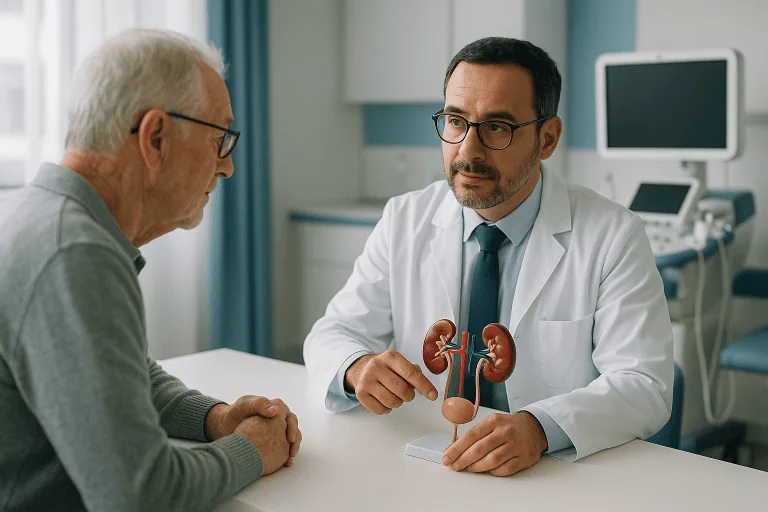
Urinary Retention Treatment
Urinary retention is the inability to empty the bladder fully or at all, causing pain, urgency, or weak flow. Treatment focuses on safe bladder drainage and correcting the underlying cause.

Quick answer
Urinary retention means the bladder cannot empty fully, or at all. Acute retention comes on suddenly, is painful and is relieved urgently with a catheter; chronic retention builds gradually and is often found on ultrasound. Treatment then targets the cause, prostate enlargement, urethral narrowing, nerve dysfunction, medication effects or constipation, using medicines, catheter strategies or a procedure to relieve the blockage.
What Is Urinary Retention?
Urinary retention is the inability to empty the bladder completely, or to pass urine at all. It happens when the kidneys produce urine normally but the bladder cannot release it in the usual way, either because something physically blocks the outflow, or because the bladder muscle and the nerves that control it are no longer working together. Retention affects men more often than women, largely because of the prostate, but it occurs in both sexes and at every age.
The essential point to understand is that urinary retention is a symptom, not a single disease. Behind it may sit an enlarged prostate, a narrowed urethra, a medication side effect, a nerve disorder, severe constipation, an infection, pelvic organ prolapse, or the after-effects of surgery and anaesthesia. Treatment therefore always has two aims running in parallel: draining the bladder safely when it cannot empty on its own, and finding out why it happened so the underlying cause can be corrected or managed. A careful medical team does not only ask how to drain the bladder. It asks why the bladder stopped emptying, and what will prevent harm or recurrence.
The distinction that shapes everything else is whether the retention is acute or chronic. The two forms feel different, carry different risks and are treated differently.
Acute urinary retention
Acute urinary retention is the sudden inability to pass urine despite a full bladder and a strong, often desperate urge to go. Pressure builds in the lower abdomen, discomfort escalates quickly, and the bladder can become firm and tender above the pubic bone. Clinicians treat this as an emergency: the overfilled bladder is under high pressure, and the standard first step is immediate drainage with a catheter, before the cause is investigated in detail. Acute retention is most common in older men, and it is sometimes the first sign that an enlarging prostate has narrowed the urethra to the point of closure. It can also be triggered by anaesthesia, a newly started medicine, infection, alcohol, cold remedies, or a combination of small factors acting on a bladder that was already emptying poorly. Drainage brings relief within minutes in most cases, which is one reason acute retention, frightening as it feels, responds well to prompt care.
Chronic urinary retention and urinary stasis
Chronic urinary retention develops gradually and leads to urinary stasis, urine standing in the bladder after each void instead of flowing through it. The person can still urinate, but the bladder never empties completely, and the leftover volume grows over months or years. Stasis is what makes chronic retention harmful: standing urine is a favourable environment for bacteria and for crystal formation, which is why chronic retention is closely linked to repeated infections and bladder stones. It also stretches the bladder wall slowly and quietly. Some people with substantial chronic retention have remarkably mild symptoms; the problem comes to light only when an ultrasound scan shows a large amount of urine remaining after voiding, or when a complication, infection, overflow leakage, reduced kidney function, finally brings them to a doctor. This silent quality is exactly why chronic retention deserves structured evaluation rather than reassurance.
Urinary Retention Symptoms
Urinary retention symptoms range from dramatic to almost invisible, depending on how quickly the problem developed and how much the bladder has adapted. Acute retention announces itself. Chronic retention often hides behind changes that people wrongly accept as normal ageing.
In acute retention, the picture is usually unmistakable: a strong and mounting urge to urinate with no ability to pass urine, worsening lower abdominal pain, bloating or firmness above the pubic bone, restlessness and sweating. The distress is real and physical: an overfilled bladder is genuinely painful.
Chronic retention is subtler. Common signs include a weak or interrupted stream, straining to start, dribbling after finishing, frequent daytime urination, waking several times at night to urinate, a persistent sense that the bladder is never quite empty, and recurrent urinary tract infections. Some people leak urine without warning because the overfilled bladder simply spills over: a pattern called overflow incontinence, one of several forms of urinary incontinence, and one that behaves very differently from stress urinary incontinence and needs a different treatment approach. Confusingly, some patients feel urgency and obstruction at the same time: the bladder signals loudly that it is full, yet emptying it takes effort. That combination is frustrating, but it is also a recognised pattern that urologists know how to untangle.
How do you know if you are in urinary retention?
The clearest sign is that the bladder holds far more urine than you are able to pass. In acute retention this is obvious: you feel a full bladder, cannot urinate, and the lower abdomen becomes tense, swollen and painful over hours. Chronic retention is much harder to recognise from sensation alone, because the bladder adapts to being stretched and the warning signals fade. That is why the diagnosis rests on a measurement rather than a feeling: an ultrasound scan of the bladder taken immediately after urinating shows how much urine remains, a value called the post-void residual. A consistently large residual confirms retention even in someone who believes they are emptying normally. In practice, many people are first alerted by the pattern of complications, infections that keep returning, leakage they cannot explain, or a stream that has slowed year by year.
What is urinary hesitancy?
Urinary hesitancy is a delay between trying to urinate and the stream actually starting. It is one of the earliest and most common signs of a narrowing outflow, typically from prostate enlargement in men, and it often appears years before retention itself. Hesitancy on its own does not mean retention is inevitable. It does mean the bladder is working against resistance, and obstruction is easier to treat before the bladder muscle has spent years straining against it. In women, hesitancy can point towards prolapse, scarring or a poorly coordinated pelvic floor rather than the prostate-driven pattern seen in men.
Difficulty urinating: blockage or weak bladder?
Difficulty urinating has two broad mechanical explanations, and telling them apart drives the entire treatment plan. Either the outlet is blocked, by prostate tissue, a urethral stricture, a stone, prolapse or scar tissue, or the bladder muscle itself contracts too weakly to push urine out, usually because of nerve damage, diabetes or long-standing overdistension. From the outside, the two can look identical: the same slow stream, the same straining, the same residual urine. Urine flow studies and, in uncertain cases, urodynamic testing exist precisely to separate them, because surgery that relieves a blockage will not help a bladder that cannot contract, and a weak bladder managed as if it were obstructed leads to disappointment on both sides.
Certain accompanying features change how quickly clinicians act. Fever alongside urinary symptoms suggests infection trapped under pressure. Blood in the urine points towards stones, clots or a lesion that needs direct inspection. New leg weakness, numbness in the saddle area or loss of bowel control raises the possibility of spinal nerve compression, which urologists and spinal surgeons treat as a surgical emergency. These combinations shape the tempo of investigation, not just its content.
What Causes Urinary Retention?
The causes of urinary retention fall into four broad groups: physical obstruction, nerve dysfunction, medication effects and a weakened bladder muscle. In real patients they frequently overlap: a modestly enlarged prostate, a new antihistamine and a bout of constipation can together tip a bladder into retention when none of the three would have done so alone. Untangling the contributions is the diagnostic work.
What are the causes of urinary retention in men?
In men, the most common cause by far is benign prostatic enlargement, also called benign prostatic hyperplasia. The prostate wraps around the urethra just below the bladder, so as it enlarges it narrows the channel through which urine must pass; the bladder compensates by pushing harder, until one day it cannot. Prostate inflammation (prostatitis), prostate cancer and previous prostate procedures can contribute in the same anatomical territory. The second major mechanical cause is urethral stricture: a narrowing of the urethra left behind by infection, trauma, catheterisation, prior surgery or inflammatory disease. Strictures typically produce a weak or spraying stream and recurrent infections, and a severe stricture can close the urethra entirely. Bladder stones and blood clots inside the bladder can also block the outlet intermittently, which explains the pattern some men describe of a stream that stops abruptly mid-flow and then restarts after a change of position.
Causes of urinary retention in women
In women, retention is less common but no less real, and it is more often missed. Pelvic organ prolapse can kink or compress the urethra as the bladder or uterus descends. Prior pelvic surgery, urethral scarring, pelvic masses and obstruction at the bladder neck all appear in female retention. Some women develop temporary retention after childbirth, anaesthesia or gynaecological procedures, when swelling and stretched nerves interfere with normal emptying for days to weeks. Because the possible causes are varied and individually uncommon, female urinary retention rewards a methodical evaluation rather than assumptions: a point worth knowing if symptoms have previously been attributed to anxiety or ‘a small bladder’.
Neurogenic bladder: when the nerves are the problem
Neurogenic bladder describes retention caused by faulty signalling between the brain, spinal cord, bladder and urinary sphincter. Diabetes is a leading contributor, because long-standing high glucose damages the small nerves that report bladder fullness and trigger contraction. Spinal cord injury, multiple sclerosis, Parkinson’s disease, stroke, spinal stenosis, disc disease and pelvic nerve injuries can all disturb the same circuitry. Two patterns dominate: a bladder muscle that contracts poorly or not at all, and a bladder that contracts against a sphincter which fails to relax at the right moment. The distinction matters, because the first is managed mainly with drainage strategies while the second may respond to treatments aimed at the outlet. In neurogenic retention, the long-term priority shifts from restoring a perfect stream to protecting the kidneys and preventing infection.
Medications that can contribute
A surprising number of everyday medicines can impair bladder emptying, especially in someone whose bladder was already borderline. The usual suspects are antihistamines, decongestants and combination cold remedies, certain antidepressants, muscle relaxants, opioid pain medicines and any drug with anticholinergic effects, which blunt the bladder muscle’s ability to contract. Retention that begins shortly after a new prescription or an over-the-counter cold treatment is a classic story in urology clinics. Because these medicines are usually treating something important, any adjustment or substitution is a decision the prescribing doctor makes with the full picture in view, identifying the culprit is the urologist’s contribution; changing the prescription safely is a coordinated one.
Can constipation cause urinary retention?
Yes. The rectum sits directly behind the bladder and urethra, and a rectum loaded with hard stool can physically compress the bladder outlet while also disturbing the shared nerve reflexes that govern both organs. Severe constipation is a well-documented and fully reversible contributor to retention, particularly in older adults and in children. It rarely acts alone in adults, more often it is the final straw on top of prostate enlargement or a weak bladder, which is why bowel management is treated as a genuine part of the urinary retention plan rather than an afterthought.
Other causes
The remaining causes are individually less common but important to rule out: postoperative retention after anaesthesia, which is usually temporary; scarring after radiation therapy to the pelvis; pelvic tumours pressing on the urinary tract; and swelling from infection or inflammation anywhere along the outflow. Because the list is broad, effective treatment depends on a structured diagnostic process rather than a single standard answer.
Urinary Retention and Infection: Which Causes Which?
Patients often ask whether infection causes retention or retention causes infection. The honest answer is that the relationship runs in both directions, and the two problems reinforce each other.
Can a urinary tract infection cause urine retention?
Yes. A urinary tract infection can inflame and swell the urethra, prostate or bladder neck enough to obstruct flow, acute prostatitis in men is a classic trigger of sudden retention. An acute UTI can also make the bladder so irritable and painful that coordinated emptying fails even without a true blockage. Retention driven by infection often improves once the infection is treated, but the episode still deserves evaluation, because infection frequently unmasks a bladder that was already emptying poorly rather than causing the problem from nothing.
Can urinary retention cause a UTI?
Yes, and this is one of the main reasons chronic retention needs treatment even when it causes little discomfort. Normal urination flushes bacteria out of the bladder several times a day. When a pool of urine remains behind after every void, that flushing effect is lost and bacteria have warm, still, nutrient-rich fluid in which to multiply. The result is a pattern of recurrent urinary infections that keep returning despite treatment, because the underlying reservoir is never addressed. Recurrent infection in anyone with a weak stream or a sense of incomplete emptying should prompt measurement of the post-void residual. Left alone, the cycle feeds itself: retention breeds infection, infection causes swelling, and swelling worsens retention.
How Urinary Retention Is Diagnosed
Diagnosis begins with a conversation, not a machine. The physician reviews the urinary symptoms in detail, when they began, how they changed, what triggers them, alongside past surgeries, current medications, neurological history, prostate or gynaecological history, diabetes, spinal disease and any recent anaesthesia or hospitalisation. Each of these can point towards a different mechanism, and a thorough history often narrows the field before a single test is ordered.
Physical examination follows: the abdomen is examined for a distended bladder, a focused neurological assessment checks the nerves that serve the pelvis, and a pelvic examination in women or a prostate examination in men is performed when clinically appropriate.
Tests are then chosen to answer the specific question the history raises, not deployed wholesale. A bladder ultrasound measures the post-void residual, the single most useful number in retention, without radiation or discomfort. Urinalysis and urine culture identify infection or blood in the urine, and urine testing can extend to urinary biomarkers when a specific underlying disease needs to be ruled in or out. Blood tests assess kidney function and general health. In men, prostate evaluation may include symptom scoring, prostate-specific blood testing where indicated, imaging or endoscopic assessment.
Functional tests answer the blockage-versus-weak-bladder question. Uroflowmetry measures the speed and pattern of urination, obstruction and weak contraction each leave a characteristic curve. Urodynamic testing measures pressure and flow together and is reserved for cases where bladder muscle or nerve function is genuinely uncertain. Cystoscopy lets the urologist look directly inside the urethra and bladder with a small camera, which is how strictures, stones, prostate lobes and bladder lesions are seen rather than inferred. Imaging of the kidneys, bladder, prostate, pelvis or spine is added in selected cases, particularly when the kidneys may be under pressure or a neurological cause is suspected. The aim throughout is precision: the right tests for the clinical question, not every possible test for every patient.
How Urinary Retention Treatment Is Performed
Treatment follows a logical sequence, and understanding that sequence removes much of the fear. In broad terms it runs:
- Step 1: drain the bladder safely if it cannot empty on its own.
- Step 2: identify why retention happened.
- Step 3: treat reversible contributors, infection, constipation, medication effects.
- Step 4: test whether the bladder can now empty on its own (a trial without catheter).
- Step 5: if it cannot, choose between medication, a drainage strategy or a procedure that corrects the underlying cause.
Initial assessment and safe bladder drainage
The first decision is whether the bladder must be drained immediately. If the patient cannot urinate and the bladder is distended, a catheter is placed through the urethra into the bladder to release the trapped urine. When urethral catheterisation is difficult or unwise, because of a stricture, recent surgery or trauma, a suprapubic catheter can be placed through the lower abdominal wall directly into the bladder, using sterile technique and imaging guidance where needed. In acute retention, drainage usually brings rapid relief. The volume drained is documented because it says a great deal about how long the problem has been building, and the patient is monitored afterwards for discomfort, bleeding, infection signs, blood pressure changes and the brisk urine output that can follow decompression of a long-overfilled bladder. In chronic retention, drainage is often planned more gradually and paired with blood tests to check how the kidneys have coped.
Finding the underlying cause
Once the immediate pressure is off, attention turns to the reason. This is where the diagnostic tools described above, ultrasound, urine and blood testing, uroflowmetry, cystoscopy, urodynamics, cross-sectional imaging, are combined to distinguish between obstruction, poor bladder muscle function, nerve-related dysfunction, infection, inflammation, stones and external compression. The findings determine everything that follows, because the same symptom can require completely different treatment depending on its mechanism.
Medication-based treatment
For many men with prostate-related retention, medicines that relax the bladder outlet, alpha-blockers, in suitable patients, improve flow enough to restore spontaneous urination. Other medicines can reduce prostate volume gradually over time or settle bladder storage symptoms. Antibiotics are used only when infection is present or strongly suspected, not as a routine addition. Medication review works in the other direction too: if an existing drug is contributing to retention, the urologist coordinates with the prescribing doctor so that any adjustment or replacement happens safely and with the original condition still covered. Hydration guidance, pain relief and bowel management round out the medical side of the plan, treating severe constipation is often a genuinely effective part of treating the retention itself.
Does drinking more water help with urinary retention?
No, drinking more water does not open a blocked outlet or strengthen a weak bladder, and in acute retention extra fluid simply adds volume to a bladder that cannot drain, making the pressure worse. The nuance is that sensible hydration still matters: deliberately restricting fluid to avoid symptoms concentrates the urine, irritates the bladder lining and raises infection risk. The useful rule is normal, steady fluid intake, with the actual treatment aimed at the cause of the retention rather than at the tap.
Trial without catheter
After initial drainage and treatment of reversible factors, many patients undergo a supervised trial without catheter. The catheter is removed, the patient urinates when ready, and the team measures the flow and checks the post-void residual by ultrasound. If the bladder empties adequately and symptoms are acceptable, treatment continues with medication and scheduled monitoring. If retention recurs, the result is not a failure but information: it tells the team that the obstruction or bladder weakness needs a more definitive answer, and the plan is adjusted accordingly.
Intermittent catheterisation and longer-term drainage
For some patients, particularly those with chronic retention or neurogenic bladder, intermittent catheterisation is the recommended strategy. A small catheter is passed to empty the bladder at set intervals and then removed, so nothing stays in place between uses. Most patients who need it can learn the technique and perform it discreetly at home, at work and while travelling. It protects the bladder and kidneys from constant overdistension while preserving independence, and for a weak bladder it is often safer than either straining or a permanent tube. When intermittent catheterisation is not practical, a longer-term urethral or suprapubic catheter is used instead, with clear teaching on catheter care, hygiene, drainage bag management, the warning signs of infection and the follow-up schedule. Whatever the drainage method, the team keeps re-evaluating whether a definitive treatment could eventually remove the need for it.
Procedures and surgery for obstruction
When retention is caused by a structural blockage, a procedure corrects it. For benign prostate enlargement, the options range from minimally invasive prostate treatments to endoscopic surgery that removes or reduces the obstructing tissue; the choice depends on prostate size and shape, bleeding risk, current medications, age, fertility considerations and overall health. Urethral strictures are treated by dilation, endoscopic incision or reconstructive urethral surgery, depending on the length, location and recurrence history of the narrowing, short first-time strictures and long recurrent ones are quite different problems. Bladder stones are removed endoscopically. Prolapse contributing to retention may be managed with a pessary or repaired surgically. Tumours, blood clots and radiation scarring each require cause-specific treatment planned with the relevant specialists. Timescales vary accordingly: catheter placement takes minutes, most diagnostic work fits into short outpatient visits, endoscopic procedures may take under an hour or longer with complexity, and reconstructive or pelvic surgery needs more planning and a longer recovery. Hospital stay ranges from same-day care to one or more nights depending on what is done and the patient’s general health.
Recovery and follow-up
Recovery tracks the treatment. After simple catheter drainage, the pressure symptoms settle quickly, though temporary bladder irritation, mild burning or blood-tinged urine is common for a short period. After endoscopic or open surgery, a catheter often stays in place briefly while tissues heal, and activity limits, fluid guidance and medication instructions are explained before discharge. Follow-up is not optional decoration: repeat bladder ultrasound, flow testing, urinalysis, kidney function tests or imaging confirm that the bladder is genuinely emptying safely rather than merely feeling better. In chronic and neurological cases, monitoring continues long-term, because the goal is to protect the kidneys and keep infections rare as the underlying condition evolves.
Why Acting Early Matters
Urinary retention rewards early attention and punishes delay. When urine stays trapped, pressure builds and the bladder wall stretches. A bladder stretched for long enough loses contractile strength, the muscle fibres decompensate, and at that point relieving the obstruction may no longer restore normal emptying, because the engine itself has weakened. Retention caught early is far more likely to be reversible than retention endured for years.
Pressure also travels upward. In severe or prolonged retention, back-pressure reaches the kidneys, causing them to swell and function less well. Alongside the kidney risk sit the everyday complications: urinary tract infection, bladder stones, blood in the urine, overflow leakage and the demoralising cycle of repeated emergency catheterisations. In chronic retention these problems tend to develop quietly, which makes them particularly dangerous in older adults and in people with diabetes, whose blunted bladder sensation hides the warning signs.
Early evaluation also keeps more options on the table. A man with early prostate-related obstruction may do well on medication or a planned minimally invasive treatment. Retention driven by a medicine may resolve once the prescribing doctor adjusts the regimen. A short urethral stricture treated promptly is a simpler problem than the longer, scarred narrowing it can become. And where retention stems from a neurological condition, early bladder management protects the urinary tract over decades rather than repairing damage after the fact.
What Treatment Can Achieve
Effective urinary retention treatment relieves the immediate symptoms, protects the urinary tract and addresses the condition behind the blockage or bladder dysfunction.
| Benefit | What It Means for You |
|---|---|
| Rapid relief of bladder pressure | Urgent drainage reduces pain, abdominal pressure and the distress of being unable to urinate. |
| Protection of kidney function | Restoring safe urine flow reduces the back-pressure that can affect the kidneys in severe or prolonged retention. |
| Lower risk of infection and bladder stones | Better bladder emptying reduces stagnant urine, the common thread behind recurrent infections and stone formation. |
| Improved daily comfort and sleep | Treatment can reduce frequency, night-time urination, weak flow, dribbling and the feeling of incomplete emptying. |
| Identification of the underlying cause | Structured evaluation uncovers prostate enlargement, urethral narrowing, nerve-related dysfunction, medication effects, prolapse or another condition. |
| A personalised long-term plan | Care may combine medication, a catheter strategy, a procedure, surgery or monitoring, matched to your diagnosis and priorities. |
Recovery Timeline After Urinary Retention Treatment
Recovery varies with the cause of retention, how overstretched the bladder became and whether treatment involved catheter drainage, medication or a procedure. The pattern below describes a typical course, not a promise for any individual.
| Time Period | What Patients Can Expect |
|---|---|
| Day 1 | If a catheter is placed, bladder pressure usually improves quickly. The team monitors urine output, discomfort, blood in the urine, infection signs and kidney function where needed. |
| First week | Medication continues, catheter care is established, or a planned trial without catheter takes place. Mild burning, urgency or bladder spasms are common, especially after catheterisation. |
| First month | Follow-up testing checks urine flow and residual urine. If retention recurs or obstruction is confirmed, procedural options or surgical planning are discussed. |
| After a procedure | Recovery depends on the intervention: some endoscopic procedures allow a return to light activity within days, while more extensive surgery needs a longer healing period and closer monitoring. |
| Longer term | Patients with prostate enlargement, urethral stricture, prolapse or neurogenic bladder have periodic follow-up to keep bladder emptying safe and prevent complications. |
Factors That Influence Outcomes
Outcomes in urinary retention depend on the cause, the duration and the severity of the condition, and it helps to be honest about each. A patient with temporary postoperative retention typically recovers quickly once the effects of anaesthesia fade and the bladder is supported for a short time. A patient with long-standing chronic retention may need more time, and sometimes ongoing bladder management, because years of overdistension may have permanently stretched or weakened the muscle.
Bladder muscle function is the single most important factor. If the bladder can still contract effectively, relieving an obstruction usually produces meaningful improvement. If the muscle is underactive from nerve damage, diabetes, spinal disease or prolonged overdistension, the realistic goal shifts from restoring normal urination to achieving safe, reliable emptying by whatever combination of methods suits the patient’s life, most often intermittent catheterisation with monitoring. Stating this plainly at the outset spares patients months of chasing an outcome the physiology cannot deliver.
The type of obstruction also matters. Prostate enlargement, urethral stricture, stones, prolapse and scarring are treated differently, and some, strictures in particular, carry a known tendency to recur and therefore need surveillance rather than a single fix. Age, kidney function, infection history, current medications, bleeding risk, neurological status and overall health all shape both the choice of treatment and its likely course.
Patient factors count too. Timely presentation preserves options; adherence to catheter care, medication schedules, hydration guidance and follow-up appointments visibly affects results. Whatever the setting, patients do best with a clear discharge plan, medical records their own physician can use, and arranged follow-up, especially if a catheter remains in place or the treatment is staged.
Finally, a good result should be defined properly. It is not merely urinating once after the catheter comes out. It is a bladder that empties safely, symptoms that are controlled, infections that become rare, kidneys that are protected, and an underlying condition that is either corrected or knowingly monitored. For some patients that is achieved with medication and observation; for others it requires a carefully chosen procedure or a long-term bladder management strategy. Both count as success when they fit the diagnosis.
Urinary Retention Care at Acibadem
Urinary retention sits at the junction of several specialties, and care at Acibadem is organised to reflect that. Urologists lead the evaluation, and depending on the cause, nephrologists, neurologists, radiologists, anaesthesiologists, gynaecologists or rehabilitation specialists join the plan. Complex cases, retention linked to cancer, neurological disease, prior surgery or several coexisting conditions, are discussed across disciplines so that the diagnostic findings and the treatment pathway actually match.
The diagnostic approach follows the principle described throughout this page: choose the right tests for the clinical question rather than every available test. Ultrasound assessment, laboratory work, endoscopic evaluation, urine flow studies, urodynamic testing and advanced imaging are all available and are used when they will change a decision. Treatment plans are built the same way: a man with acute retention from prostate enlargement, a woman with retention related to prolapse, a patient with diabetes and an underactive bladder, and a patient with a urethral stricture all present with the same symptom and leave with four different plans.
Continuity of care is treated as part of the treatment itself. Before discharge, patients receive clear documentation of the diagnosis, the test results, any procedures performed and the follow-up schedule, so that whichever physician continues the care can pick it up without gaps, particularly important when a catheter remains in place or a second-stage procedure is planned. Where long-term monitoring is needed, as in neurogenic bladder or recurrent stricture disease, the surveillance plan is written down rather than left to memory: which tests, at which intervals, and which findings should prompt an earlier review.
Living Well After Urinary Retention
Urinary retention feels alarming, but it is a condition with a clear logic: drain the bladder safely, find the cause, treat what is reversible, and correct or manage what remains. Most of the harm associated with retention comes not from the condition itself but from time: the months or years in which a stretched bladder, standing urine and quiet kidney pressure do their work unnoticed. Evaluation interrupts that process.
The encouraging reality is that the common causes are treatable. Prostate obstruction responds to medication and, where needed, well-established procedures. Strictures can be opened or reconstructed. Medication effects and constipation are reversible. Even where the bladder muscle itself has weakened, structured management keeps the kidneys safe and infections rare, and lets people live full, mobile lives around it. Understanding which of these situations applies to you is what the diagnostic process exists to answer, and it is the point at which urinary retention stops being a frightening mystery and becomes a manageable medical problem with a plan.
Preparation
- Evaluation usually includes a medical history, medication review, physical examination, urinalysis, and ultrasound to measure retained urine. Blood tests or further urologic tests may be needed to identify prostate, nerve, infection, or obstruction-related causes. Patients should inform the doctor about all medicines, especially blood thinners and drugs affecting urination.
Aftercare
- After bladder drainage or catheter placement, patients are guided on catheter hygiene, fluid intake, and warning signs such as fever, pain, or blood in the urine. Follow-up may include medication, catheter removal trials, imaging, or further treatment for the underlying cause. Seek urgent care if urine flow stops again or severe lower abdominal pain returns.
Frequently Asked Questions
What affects the cost of urinary retention treatment?
The main factors are the cause of retention, the urgency of care, tests required, catheter type, medication, need for cystoscopy or surgery, anaesthesia, hospital stay, and follow-up. Travel, translation, and accommodation can also affect the total budget for international patients.
Can I get a quote before travelling to Turkey?
Yes. A preliminary quote can usually be prepared after reviewing your symptoms, medical history, current medications, previous test results, imaging, and any catheter or emergency treatment records. A final plan is confirmed after specialist evaluation.
Is urinary retention suitable for medical travel?
Planned evaluation and treatment may be suitable for travel, but acute painful retention is an urgent condition and should be treated immediately at the nearest appropriate medical facility. Travel should be considered only when you are stable and cleared by a clinician.
What is typically included in an international patient package?
Depending on the case, a package may include urology consultation, diagnostic tests, catheter management, procedure planning, hospital services, translation support, and follow-up coordination. The exact inclusions should be confirmed in writing before travel.
How do specialists decide which treatment I need?
The decision is based on the suspected cause, bladder emptying tests, urine and blood tests, imaging, endoscopic findings if needed, symptom severity, infection risk, kidney function, and overall health. A urologist will recommend the most appropriate option.
Is a free consultation available for a personalised estimate?
You can request a free consultation to share your medical information and receive guidance on the likely evaluation and treatment pathway. The information provided is general and is not a substitute for medical or financial advice.
Medically reviewed by the Acıbadem International Medical Board September 1, 2026
See our medical review board →
Update history
- PublishedJune 8, 2026
- Medical review approvedSeptember 1, 2026
- Last content updateSeptember 8, 2026
References1
- Urinary Retention my.clevelandclinic.org
Trusted care for international patients
From the Acibadem Blog

Catheter Hygiene, Fluids and Follow-Up: Daily Life After Bladder Drainage for Retention
Living with a urinary catheter after urinary retention means keeping the tube and bag clean with daily soap-and-water washing, drinking enough fluid that urine…

What Happens When a Catheter Is Placed for Urinary Retention: Drainage Explained Step by Step
When a catheter is placed for urinary retention, a thin, flexible tube is passed through the urethra (or, less often, through the lower abdomen)…