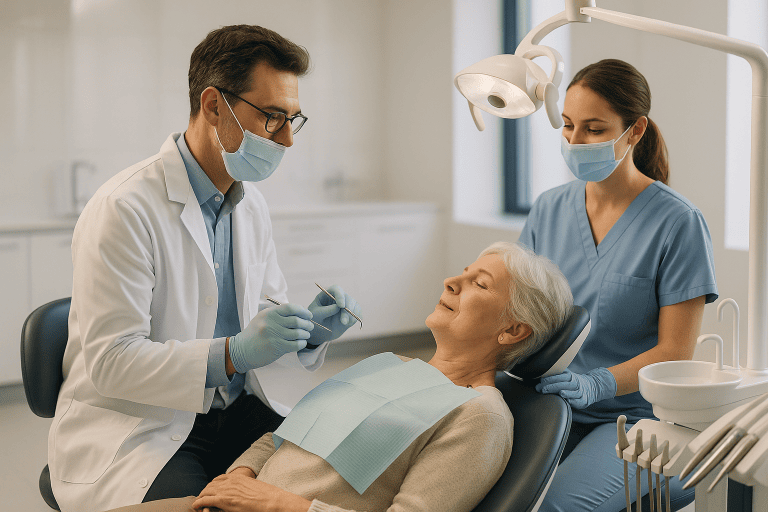
Dental Bone Grafts
Dental bone grafts rebuild or strengthen jawbone volume, often before dental implant placement. Graft material supports new bone growth for a more stable, functional, and aesthetic result.
Quick answer
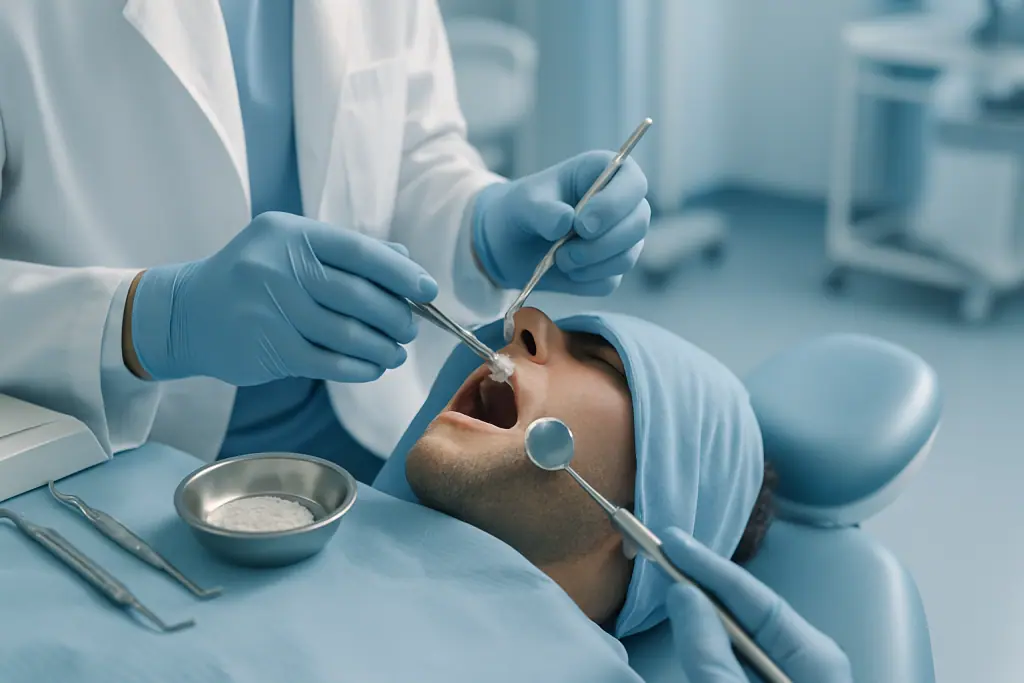
A dental bone graft rebuilds jawbone that has shrunk after tooth loss, gum disease, infection or injury. Graft material: your own bone, processed donor bone, animal-derived mineral or a synthetic substitute, acts as a scaffold that the body gradually replaces with new living bone. It is most often used to create a stable foundation for dental implants, and the graft typically needs several months to mature.
What Is a Dental Bone Graft?
A dental bone graft is a procedure that rebuilds, preserves or strengthens the jawbone using grafting material that supports new bone formation. The graft works as a scaffold: over the months that follow surgery, your body grows blood vessels and bone-forming cells into the material and gradually replaces it with living bone. It is most often recommended when the jaw no longer has enough volume to hold a dental implant securely, but it also has a role after tooth extraction, in periodontal treatment and in wider jaw reconstruction.
The jawbone is a living structure, and it responds to how it is used. When a tooth is lost, the bone that once anchored its root stops receiving chewing stimulation and begins to shrink. Gum infection, dental abscesses, cysts, injury and years of pressure from a removable denture can all reduce bone volume further. If the remaining ridge is too thin, too short or too soft, placing an implant anyway risks poor stability, a compromised position and a restoration that neither functions nor looks right.
Being told you do not have enough bone for implants can feel discouraging, particularly if you have already spent years managing missing teeth, loose dentures or previous treatment that did not last. A bone graft is often the step that turns “not possible” into “possible with preparation”. It does not shortcut the biology, grafted bone needs time to mature, but it can restore the foundation that tooth loss took away.
The decision involves more than the operation itself. You are also weighing the number of visits required, the healing interval between stages and how the graft fits into the wider plan for your teeth. A well-designed grafting plan should answer these questions before anything is booked, and it should be based on imaging and examination rather than assumption: not simply whether an implant can be placed, but whether it can be placed in the right position, surrounded by healthy tissue, and restored in a way that looks and functions naturally.
At Acibadem, dental bone grafting is planned as part of a complete oral rehabilitation pathway within the Dental & Oral Health unit. Depending on the case, care may involve oral and maxillofacial surgeons, periodontists, prosthodontists, restorative dentists, radiology teams and anaesthesiology support. That coordination matters most for patients with complex medical histories, extensive tooth loss, sinus involvement, previous failed implants or aesthetic concerns in the front of the mouth.
How does a bone graft heal?
A bone graft heals through a biologic process, not a mechanical one. The graft material is placed where bone is missing or insufficient, and the body’s own healing response does the real work: a blood clot forms around the particles, new blood vessels grow in, bone-forming cells migrate along the scaffold, and the site gradually mineralises and remodels into bone that belongs to you. In many procedures, a protective membrane is placed over the graft, a technique often described as guided bone regeneration, to stop faster-growing soft tissue from occupying the space where bone is meant to form. This is why stability and protection during healing matter so much: the graft needs an undisturbed environment while your biology converts it.
What types of bone graft dental materials are used?
Four groups of bone graft dental material are in routine use, and many procedures combine more than one:
- Autograftyour own bone, usually taken from another area of the mouth or, in larger reconstructions, from a separate donor site. It brings living cells with it, which is a biologic advantage, but it requires a second surgical area.
- Allograftcarefully processed human donor bone from regulated tissue sources, prepared so that it is safe and acts as a scaffold for your own bone to replace.
- Xenograftprocessed bone mineral from an animal source, most commonly bovine, treated to be biocompatible. It tends to hold volume well over time.
- Synthetic graftbiocompatible mineral materials manufactured to support bone regeneration without any human or animal tissue.
No single material is best for every situation. Your surgeon weighs how much volume must be rebuilt, how stable the site is, how well the area is likely to heal and what the final restoration requires. Combinations, for example, a volume-stable mineral mixed with the patient’s own bone, are common precisely because they balance stability, volume maintenance and biologic healing.
How much bone can a graft rebuild?
Grafting ranges from a small socket preservation procedure after a single extraction to staged reconstruction of a severely resorbed ridge. What matters is not only creating enough volume, but creating bone in the correct three-dimensional position. An implant must be surrounded by adequate bone on all sides and placed at the correct angle and depth to support a crown, bridge or denture that is functional, cleanable and aesthetically balanced. A graft that produces bone in the wrong place does not solve the implant problem, which is why planning starts from the position of the final tooth and works backwards to the bone.
Who May Need a Dental Bone Graft?
You may need a dental bone graft if the jawbone has lost volume or density and cannot safely or predictably support the restoration you are planning. Many patients only discover this after a detailed examination and three-dimensional imaging. Others already notice the signs: a change in facial contour, receding gums, loosening teeth, or a denture that no longer sits the way it used to.
Common situations that lead to grafting include:
- Missing teeth, especially teeth that have been absent for a long time
- Advanced gum disease with bone loss around the teeth
- Teeth that need extraction because of fracture, decay or infection
- Previous dental abscesses that damaged the surrounding bone
- Trauma to the jaw or teeth
- A failed dental implant that took bone with it
- Cysts or lesions that removed bone when they were treated
- Long-term denture wear that has contributed to ridge shrinkage
Diagnosis begins with your history. The clinician will ask about missing teeth, previous extractions, periodontal disease, smoking, diabetes, osteoporosis medication, immune conditions, any radiation therapy to the head and neck, and whether an implant has failed before. Each of these changes either the risk profile or the sequence of treatment, so honesty here shapes the plan.
A clinical examination then assesses the gums, the bite, the remaining teeth, the jaw relationship, the smile line and the amount of attached gum tissue. For graft assessment and implant planning, three-dimensional imaging is usually the deciding step: it shows bone height, width and density, the position of nerves and the sinus floor, root proximity, and defects that a standard dental X-ray simply cannot show.
Do you always need a bone graft for tooth implant treatment?
No, many implants are placed without any grafting at all. Whether you need a bone graft for tooth implant placement depends on how much healthy bone remains exactly where the implant needs to sit, which is a question imaging answers, not guesswork. If the ridge has adequate height and width in the right position, a dental implant can often be placed directly. If the deficit is small, a minor graft at the time of implant placement may be enough. Only when the shortfall is significant does grafting become its own stage with its own healing period.
Can extraction, grafting and implant placement happen in one visit?
Sometimes, but the biology of the individual case decides. In selected situations a tooth is removed, the socket is grafted immediately and the implant follows after healing; in others, extraction, graft and implant can genuinely be combined. Where there is significant infection or major bone loss, a staged approach is usually safer and more predictable, and a careful team will say so rather than promise speed. If graft healing is required before the implant, your plan should spell out the number of visits, the expected interval between them, and how temporary teeth will be managed while you heal: the timing questions are covered in more depth in our guide to dental implants after tooth extraction.
Conditions Dental Bone Grafts Address
Dental bone grafts are used across several areas of oral and maxillofacial care, each with a distinct purpose and technique.
Socket preservation after tooth extraction
When a tooth is removed, the surrounding bone remodels and shrinks, most rapidly in the first months. Placing graft material into the extraction socket helps preserve ridge volume and can reduce the complexity of later implant treatment. Socket preservation is often considered when you plan to replace the tooth with an implant but cannot, or should not, have the implant placed immediately. It is typically the smallest and least invasive form of grafting.
Ridge augmentation
Ridge augmentation rebuilds a jaw ridge that has become too narrow, too low or irregular after tooth loss, trauma, infection or previous surgery. It may be horizontal, to increase width; vertical, to increase height; or combined, when both dimensions are deficient. Vertical augmentation is generally the more demanding of the two, which is one reason early treatment, before height is lost, tends to keep options simpler.
Sinus lift grafting
A sinus lift addresses the upper back jaw, where implants often run out of room. After upper molars or premolars are lost, the maxillary sinus can expand downwards while the ridge shrinks upwards, leaving too little bone height between the two. The surgeon gently elevates the sinus membrane and places graft material beneath it, creating a foundation for implants placed either at the same time or after the graft has matured.
Periodontal regeneration
Selected bone defects caused by gum disease can be treated regeneratively. When bone loss around a tooth forms a contained defect, grafting combined with membranes and biologic materials may help rebuild supporting structures and improve the tooth’s stability. Not every periodontal defect is suitable for regeneration, the shape of the defect largely determines what is achievable, so careful diagnosis comes first.
Rebuilding bone after a failed implant
If an implant was lost to infection, overload, poor positioning or inadequate bone, grafting is often needed to rebuild the site before a new implant is considered. These are among the most demanding cases, because the reason for the original failure has to be understood and corrected first. Repeating the same conditions with new hardware is not a plan; it is the same problem on a delay.
How Dental Bone Grafting Is Performed
Everything starts with planning. Before recommending a graft, the specialist reviews your oral health, medical condition, imaging and restorative goals together. This stage can begin with recent dental X-rays, three-dimensional scans where available, photographs and a summary of previous treatment; an in-person examination and updated imaging then confirm or refine the plan. The final crown or prosthesis is considered from the outset, because it defines where the bone actually needs to be.
Preparation may include professional cleaning, treatment of active gum disease, removal of teeth that cannot be saved, and coordination with your physician if you have diabetes, cardiovascular disease, bleeding risk, immune suppression or a history of bisphosphonate or other antiresorptive medication. Any medication adjustments are decided by your treating doctors, not left to you. Smoking is a significant risk factor for delayed healing and graft complications, and patients are usually advised to stop before and after surgery. If infection is present, it is dealt with first, through antibiotics, drainage, extraction or a staged approach, because grafting into an infected site works against the graft.
Anaesthesia is chosen according to the complexity of the surgery and your comfort. Small grafts are commonly performed under local anaesthesia. Longer procedures, anxious patients or combined surgeries may involve sedation or general anaesthesia with appropriate monitoring, one reason a hospital setting can matter for medically complex patients.
What happens during the procedure?
The details vary by technique, but the core sequence is consistent:
- The area is cleaned and anaesthetised, and a precise incision gives access to the bone defect.
- The site is prepared: infected or inflamed tissue is removed and the bone surface is readied to receive the graft.
- Graft material is shaped and placed to rebuild the missing contour.
- Where needed, small fixation screws, tacks or a membrane stabilise and protect the graft.
- The gum tissue is closed over the site without tension and sutured.
- Post-operative instructions, medication and follow-up appointments are confirmed before you leave.
For socket preservation, the tooth is removed carefully to protect the surrounding walls, the socket is cleaned of inflamed tissue, graft material is packed into the space, and a membrane or collagen plug protects it before suturing. This is usually the shortest of the grafting procedures.
For ridge augmentation, the gum is gently lifted to expose the deficient ridge and the graft is built up to restore width, height or both. Stability is critical here: graft particles or blocks need a quiet, protected environment for blood vessels and new bone to grow in, which is why fixation and membranes feature more often in these cases.
For a sinus lift, the surgeon reaches the sinus through a carefully planned approach, elevates the membrane and places graft material beneath it. If enough native bone exists to stabilise an implant, placement can sometimes happen in the same session; if the residual bone is very limited, the graft heals first and the implant follows later.
Modern tools improve precision at every stage. Three-dimensional imaging maps bone volume, nerves and sinus anatomy. Digital implant planning links the grafting decision to the future crown position, and surgical guides support accurate implant placement in selected cases. Intraoral scanning assists restorative planning and temporary tooth design, while magnification, microsurgical instruments, piezosurgical bone instruments and regenerative membranes are used according to the procedure and the surgeon’s judgement.
Duration varies widely. A small socket graft may take less than an hour; complex ridge augmentation or sinus grafting takes longer, especially when combined with extractions or implant placement. Your team should tell you the expected time, the anaesthesia plan, whether you need a companion after sedation and what to plan around the appointment.
How painful is dental bone grafting?
During the procedure itself you should not feel pain, because the area is fully anaesthetised, whether under local anaesthesia, sedation or general anaesthesia. Afterwards, expect tenderness, swelling and some bruising rather than severe pain; most patients describe discomfort that is managed with the prescribed medication and that improves noticeably over the first days. Larger grafts, sinus procedures and combined surgeries tend to produce more swelling than small socket grafts. What matters is the trajectory: discomfort should ease day by day. Pain that worsens after initially improving, or that appears together with fever or spreading swelling, is not part of normal healing.
Recovery After a Dental Bone Graft
Recovery depends on the size of the graft, the site, your general health and whether other procedures were performed at the same time. As a broad guide:
| Time Period | What Patients Can Expect |
|---|---|
| Day 1 | Some bleeding, numbness, tenderness and swelling. Rest, cold compresses if advised, and prescribed medication matter most on this day. |
| First week | Swelling and bruising usually peak and then begin to settle. A soft diet and gentle oral hygiene protect the grafted area. |
| First month | Gum tissue continues healing and most patients are back to normal daily routines, but pressure on the graft and smoking must still be avoided. |
| Several months | The graft integrates and matures. Follow-up imaging or examination determines when the site is ready for implant placement. |
| Longer term | Once implants and final restorations are complete, maintenance visits, good hygiene and bite management protect the result. |
Two different clocks run at once. The gum usually heals within weeks; the bone underneath takes months to integrate and mature, and larger grafts and sinus procedures need longer than small ones. If an implant was placed at the same time as the graft, the implant still requires its own period of osseointegration before it can carry the final crown. Rushing either clock is how results are lost.
What should you not do after a dental bone graft?
The graft needs stability and an undisturbed blood supply, so most restrictions exist to protect exactly that:
- Do not smoke. Smoking restricts blood supply to healing tissue and is one of the most consistent risk factors for graft complications: the reasoning is the same as for implants, explained in our guide to smoking after dental implants.
- Do not drink through a straw or spit forcefully in the early days; the suction can disturb the healing clot.
- Do not rinse vigorously at first, gentle rinsing only, when your team says to start.
- Do not chew on the grafted side or eat hard, crunchy or sharp foods over the site. A soft diet protects the area; if you need ideas, see our list of soft foods after dental implant surgery, which applies equally after grafting.
- Do not prod the site with your tongue, fingers or a toothbrush before you are told it is safe.
- Do not wear a removable denture that presses on the graft unless it has been adjusted specifically to avoid loading the area.
- Do not resume heavy exertion before your surgeon clears it.
Follow the written instructions you are given even where they differ from general advice: your surgeon knows what was done at your specific site.
When can I exercise after a dental bone graft?
Plan on genuine rest for the first couple of days, then a gradual return. Strenuous exercise, heavy lifting and prolonged bending raise blood pressure and heart rate, which can restart bleeding and disturb the graft while it is at its most fragile. For a small socket graft, light activity often resumes within the first week; larger ridge or sinus grafts usually need a longer pause. The honest answer is that your surgeon sets the timeline based on what was done and how your site looks at review, treat any general guideline as a starting point, not permission.
If you have a flight planned in the weeks after treatment, timing deserves attention too. Sinus grafts in particular involve a conversation about cabin pressure and when it is sensible to fly; our guide to flying after dental surgery covers the practicalities.
Why Acting Early Matters
Jawbone loss progresses. After a tooth is removed or lost, the ridge narrows and shortens, with the fastest change in the early healing period. The longer a tooth is missing, the more likely it becomes that the ideal implant position is compromised or that a larger, more complex graft will be needed. Early evaluation does not always mean early surgery, sometimes it means monitoring, but it consistently means more options.
Delay also lets other problems compound. An untreated abscess destroys surrounding bone. Advanced periodontal disease spreads to neighbouring teeth and reduces the chance of saving them. A poorly fitting denture irritates the ridge and accelerates its shrinkage. Meanwhile, adjacent teeth drift into the gap, opposing teeth over-erupt, and chewing forces redistribute in ways that make the eventual restoration more complicated than it needed to be.
Timing carries extra weight in the aesthetic zone: the front teeth visible when you smile. Bone and gum volume there strongly influence how naturally the final crown emerges from the gumline. Once loss becomes severe, achieving a natural contour may require complex staged treatment and may still have limits that no amount of surgery fully overcomes. That is a limitation worth hearing before it happens rather than after.
Early assessment also surfaces the medical factors that should be optimised before any surgery: blood sugar control, periodontal inflammation, smoking, nutrition and medication history all influence healing. Addressing them in advance, with your physicians involved, gives the graft its best environment.
Benefits of Dental Bone Grafting
When it is properly planned and carefully performed, bone grafting offers functional and aesthetic advantages that are hard to achieve any other way:
| Benefit | What It Means for You |
|---|---|
| Improved implant foundation | More bone volume allows an implant to be placed in a stable and prosthetically correct position. |
| Better long-term function | A stronger jaw foundation supports chewing forces and may reduce the risk of mechanical or biological complications. |
| Enhanced aesthetic contour | Rebuilding lost bone supports the gum shape around crowns, especially in the visible front teeth. |
| Preservation after extraction | Socket grafting may reduce ridge shrinkage and simplify future implant treatment. |
| Expanded treatment options | Patients previously told they lacked enough bone may become implant candidates after reconstruction. |
| Support for oral health planning | Grafting can anchor a broader plan to replace missing teeth, stabilise the bite and improve cleanability. |
Is dental bone grafting worth it?
For many patients, yes, because it is often the difference between an implant placed in the right position and no implant at all, or one placed as a compromise. But the honest answer depends on your case. Grafting adds healing time, sometimes an additional procedure, and its own recovery. In some situations there are alternatives worth discussing, such as implants of different dimensions, a different implant position, or restorative options that do not require implants. A trustworthy assessment lays out what grafting adds in your specific mouth, what it costs you in time and recovery, and what the realistic alternatives look like, then lets you decide with the full picture.
How long will a dental bone graft last?
Once a graft has fully integrated, it is no longer graft material: it is your own living bone, maintained by the same biology as the rest of your jaw. It does not have an expiry date. What determines its future is how it is used and cared for: bone that supports a well-positioned implant under a balanced bite tends to stay stimulated and stable, while bone around any tooth or implant can still be lost to gum infection, peri-implant disease or neglect. Long-term hygiene, maintenance visits and bite management protect the graft the same way they protect everything else in your mouth.
What Influences the Outcome of a Dental Bone Graft?
A good result depends on surgical precision and on your body’s healing capacity, and the plan has to respect both. The single most important factor is accurate diagnosis. The clinician must understand the type of defect, why it developed and what the restorative goal is. As noted earlier, bone built in the wrong place solves nothing, so the final crown or prosthesis is designed first, at least conceptually, and the graft serves that design.
The quality of the remaining bone and soft tissue matters next. Healthy gum tissue protects the graft during healing and shapes the aesthetic result afterwards. Active periodontal disease, poor oral hygiene or inadequate attached tissue may need treatment before or alongside grafting, and in some patients soft tissue grafting is added to improve gum thickness and stability around future implants.
Infection control is non-negotiable. Grafting into an infected site raises the risk of delayed healing or graft loss. Sometimes a tooth can be removed and the socket grafted at the same appointment after thorough cleaning; with severe infection or extensive destruction, staging is the more predictable route, even though it takes longer.
Your general health carries real weight. Poorly controlled diabetes, heavy smoking, immune suppression, poor nutrition and certain medications all affect healing. A history of radiation therapy to the jaws, or of antiresorptive medication for osteoporosis or cancer, requires a specific risk assessment. None of these automatically rules out treatment, but each can change the timing, the technique, the consent discussion and the follow-up plan, and you should expect them to be discussed openly.
Surgical technique and graft stability close the loop on the clinical side: a well-prepared site, a graft protected from movement, and tension-free closure with healthy tissue over the top. Your side of the loop is compliance. Patients who follow the diet restrictions, hygiene guidance, medication schedule and follow-up visits give the graft a quiet environment to heal in, and that is measurably within your control.
Finally, remember that a successful graft is one link in a chain. Implant position, bite design, crown shape, cleaning access, a nightguard where indicated and long-term maintenance all determine how the finished restoration performs over the years.
What are the possible complications of bone grafting?
Bone grafting is a routine, well-established procedure, but like any surgery it carries risks that deserve an honest mention. The most common early issues are swelling, bruising and minor bleeding, which usually settle without consequence. Less commonly, the wound can open and expose the membrane or graft particles, infection can develop at the site, or part of the graft may fail to integrate and resorb instead of turning into bone. Sinus lift procedures carry the additional, specific risk of a small tear in the sinus membrane, which the surgeon usually repairs during the operation, and surgery in the lower jaw is planned carefully around the nerve that supplies sensation to the lip and chin. None of these risks argues against grafting when it is genuinely needed; they argue for careful case selection, meticulous technique, honest consent and disciplined aftercare, because each of those lowers the chance of a problem.
Who performs a dental bone graft?
A dental bone graft specialist is typically a periodontist or an oral and maxillofacial surgeon, working alongside the prosthodontist or restorative dentist who will design the final teeth. Smaller grafts, such as socket preservation, are also performed by implant dentists with the appropriate surgical training. What you should look for is less the job title than the pathway: a clinician who plans from three-dimensional imaging, explains why a particular material and technique suit your defect, is candid about staging and healing times, and coordinates with the restorative side rather than grafting in isolation.
Dental Bone Grafting at Acibadem
Patients considering bone grafting usually want three things at once: clinical depth, clear communication and careful coordination. Some are seeking a second opinion after being told implants are not possible; some are planning full-mouth rehabilitation; some are correcting problems left by previous treatment. At Acibadem, these cases are evaluated within a hospital-based medical and dental framework, with attention to the technical procedure and to the practical pathway around it.
Care planning is individual rather than formulaic. Clinicians assess the defect, the health of the mouth, the desired restoration and your realistic time constraints. One patient may be suited to socket preservation with later implant placement; another may need sinus lift surgery, ridge augmentation, periodontal therapy or revision of a previous implant site. In complex cases, multidisciplinary discussion aligns the surgical, prosthetic, radiologic and anaesthetic decisions before anything irreversible happens.
The diagnostic pathway supports that honesty. Three-dimensional imaging shows jawbone volume, sinus anatomy, nerve position and defect shape; digital planning connects the surgical plan to the final tooth position. This matters in a very concrete way: it clarifies early whether treatment can realistically be completed within a short window or should be staged over time, and a responsible team will sometimes recommend the slower plan, because in bone grafting the most professional advice is occasionally to wait, stabilise or stage rather than rush toward implants.
Continuity of information runs through the whole pathway. After treatment, your team can provide operative details, imaging, medication records and clear recommendations that your own dentist or physician can use. That continuity is particularly relevant when implant placement or the final restoration will happen later, whether at Acibadem or in collaboration with another dentist.
A Graft Is One Step in a Longer Plan
Dental bone grafting can be the foundation for a stable implant, a natural-looking restoration and better oral function, but it is a means, not an end. The right plan depends on how much bone has been lost and where, what caused the loss, your medical health, your aesthetic goals and the timeline that is genuinely workable for you.
If you have been told there is not enough bone for implants, if you are facing an extraction, or if an implant has failed, the useful next step is a proper diagnostic work-up: history, examination and three-dimensional imaging, read by clinicians who plan the final restoration first and the graft second. Where the proposal involves sinus grafting, full-mouth rehabilitation or multiple staged procedures, many patients find a second opinion clarifying before they commit. Good grafting is patient in both senses of the word, and the results tend to reflect the quality of the plan at least as much as the skill of the hands.
Preparation
- A dental and oral surgery evaluation is performed with imaging to assess bone volume and implant planning. Patients should share medical history, medications, allergies, and smoking status. Blood thinners or certain medicines may need adjustment under medical guidance, and oral hygiene should be optimized before the procedure.
Aftercare
- Mild swelling, bruising, and discomfort are common and usually managed with prescribed medication and cold compresses. Patients should avoid smoking, strenuous activity, and chewing on the treated area during early healing. Follow-up visits monitor graft healing and determine when dental implant placement is possible.
Frequently Asked Questions
What affects the cost of a dental bone graft?
The final cost depends on the size and location of the defect, graft material, need for additional procedures, imaging, anaesthesia, specialist expertise, facility standards, medications, and follow-up requirements.
How can I get a personalised quote for dental bone grafting in Turkey?
You can request a free consultation and share your dental images, medical history, and implant goals. A specialist team can then review your case and provide a personalised treatment plan and quote.
Is a dental bone graft always needed before implants?
No. Some patients have enough jawbone for implant placement without grafting, while others need grafting to improve stability, function, or aesthetics. A specialist decides after examination and imaging.
Can the graft and dental implant be done during the same visit?
Sometimes, but not always. It depends on bone quality, infection status, implant stability, and the type of graft required. Some cases are better managed in staged treatment for safer healing.
What is usually included in an international patient package?
Package contents vary by provider, but may include consultation, imaging review, treatment planning, procedure coordination, translation support, transfer guidance, and follow-up instructions. Always confirm inclusions before booking.
Is this information medical or financial advice?
No. This is general educational information. A personalised recommendation and quote should be provided only after assessment by a qualified dental specialist.
Medically reviewed by the Acıbadem International Medical Board September 13, 2026
See our medical review board →
Update history
- PublishedJune 8, 2026
- Medical review approvedSeptember 13, 2026
- Last content updateSeptember 12, 2026
References1
- Dental Implants medlineplus.gov
Trusted care for international patients
From the Acibadem Blog
How a Dental Bone Graft Is Done: Ridge Exposure, Graft Placement, Membranes and Closure
A dental bone graft procedure adds bone or bone-like material to a thinned area of the jaw so it can later hold an implant…