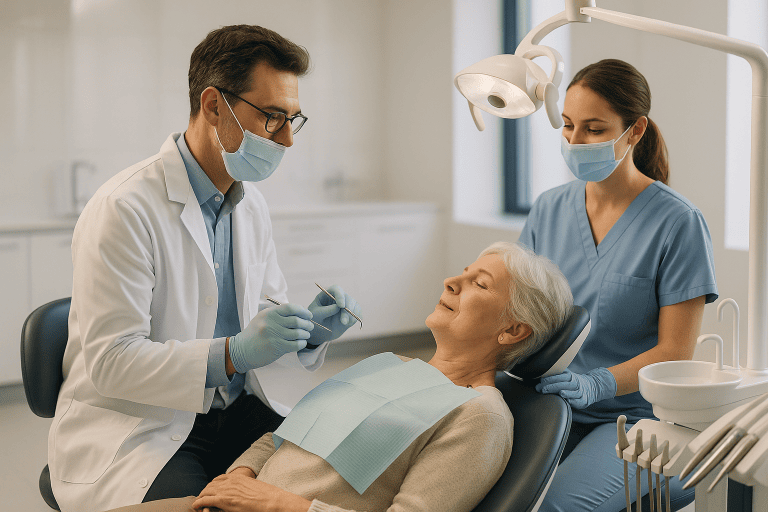
Dental Robotics
Dental robotics uses computer-guided planning and robotic assistance to support precise dental implant placement and selected oral procedures. It helps improve accuracy, safety, and patient comfort in appropriate cases.
Quick answer
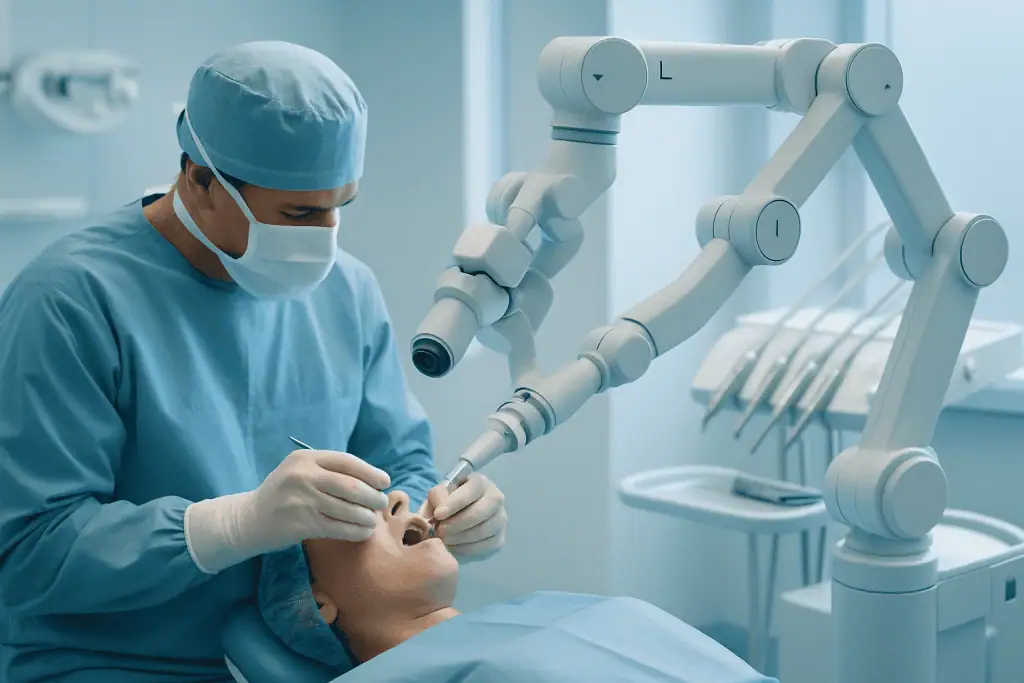
Dental robotics combines three-dimensional imaging, digital planning software and robotic guidance to help a dentist or oral surgeon place dental implants at a pre-planned position, angle and depth. The clinician stays in control throughout; the robot tracks the jaw and physically guides the instruments along the planned pathway. It is used mainly for implant placement, from a single tooth to full-arch rehabilitation.
What Dental Robotics Is
Dental robotics is the use of computer-guided planning and robotic assistance to help clinicians carry out certain dental procedures, most commonly the placement of dental implants. A digital plan built from three-dimensional imaging and intraoral scans defines where each implant should sit, its position, its angle and its depth, and the robotic system then helps the clinician follow that plan during surgery, on the patient’s actual anatomy, in real time. The clinician remains in control at every stage. The robot guides, tracks and constrains movement; it does not operate on its own.
Choosing implant treatment is a practical decision, but it is also an emotional one. Most patients are not simply asking whether an implant can replace a missing tooth. They are asking whether the procedure will be controlled and predictable, whether the result will look natural, how much discomfort to expect, and whether the planning behind the surgery can be trusted. For international patients these questions can feel sharper still. You may be comparing care options across countries, re-reading imaging reports, or seeking a second opinion after being told that your case is complex.
The purpose of robotic assistance is not to replace the skill of the dentist, oral surgeon or implantologist. It is to translate a carefully designed treatment plan into your anatomy with a high degree of control, nothing more, and nothing less. Understanding that distinction is the single most useful thing you can take from this page.
Which robotic systems are used in dentistry?
The field is small: a handful of robotic and navigation systems are used in implant dentistry worldwide. The system most people have in mind when they search in this area is Yomi, developed by the American company Neocis, which is covered in detail further down this page.
The sections that follow explain how the technology works, who it can genuinely help, what it cannot do, and how recovery unfolds.
Why implant precision is measured in millimetres
Implant dentistry depends on details measured in millimetres. The position, angle and depth of an implant influence chewing function, aesthetics, long-term stability, gum health and the design of the final crown or bridge. An implant placed a few millimetres away from its ideal position can complicate the restoration, crowd a neighbouring tooth root, or emerge from the gum at an angle that is difficult to disguise with the final tooth.
Precision matters most when the anatomy is demanding: limited bone, proximity to the nerve canal in the lower jaw or the sinus floor in the upper jaw, multiple missing teeth that must share a single restoration, or high aesthetic expectations at the front of the mouth. In these situations, careful digital planning, and a reliable way of transferring that plan to the surgical field, becomes especially valuable. Robotic guidance is one of the tools that makes this transfer more controlled.
Can robots do dental procedures?
Yes, within clearly defined limits, robots can assist with dental procedures, but they do not perform them independently. Current dental robotic systems are guidance platforms: they hold, steer or constrain surgical instruments so that the drilling and implant placement follow a plan the clinician designed in advance. The dentist or oral surgeon makes every clinical decision, performs the surgery, and can override or adjust the guidance at any moment if what they find in the mouth demands it.
What robots cannot do is diagnose, plan, judge tissue quality by feel, manage the unexpected, or communicate with the patient. They are best understood as a very steady extra pair of hands that never loses track of the plan, powerful in the right case, and unnecessary in many others.
At Acibadem, dental robotics is considered as part of a broader diagnostic and treatment pathway that includes clinical examination, three-dimensional imaging, digital oral scanning, prosthetic planning and specialist evaluation within the dental and oral health unit. For appropriate patients, robotic assistance can support a more controlled surgical experience and more predictable implant positioning, with a plan designed around both function and appearance.
Dental Robot Systems: Neocis, Yomi and What the Names Mean
It helps to be clear about what actually exists. The field is small. A handful of robotic and navigation systems are used in implant dentistry worldwide, and one name dominates the conversation.
What does a dental robot actually do?
A dental robot is a guidance tool, not an autonomous surgeon. During implant surgery it typically does four things: it tracks the position of the patient’s jaw continuously, so the plan stays aligned even if the patient moves; it steers or physically constrains the handpiece so the drill follows the planned trajectory; it controls depth, stopping the preparation at the planned point; and it gives the clinician visual and tactile feedback throughout the procedure. Some systems add haptic resistance: the instrument becomes harder to move the further it drifts from the planned pathway, which helps the surgeon stay inside the plan without looking away from the patient.
Everything else, anaesthesia, incisions, judging bone quality, deciding whether the plan still fits what is found during surgery, placing the implant, closing the site, remains the work of the clinical team.
Neocis and the Yomi dental robot
Neocis is the American medical technology company behind Yomi, and the Yomi dental robot is currently the best-known robotic system for dental implant surgery. Yomi works from a plan built on the patient’s cone-beam CT scan. During surgery, its robotic arm provides physical guidance for the drill while continuously tracking the patient’s jaw, so the guidance adapts if the patient shifts in the chair. The surgeon holds and moves the instrument at all times; the robot constrains the angle and depth to the plan.
In 2017, Yomi received FDA clearance, making the Neocis system the first dental implant robot cleared by the US Food and Drug Administration for robot-assisted dental surgery. Clearance means the regulator reviewed the device for its intended use; it is not a promise about individual outcomes, and availability varies by country, clinic and case. Other approaches, static surgical guides printed from the same digital plan, and dynamic navigation systems that display the drill position on a screen in real time, pursue the same goal of accurate plan transfer by different means. Your clinician chooses among them based on the anatomy, the number of implants and the restorative plan, not on novelty.
What are “robot teeth”?
“Robot teeth” is an informal phrase, not a clinical one: the teeth involved in robotic dentistry are entirely conventional. When people search for robot teeth, they usually mean teeth replaced with robotic assistance: standard titanium or ceramic implants topped with standard crowns, bridges or full-arch prostheses. The robot influences where the implant goes, not what the final tooth is made of or how it looks. If anything, a well-planned robotic case should produce teeth that look less artificial, because the implant position is chosen to support a natural emergence of the crown from the gum.
Will dental hygienists be replaced by robots?
No: there is no realistic prospect of dental hygienists being replaced by robots in the foreseeable future. Current dental robotics addresses one narrow task: guiding instruments along a pre-planned pathway in bone. Hygiene care is almost the opposite kind of work. It involves assessing soft tissue that changes from visit to visit, adapting instruments to individual anatomy by feel, spotting early signs of disease, and coaching patients on daily habits. Automation may eventually assist with specific technical tasks, but the core of the profession is diagnostic and human. The same holds for dentists and surgeons: robotics in dentistry has developed as an extension of the clinician’s hands, not a substitute for them.
Who May Consider Dental Robotics
Patients typically consider dental robotics when they need dental implants or when their case requires a high level of precision during oral surgery. Teeth are lost for many reasons: decay, gum disease, trauma, failed root canal treatment, congenital absence of teeth, or previous dental work that can no longer be maintained. Some patients have a single gap; others need multiple implants or full-arch rehabilitation of one or both jaws.
Common reasons people seek implant treatment include difficulty chewing, drifting of nearby teeth into the gap, changes in speech, visible spaces in the smile, discomfort from removable dentures, or loss of confidence in social and professional settings. Some patients arrive after being told that their jawbone is thin, that the implant site lies close to the sinus or a nerve, or that a previous implant failed. In these situations, digital planning and robotic assistance can help the treatment team understand the anatomy more clearly and carry out the surgical plan with greater control.
Diagnosis begins with a detailed dental and medical history. Your clinician will ask about missing teeth, previous dental procedures, gum health, bite problems, smoking or nicotine use, diabetes, osteoporosis medicines, blood thinners, immune conditions, and any history of head and neck radiation. These details matter because they can influence healing, infection risk, bone quality and the timing of implant placement.
A clinical examination then evaluates the teeth, gums, bite relationship, jaw movement and soft tissues. For implant planning, three-dimensional imaging is commonly used to assess bone height, width and density, and to map the location of important structures, nerves, sinuses, adjacent tooth roots and blood vessels. Digital impressions or intraoral scans create a precise model of the teeth and gums, often without conventional impression material. Photographs and bite records may also be collected, particularly when the front teeth or smile aesthetics are involved.
Robotic assistance tends to be discussed when the team wants to improve the transfer of the digital plan to the surgical procedure. That can be relevant for a single implant in a visible area, an implant near an important anatomical structure, several implants that must align accurately for a bridge, or a full-arch case where implant positions must support a fixed restoration. It may also appeal to patients who value a minimally invasive approach where the anatomy allows one, since accurate placement can sometimes reduce the need for larger incisions or extensive surgical exposure.
Not every patient is an immediate candidate. Active gum infection, untreated decay, inadequate oral hygiene, certain uncontrolled medical conditions or insufficient bone may need to be addressed first. Some patients require bone grafting, sinus augmentation, periodontal treatment, orthodontic preparation or extraction of teeth that cannot be saved before implants are placed. A personalised plan establishes the safest sequence for your particular mouth.
Conditions and Indications Dental Robotics Can Address
Dental robotics is most closely associated with implant placement, but its real value lies in the broader goal of precision-guided oral rehabilitation. It can serve patients with a single missing tooth, several missing teeth, or complete tooth loss in one or both jaws, and it supports planning in both straightforward and complex cases depending on the clinical need.
One common indication is replacement of a single missing tooth. The implant must be positioned so that the final crown looks natural, fits the bite and does not endanger neighbouring teeth. This is particularly demanding at the front of the mouth, where gum contours and tooth symmetry are highly visible and small positional errors are hard to hide.
Another indication is replacement of several missing teeth with an implant-supported bridge. Multiple implants must be placed in accurate relation to one another so that the bridge fits passively and distributes chewing forces appropriately. When implants are poorly aligned, the final restoration becomes harder to design, harder to clean and harder to maintain over the years.
Dental robotics may also be considered in full-arch implant rehabilitation. Patients who struggle with loose dentures or failing teeth may be candidates for a fixed, implant-supported set of teeth. These cases demand careful planning because a small number of implants must support an entire arch while respecting bone volume, facial aesthetics, speech and hygiene access.
Some patients have limited bone after years of tooth loss, gum disease or trauma. Robotic assistance can help the surgeon work within the bone that is available, or coordinate implant placement with grafting procedures where they are needed. It is also relevant when implants are planned near the maxillary sinus in the upper jaw or the inferior alveolar nerve in the lower jaw. Respecting these structures is essential to reduce the risk of complications such as sinus involvement, nerve irritation, numbness or pain, and a guided pathway makes it easier to keep the preparation exactly where it was planned.
Robotic planning can also contribute in revision situations. A patient may seek care after a failed implant, a poorly positioned implant, a fractured restoration or inadequate earlier planning. Revision dentistry requires careful reassessment, because bone, gum tissue and bite forces may have changed since the original treatment. Detailed digital planning helps the team understand what remains possible, though every revision case must be judged individually and honestly, sometimes the right answer involves staged treatment rather than a single ambitious procedure.
In selected oral procedures beyond implant placement, robotic guidance can support surgical precision, but its use depends on the indication, the treating team and the available clinical setup. The central principle never changes: digital planning is used to guide controlled movement within a patient-specific anatomical environment.
How Robotic Dental Implant Surgery Is Performed
Initial consultation and treatment planning
The process begins with a consultation focused on your goals, your dental condition and your overall health. Many international patients arrive with previous X-rays, CT scans, treatment plans or opinions from home. These records are useful, but new imaging or digital scans may still be recommended if the existing information is incomplete, outdated or unsuitable for implant planning: a decade-old panoramic X-ray, for example, cannot substitute for a current three-dimensional scan.
Your clinician evaluates whether the missing tooth or teeth should be replaced with implants at all, whether other options suit you better, and whether robotic assistance offers a meaningful benefit in your specific case. Planning covers both the surgical and the restorative side. In other words, the team plans not only where the implant will go, but what the final crown, bridge or full-arch prosthesis should look like and how it should function, and then works backwards from that result to determine the implant position. This is what clinicians mean by a prosthetically driven plan: the implant is placed where the final tooth needs support, not simply where bone happens to be available.
Three-dimensional imaging lets the team assess bone anatomy in detail. Intraoral scanning creates a digital model of the mouth. These datasets are combined in planning software so the clinician can design implant positions in relation to the bone, the gums, the remaining teeth and the planned restoration. That digital plan becomes the reference the robot follows during surgery.
Medical and dental preparation
Before treatment, any active infection or inflammation may need to be controlled. Patients with periodontal disease may need deep cleaning or gum therapy first. Teeth that cannot be restored may need extraction. If bone is insufficient, grafting may be performed before implant placement or, in some situations, at the same visit. Patients with complex medical conditions may need coordination with their physicians before surgery is scheduled.
You will receive instructions about eating and drinking before the procedure, oral hygiene, and what to expect afterwards; any questions about your regular medicines belong with your treating doctor, who will plan around them. Some patients are treated under local anaesthesia only, while others benefit from sedation depending on anxiety level, procedure length and medical suitability. That choice is made after clinical assessment and an open discussion with the care team.
How is robotic dental implant surgery done step by step?
The sequence below describes a typical robotic-assisted implant procedure from arrival to departure; details vary with the system used and the complexity of the case.
- Plan confirmation. The team reviews the digital plan against the day’s clinical findings and confirms the surgical site.
- Anaesthesia. Local anaesthetic numbs the area; if sedation is planned, monitoring is set up according to your needs.
- Registration. The robotic system is registered to your anatomy: the digital plan is matched to the actual position of your jaw and teeth, often via a small attachment. This step is critical: it tells the system where the planned implant pathway sits in real space.
- Verification. The clinician checks that tracking is accurate before any preparation begins.
- Guided site preparation. The implant site is prepared gradually with drills of increasing size, while the robot constrains position, angle and depth to the plan and tracks any movement of your jaw.
- Implant insertion. The implant, a small post of biocompatible material that acts as an artificial tooth root, is placed into the prepared site.
- Healing arrangement. Depending on the case, a healing cap is attached and the gum shaped around it, or the implant is covered by gum tissue and uncovered at a later visit.
- Immediate temporaries, if appropriate. Where implant stability and bite forces are favourable, temporary teeth may be fitted the same day; not every patient is a candidate, and the long-term plan always takes priority over speed.
- Aftercare briefing. The team explains what to expect in the first days and schedules follow-up.
Throughout every step, the clinician evaluates what the anatomy shows and adjusts where necessary. The robot enforces the plan; the surgeon owns the judgement.
Technology used in dental robotics
Dental robotics relies on several technologies working together. Three-dimensional dental imaging identifies bone volume, nerve pathways, sinus position and other anatomical landmarks. Digital oral scans capture tooth shape, gum contours and bite relationships. Planning software lets the clinician design implant positions around the final restoration. Robotic guidance or navigation then translates that plan into the surgical field. The same philosophy underpins robotic surgery across medicine: technology reduces uncertainty, and the clinician retains judgement and control.
These tools also change the patient’s experience of planning. The care team can review diagnostic information in advance, anticipate anatomical challenges, explain the recommended sequence clearly, and clarify whether treatment can be completed in one trip or needs staged visits: a practical point that matters greatly to anyone travelling for care.
How long does the procedure take?
The duration of robotic-assisted implant surgery depends on the number of implants, the need for extractions or grafting, the location of the implants and whether sedation is used. A single implant procedure can be relatively brief; multiple implants or full-arch rehabilitation takes considerably longer. Much of the work happens before the surgical day: the planning phase is an integral part of the treatment, not a formality.
The total treatment timeline typically spans consultation, imaging, planning, surgery, early healing review and later restoration. Some patients receive temporary teeth during the early phase; others need a healing period before the final crown or bridge is made. The care team explains the expected sequence based on your anatomy and goals rather than a standard schedule.
Recovery After Robotic-Assisted Implant Placement
Recovery after robotic-assisted implant placement is broadly the same as recovery after any carefully planned implant surgery. Many patients experience swelling, mild bleeding, tenderness and temporary difficulty chewing on the treated side. Discomfort is usually manageable with the measures your clinician recommends, cold compresses and careful oral hygiene; our guide to typical pain patterns after a dental implant describes what most patients feel in the first days.
You will usually be asked to eat soft foods at first: there are plenty of appealing options, and our list of soft foods to eat after dental implant surgery makes the early days easier to plan. Avoiding smoking, avoiding vigorous rinsing in the early period and keeping pressure away from the implant site all support healing; practical habits that help are collected in our guide on how to heal faster after dental implant surgery. Follow-up visits let the clinician check healing, remove sutures where needed and confirm that the implant is integrating properly.
Implant healing depends on osseointegration: the biological process in which bone attaches to the implant surface. This takes time. Even when the surgical visit itself is efficient, the body needs weeks to months to build a stable foundation for the final restoration. The exact timeline varies with bone quality, implant location, any grafting, medical factors and the type of restoration planned. Robotic guidance improves the accuracy of placement; it does not accelerate biology.
Recovery timeline at a glance
Recovery varies by patient and by procedure, but the following timeline describes what many patients can generally expect after implant placement.
| Time Period | What Patients Can Expect |
|---|---|
| Day 1 | Numbness gradually wears off. Mild bleeding, swelling and tenderness may occur. Soft foods, cold compresses and rest are usually recommended. |
| First week | Swelling and discomfort typically improve. Patients continue careful oral hygiene and avoid chewing directly on the implant site unless instructed otherwise. |
| First month | Soft-tissue healing progresses. Follow-up visits may be scheduled to check the gum tissue, the bite and early implant stability. |
| Healing phase | The implant integrates with the jawbone over time. If grafting was performed, healing may take longer before the final restoration is made. |
| Longer term | The final crown, bridge or full-arch restoration is placed when the implant is ready. Long-term maintenance means professional check-ups and excellent home care. |
Why Acting Early Matters
Delaying treatment for missing or failing teeth tends to make future care more complex. After a tooth is lost, the jawbone in that area gradually shrinks because it is no longer stimulated by a natural tooth root. Neighbouring teeth may drift into the gap, opposing teeth may over-erupt, and the bite becomes less stable. Each of these changes can affect chewing, speech, appearance, and the amount of bone left for implant placement.
Untreated gum disease or chronic dental infection also erodes future options. Infections around failing teeth damage bone and soft tissue, sometimes creating the need for additional procedures before implants become possible at all. Acting earlier can allow the team to preserve more bone, protect adjacent teeth and plan a more conservative approach.
Early evaluation does not always mean immediate surgery. Sometimes the right first step is diagnosis, periodontal treatment, extraction planning or simple monitoring. But a timely assessment lets you understand your options before further bone loss, tooth movement or infection narrows the choices. For anyone weighing treatment abroad, early planning also leaves time to organise records, travel, recovery days and any staged visits without pressure.
Benefits of Dental Robotics
For appropriate patients, robotic assistance can offer several practical benefits within a carefully planned implant pathway. None of them replaces good diagnosis or surgical skill; they build on it.
| Benefit | What It Means for You |
|---|---|
| More precise implant positioning | The implant can be placed according to a digital plan that considers bone anatomy, neighbouring teeth and the final restoration. |
| Improved protection of sensitive structures | Three-dimensional planning and guided execution help the clinician work at a safe distance from nerves, sinuses and adjacent roots. |
| Prosthetically driven planning | The implant position is designed around the crown, bridge or full-arch restoration, supporting better function and aesthetics. |
| Potentially less invasive surgery in selected cases | When anatomy and planning allow, accurate guidance may reduce the need for wider surgical exposure. |
| Clearer communication | Digital planning helps you understand the procedure, the expected stages and the reasons behind the recommended approach. |
| Support for complex cases | Robotic assistance may be useful when bone is limited, multiple implants are needed, or previous treatment has failed. |
Factors That Influence a Good Result
The success of implant treatment depends on far more than the technology used on the surgical day. Robotic assistance improves precision, but the overall result is shaped by diagnosis, planning, biology, surgical skill, restoration design and how the implant is cared for afterwards. It is worth understanding each of these honestly before deciding on any approach.
Bone quality and quantity come first. An implant needs sufficient bone for stability and long-term support. If bone is thin, soft or reduced by infection and years of tooth loss, grafting or an alternative implant position may be necessary. The upper back jaw is a common example: the sinus can limit the available bone height and demands specific planning.
Gum health is equally important. Active periodontal disease raises the risk of inflammation around implants. Patients with a history of gum disease can still be candidates, but they need thorough periodontal management first and consistent maintenance afterwards. Healthy soft tissue also underpins the aesthetics of the result, especially at the front of the mouth where the gumline frames every tooth.
Medical background influences healing. Diabetes, smoking or nicotine use, immune suppression, certain bone medicines and previous radiation therapy can all shape the treatment plan. These factors rarely rule out implants outright, but they require honest discussion and an individual risk assessment. A complete medical history, including supplements and every medicine you take, gives the team what it needs to plan properly.
The bite deserves attention too. Implants lack the ligament cushioning of natural teeth, so excessive force can stress the restoration or the surrounding bone. Patients who grind or clench may need bite adjustment, a protective night guard, or a restoration designed to manage force more evenly.
The restorative plan is central to the outcome. A well-placed implant still needs a well-designed crown, bridge or full-arch prosthesis, one that fits accurately, allows cleaning, supports speech and chewing, and suits the patient’s face and smile. This is why collaboration between the surgical and restorative clinicians from the very beginning matters more than any single piece of equipment.
Finally, your own participation counts. Following post-operative instructions, avoiding smoking, attending follow-up visits and maintaining daily oral hygiene all contribute to long-term implant health. Implants are not immune to inflammation: peri-implant disease can develop when plaque and risk factors go uncontrolled, and regular professional maintenance is what catches concerns early, while they are still simple to address.
Dental Robotics at Acibadem
At Acibadem, dental robotics sits within a structured evaluation and planning process rather than a one-size-fits-all procedure. Care is provided by experienced physicians and dental specialists who assess your anatomy, oral health, medical background and restorative goals before any technique is chosen. In complex cases, multidisciplinary discussion may involve oral and maxillofacial surgery, prosthodontics, periodontology, radiology, anaesthesiology and other relevant specialties, so that the surgical plan stays aligned with the final functional and aesthetic result.
The hospital setting is relevant for dental surgery in a specific way: patients who need advanced imaging, sedation assessment or medical consultation before an oral procedure can be evaluated within one system. Many implant patients have health considerations that must be understood before surgery, and access to broader medical expertise supports more careful planning.
Technology is treated as a clinical tool, not a selling point. Three-dimensional imaging, digital oral scanning, planning software and robotic guidance help clinicians plan more accurately and explain their recommendations more clearly, but the clinician decides whether robotic assistance genuinely adds value in your case, how the implant should be positioned, and which sequence balances safety, efficiency and long-term function. Some patients are suited to same-day extraction and implant placement; others need infection control, grafting, sinus procedures or a staged restorative approach; some are better served by a static guide or dynamic navigation than by a robot. A responsible recommendation explains not only what can be done, but why it fits your anatomy and goals, and states the limitations, such as insufficient bone or elevated healing risk, just as plainly.
For patients who travel for treatment, Acibadem International’s patient services coordinate the practical side: appointment scheduling, medical record transfer, language support and communication with the clinical team before, during and after the visit. This coordination matters in implant dentistry in particular, because treatment often involves staged visits, temporary restorations, healing periods and follow-up planning after the patient has returned home.
Making an Informed Decision
Dental robotics is a valuable option for patients who need precise implant placement and carefully planned oral rehabilitation. By combining detailed imaging, digital planning and robotic assistance, a dental team can work from a plan designed around your anatomy and your final restoration. For the right patient, that supports a more controlled procedure, more accurate implant positioning and a more confident path towards restored chewing function and appearance. For other patients, a conventional or guide-based approach achieves the same ends: the technique should follow the case, never the other way round.
Whatever route you consider, a sound treatment plan should be able to answer a consistent set of questions:
- What will the final teeth look like, and how was the implant position derived from that result?
- Is there enough bone, and if not, what preparation is needed first?
- Which technique, robotic guidance, a static guide, dynamic navigation or freehand surgery, suits this specific anatomy, and why?
- How many visits and how much healing time does the full sequence involve?
- What are the specific risks in this mouth, and how will they be managed?
- What maintenance will the restoration need over the years?
A plan that answers these questions clearly, including its limits, tells you more about the quality of your future care than any single piece of technology. Robotic guidance can execute an excellent plan with remarkable fidelity; it is the thinking behind the plan, and the honesty with which it is explained, that determines whether the result serves you for decades.
Preparation
- Preparation begins with a dental examination, medical history review, and digital imaging to assess bone structure and treatment suitability. Your dentist may adjust medications, treat gum infection, or recommend oral hygiene steps before the procedure. Smoking and alcohol should usually be avoided before implant-related treatment.
Aftercare
- Mild swelling, tenderness, or minor bleeding can occur after robot-assisted dental procedures and usually improves within a few days. Follow prescribed medications, oral hygiene instructions, and dietary recommendations, such as eating soft foods initially. Attend follow-up visits so your dentist can monitor healing and implant integration if implants are placed.
Frequently Asked Questions
What affects the cost of dental robotics?
The final cost depends on the complexity of the case, the number and position of implants, the need for grafting or extractions, the implant and prosthetic materials, the imaging and planning workflow, anaesthesia needs, and what is included in the care package.
How can I get a personalised quote?
A personalised quote usually requires dental photographs, recent imaging if available, a medical history, and a specialist review. Acibadem International can arrange a free consultation to assess suitability and provide a tailored treatment plan.
Is robot-assisted dental implant surgery always more suitable than conventional implant surgery?
Not always. Robotic assistance may be useful in appropriate cases, but some patients may be better suited to static guided, navigation-assisted, or conventional implant placement. A specialist decides based on anatomy, bone quality, treatment goals, and overall health.
What is typically included in an international dental robotics package?
Packages may include consultation, imaging, digital planning, the surgical procedure, selected medications, translation support, appointment coordination, and follow-up planning. Patients should confirm whether implants, crowns, temporary teeth, transfers, and accommodation are included.
Will I need more than one visit?
Some treatments can be coordinated within a planned visit, while others require staged care for healing, grafting, implant integration, or final prosthetic work. The schedule depends on clinical findings and the treatment plan.
Medically reviewed by the Acıbadem International Medical Board September 13, 2026
See our medical review board →
Update history
- PublishedJune 8, 2026
- Medical review approvedSeptember 13, 2026
- Last content updateSeptember 12, 2026
References2
- Dental Implants my.clevelandclinic.org
- Dental Care nhs.uk
Trusted care for international patients
From the Acibadem Blog
Dental Robotics Myths: Does the Robot Operate Alone, and What Does the Surgeon Still Control?
No, a dental robot does not operate alone. In robot-assisted implant surgery, the surgeon plans the implant position on a 3D scan, then holds…
Who Benefits Most From Dental Robotics? Tight Spaces, Full-Arch Cases and Limited Bone
Dental robotics most often helps when the margin for error is thin: a single narrow gap between healthy teeth, a full-arch case where several…
Dental Robotics vs Static Surgical Guides: Two Ways to Place Implants by the Plan Compared
Robotic vs guided implant surgery compares two ways of transferring a digital implant plan into the jaw. A static surgical guide is a 3D-printed…