Hair Transplant Without Shaving
Hair transplant without shaving restores hair density while keeping existing hair length largely unchanged. It is a discreet option using selected FUE or DHI techniques for suitable candidates.
Quick answer
A hair transplant without shaving moves healthy follicles from the back or sides of the scalp into thinning areas while your existing hair stays at its usual length. Surgeons use unshaven FUE or DHI-style implantation, sometimes trimming only a small hidden donor zone. It suits smaller sessions and patients who want a discreet recovery, though mild redness and crusting can still occur during healing.
Hair Transplant Without Shaving: Restoring Density Without Changing How You Look
A hair transplant without shaving is a surgical hair restoration procedure in which healthy follicles are moved from a donor area, usually the back or sides of the scalp, into areas of thinning, while most or all of your existing hair stays at its usual length. It uses refined follicular unit extraction or direct implantation techniques instead of a full head shave. It is designed for men and women who want restoration with far less visible disruption during the early weeks of healing.
If you are weighing up this procedure, the medical questions are probably only part of your concern. The practical ones matter just as much. Will colleagues notice? How soon can you return to work, travel or social life? Can the result look natural if you keep your existing hair length? These are reasonable questions, and the honest answers depend on your hair, your pattern of loss and the technique chosen, not on marketing.
In some cases only a small donor zone is trimmed and hidden beneath the surrounding hair. In others, the procedure can be performed with no visible shaving at all, depending on the size of the transplant, the donor characteristics and the planned technique. That flexibility is what makes the approach valuable for executives, public-facing professionals, women with pattern hair loss, and men who are simply not ready to change their hairstyle for several months.
One thing should be clear from the start: an unshaven transplant is not a cosmetic variation of a standard one. It requires careful candidate selection, precise planning and significant technical skill, because working among existing hairs leaves less room for error. The purpose of treatment is not only to add hair. It is to restore density in a way that respects your age, facial structure, hair direction, donor supply and future hair loss pattern. A natural result depends on thousands of small decisions: where the hairline sits, how each graft is angled, how donor follicles are preserved, and how your existing hair is protected during implantation.
Can you get a hair transplant without shaving your head?
Yes, in properly selected cases you can. There are three practical levels of discretion. A fully unshaven procedure leaves both the donor and recipient hair at length; it is the slowest option and generally suits smaller sessions. A partially shaven procedure trims a narrow strip or small windows in the donor area, concealed by the hair above, and allows a larger number of grafts. A conventional shaven session remains the most efficient choice for extensive work. Whether the unshaven route is realistic for you depends on how many grafts you need, how dense and long your donor hair is, and which technique your surgeon judges safest for graft survival. The term describes a preserved appearance, not invisibility: mild redness, small crusts, temporary swelling or local tenderness can still occur after surgery, even when longer hair conceals them well.
What Is a No Shave Hair Transplant?
A no shave hair transplant is a refined form of surgical hair restoration in which follicular units are moved from a donor area to areas of thinning or loss while the surrounding hair remains largely uncut. The transplanted follicles are typically resistant to the hormonal and genetic processes that drive androgenetic hair loss, which is why they can continue growing in their new location once healing is complete. The biology is identical to any other modern transplant; what changes is how the surgical team works around your existing hair.
Two main techniques are used. In an FUE hair transplant, individual follicular units are removed from the donor area with very small circular punches, prepared under magnification, and placed into tiny recipient sites created in the thinning area. In DHI hair transplant approaches, grafts are loaded into specialised implanter instruments that let the surgeon control depth, angle and direction while working directly between existing hairs. Both methods avoid a linear donor incision, and both can be adapted to unshaven or minimally shaven work when the case is suitable.
In a standard FUE session, the donor area is usually shaved because it makes extraction faster and the follicle angles easier to see. In an unshaven or partially shaven procedure, the team works around longer hairs or trims only zones that the hair above can hide. This is more discreet, but also more technically demanding. Assistants must separate strands, identify healthy follicular units, and extract them without damaging their neighbours. Recipient placement demands equally careful spacing, so that existing hairs are not injured and the new grafts blend into your natural pattern rather than fighting it.
There are several variations worth understanding before you compare clinics:
- Partially shaven: a narrow strip or small windows in the donor area are trimmed and hidden by the surrounding hair. This is often practical for patients with medium or long hair and allows a meaningful graft number while keeping visible change minimal.
- Fully unshaven: no obvious shaving in either the donor or the recipient area. This is more time-consuming and is usually best suited to smaller sessions or carefully selected patients.
- Recipient-area preservation: the donor zone is trimmed conventionally, but the existing hair in the thinning area is left at length, sometimes used when the loss sits behind an intact hairline that can cover the donor during healing.
Your treating physician determines which option is medically appropriate after evaluating donor density, hair length, curl, scalp laxity, the pattern of thinning and your goals. Preference matters, but graft survival matters more.
What is no shave FUE?
No shave FUE, often written as unshaven FUE or U-FUE, is follicular unit extraction performed while the donor hair stays long. In some protocols, individual hairs are trimmed at skin level one by one as each graft is extracted, so no trimmed patch is ever visible. In others, tiny concealed windows are opened beneath the longer hair. The method is described in more detail on our Unshaven (U-FUE) Hair Transplant page. Because every graft must be located and freed among full-length hair, extraction takes longer and demands more from the surgical team. This is why not every clinic offers it, and why session sizes are usually smaller than in shaven work.
How does a no shave FUE hair transplant differ from a standard session?
A no shave FUE hair transplant follows exactly the same biological steps as a shaven one, extraction, graft preparation, implantation, so the differences are practical rather than medical. Expect a longer procedure day for the same graft number, a lower practical ceiling on grafts per session, and a greater dependence on the experience and organisation of the team. In exchange, you keep your hairstyle, your recovery is easier to keep private, and there is no waiting period while shaved hair grows back. If you need a large area covered, your surgeon may recommend staging the work over more than one session, or discussing honestly whether a small concealed trim gives a better balance of discretion and surgical efficiency.
What is a long hair transplant?
A long hair transplant is a variation in which selected grafts are implanted with their hair shafts left at length rather than trimmed short. The immediate advantage is preview: you and the surgeon can see the direction, angle and distribution of the transplanted hair on the day of surgery. The limitation is that these long transplanted hairs still shed in the weeks that follow, exactly as short grafts do, before regrowing over the following months. The preview is temporary, not the final result. Long hair work is technically demanding and offered selectively; it is usually discussed for hairline refinement and smaller cases rather than large sessions, and it does not change the underlying growth timeline.
Who Is a Good Candidate for an Unshaven Hair Transplant?
An unshaven hair transplant may suit men and women who have stable or medically manageable hair loss and enough healthy donor hair to support transplantation. The typical candidate wants to improve density or restore a hairline while minimising the visible signs of surgery during early healing. Suitability rests on medical, anatomical and aesthetic factors, never on preference alone.
Patients usually seek this treatment after noticing a widening parting, thinning at the crown, recession at the temples, reduced frontal density or visible scalp under bright light. Some have already tried topical or oral hair loss therapies and now want a surgical option for areas where follicles have miniaturised or disappeared. Others have localised loss from previous surgery, trauma or scarring, cases that need especially careful evaluation, because scar tissue heals differently and its blood supply is less predictable.
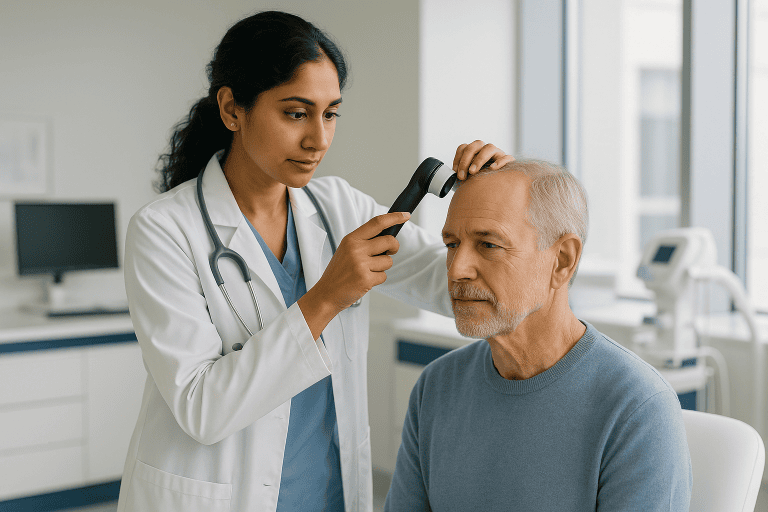
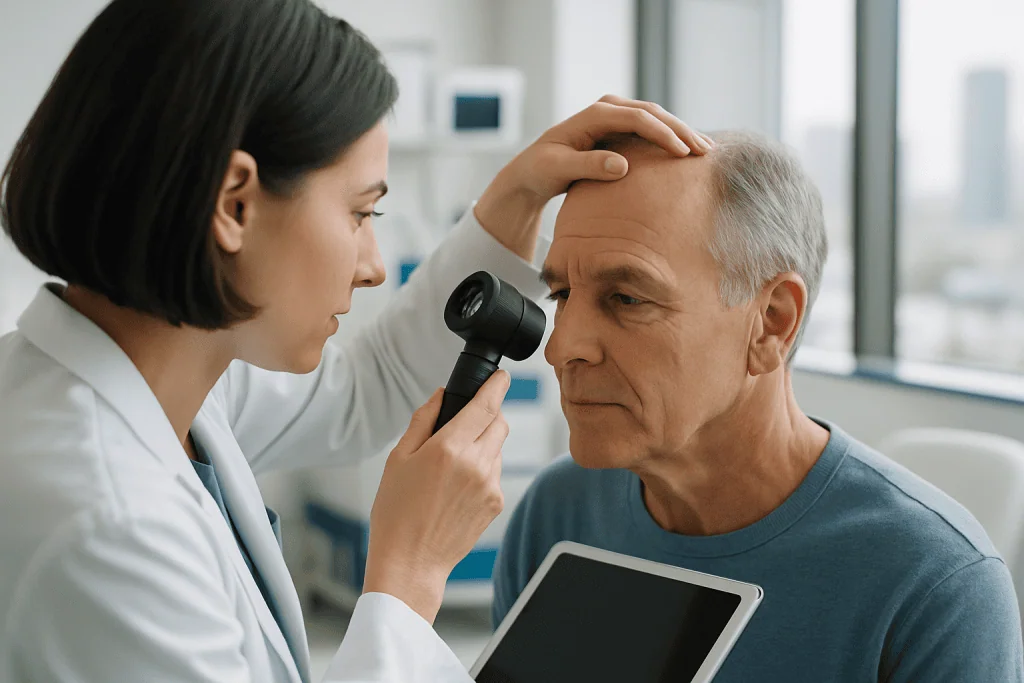
Diagnosis begins with a detailed consultation. The physician reviews the pattern and duration of hair loss, family history, medications, previous treatments, hormonal or dermatological conditions, and lifestyle factors such as smoking or nutritional issues. Scalp examination may include magnified imaging or trichoscopic assessment to evaluate hair shaft thickness, donor density, miniaturisation, inflammation and the ratio of single-hair to multiple-hair follicular units. When indicated, blood tests or dermatology input may be recommended, particularly for women, for diffuse shedding, for suspected autoimmune conditions or for hair loss that began suddenly.
Good candidates have realistic expectations. Transplantation redistributes existing follicles; it does not create an unlimited new supply. If the donor area is weak, if loss is progressing rapidly, or if you expect very high density across a large bald area in one session, the plan will need adjusting. Sometimes medical therapy is discussed before or after surgery to help stabilise existing hair and protect the long-term result: a decision that always belongs to the treating doctor.
Unshaven transplantation may be especially appropriate if you:
- Have early to moderate hairline recession and want a discreet correction.
- Have localised thinning with enough surrounding hair to camouflage the healing period.
- Are a woman with a suitable thinning pattern and adequate donor density.
- Cannot easily shave your head for professional, social or personal reasons.
- Want refinement after a previous transplant, where donor planning remains favourable.
- Have medium or longer hair that can cover a small trimmed donor zone.
What disqualifies you from a hair transplant?
No single factor automatically rules everyone out, but several findings commonly lead a responsible surgeon to defer or decline. Very large bald areas combined with weak donor density are the most frequent reason: the arithmetic of available grafts simply does not support the goal. Active, rapidly progressing shedding is another, because transplanting into an unstable scalp risks chasing a moving target. Active scalp disease, including scarring alopecias, uncontrolled dermatitis, psoriasis or folliculitis, usually needs treatment first. Uncontrolled medical conditions that impair healing, and expectations of density that the donor supply cannot deliver, also count against surgery. Importantly, many of these barriers are temporary or manageable. The alternative to an immediate transplant may be a staged plan, a period of medical stabilisation, a standard shaven technique that harvests more efficiently, or a different restoration strategy altogether.
FUE Hair Transplant for Women
Interest in the kind of FUE hair transplant women can have without cutting their hair has grown steadily, and unshaven techniques are a large part of the reason. Most women keep their hair at length, and a shaved donor area is often simply unacceptable, professionally, socially or personally. Female pattern loss also tends to be more diffuse than male pattern loss, with a widening central parting rather than a receding hairline, which changes both the planning and the placement strategy. Because diffuse shedding in women can have hormonal, nutritional, autoimmune or medication-related causes, a proper diagnostic work-up matters even more than it does for men: not every thinning scalp is a surgical scalp. When the diagnosis is androgenetic loss and the donor area is strong, unshaven approaches can deliver meaningful improvement without visible disruption. You can read more about the specific considerations on our Hair Transplant For Women page.
Conditions and Indications Addressed
Hair transplant without shaving is most often used to treat androgenetic alopecia, male or female pattern hair loss. In men, this typically appears as recession at the temples, thinning of the frontal hairline or loss at the crown. In women, the pattern is usually more diffuse: a widening of the central parting or reduced density across the top of the scalp, often with the frontal hairline preserved. Because women are more likely to wear their hair long and to be concerned about visible shaving, unshaven techniques are an important option whenever the donor characteristics support them.
The procedure can also address selected cases of localised hair loss. This includes thinning after previous cosmetic surgery, small traumatic scars, carefully assessed burn scars, and correction of unnatural density from earlier transplant work. Scar tissue behaves differently from normal scalp and its blood supply is less predictable, so planning in these cases is individualised and sometimes deliberately staged.
Some patients request hairline lowering or hairline refinement. Here, conservative design is essential. The physician must account for future ageing and the possibility of continued loss behind the new hairline: a line placed too low or built too densely can become difficult to maintain if progression continues. Responsible planning therefore always includes a discussion of long-term donor preservation, how much donor hair to use now, and how much to hold in reserve.
Eyebrow, beard and moustache restoration use related follicular transfer principles, but they are separate procedures with different technical details and are planned on their own terms. For the scalp, the main indications of unshaven work remain restoring density, improving how the hairline frames the face, camouflaging thinning areas, and refining previous work in properly selected patients.
How a Hair Transplant Without Shaving Is Performed
Can a hair transplant be done without shaving the head?
Yes. Performing a hair transplant without shaving head hair at all is possible in selected cases, typically smaller sessions where each donor follicle can be trimmed individually at skin level or harvested through concealed windows. For larger graft numbers, most surgeons recommend at least a partial hidden trim, because it improves visibility during extraction and protects graft quality. The right level of shaving is a surgical judgement, made after examining your donor area, not a menu choice. What follows is the typical pathway from first assessment to early recovery.
Consultation and personalised planning
The process begins well before the procedure day. A thorough consultation establishes whether unshaven transplantation is genuinely your best option, or whether a partially shaven or standard technique would produce a better medical and aesthetic result. For international patients, initial evaluation often starts with photographs, medical history and a discussion of goals; in-person examination confirms the final plan after arrival.
The physician evaluates donor quality, hair calibre, curl, the contrast between hair and scalp colour, the size of the recipient area and the likely progression of your hair loss. Hairline design considers facial proportions, age, ethnicity, gender, natural hair direction and the soft irregularity of a real hairline. The number of grafts is estimated from the area to be treated and the safe donor supply, and the plan should state plainly what one session can achieve and what may need future treatment. You will also receive instructions covering hair products, smoking, alcohol and scalp care. Any question about pausing medicines that affect bleeding is decided by the doctors who prescribe them, in coordination with the surgical team, and chronic conditions such as hypertension, diabetes, thyroid disease or autoimmune disease are reviewed as part of this planning.
Preparation on the day of treatment
On the day of surgery, the team reviews consent, confirms the treatment plan and marks the donor and recipient areas. Clinical photographs document the starting point. The hair may be washed with an antiseptic preparation. If partial shaving is planned, a small donor zone is trimmed so that the surrounding hair covers it afterwards; in fully unshaven cases, the team organises the existing hair and works around it, which takes more time. Local anaesthetic numbs the donor and recipient areas. You are usually awake and can rest during the procedure; sedation practices vary with medical assessment and individual needs, and comfort is monitored throughout the day, with breaks scheduled for longer sessions.
Follicle extraction
During extraction, the surgeon removes individual follicular units, each containing one, two, three or more hairs, from the donor area. The extraction pattern is deliberately distributed to avoid overharvesting and to preserve a natural donor appearance. In unshaven cases, longer hair makes visualisation harder, so the team separates strands, reads each follicle’s direction and works with micro-instruments at close magnification. Fine punches and controlled extraction reduce trauma to the follicles and the surrounding tissue. After removal, grafts are kept in controlled storage conditions and handled gently; experienced technicians sort them by size and hair count, so single-hair grafts can build a soft front hairline while multi-hair grafts supply density behind it.
Recipient site creation and implantation
The recipient area is mapped according to natural hair direction, angle and density. In FUE-based placement, tiny channels are opened in the scalp before grafts are inserted. In DHI-style approaches, implanter pens place follicles directly while controlling angle and depth in a single motion. The choice depends on your hair characteristics, the area being treated and the surgeon’s preferred method. When working without shaving, protecting your existing hair is a central priority: the team must implant between native hairs without cutting them and without crowding grafts, which matters most in diffuse thinning where living miniaturised hairs are still present. In sequence, a typical procedure day runs as follows:
- Final design confirmation, marking and photographs.
- Local anaesthetic in the donor area.
- Graft extraction, sorting and controlled storage.
- Local anaesthetic in the recipient area.
- Channel creation (FUE) or direct placement (DHI-style).
- Implantation graft by graft, checking angle and spacing.
- Final review, donor dressing where needed, and aftercare briefing.
A typical unshaven transplant takes several hours and can last most of the day. Smaller refinements are shorter; larger sessions are more demanding and may need staging. Because fully unshaven extraction and placement are slower, the maximum practical graft number is lower than in a fully shaven FUE session, one more reason honest planning matters more than an impressive quoted number.
Aftercare and early recovery
Before you leave, the team explains how to sleep, how and when to wash, how to protect the grafts and what normal early symptoms look like. The donor area may feel tight or tender for a few days; the recipient area may show redness, small crusts and mild swelling. Longer existing hair helps conceal these changes, but the transplanted zone still needs careful handling. You will usually be advised to avoid touching or scratching the grafts, strenuous exercise, swimming, saunas, direct sun and anything that rubs the recipient area during early healing. Washing begins on the clinic’s schedule, with gentle techniques designed to soften crusts without dislodging grafts. Step-by-step instructions are collected in our guide to hair transplant aftercare.
Transplanted hairs commonly shed in the weeks after surgery. This can be unsettling, but it is a normal part of the hair cycle after transplantation: the follicles remain beneath the skin and gradually begin producing new hair over the following months. Visible density builds progressively, final maturation takes many months, and crown areas often lag behind the frontal scalp. A detailed month-by-month picture is set out in our hair transplant recovery timeline.
Why Acting Early Matters
Hair loss is usually progressive. Acting early does not mean rushing into surgery; it means getting an accurate diagnosis and building a long-term plan before the donor supply is used inefficiently or the thinning area grows much larger. Early assessment can identify whether your hair loss is genetic, inflammatory, hormonal, nutritional, medication-related or caused by another medical condition. Some causes of shedding are reversible or need medical treatment rather than transplant surgery, and finding that out early changes everything about the plan.
For pattern hair loss, early planning protects your future options. If a hairline is lowered aggressively while untreated loss continues behind it, you may later need additional procedures just to keep the result balanced. Conversely, if appropriate medical treatment stabilises your existing hair early, less surgery may be needed overall. The right timing is individual: some patients benefit from a period of stabilisation before transplantation, while others have stable, localised loss that can be addressed sooner.
Delaying evaluation carries its own costs. Thinning can progress to a point where the density you want is harder to achieve with the donor hair available. The psychological weight can grow too, many patients describe changing hairstyles, avoiding photographs or limiting social plans long before they seek help. Even when the right recommendation turns out to be observation or medical therapy rather than surgery, an accurate early diagnosis brings that clarity.
Benefits of a Hair Transplant Without Shaving
The advantages of unshaven transplantation are best read against your own goals, lifestyle and medical suitability: they are real, but they apply to selected patients, not to everyone.
| Benefit | What It Means for You |
|---|---|
| More discreet recovery | Existing hair can help cover donor trimming, redness or crusting, making early healing less visible in many patients. |
| Natural-looking integration | Grafts are placed among existing hairs with attention to angle, direction and density, helping new growth blend with your current hairstyle. |
| No major hairstyle change | Many patients keep their usual hair length, which can matter for work, travel or personal comfort. |
| Lasting redistribution of donor follicles | Follicles taken from stable donor areas are intended to keep growing in the recipient area after the normal healing and growth cycle. |
| Personalised planning for future hair loss | A responsible plan considers not only today’s thinning but also donor preservation and the likelihood of future progression. |
| Suitable for selected men and women | The technique can be considered across different hair loss patterns when donor density, scalp health and goals are appropriate. |
Recovery Timeline After an Unshaven Hair Transplant
Recovery varies with graft number, technique, skin sensitivity and how closely you follow aftercare, but most patients move through a broadly similar pattern of healing and regrowth.
| Time Period | What to Expect |
|---|---|
| Day 1 | The scalp may feel numb, tight or mildly tender. Small crusts and redness may be visible in the recipient area. You receive detailed washing, sleeping and activity instructions. |
| First week | Swelling, redness and crusting gradually settle. Gentle washing is performed as directed. Most patients avoid strenuous exercise, sun exposure and anything that rubs the grafts. |
| First month | Many transplanted hairs shed: an expected phase, not a lost result. The scalp usually looks calmer, and existing longer hair makes healing easier to conceal. |
| Three to six months | Early new growth typically begins. Hair may at first be fine or uneven, then gradually thickens. |
| Longer term | Density and texture continue to mature. The final cosmetic impression develops progressively, with ongoing care focused on protecting native hair and scalp health. |
Two practical points come up repeatedly. First, sleeping position matters in the early nights: keeping pressure off the recipient area protects fresh grafts, and your clinic will tell you when normal positions can resume. Second, headwear needs timing: a loose covering may be permitted early for sun protection, while anything that rubs the grafts waits longer. In an unshaven procedure, both issues are easier to manage than many patients fear, because the surrounding hair itself offers cover during the most visible days.
Factors That Influence a Good Result
The outcome of an unshaven transplant depends on several interrelated factors, and the most important is patient selection. Someone with stable localised thinning, strong donor density and realistic goals is far more likely to be satisfied than someone with diffuse active shedding and a limited donor supply. Hair calibre matters too: coarser or slightly wavy hair creates more visual coverage than very fine, straight hair, even at the same graft count. The contrast between hair colour and scalp colour also shapes how dense a result appears.
Donor management is central to long-term success. The donor area is finite, so follicles must be harvested conservatively and distributed wisely. Overharvesting creates visible thinning at the back or sides and closes off options for future procedures. In unshaven surgery, harvesting demands extra precision, because the surrounding hair is not fully trimmed and follicle direction is harder to see.
Hairline design is the next critical factor. A natural hairline is not a straight line: it carries soft irregularities, age- and gender-appropriate recession, and a gradual transition from fine single hairs to denser multi-hair units. A hairline that is too low, too dense or too uniform can look artificial, especially as the face ages or if loss progresses behind it. Experienced planning balances immediate improvement against long-term credibility.
Graft handling strongly affects growth. Follicles are delicate living tissue. They must be extracted with minimal trauma, kept hydrated, organised carefully and implanted at the correct depth and angle. The time grafts spend outside the body, the quality of storage conditions and the coordination of the team all matter. Technology assists each of these steps, but technique and judgement remain decisive.
Scalp health influences outcomes as well. Active dermatitis, infection, scarring alopecia or uncontrolled inflammation can compromise healing and graft survival, so conditions such as dandruff, psoriasis or folliculitis may need treatment before transplantation. General health plays its part: smoking, poorly controlled diabetes, nutritional deficiencies and certain medicines can affect healing, and the medical team reviews all of this before surgery.
Aftercare is a shared responsibility. Even a well-performed transplant can be undermined if grafts are rubbed, scratched, knocked or washed incorrectly in the first days. Following instructions closely and attending scheduled checks protects the work already done. Unusual pain, increasing redness, discharge or fever are not part of normal healing and are always taken seriously in follow-up.
Finally, ongoing hair loss management often determines how the result ages. Transplanted hair may keep growing while native, non-transplanted hair continues to thin around it. Many patients benefit from a medical maintenance plan agreed with their treating doctor, which may include prescription or non-prescription therapies when appropriate. The aim is to preserve existing hair, plan future needs responsibly and avoid spending donor hair faster than necessary.
What is the success rate of no shave FUE?
There is no single, honest number. Clinics define success differently, some count graft survival, some measure density, some report patient satisfaction, and those measures are not comparable across providers. What can be said with confidence is that the unshaven approach itself does not change follicle biology: a well-selected graft, extracted with minimal trauma and implanted correctly, behaves the same whether the surrounding hair was shaved or not. What the unshaven approach does change is difficulty. Because extraction and placement are harder among full-length hair, the experience of the surgeon and team weighs even more heavily than usual. Treat any flat success figure quoted without context, especially one attached to a sales pitch, with caution, and judge a clinic instead on its selection criteria, its planning process and its willingness to say no.
How Much Does a No-Shave Hair Transplant Cost?
There is no meaningful universal price, and any page that quotes one without examining your scalp is guessing. What can be explained honestly is what drives the cost. The number of grafts is the largest factor, because it determines surgical time and team size. The level of discretion matters too: fully unshaven work is slower than partially shaven work, and slower surgery means more clinical hours per graft. The technique chosen, the surgeon’s direct involvement, the facility standard and what the quoted package actually includes, consultations, medications, post-operative washes, follow-up reviews, all move the figure. When you compare quotations, compare their contents, not just their totals: a lower headline price that excludes follow-up care is not the same product as a complete pathway. And be wary of any offer built around a maximum graft count rather than a diagnosis; in unshaven surgery especially, the right number of grafts is a medical conclusion, not a bargaining position.
How Acibadem Approaches Unshaven Hair Transplantation
At Acibadem, hair transplantation is treated as a medical procedure requiring diagnosis, surgical judgement and individualised planning, not as a cosmetic appointment with a fixed menu. Physicians assess the pattern of hair loss, donor capacity, scalp condition and your preference for discretion before any technique is proposed.
When unshaven transplantation is appropriate, the team discusses whether a fully unshaven or partially shaven method serves you better. The distinction matters. You may want no visible shaving at all, but a small concealed donor trim can allow safer extraction and a stronger graft plan. Talking this through openly before surgery prevents the mismatch between expectation and outcome that causes most disappointment in hair restoration.
Multidisciplinary support is available when it is needed. Some hair loss is linked to dermatological disease, hormonal conditions, prior surgery or medical treatments, and in those situations input from the relevant specialists helps determine whether transplant surgery is advisable and whether other treatment should come first. Evidence-based protocols guide decisions around patient safety, infection prevention, anaesthesia, medication review and follow-up.
Technology supports the clinical pathway at several stages: high-resolution scalp assessment and magnification for evaluating donor and recipient areas, fine surgical instruments for lower-trauma extraction and implantation, controlled graft-handling systems to maintain viability during the procedure, and digital imaging for documentation and planning. These tools are most valuable inside an experienced surgical workflow, where each graft is selected and placed according to a coherent aesthetic plan.
For patients travelling from abroad, logistics can matter as much as the surgery itself. Acibadem International provides coordination in more than 20 languages, covering appointment scheduling, medical record transfer, interpretation, hospital admission processes and follow-up communication, particularly relevant for hair transplant patients who arrive for a short stay and need clear instructions for the first days after treatment and after returning home.
Personalisation runs through the whole process. Not every patient is a candidate for unshaven transplantation, and not every candidate should have the maximum possible graft count. A careful plan may recommend medical treatment first, a smaller discreet session, a staged approach, or a different technique entirely if it will produce a better result. That measured approach protects donor hair and supports a more natural long-term outcome. Discretion is respected throughout, but the team will also prepare you honestly for visible healing signs and the normal shedding phase, because knowing what to expect is one of the most important parts of a good treatment experience.
What a Consultation for Unshaven Transplantation Involves
A proper evaluation for a hair transplant without shaving covers more ground than a quote. It typically includes clear photographs of the scalp from several angles, a full medical and hair loss history, and, in person, magnified examination of both the donor and recipient areas. From that assessment, the physician can explain which level of discretion is realistic in your case, roughly how many grafts the plan requires, which technique fits your hair characteristics, what one session can and cannot deliver, and whether medical therapy belongs in your long-term plan.
A good consultation also answers the uncomfortable questions: how your loss is likely to progress, how much donor hair should stay in reserve, and what the healing period will actually look like day by day with your hair length. If the honest answer is that a partially shaven approach, or waiting, or medical stabilisation first, would serve you better than the procedure you arrived asking for, that answer should be given plainly. A personalised treatment plan explains not only what can be done, but what should be done for a natural, sustainable result.
Preparation
- A specialist evaluates hair loss pattern, donor area quality, medical history, and expectations to confirm suitability for an unshaven technique. Patients may be asked to stop smoking, avoid alcohol, and pause certain blood-thinning medicines if medically appropriate. Hair and scalp should be clean on the day of the procedure, and detailed instructions are provided before treatment.
Aftercare
- Mild swelling, redness, and crusting can occur and usually improve within days. Patients should protect the grafts, avoid scratching, heavy exercise, swimming, and direct sun exposure during the early healing period. Washing is restarted according to the clinic’s instructions, and follow-up visits help monitor graft survival and growth progress.
Frequently Asked Questions
What affects the cost of a hair transplant without shaving?
The main factors are the technique used, the planned graft volume, donor hair quality, target density, surgeon involvement, hospital or clinic standards, anesthesia and medication needs, and whether travel, translation, transfers, and aftercare are included. A specialist assessment is needed for a personalised quote.
Does an unshaven hair transplant usually cost more than a shaven procedure?
It may cost more because unshaven techniques can require more time, detailed planning, and delicate handling of existing hair. The difference depends on your hair characteristics, the selected method, and the clinical team’s approach.
How can I get an accurate quote from Acibadem?
You can request a free consultation and share clear photos, your hair loss history, any previous treatments, and your expectations. The medical team can then review suitability and prepare a personalised plan and quote. This information is general and is not medical or financial advice.
What is usually included in a Turkey hair transplant package?
Package contents vary, but may include specialist evaluation, procedure planning, hospital services, medications, post-procedure hair wash guidance, follow-up communication, translation support, transfers, and accommodation coordination. Always confirm inclusions in writing before booking.
Am I a candidate for a fully unshaven hair transplant?
Candidacy depends on donor density, hair length, hair texture, recipient area size, hair loss pattern, and the number of grafts needed. Some patients are better suited to a partially unshaven or standard shaven approach, which a specialist can determine.
Medically reviewed by the Acıbadem International Medical Board September 8, 2026
See our medical review board →
Update history
- PublishedJune 8, 2026
- Medical review approvedSeptember 8, 2026
- Last content updateSeptember 8, 2026
References1
- Hair loss nhs.uk
Planning tools for this treatment
Indicative figures for orientation only: your written plan and quote follow a free medical review.
Trusted care for international patients
Compare options, costs and recovery
Hair transplant cost in Turkeyledger-based guide ranges, or browse the full Turkey Medical Price Index.
From the Acibadem Blog
No-Shave vs Shaved Hair Transplant: What Keeping Your Length Changes in the Operating Room
A no-shave hair transplant keeps most of your hair at its existing length, while a shaved transplant trims the donor area, and often the…