Trigeminal Neuralgia Surgery
Trigeminal neuralgia surgery is a set of procedures for severe, shock-like facial pain caused by irritation of the trigeminal nerve. It is considered when medicines stop working or cause troublesome side effects.…
Quick answer
Trigeminal neuralgia surgery refers to procedures that relieve severe facial nerve pain when medication no longer works. Options include microvascular decompression, which moves a blood vessel off the trigeminal nerve; Gamma Knife radiosurgery, which uses focused radiation; and percutaneous needle procedures. Each differs in invasiveness, durability of relief, and risk of facial numbness.
What is trigeminal neuralgia surgery?
Trigeminal neuralgia surgery is a group of procedures used to relieve severe facial pain caused by trigeminal neuralgia. The trigeminal nerve is the main nerve that carries sensation from the face to the brain. It has three branches that supply the forehead and eye, the cheek and upper jaw, and the lower jaw. Trigeminal neuralgia is a chronic pain condition in which this nerve sends sudden, intense, electric-shock-like pain signals, usually on one side of the face. Everyday triggers such as chewing, talking, brushing teeth, or a light breeze can set off an attack.
In many people, the cause is a small blood vessel pressing on the nerve near the point where it leaves the brainstem. Over time this pressure can wear away the protective coating of the nerve (called myelin), which makes the nerve misfire. Less commonly, trigeminal neuralgia is linked to multiple sclerosis (a disease that damages myelin in the brain and spinal cord) or, rarely, to a tumor or other structural problem pressing on the nerve.
The main surgical and procedural options include:
- Microvascular decompression (MVD): an open operation in which the surgeon moves the blood vessel away from the nerve and places a small cushion between them.
- Gamma Knife radiosurgery: a non-invasive treatment that uses focused beams of radiation aimed at the nerve root, with no incision. It is one form of stereotactic radiosurgery, which means precisely targeted radiation delivered in a single session or a few sessions.
- Percutaneous (through-the-skin) procedures: a needle is passed through the cheek to the nerve under X-ray guidance. The nerve is then partially damaged on purpose using heat (radiofrequency rhizotomy), a chemical (glycerol injection), or a small balloon (balloon compression) to interrupt pain signals.
Surgery is not the first step in trigeminal neuralgia treatment. Most people start with medication, and surgery is considered when medicines stop working, cause troublesome side effects, or are not tolerated. In a hospital, these procedures are usually managed by the neurosurgery department, often together with neurologists and radiation specialists.
Who is a candidate for trigeminal neuralgia surgery
A specialist will usually consider a surgical or procedural option when one or more of the following applies:
- Pain is confirmed to be trigeminal neuralgia rather than another cause of facial pain, such as dental disease, sinus problems, or migraine.
- Anticonvulsant medicines (drugs originally developed for epilepsy that calm nerve firing, such as carbamazepine) no longer control the pain, or the doses needed cause side effects like drowsiness, dizziness, or unsteadiness.
- Imaging, usually magnetic resonance imaging (MRI), has been performed to look for a vessel pressing on the nerve or to rule out other causes.
The choice between microvascular decompression, Gamma Knife for trigeminal neuralgia, and percutaneous procedures depends on several factors. Microvascular decompression is generally considered for people who are healthy enough for a general anesthetic and an open operation, especially when MRI shows a blood vessel in contact with the nerve. Gamma Knife or a percutaneous procedure may be preferred for older adults, people with other serious medical conditions, those who do not want an open operation, or people whose pain has returned after earlier treatment.
Surgery may not be suitable, or may need to be approached differently, in the following situations:
- The pain has features of atypical facial pain, meaning constant aching or burning rather than brief shocks. These forms often respond less well to surgery.
- Trigeminal neuralgia is caused by multiple sclerosis. Because the problem lies within the brainstem rather than at a vessel contact point, microvascular decompression is often less effective, and other options may be discussed.
- Serious heart or lung disease, bleeding disorders, or other conditions make a general anesthetic risky. In such cases, a less invasive option may be considered instead.
- Facial pain has not been properly evaluated. Surgery for the wrong diagnosis will not relieve pain and carries unnecessary risk.
How the procedure works
The steps below describe the main options in plain language. Your surgical team will explain exactly which approach is planned for you and why.
Before the procedure
You will have a consultation with a neurosurgeon, and often a neurologist, to confirm the diagnosis and review your MRI. Blood tests, a heart tracing (electrocardiogram), and an anesthetic assessment are typical before microvascular decompression. For Gamma Knife, a planning MRI or CT scan is used to map the nerve precisely.
During microvascular decompression
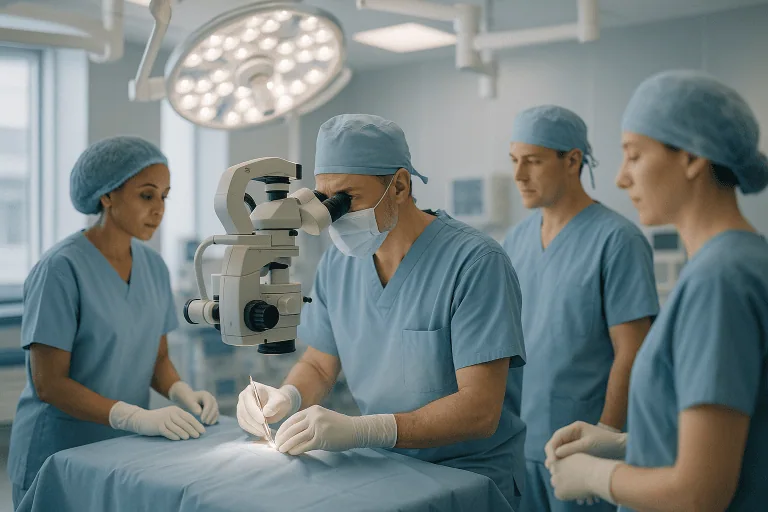
This operation is performed under general anesthesia, so you are asleep. The surgeon makes a small incision behind the ear on the side of the pain and removes a small piece of bone, roughly the size of a coin, to reach the area where the trigeminal nerve leaves the brainstem. Using a microscope, the surgeon identifies the blood vessel pressing on the nerve, gently moves it away, and places a small pad of soft material (often Teflon felt) between the vessel and the nerve so they no longer touch. The bone opening is then closed, sometimes with a small plate, and the skin is stitched. The operation typically takes about two to four hours.
During Gamma Knife radiosurgery
Gamma Knife for trigeminal neuralgia is an outpatient treatment. A lightweight frame or a custom mask is fitted to keep the head still, usually with local anesthetic if pins are used. Imaging is taken to locate the nerve root, and a treatment plan is created. You then lie on a couch while many fine beams of radiation converge on a small target on the nerve. The treatment itself is painless and takes less than an hour in most cases. The radiation gradually disrupts the nerve’s ability to send pain signals, so relief is not immediate and often develops over weeks to a few months.
During percutaneous procedures
These are usually done under sedation or brief general anesthesia. A thin needle is guided through the cheek to an opening at the base of the skull where the nerve passes, with X-ray guidance to confirm the position. Depending on the technique, heat, glycerol, or a small inflated balloon is used to partially injure the nerve fibers that carry pain. The needle is removed and a small dressing is applied. Most people go home the same day or after one night.
After the procedure
After microvascular decompression, you will wake in a recovery area and are often monitored in an intensive care or high-dependency unit for the first night. Pain relief from MVD is frequently noticed soon after surgery. After Gamma Knife or a percutaneous procedure, you are observed for a few hours and then discharged with instructions.
Preparation for trigeminal neuralgia surgery
Careful preparation helps reduce risks and supports a smoother recovery. Your team will give you specific instructions, which may include the following:
- Medication review: Bring a complete list of your medicines. Blood thinners, aspirin, and some supplements may need to be paused before surgery, but only on your doctor’s advice. Do not stop trigeminal neuralgia medication on your own, as pain can flare.
- Fasting: For general anesthesia you will typically be asked not to eat or drink for several hours beforehand.
- Imaging and tests: Make sure recent MRI scans are available to the surgical team. Additional blood tests or heart checks may be requested.
- Smoking and alcohol: Stopping smoking and limiting alcohol before surgery can help wound healing and reduce anesthetic complications.
- Practical arrangements: Arrange for someone to accompany you home and to help for the first days after an open operation. If you are traveling for treatment, plan to stay nearby for follow-up checks before a long journey.
- Questions to ask: Which procedure is recommended and why, what the alternatives are, the expected hospital stay, and how medication will be adjusted afterward.
Recovery and aftercare after trigeminal neuralgia surgery
Trigeminal neuralgia surgery recovery varies considerably depending on the procedure. The timelines below are general and your own experience may differ.
After microvascular decompression
- Hospital stay: Typically two to four nights, depending on how you recover.
- First week: Headache, neck stiffness, tiredness, and some nausea are common. Pain medicine is given as needed. The incision behind the ear should be kept clean and dry as instructed.
- Two to six weeks: Many patients gradually return to light daily activities within a few weeks. Fatigue can last longer than expected. Driving, heavy lifting, and strenuous exercise are usually delayed until your surgeon confirms it is safe.
- Medication: Trigeminal neuralgia medicines are often reduced slowly rather than stopped suddenly, under medical supervision, once pain relief is confirmed.
After Gamma Knife
Most people return to normal activities within a day or two. Mild headache or tenderness where the frame was fixed is common. Because pain relief typically builds over weeks to months, you will usually continue medication for a period and reduce it gradually with your doctor’s guidance.
After percutaneous procedures
Recovery is often quick, with return to routine activities within a few days. Facial numbness on the treated side is expected, and some soreness in the cheek where the needle entered can occur. Jaw weakness on chewing may be noticed after balloon compression and often improves over time.
General aftercare
- Attend all follow-up appointments so your team can check the wound, your pain, and your medication plan.
- If you have facial numbness, take care with hot food and drink, and check the numb side of your mouth after eating. Regular dental checks are important because tooth problems may be less noticeable.
- If the eye area is numb, protect the eye from dust and dryness and report any redness or irritation promptly.
Risks and side effects
All treatments for trigeminal neuralgia carry some risk. Your surgeon will discuss the specific risks of the recommended procedure in detail. Broadly, they include the following:
Microvascular decompression
- Risks common to any operation near the brain, including infection, bleeding, and leakage of the fluid that surrounds the brain (cerebrospinal fluid), which sometimes requires further treatment.
- Hearing loss or ringing in the ear on the operated side, because the hearing nerve lies close to the surgical area.
- Facial numbness or weakness, dizziness, or balance problems, which are usually temporary but can occasionally persist.
- Rare but serious complications such as stroke or, very rarely, death, as with any major operation under general anesthesia.
- Pain may not be relieved, or may return months or years later.
Gamma Knife radiosurgery
- Facial numbness on the treated side, which can range from mild to bothersome and may develop months after treatment.
- Delayed onset of pain relief, meaning medication is usually needed in the meantime.
- Pain recurrence over time, sometimes requiring repeat treatment.
- Rarely, more troublesome sensory changes such as unpleasant tingling or, uncommonly, a constant painful numbness.
Percutaneous procedures
- Facial numbness is expected and is part of how the treatment works; occasionally it is more extensive than intended.
- Jaw muscle weakness, especially after balloon compression.
- Reduced sensation on the surface of the eye, which can increase the risk of eye irritation or injury.
- Bleeding, infection, or rarely injury to nearby structures.
- Pain tends to return sooner than after microvascular decompression, and procedures may need to be repeated.
Results and outlook
The evidence generally shows that microvascular decompression offers the highest likelihood of long-lasting, complete pain relief among the available options, particularly when MRI shows a clear vessel compressing the nerve and the pain has classic, shock-like features. Because it treats the underlying cause rather than damaging the nerve, it is also the option least likely to cause lasting facial numbness. However, it is the most invasive choice and carries the risks of an open operation.
Gamma Knife radiosurgery and percutaneous procedures work by reducing the nerve’s ability to transmit pain. They are less invasive and suitable for more patients, but relief may be less durable, and facial numbness is more common. Pain can return after any of these treatments, and some people need more than one procedure over their lifetime. Repeat treatments are possible, although the balance of benefits and risks changes with each one.
Outcomes are influenced by how typical the pain pattern is, how long symptoms have been present, the person’s general health, whether multiple sclerosis is involved, and whether earlier procedures have been performed. Your surgeon can explain how these factors apply to your situation, but no procedure can guarantee permanent freedom from pain.
Cost considerations
The cost of trigeminal neuralgia surgery varies widely between procedures, hospitals, and health systems. Rather than a single figure, it is more useful to understand what drives the price:
- Type of procedure: An open operation such as microvascular decompression involves an operating room, a surgical team, general anesthesia, and monitoring, which generally costs more than an outpatient percutaneous procedure. Gamma Knife requires specialized equipment and planning time.
- Hospital stay: Nights in an intensive care unit and on a regular ward add to the total, and an unexpected longer stay increases it further.
- Imaging and tests: Pre-operative MRI, blood tests, anesthetic assessments, and any post-operative scans are usually billed separately.
- Devices and materials: Implanted cushioning material, bone plates, or radiofrequency equipment may be itemized.
- Follow-up care: Clinic visits, medication adjustment, and treatment of any complications contribute to overall cost.
- Insurance and travel: Coverage rules differ, and international patients should consider travel, accommodation, and time away from work when planning. Some centers, including those within Acibadem, provide itemized estimates on request so patients can see how these elements are combined.
Frequently asked questions
Is trigeminal neuralgia surgery the only trigeminal neuralgia treatment?
No. Medication is the usual first-line trigeminal neuralgia treatment, and many people are managed with medicines alone for years. Surgery is typically considered when drugs stop working, cause unacceptable side effects, or cannot be tolerated. Your neurologist and neurosurgeon can help you weigh medical and procedural options.
How is microvascular decompression different from Gamma Knife for trigeminal neuralgia?
Microvascular decompression is an open operation that moves a blood vessel off the nerve and aims to treat the cause, often giving relief soon after surgery. Gamma Knife uses focused radiation with no incision, and relief usually builds gradually over weeks to months. MVD tends to give longer-lasting relief with less numbness, while Gamma Knife is less invasive and suitable for people who cannot have or do not want an open operation.
How long does trigeminal neuralgia surgery recovery take?
It depends on the procedure. After microvascular decompression, many patients spend two to four nights in the hospital and return to light daily activities within a few weeks, with full recovery often taking longer. After Gamma Knife or a percutaneous procedure, most people are back to routine activities within a few days, although the effect of Gamma Knife takes time to develop.
Will I be numb in the face after trigeminal neuralgia surgery?
Facial numbness is expected after percutaneous procedures and is common after Gamma Knife, because these treatments work by reducing nerve function. It is less common after microvascular decompression, which does not intentionally damage the nerve. Your surgeon can explain how likely numbness is with the procedure recommended for you.
Can pain come back after microvascular decompression?
Yes, it can. Although microvascular decompression is generally the most durable option, pain returns in some people months or years later. If this happens, options may include restarting medication, repeat surgery, Gamma Knife, or a percutaneous procedure, depending on your circumstances.
Is Gamma Knife for trigeminal neuralgia painful?
The radiation treatment itself is painless. Some people feel brief discomfort when a head frame is attached under local anesthetic, and mild headache or scalp tenderness afterward is common. Relief from trigeminal neuralgia pain is not immediate and usually develops gradually.
Who performs trigeminal neuralgia surgery?
Microvascular decompression and percutaneous procedures are performed by neurosurgeons. Gamma Knife is usually delivered jointly by a neurosurgeon and a radiation oncologist with support from medical physicists. A neurologist is often involved in diagnosis and medication management before and after treatment.
When to see a doctor
You should be assessed by a specialist if you have any of the following:
- Sudden, severe, shock-like pain in the face that is triggered by touch, chewing, speaking, or cold air, especially if it keeps recurring.
- Facial pain that has been diagnosed as trigeminal neuralgia but is no longer controlled by medication, or medication side effects that are affecting your daily life.
- Facial pain accompanied by numbness, weakness, hearing change, vision change, or unsteadiness, which may point to another cause that needs investigation.
- Facial pain in someone with multiple sclerosis, as treatment planning differs.
After trigeminal neuralgia surgery, seek urgent medical attention if you notice:
- Fever, chills, or increasing redness, swelling, or discharge from the incision.
- Clear fluid leaking from the wound, nose, or ear, or a persistent headache that is worse when sitting up, which can indicate a cerebrospinal fluid leak.
- Severe or worsening headache, stiff neck, confusion, or drowsiness.
- New weakness of the face or limbs, difficulty speaking or swallowing, double vision, or severe dizziness.
- Sudden hearing loss on the operated side.
- Redness, pain, or discharge from the eye on the treated side, particularly if that area is numb.
- Rapidly returning severe facial pain that is not controlled by your prescribed medication.
Preparation
- Bring a full list of medications and ask which ones, such as blood thinners, need to be paused; do not stop trigeminal neuralgia medicines on your own. Ensure recent MRI scans are available to the surgical team and complete any requested blood tests and anesthetic assessment. Fast as instructed before general anesthesia, and arrange for someone to accompany you home and help during the first days.
Aftercare
- Keep the incision clean and dry, and attend all follow-up appointments so your team can check healing, pain, and medication. Reduce trigeminal neuralgia medicines gradually only under medical supervision. If you have facial numbness, take care with hot foods, check the numb side of your mouth after eating, protect the eye on that side, and keep up regular dental checks. Avoid heavy lifting and strenuous activity until your surgeon confirms it is safe.
Medically reviewed by the Acıbadem International Medical Board September 8, 2026
See our medical review board →
Update history
- PublishedSeptember 8, 2026
- Medical review approvedSeptember 8, 2026
- Last content updateSeptember 8, 2026
References2
From the Acibadem Blog

Trigeminal Neuralgia Surgery Recovery: The First Days, Incision Care and Returning to Work
Recovery after microvascular decompression usually means a hospital stay of a few days, then several weeks at home while a small incision behind the…

Microvascular Decompression vs Gamma Knife vs Percutaneous Procedures for Trigeminal Neuralgia
Microvascular decompression, Gamma Knife radiosurgery and percutaneous procedures all treat trigeminal neuralgia by interrupting or relieving pressure on the trigeminal nerve, but they differ…

Inside Microvascular Decompression: How Trigeminal Neuralgia Surgery Cushions the Nerve
Microvascular decompression is an operation for trigeminal neuralgia in which a surgeon opens a small window in the skull behind the ear, finds the…