Urethral Reconstruction
Urethral reconstruction is a surgical procedure to repair urethral narrowing, injury, or complex strictures, helping restore normal urine flow and reduce recurrent urinary problems.
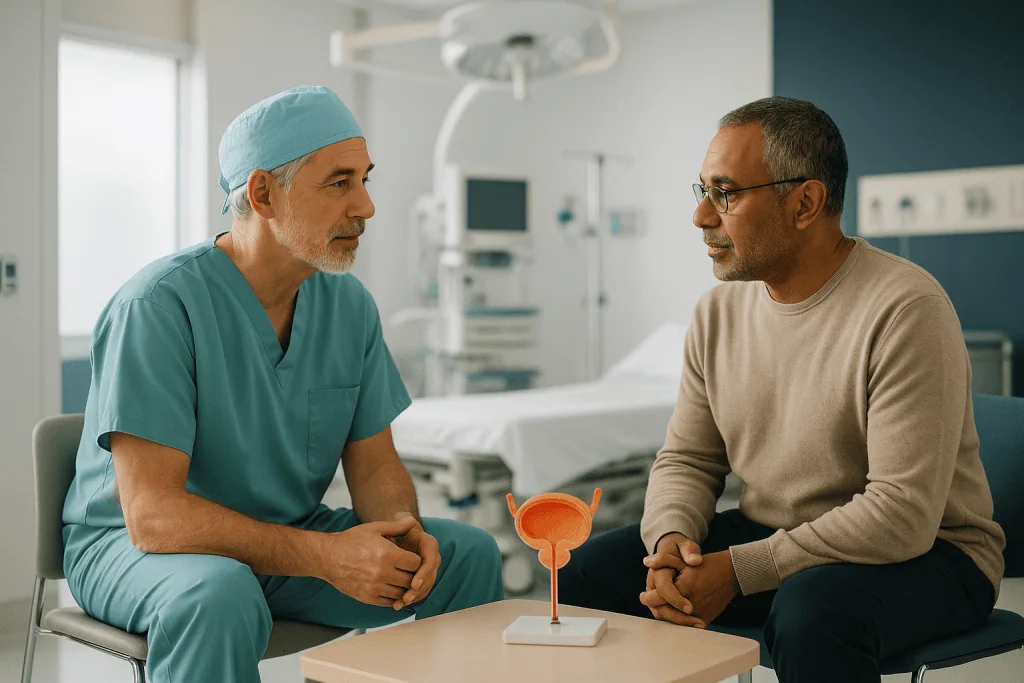
Quick answer
Urethroplasty, also called urethral reconstruction, is open surgery to repair a narrowed or scarred urethra: the tube that carries urine from the bladder out of the body. The surgeon either removes the scarred segment and rejoins the healthy ends, or widens the narrowed section with a graft, usually taken from the inner cheek. It is considered when strictures are long, recurrent or complex.
What Is Urethral Reconstruction (Urethroplasty)?
Urethral reconstruction is surgery to repair or rebuild a urethra that has been narrowed, scarred or damaged. In most adult cases the operation is called urethroplasty: the surgeon either removes the scarred segment and joins the healthy ends of the urethra together, or opens the narrowed section and widens it with transferred tissue, most often a graft taken from the inside of the cheek. It is offered to people whose urine flow is obstructed by a urethral stricture, particularly when the narrowing is long, recurrent, or has come back after simpler procedures.
The urethra is the tube that carries urine from the bladder to the outside of the body. In men, it also carries semen during ejaculation. Surgeons divide it into segments because location changes almost everything about the repair. The anterior urethra runs from the external opening, the meatus, through the penile urethra to the bulbar urethra, the deeper section beneath the perineum. The posterior urethra passes through the sphincter mechanism and the prostate to the bladder neck. A short bulbar stricture, a narrowing at the meatus and a posterior injury after a pelvic fracture are three very different surgical problems, even though all three obstruct the same tube.
A stricture rarely announces itself suddenly. Many people first notice a slow stream, straining, repeated urinary tract infections, discomfort, interrupted sleep, or the uneasy sense that the bladder never fully empties. For some, the problem follows an injury, a previous procedure, catheterisation, prostate treatment, infection or inflammation. For others, symptoms develop gradually and are put down to ageing, prostate enlargement or recurrent infections, which delays the correct diagnosis.
When a stricture becomes persistent or complex, temporary measures may no longer be enough. Repeated dilation or endoscopic cutting of the scar can provide short-term relief, but strictures often return, particularly when the scar is long, dense, recurrent or sits in a difficult location. Urethroplasty is considered when the goal is to repair the narrowed segment more definitively and restore a reliable urine channel, rather than to manage the blockage again and again.
The operation itself takes several forms. Some strictures are repaired by removing the scarred segment and reconnecting the healthy ends: a technique called excision and primary anastomosis. Longer strictures usually need tissue transfer, most commonly buccal mucosa from the inner cheek. The most complex cases are reconstructed in stages, with a first operation to lay healthy tissue and a second, months later, to form the new urethral tube. Which approach applies depends on the location and length of the stricture, the quality of the surrounding tissue, previous operations, and whether there are associated injuries or fistulas.
Good urethral reconstruction is individualised. A short bulbar stricture after catheterisation is not managed the same way as a long penile stricture caused by lichen sclerosus, pelvic trauma, previous hypospadias surgery or multiple failed procedures. The right operation starts with a precise understanding of the disease, not a one-size-fits-all technique. One small note on terminology: the operation is sometimes misspelled online as “erythroplasty”: the correct medical name is urethroplasty.
Can the urethra be changed or replaced during reconstruction?
Yes, sections of the urethra can be removed, widened or effectively rebuilt, although the whole urethra is almost never replaced in one piece. In excision and primary anastomosis, the diseased segment is cut out entirely and the channel is re-formed from the patient’s own healthy urethra. In graft urethroplasty, transferred tissue is stitched into the opened urethra and, as it heals, becomes a living part of the urethral wall. In staged surgery, a badly scarred segment may be laid open and later reconstructed into a new tube from grafted tissue. What the surgeon cannot do is simply swap in an artificial pipe: reconstruction depends on living tissue with a good blood supply, which is why tissue quality drives so many planning decisions.
How is urethroplasty different from dilation and internal urethrotomy?
Dilation and internal urethrotomy manage the scar from inside; urethroplasty removes or replaces it. Dilation stretches the narrowed area with instruments passed along the urethra. Internal urethrotomy uses an endoscopic blade or laser to cut the scar internally. Both may be reasonable for selected short, first-time strictures, but neither removes extensive scar tissue, and in complex or recurrent disease the narrowing tends to come back. Reconstruction is generally the more durable surgical repair when the anatomy and the patient’s situation support it, at the cost of being a larger operation with a longer recovery.
Can a damaged urethra heal itself in men?
Once a true stricture has formed, no, established scar tissue in the male urethra does not dissolve on its own. Mild inflammation of the urethral lining can settle, and symptoms sometimes fluctuate, which creates the impression of improvement. But scar tissue behaves differently from normal urethral lining: it lacks elasticity, and it tends to contract over time, which is why many strictures slowly worsen rather than resolve. This is also why a stricture that returns after dilation is unlikely to behave differently after the same procedure is repeated. What a man can influence is the environment around the problem, treating infections promptly, avoiding unnecessary instrumentation and seeking a structured urological assessment rather than waiting for the stream to improve by itself.
Who Needs Treatment for Urethral Stricture?
Treatment for urethral stricture becomes a serious question when symptoms point to significant obstruction, when imaging confirms a narrowing, or when previous procedures have not produced lasting improvement. Some patients arrive at a reconstructive urologist after years of recurrent urinary problems. Others are diagnosed after an acute event: an inability to urinate, a pelvic injury, or complications following an earlier urological procedure. You can read more about the underlying condition itself on our page about urethral strictures.
Typical symptoms of a urethral stricture include:
- Weak, slow or spraying urine stream
- Straining to urinate or taking a long time to empty the bladder
- A feeling of incomplete bladder emptying
- Frequent urination or an urgent need to urinate
- Burning, discomfort or pain during urination
- Recurrent urinary tract infections
- Dribbling after urination
- Blood in the urine or semen
- Swelling or infection around the urethra in complicated cases
- Acute urinary retention: the inability to pass urine at all
How is a urethral stricture diagnosed?
Diagnosis begins with a detailed history and physical examination, then moves to tests that map the narrowing precisely. The urologist will ask about prior catheterisation, endoscopic procedures, prostate treatments, pelvic trauma, sexually transmitted infections, inflammatory skin conditions, childhood urethral surgery, and how the symptoms developed over time. Patients may complete symptom questionnaires and are asked to bring prior medical records, operative reports and imaging: these documents genuinely change surgical planning, because they tell the surgeon what has already been tried and how the tissue responded.
Common diagnostic tests include urine analysis and culture to check for infection, uroflowmetry to measure the strength and pattern of urine flow, and ultrasound to assess how completely the bladder empties. Imaging of the urethra itself is central: a retrograde urethrogram uses contrast dye to outline the urethra and show the location and length of the narrowing, while a voiding cystourethrogram assesses the bladder neck and posterior urethra during urination. Cystoscopy lets the physician look directly inside the urethra and bladder with a thin camera. In pelvic trauma, fistula or recurrent cases, additional cross-sectional imaging may be added. The point of all this testing is simple: the operation chosen depends entirely on where the stricture is, how long it is and what caused it, and none of that can be guessed from symptoms alone.
Who is a candidate for urethroplasty?
Candidates typically include men with recurrent strictures after dilation or internal urethrotomy, long strictures, dense scar tissue, strictures after trauma, strictures following prostate or bladder surgery, strictures related to lichen sclerosus, and patients who depend on repeated catheterisation because urine cannot pass normally. Reconstruction is also considered when quality of life is significantly affected, by constant infections, disturbed sleep, or dependence on a suprapubic catheter. Not everyone with a stricture needs urethroplasty: a first-time, short bulbar narrowing may reasonably be managed endoscopically. The decision rests on anatomy, history and the patient’s own goals, discussed openly with a urologist who is comfortable offering both endoscopic and reconstructive options.
Conditions Urethral Reconstruction Can Address
Urethral reconstruction covers a spectrum of problems, from an isolated short narrowing to complex injuries with tissue loss. The common feature is disruption of the urethral channel by scar, narrowing, tissue loss or abnormal healing. The main patterns are worth understanding, because each one points towards a different repair.
Bulbar urethral strictures are among the most common strictures in men. They may follow instrumentation, trauma or infection, or appear without an obvious cause. The bulbar urethra sits deep in the perineum and has relatively generous surrounding tissue, which gives the surgeon options: shorter strictures may suit excision and primary anastomosis, while longer ones are usually widened with a graft.
Penile urethral strictures affect the portion of the urethra within the penis. They are often associated with inflammatory conditions, prior hypospadias repair, catheter trauma or repeated endoscopic procedures. Because the penile urethra is more superficial and mobile, removing a segment and pulling the ends together risks curvature or shortening, so these strictures typically require graft-based reconstruction and careful planning to preserve both function and appearance.
Panurethral strictures involve a long segment or most of the anterior urethra, often in lichen sclerosus or after multiple previous interventions. These cases demand advanced reconstructive planning and may be treated in one stage or in stages, depending on tissue quality and the underlying cause.
Posterior urethral injuries can follow pelvic fracture or major trauma, separating or scarring the urethra near the prostate and bladder neck. These injuries are usually stabilised first, often with a suprapubic catheter, and reconstructed after swelling has settled and the anatomy can be assessed properly. Our page on urethral trauma covers the acute injury in more detail.
Recurrent strictures after previous treatment are one of the most frequent reasons for referral to reconstructive urology. Repeated dilation or urethrotomy can increase scar complexity rather than reduce it, and each failed procedure narrows the remaining options. A reconstructive approach is recommended when less invasive treatment has failed or is unlikely to give durable benefit.
Strictures after prostate or urinary tract procedures may develop following prostate surgery, radiation therapy, catheterisation or endoscopic interventions. These cases require particularly careful evaluation, because the continence mechanism, bladder function and tissue healing may all have been affected by the earlier treatment.
Lichen sclerosus-related urethral disease causes progressive scarring, often affecting the penile urethra and the urethral opening. Because the condition is chronic and can involve the local genital skin, planning must account for its ongoing nature, and local skin is generally avoided as reconstructive material, in favour of buccal mucosa.
Urethral fistulas, false passages and complex tissue defects may need reconstructive surgery when urine leaks through an abnormal tract or when previous injury has distorted the anatomy. These repairs are sometimes staged and may involve coordination with colleagues in plastic and reconstructive surgery when skin coverage or tissue flaps are needed.
Meatal stricture treatment
Meatal stricture treatment addresses narrowing at the meatus: the opening of the urethra at the tip of the penis. A meatal stricture can cause a fine, spraying or deflected stream and is often linked to lichen sclerosus, prior instrumentation, catheter injury or previous hypospadias surgery. Simple cases may be managed with a meatotomy, a small procedure that opens the narrowed tip. Recurrent or inflammatory cases usually need a meatoplasty: a formal reconstruction of the opening, sometimes using a small buccal mucosa graft, so that the new opening is lined with healthy tissue rather than scar. Meatal disease is also a warning sign worth taking seriously, in lichen sclerosus it can be the visible edge of narrowing that extends further along the urethra, which is why imaging of the whole urethra is sensible before any repair at the tip.
How Is a Urethra Reconstruction Done?
A urethral reconstruction is done under general anaesthesia through an incision over the affected segment: the surgeon exposes the scarred urethra, then either removes the narrowing and rejoins the healthy ends, or opens the urethra and widens it with grafted tissue, before placing a catheter to protect the repair while it heals. In outline, the sequence looks like this:
- Imaging and endoscopy map the exact location and length of the stricture.
- The anaesthetic team assesses fitness for surgery, and any urine infection is treated first.
- Under anaesthesia, the surgeon reaches the urethra through an incision in the perineum, the area between the scrotum and anus, or along the penis, depending on the stricture’s location.
- The scarred segment is removed and the ends rejoined, or the urethra is opened and widened with a graft; complex cases may be reconstructed in two stages.
- A urinary catheter is placed to splint the repair; some patients also have a suprapubic catheter draining the bladder through the lower abdomen.
- Before catheter removal, imaging confirms the repair has healed without leakage.
Preparing for urethroplasty surgery
Before urethroplasty surgery, the team reviews your medical history, medications, allergies, prior operations and imaging. Blood tests, urine tests, anaesthesia evaluation and infection screening are usually completed, and if a urine culture shows infection, antibiotics are given before surgery to reduce complication risk. If you take blood thinners or other medicines that affect surgery, the surgical and anaesthesia teams will decide how these should be handled around the operation: those decisions belong to your treating doctors, not to a checklist. Stopping smoking is strongly encouraged, because nicotine impairs wound healing and graft take. Diabetes, cardiovascular disease and other chronic conditions may need optimisation before anaesthesia.
Two preparatory steps are specific to this operation. First, if you cannot urinate adequately, a suprapubic catheter may be placed through the lower abdomen into the bladder, protecting the urethra, relieving retention and letting inflammation settle. Second, a period of “urethral rest” may be advised after recent dilation or catheter manipulation, so the true length and severity of the stricture can be measured accurately. Operating on a recently stretched stricture risks underestimating the disease and repairing too short a segment.
Excision and primary anastomosis
Excision and primary anastomosis removes the scarred segment completely and reconnects the healthy urethral ends. It is best suited to shorter strictures, most often in the bulbar urethra, where the surrounding tissue allows the ends to be brought together without tension. When the anatomy is right, this is an attractive repair: no graft is needed, the new channel is entirely the patient’s own healthy urethra, and the scar is gone rather than merely widened. Its limits are equally clear, stretch a long gap closed and you risk tension, curvature or shortening, which is why longer strictures are handled differently.
Buccal mucosa graft urethroplasty
For longer strictures, the urethra is opened along the narrowed section and widened with a graft rather than removed. Tissue is most commonly taken from the inner cheek, buccal mucosa, because it is resilient, moist, accustomed to a wet environment, quick to pick up a new blood supply, and harvested from a site that heals well and leaves no visible scar. The graft is carefully shaped and secured to widen or replace the narrowed segment. The mouth donor site usually heals uneventfully, though temporary soreness, tightness or a few days of modified diet are common and worth planning for. In selected cases, other graft materials may be considered based on tissue availability and the disease pattern.
Staged (two-stage) urethroplasty
In staged reconstruction, the repair is deliberately split across two operations. The first opens the scarred urethra fully and lays graft tissue to create a healthy, flat plate. After this has matured over several months, a second operation rolls the plate into a tube and closes the urethra. Staging is recommended when tissue quality is poor, when lichen sclerosus is extensive, after multiple failed surgeries, or when infection and scarring make a single-stage repair unreliable. It asks more patience of the patient, including a period of urinating through a temporary opening, but in the right case it produces a more dependable final result than forcing a one-stage repair into hostile tissue.
Is urethroplasty a major surgery?
Yes, urethroplasty is major reconstructive surgery, though not in the sense of opening the abdomen or chest. It is performed under general anaesthesia, can take several hours depending on complexity, may involve harvesting graft tissue from the mouth, and requires a catheter for weeks afterwards. At the same time, in experienced hands it is a well-established operation with a defined pathway: most patients are walking the next day, the hospital stay is measured in days rather than weeks, and the physical work of recovery is mainly about protecting the repair rather than regaining strength. Calling it “major” is accurate; treating it as frightening is not, but it does deserve an experienced reconstructive team and a properly planned recovery.
Technology and surgical planning
Modern urethral reconstruction rests on accurate imaging and careful intraoperative judgement. Contrast urethrography maps the stricture’s length and position; endoscopy shows the state of the urethral lining and bladder directly; ultrasound assesses bladder emptying and, in selected cases, the depth of scarring in the spongy tissue around the urethra. Cross-sectional imaging helps in pelvic trauma, fistulas, abscesses and complex recurrent disease. In theatre, magnified visualisation, fine reconstructive instruments, precise suture technique and meticulous tissue handling protect delicate structures and support healing. Anaesthetic monitoring, infection-prevention protocols and attentive perioperative nursing matter just as much. The aim is not merely to open the urethra, but to create a repair that heals with stable tissue while preserving urinary control and sexual function as far as the anatomy allows.
What Happens After a Urethroplasty?
After a urethroplasty, you wake with a urinary catheter in place, spend a short period in hospital, and go home with the catheter still protecting the repair: it stays for a period set by your surgeon and the type of repair, and is removed only once imaging confirms the urethra has healed without leakage. The hospital stay varies: straightforward reconstructions may need only a brief inpatient stay, while complex or staged repairs are observed for longer. During admission the team monitors urine drainage, wound healing, bleeding, swelling and any signs of infection, and teaches you catheter care before discharge.
At home, the priorities are protecting the repair and avoiding pressure on the perineum. Patients are advised to avoid heavy lifting, cycling, straddling activities, sexual activity and strenuous exercise during early healing. Walking is encouraged from early on: it reduces the risk of blood clots and supports recovery generally. It is sensible to plan enough time for the operation, early recovery, catheter management and the first follow-up assessment before returning to work and normal commitments; the exact timeline should be agreed with the surgical team, especially for staged procedures.
| Time Period | What Patients Can Expect |
|---|---|
| Day 1 | Monitoring after anaesthesia, pain control, and gentle movement as advised. The catheter drains urine and protects the repair. |
| First week | Swelling, bruising, catheter awareness and mild discomfort are common. Patients learn catheter care and avoid heavy activity, straining and prolonged sitting pressure. Mouth donor-site soreness settles for most graft patients. |
| First month | Imaging is typically performed before catheter removal to confirm healing. Many patients gradually return to light daily activities once cleared by the surgeon. |
| Longer term | Urine flow is reassessed with flow testing, and the team monitors for recurrence, infection, wound issues and functional concerns. Staged repairs follow their own schedule between operations. |
Is urethral stricture surgery painful?
Expect discomfort rather than severe pain, and expect it to be manageable. Most patients describe soreness at the perineal or penile wound, an aching or pulling sensation from the catheter, and, after graft procedures, a sore inner cheek for some days. Pain is controlled with medication prescribed by the team, and it typically eases substantially within the first one to two weeks. Catheter awareness is often the most persistent nuisance rather than the wound itself. What you should not expect is an entirely comfortable recovery: this is real surgery in a sensitive area, and honest preparation, planning time off work, arranging help at home for the first days, following the activity restrictions, makes the discomfort easier to live with.
What if you cannot pass urine after urethral reconstruction?
Most patients void normally once the catheter is removed, but occasionally the flow does not start or is much weaker than expected. There are several possible explanations, and they carry very different implications: swelling around a fresh repair, a bladder that has temporarily lost tone after prolonged obstruction or catheter drainage, or, later on, early re-narrowing at the repair site. This is why follow-up after urethroplasty is structured rather than casual: teams typically use flow measurement, bladder ultrasound and, where needed, imaging or gentle endoscopy to work out which of these is happening, and a temporary catheter can be replaced while the cause is clarified. Difficulty voiding after reconstruction is a known, assessable event with a defined diagnostic pathway, not a sign that the operation has necessarily failed.
Why Acting Early Matters
Urethral strictures tend to progress. A slow stream may feel manageable for years, but persistent obstruction puts sustained strain on the bladder: the muscle thickens, becomes less efficient, and empties less completely. Some patients go on to develop urinary retention, recurrent infections, bladder stones or kidney-related complications when urine cannot drain properly. The urinary tract tolerates obstruction quietly for a long time, until it doesn’t.
Delay also makes the stricture itself harder to treat. Repeated inflammation, infection and instrumentation add scar. A patient who cycles through multiple temporary procedures without a durable plan can end up with a longer, denser, more complex narrowing than the one he started with. This does not mean everyone needs immediate surgery: it means persistent urinary symptoms deserve a structured assessment by a urologist who is familiar with the full range of reconstructive options, so that the choice between observation, endoscopic treatment and reconstruction is made deliberately.
Early specialist evaluation also protects against treating the wrong disease. Urethral stricture shares symptoms with prostate enlargement, overactive bladder, neurological bladder dysfunction, urinary infection and bladder neck obstruction. Treating the wrong condition delays relief and exposes patients to unnecessary procedures. Some situations, complete inability to urinate, spreading infection, significant bleeding, or abscess formation near the urethra, are urgent problems in their own right and are generally stabilised before any definitive reconstruction is planned.
Potential Benefits of Urethral Reconstruction
When appropriately selected and carefully performed, urethral reconstruction can deliver meaningful functional and quality-of-life gains. The table below summarises what a successful repair is designed to achieve, noting that individual results always depend on the anatomy, the technique and healing.
| Benefit | What It Means for You |
|---|---|
| Improved urine flow | A wider urethral channel can reduce straining, slow stream, spraying and prolonged time in the bathroom. |
| Fewer recurrent urinary problems | By addressing the scarred anatomy directly, reconstruction may reduce repeated infections, retention episodes and the need for frequent temporary procedures. |
| A more durable repair in suitable cases | Compared with repeated dilation or internal cutting for complex strictures, reconstruction may provide a longer-lasting solution when the anatomy is appropriate. |
| Protection of bladder and urinary tract function | Relieving obstruction can reduce pressure on the bladder and support healthier urinary drainage over time. |
| Individualised preservation of function | Careful planning considers continence, sexual function, tissue quality and prior treatments, not only the narrowed segment. |
What Influences a Good Outcome?
Several factors shape the result of urethral reconstruction, and it helps to understand them before surgery rather than after. The first is the stricture itself: its length, location, depth of scarring, cause, and whether the surrounding tissue has a healthy blood supply. Shorter, first-time strictures in favourable locations, the bulbar urethra above all, are generally simpler problems than long, recurrent strictures after multiple procedures or radiation.
Prior treatment matters. Repeated dilation, internal urethrotomy, catheter trauma or previous open surgery changes tissue planes and adds scar. None of this rules out reconstruction, but it affects which technique is chosen and what recovery looks like. This is the practical reason patients are asked for old operative notes and imaging: they let the surgical team plan around what has already been done rather than discovering it in theatre.
The underlying cause matters too. Trauma-related strictures, inflammatory disease, lichen sclerosus, radiation-associated scarring and post-surgical strictures each behave differently. Chronic inflammatory conditions require long-term management, not just a mechanical repair. Active infection, abscess, fistula or poor tissue quality may mean surgery is deliberately delayed or staged: a slower plan that protects the final result.
General health influences healing. Diabetes control, smoking status, nutrition, immune function, vascular health and medication use all affect wound healing and infection risk. Patients who stop smoking, manage their chronic conditions and follow perioperative instructions give the repair a measurably better environment in which to heal.
Surgical expertise sits at the centre. Urethral reconstruction is a specialised corner of urology, and a good result depends on matching the technique to the patient rather than applying a favourite operation to every stricture. The surgeon must balance scar removal against tissue preservation, urethral length against tension, graft placement against blood supply, and must be prepared to adjust the plan during surgery if the scarring proves more extensive than imaging suggested.
Finally, expectations should be realistic. Many patients experience substantial improvement in urinary flow and quality of life, but no surgical repair is free of risk. Possible complications include bleeding, infection, wound separation, urine leak, recurrence of the stricture, catheter-related discomfort, mouth donor-site symptoms, changes in ejaculation, erectile function concerns, penile curvature or shortening in selected cases, and anaesthesia-related risks. These vary by procedure and should be discussed in detail before consent: a surgeon who lists them plainly is doing the job properly.
What is the complication rate of urethroplasty?
There is no single complication rate for urethroplasty, because the risk depends heavily on the type of repair, the length and location of the stricture, prior surgery, radiation history and the patient’s general health, which is why honest surgeons quote figures for cases like yours, not a single number for the operation. As a general pattern reported in the surgical literature, most complications after urethroplasty are early and manageable, wound issues, infection, temporary voiding difficulty, donor-site soreness, while the main long-term concern is recurrence of the narrowing, which is more likely with longer strictures, penile and panurethral disease, lichen sclerosus and multiple previous procedures. The most useful question to ask any surgeon is specific: what outcomes do you see with my kind of stricture, using the technique you are proposing, and how do you follow patients afterwards to catch problems early?
Urethral Reconstruction at Acibadem
The operation itself is only one part of the picture. What surrounds it matters just as much: accurate diagnosis, candid discussion of the options, safe anaesthesia, experienced surgical and nursing teams, and a practical plan for recovery and follow-up.
At Acibadem, urethral problems are evaluated with the whole urinary tract in view, not only the narrow point in the urethra. Diagnostic work-up may include uroflowmetry, bladder ultrasound, contrast urethral imaging, cystoscopic assessment, laboratory testing and further imaging where the case requires it. Complex problems, pelvic trauma, prior cancer treatment, radiation, fistula, significant comorbidity, are discussed across specialties where needed, so that the plan reflects more than one clinical perspective. The surgical approach may be anastomotic repair, graft urethroplasty, staged reconstruction or another reconstructive technique, depending on what the assessment actually shows.
Personalised planning cuts both ways. Some patients are best served by proceeding to reconstruction; others need infection treatment, urethral rest or a suprapubic catheter first; some discover that their symptoms are partly driven by bladder dysfunction or prostate disease rather than the stricture alone. A careful plan avoids unnecessary intervention as deliberately as it schedules necessary surgery. And for an operation where catheter care, activity restrictions and follow-up timing must be understood precisely, clear communication and a structured follow-up schedule are part of clinical safety, not a courtesy.
Deciding on the Next Step
Urethral reconstruction is worth understanding properly if you live with a recurrent stricture, an obstructed urine flow, catheter dependence or a complex urethral injury. The right treatment follows from a precise diagnosis and an individualised plan, and that plan is built from information you can help assemble. Wherever you are evaluated, the assessment is more accurate when prior operative notes, imaging studies, urine test results and a clear timeline of symptoms and previous procedures are available; a surgeon planning a repair around two failed urethrotomies needs to know exactly where and when they were done.
It is also reasonable to weigh the alternatives explicitly. If you have been offered another dilation, useful questions include how long the last one lasted, what the stricture looks like on imaging now, and what a reconstructive option would involve in your specific anatomy. If reconstruction is proposed, ask which technique is planned and why, whether a graft or staged approach is anticipated, how long the catheter will stay, and how follow-up will be organised, including who monitors your flow and symptoms in the years afterwards. Men who arrive at that conversation informed tend to make decisions they remain comfortable with, whichever path they choose. Similar principles apply to strictures that began in childhood after hypospadias repair: a field managed by pediatric surgerywhere the adult reconstruction must respect what was rebuilt decades earlier.
Preparation
- Before urethral reconstruction, the urologist reviews medical history, urinary symptoms, imaging, and endoscopic findings to plan the repair. Blood tests, urine tests, and anesthesia assessment are usually required. Patients may need to stop blood thinners and avoid eating or drinking for several hours before surgery.
Aftercare
- After surgery, a urinary catheter is usually kept in place while the repair heals. Patients should avoid heavy lifting, cycling, sexual activity, and strenuous exercise until cleared by the surgeon. Follow-up visits and imaging may be scheduled to confirm healing and urine flow.
Frequently Asked Questions
What affects the cost of urethral reconstruction in Turkey?
The main factors are stricture complexity, location, prior procedures, required imaging, surgical technique, graft or flap need, anaesthesia, hospital stay, catheter care, and follow-up arrangements. Travel, accommodation, and interpreter support may also affect the total plan.
How can I get a personalised quote from Acibadem?
You can request a free consultation by sharing your medical history, previous operation notes, imaging, cystoscopy findings, urine tests, and current symptoms. A urology specialist can review the information and the international patient team can prepare a personalised care and cost plan.
Is urethral reconstruction usually included in an international patient package?
Many international packages may include medical review, surgery planning, anaesthesia, hospital stay, nursing care, interpreter support, and coordination services. Inclusions can vary, so it is important to confirm diagnostics, medications, catheter follow-up, transfers, and hotel support before travel.
Why can quotes differ between hospitals or countries?
Quotes differ because hospitals use different billing models and may separate or bundle surgeon fees, operating room charges, anaesthesia, imaging, laboratory tests, inpatient care, and follow-up. Accreditation status, hospital category, and specialist experience may also influence pricing.
Will I need to stay in Turkey after urethral reconstruction?
A short recovery period near the treating hospital may be recommended so the team can monitor healing, catheter care, and early postoperative progress. The exact stay depends on the surgical method and your specialist’s plan.
Is the lowest quote always the best option?
Not necessarily. For urethral reconstruction, it is important to consider the surgeon’s reconstructive experience, hospital quality standards, diagnostic accuracy, aftercare plan, communication support, and what is included in the quote. This information is general and is not medical or financial advice.
Medically reviewed by the Acıbadem International Medical Board September 1, 2026
See our medical review board →
Update history
- PublishedJune 8, 2026
- Medical review approvedSeptember 1, 2026
- Last content updateSeptember 1, 2026
References1
- Urethral Stricture medlineplus.gov
Trusted care for international patients
From the Acibadem Blog

Urethroplasty Recovery Timeline: Catheter Weeks, the First Void and Returning to Cycling
Urethroplasty recovery time usually unfolds in stages: a hospital stay of about one to two nights, a urinary catheter for roughly one to three…