Hiatal Hernia Treatment
Hiatal hernia treatment repairs a stomach herniation through the diaphragm, often relieving reflux, chest discomfort and swallowing problems. Surgery is usually laparoscopic when symptoms persist despite medication.
Quick answer
A hiatal hernia occurs when part of the stomach pushes up through the hiatus, the opening in the diaphragm that the oesophagus passes through. Small hernias are often managed with dietary changes and doctor-prescribed acid-reducing medication. Larger or persistently symptomatic hernias may be repaired with keyhole surgery: the stomach is returned to the abdomen, the diaphragm opening is narrowed, and the reflux barrier is often reinforced.
Hiatal Hernia: The Essentials Before Any Decision
A hiatal hernia occurs when part of your stomach pushes upwards through the hiatus: the opening in the diaphragm that your oesophagus passes through on its way into the abdomen. The result is that a portion of the stomach sits in the chest rather than below it. This weakens the body’s natural barrier against reflux, which is why heartburn, regurgitation and chest pressure are the symptoms most people notice first. Small hernias often need no treatment at all. Larger or persistently symptomatic ones can be repaired surgically, usually through keyhole surgery.
A hiatal hernia can be confusing to live with because its symptoms overlap with several other conditions. Many people first notice persistent heartburn, a sour or bitter taste in the throat, pressure in the chest after meals, difficulty swallowing, or regurgitation when lying down. Others feel nothing and are told they have a hiatal hernia after an endoscopy performed for reflux, anaemia, chronic cough or unexplained upper abdominal discomfort. Both situations are common, and they lead to different questions: is the hernia really the cause of my symptoms, is medication enough, and when does surgery genuinely make sense?
The honest starting point is this: no single rule decides treatment. Small sliding hernias that cause mild reflux are usually managed with lifestyle measures and medication prescribed by a doctor. Larger hernias, para-oesophageal hernias, and hernias linked to persistent reflux, swallowing problems, bleeding, anaemia or breathing-related symptoms may justify surgical repair. What decides the plan is careful evaluation of the type and size of the hernia, the severity of reflux, how well the oesophagus functions, the position of the stomach, your other medical conditions, any prior abdominal surgery, your body weight and your own priorities. Everything on this page follows from that principle.
What is a hiatal hernia?
A hiatal hernia is a displacement of part of the stomach through the diaphragmatic hiatus into the chest. “Hiatal hernia” is the US spelling; British sources call the same condition a hiatus hernia, and some people search for “hiatal hernia disease”, all three phrases describe one problem, not three. The diaphragm is the broad sheet of muscle that separates the chest from the abdomen and drives your breathing. The hiatus is the natural gap in that muscle through which the oesophagus passes. When the gap enlarges or the tissues anchoring the stomach weaken, the junction between oesophagus and stomach, and sometimes a larger part of the stomach itself, can slide or bulge upwards.
Why does that matter? The diaphragm normally reinforces the lower oesophageal sphincter, the muscular valve that keeps stomach contents where they belong. Move the junction above the diaphragm and the valve loses its structural support. Acid and stomach contents can then flow back into the oesophagus more easily, which is the mechanical link between a hiatal hernia and reflux disease. In larger hernias, the displaced stomach can also cause pressure symptoms in the chest that have nothing to do with acid at all.
Hernia in stomach: what the phrase usually means
A search for “hernia in stomach” almost always points to one of two different conditions, and it is worth separating them. If the stomach itself has moved upwards through the diaphragm, that is a hiatal hernia: the subject of this page. If a bulge is visible or palpable in the abdominal wall, at the navel, in the groin or through an old surgical scar, that is an abdominal wall hernia, in which intestine or fatty tissue pushes through a defect in the muscles of the belly. The word “hernia” simply means tissue protruding through an opening it should not pass through. A hiatal hernia cannot be seen or felt from the outside; it is diagnosed with tests, not by looking at the abdomen.
Hiatal Hernia Symptoms
Hiatal hernia symptoms range from nothing at all to daily disruption, and the pattern depends largely on the type and size of the hernia. The classic picture is reflux: burning behind the breastbone, regurgitation of fluid or food, a sour taste, chronic throat irritation, hoarseness, cough or disturbed sleep. These symptoms typically worsen after large meals, when bending forwards or when lying flat. Some people never develop typical heartburn but instead feel chest tightness, upper abdominal pressure, frequent belching, nausea, or a sensation that food sticks on the way down.
Larger hernias, particularly para-oesophageal ones, tend to produce mechanical symptoms rather than acid symptoms. Part of the stomach sitting in the chest can cause early fullness after small meals, pressure or discomfort behind the breastbone, shortness of breath after eating, vomiting or difficulty swallowing. Some large hernias cause slow, unnoticed blood loss and are discovered only through iron-deficiency anaemia on a routine blood test. And a substantial number of hernias cause no symptoms whatsoever, turning up incidentally on a scan or endoscopy done for another reason.
What are the worst symptoms of a hiatal hernia?
The most serious symptoms are those suggesting the hernia is obstructing, bleeding or twisting rather than simply causing reflux. In clinical practice these include severe chest or upper abdominal pain, persistent retching or vomiting, complete inability to swallow, black or tarry stools indicating bleeding, and worsening breathlessness. These features are most relevant to large para-oesophageal hernias, in which the stomach can rotate on itself, a condition called volvulus, or become trapped in the chest. Hospitals treat these situations as emergencies. They are uncommon, and the great majority of people with a hiatal hernia will never experience them, but they explain why specialists take large symptomatic hernias seriously even when day-to-day symptoms seem tolerable.
Where is hiatal hernia pain located on a woman?
The location is the same for women and men: typically behind the breastbone, in the upper central abdomen just below the ribs, and sometimes rising towards the throat. Discomfort may spread across the lower chest or feel like a band of pressure after meals. The reason this question is asked so often is that chest discomfort in women is more likely to be attributed to digestive causes when it is in fact cardiac, and vice versa, heart-related symptoms in women can be less typical than the textbook pattern. Hiatal hernia pain and cardiac pain can genuinely resemble each other. That overlap is exactly why chest symptoms are investigated properly, with the heart assessed alongside the digestive tract, rather than assigned to a hernia by assumption.
What Causes a Hiatal Hernia?
Most hiatal hernias develop gradually, through a combination of tissue changes and pressure. With age, the muscle and connective tissue around the hiatus lose elasticity, and the ligaments anchoring the oesophagus and stomach stretch. Anything that repeatedly raises pressure inside the abdomen then pushes against a weakened gap: obesity, pregnancy, chronic coughing, straining with constipation, repeated vomiting and frequent heavy lifting are the usual contributors. Some people are born with a larger hiatus or have connective tissue that stretches more easily. Injury to the area and previous surgery near the diaphragm can also play a role. Often several factors act together over years.
What is the root cause of a hiatal hernia?
The root cause is a mismatch between the strength of the hiatus and the pressure applied to it. The abdomen is a higher-pressure environment than the chest, so there is a constant gradient pushing abdominal contents upwards. A strong, snug hiatus resists that gradient for a lifetime. A hiatus that has widened, through ageing, genetics, weight, pregnancy or chronic straining, gradually gives way, and the stomach follows the pressure gradient into the chest. This is why treatment addresses both sides of the equation: surgery narrows the opening and restores anatomy, while weight management and avoiding chronic straining reduce the pressure that caused the problem in the first place.
What causes heartburn?
What causes heartburn is the backflow of stomach contents, acid, and sometimes bile and undigested food, into the oesophagus, whose lining is not built to tolerate them. The burning sensation is the oesophagus reacting to that exposure. Normally the lower oesophageal sphincter, reinforced by the diaphragm, keeps stomach contents down. Heartburn occurs when that barrier relaxes at the wrong moment, is overwhelmed by pressure, or is structurally weakened, which is where a hiatal hernia comes in. Not everyone with heartburn has a hernia, and not everyone with a hernia has heartburn, but a hernia makes reflux mechanically easier. Large meals, lying down soon after eating, certain foods, alcohol, smoking and excess weight all make episodes more likely.
Sliding and Para-oesophageal: The Two Main Types
In a sliding hiatal hernia, the junction between the oesophagus and the stomach moves upwards through the diaphragm, so the top of the stomach sits in the chest in line with the oesophagus. This is by far the more common type. It is the type most closely associated with gastro-oesophageal reflux disease, usually shortened to GERD, or GORD in British spelling, because displacing the junction directly undermines the reflux barrier. Many sliding hernias are small, and many cause either no symptoms or symptoms that respond well to conservative measures.
In a para-oesophageal hernia, the junction stays roughly in place but part of the stomach rolls up into the chest beside the oesophagus. These hernias behave differently. Because the stomach is folded into a space it was never meant to occupy, the dominant problems are often mechanical: early fullness, chest pressure, breathlessness after eating, vomiting, difficulty swallowing, or anaemia from chronic low-grade bleeding. Para-oesophageal hernias can enlarge over time, and they carry the specific risks of obstruction and twisting that sliding hernias essentially do not.
Mixed forms exist, and at the largest end of the spectrum a so-called giant hernia can bring most of the stomach, occasionally other organs, into the chest. Surgeons often describe four grades: type I is the sliding hernia; type II is the pure rolling, para-oesophageal pattern; type III combines the two; and type IV means another organ, such as the colon or spleen, has followed the stomach into the chest. Classifying the hernia correctly matters because it changes both the urgency of treatment and the operation performed. This is one of the first things a specialist establishes from your tests.
How a Hiatal Hernia Is Diagnosed
Symptoms alone do not confirm that a hiatal hernia is the cause of your trouble. Chest pain, breathlessness and swallowing difficulty have several possible explanations, spanning heart, lung, oesophageal and stomach conditions. Diagnosis therefore rests on a combination of history, examination and targeted tests, and before any surgery, on tests that measure not just anatomy but function.
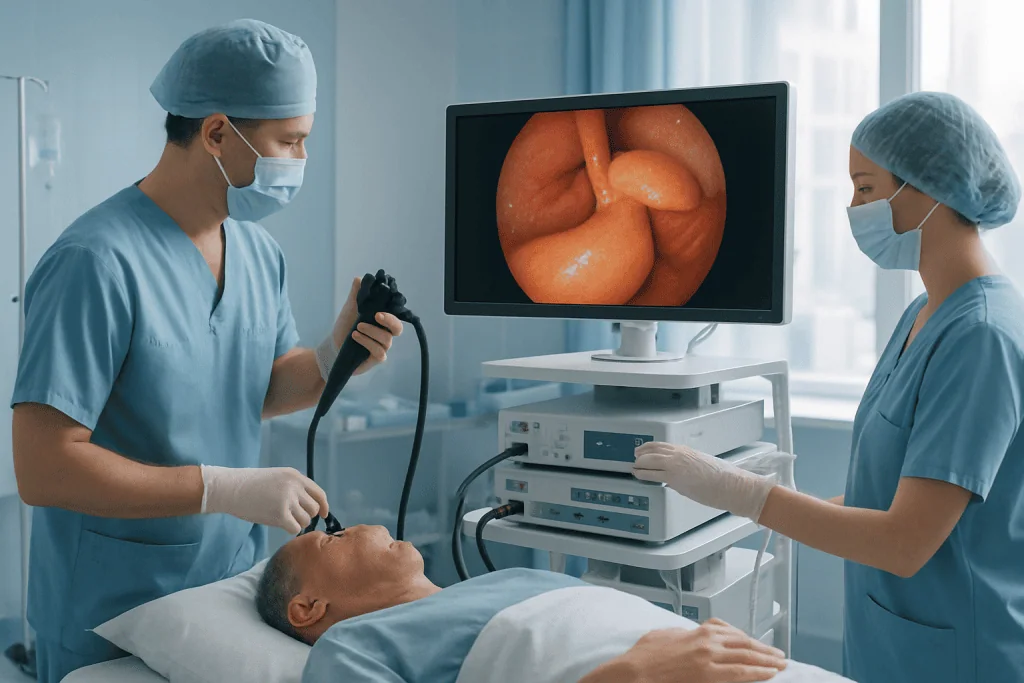
Upper gastrointestinal endoscopy is usually the central investigation. A thin flexible camera lets the physician examine the oesophagus, the stomach and the first part of the small intestine directly. Endoscopy identifies the hernia and estimates its size, and it also detects the consequences of reflux, oesophagitis, ulcers, narrowing, Barrett’s oesophagus, as well as bleeding sources. Just as importantly, it excludes other explanations for your symptoms, including conditions such as stomach cancer, which is one reason persistent upper digestive symptoms deserve investigation rather than years of self-management.
A barium swallow study shows how the oesophagus and stomach move while you swallow contrast liquid under X-ray. It helps define the size, shape and position of the hernia and how the stomach empties, information endoscopy alone cannot always provide, and particularly useful for planning para-oesophageal repairs.
Oesophageal manometry measures the strength and coordination of the muscle contractions that push food down the oesophagus. This test matters most before anti-reflux surgery: if the oesophagus pushes weakly, a full wrap around it may cause swallowing difficulty afterwards, and the surgeon will adapt the technique accordingly. Ambulatory pH or impedance testing records acid and non-acid reflux over an extended period of normal life, providing objective evidence that reflux, not something else, explains your symptoms.
Depending on your age, symptoms and history, further tests may be added: blood tests for anaemia, chest imaging if the hernia is large, cardiology assessment for chest symptoms, or pulmonary review for chronic cough or suspected aspiration. A CT scan of the chest and abdomen is sometimes added for very large hernias, because it shows precisely which organs have entered the chest and how the stomach is oriented, information that directly shapes the operative plan. This layered evaluation is not bureaucracy. It is how a surgeon makes sure that an operation is being recommended for the right reason, planned around your actual anatomy, and likely to address the symptoms that brought you to the clinic.
What Hiatal Hernia Treatment Involves
Hiatal hernia treatment sits on a spectrum from watchful waiting to surgical repair, and most people start at the conservative end. A small hernia found incidentally, causing no symptoms, generally needs no treatment at all. When reflux symptoms are present but manageable, the first-line approach combines lifestyle measures with medication, and for many people this is enough.
The lifestyle measures with the best rationale are practical rather than exotic:
- eating smaller meals and avoiding eating in the two to three hours before lying down;
- raising the head of the bed so gravity works for you overnight;
- losing excess weight, which directly lowers the abdominal pressure driving reflux;
- stopping smoking, which impairs the reflux barrier as well as healing;
- avoiding tight clothing around the waist and minimising heavy straining.
Acid-reducing medication, prescribed and adjusted by your treating doctor, reduces the acidity of what refluxes and allows an inflamed oesophagus to heal. What medication cannot do is repair the anatomical defect. The hernia remains, and mechanical reflux, regurgitation of volume rather than acid, may continue even when burning is controlled. That distinction is central to treatment decisions: when medication controls acid but regurgitation persists, when symptoms return quickly whenever therapy is paused, when medication is poorly tolerated, or when the hernia is large or at risk of complications, surgical repair enters the conversation.
What foods trigger a hiatal hernia?
Foods do not cause or enlarge a hiatal hernia, the hernia is structural, but certain foods reliably trigger the reflux symptoms a hernia makes possible. The usual offenders are fatty and fried foods, chocolate, caffeine, alcohol, spicy dishes, citrus fruits, tomato-based sauces, onions, peppermint and carbonated drinks. Large meals late in the evening are a trigger regardless of content, because a full stomach pressed against a weakened barrier at bedtime is the perfect setup for overnight reflux. Triggers vary considerably between individuals, so a short food-and-symptom diary is often more useful than a universal banned list. The aim is a diet you can actually sustain, not a joyless one.
Who May Need Surgical Repair
Surgery is considered when the hernia causes problems that conservative treatment cannot solve, or when the hernia itself poses a risk worth pre-empting. The decision is always made against objective test results, never against symptoms alone. Situations in which specialists typically discuss repair include:
- reflux that remains troublesome despite properly optimised medical therapy;
- regurgitation that disturbs sleep or daily life even when acid is controlled;
- swallowing difficulty clearly linked to the hernia;
- recurrent aspiration, chronic cough or other respiratory symptoms driven by reflux;
- large or symptomatic para-oesophageal hernias;
- bleeding or iron-deficiency anaemia caused by hernia-related erosions;
- a wish to move away from long-term medication, where testing confirms surgery is medically appropriate.
The anaemia point deserves explanation. In large hernias, the stomach lining can be repeatedly rubbed and pinched at the level of the diaphragm, producing linear erosions known as Cameron lesions. These bleed slowly, often without any visible sign, and present as fatigue, weakness, breathlessness on exertion or an abnormal blood count. Repairing the hernia removes the mechanical cause of the bleeding.
Chronic reflux itself can also injure the oesophagus over time, inflammation, ulceration, scar-related narrowing, and in some people the cellular change called Barrett’s oesophagus. Surgery does not replace endoscopic surveillance when Barrett’s oesophagus is present, but controlling reflux mechanically can be part of the broader management plan in selected patients. At the urgent end of the spectrum sit obstruction, strangulation and gastric volvulus: the twisting of the stomach described earlier. These are treated as emergencies, and their existence is a key reason specialists sometimes recommend planned, elective repair of a large para-oesophageal hernia before a crisis forces a far more difficult operation on a less stable patient.
Hiatal Hernia Surgery: How the Repair Is Performed
Hiatal hernia surgery has one core aim: to restore normal anatomy, stomach in the abdomen, hiatus at a normal size, reflux barrier working, in the least invasive way that is safe for your particular hernia. At experienced centres, it is carried out by general surgery teams with specific foregut expertise, almost always through keyhole (laparoscopic) access.
How do you fix a hiatal hernia?
You fix a hiatal hernia by returning the stomach to the abdomen, narrowing the enlarged opening in the diaphragm, and, where reflux is part of the picture, rebuilding the anti-reflux barrier. In a standard laparoscopic repair, the sequence looks like this:
- Several small incisions are made in the abdomen and a high-definition camera and long, precise instruments are introduced.
- The herniated stomach and lower oesophagus are carefully freed from the chest, the hernia sac is removed where appropriate, and an adequate length of oesophagus is restored below the diaphragm.
- The widened hiatus is narrowed with sutures placed in the diaphragm muscle, snug around the oesophagus but not tight.
- If reflux is a problem, a fundoplication is performed: the upper part of the stomach is wrapped fully or partially around the lower oesophagus to reinforce the valve.
- In selected cases, typically large para-oesophageal hernias, the stomach is additionally stitched into position, a step called gastropexy.
Preparation starts well before the operating room. Your surgeon reviews your symptoms, prior tests, medication history, previous operations and general health; if the diagnostic picture is incomplete, further testing is arranged first. Standard preparation includes blood tests and anaesthesia assessment, and a structured review of medicines such as blood thinners and diabetes drugs, any adjustments are decided by the treating team, never by the patient alone. If you smoke, stopping before surgery is strongly encouraged, because smoking impairs healing and worsens reflux control. You will also receive clear fasting instructions and a preview of the post-operative diet, so nothing about the first weeks comes as a surprise.
Closing the hiatus is usually done with sutures alone. In selected large or complex hernias, the surgeon may consider reinforcement material, but this is an individualised judgement: mesh at the hiatus has potential benefits and potential risks, and responsible surgeons weigh both rather than applying it routinely. The objective is a repair that is secure without making the opening too tight: an oesophagus needs room to swallow.
Fundoplication is where preoperative testing pays off. A complete wrap encircles the lower oesophagus fully and gives the strongest reflux control; a partial wrap covers part of the circumference and places less resistance in the path of a swallow. Manometry guides the choice: if your oesophagus pushes weakly, a partial wrap reduces the risk of postoperative swallowing difficulty. In some complex situations, for example, a shortened oesophagus after years of inflammation, additional techniques are used to achieve adequate length below the diaphragm. Throughout the dissection, the surgeon also works to protect the vagus nerves, which run along the oesophagus and help regulate stomach emptying; preserving them is one of the quiet technical priorities of a well-performed repair. The operation is tailored, not templated.
Weight and reflux interact, and honest planning acknowledges it. In patients with significant obesity and severe reflux, a standard fundoplication may not be the best answer, because high abdominal pressure works against the repair and raises the chance of recurrence. In these cases the specialist may discuss whether a weight-loss operation better addresses both problems at once; Acibadem’s bariatric and metabolic surgery teams are involved in exactly these discussions. This is a decision made with the patient after reviewing the full clinical picture, not a default.
Technology serves the surgeon’s judgement rather than replacing it. High-resolution laparoscopic imaging magnifies the delicate structures around the oesophagus, stomach, diaphragm, spleen, liver and major vessels; energy devices control bleeding and divide tissue precisely; modern anaesthesia monitoring keeps breathing and circulation stable throughout. For selected patients, robotic-assisted surgery may be used where clinically suitable, offering articulated instruments and stable three-dimensional vision in a confined space. None of this substitutes for planning and experience; it extends them.
Duration and hospital stay vary with the size of the hernia, the amount of scar tissue, whether a fundoplication is added, and whether you have had previous surgery in the area. Many laparoscopic repairs take a few hours; complex or revisional cases take longer. Some patients go home after a short hospital stay, while others, particularly after large para-oesophageal repairs, or with significant other medical conditions, need additional monitoring before discharge.
Recovery After Hiatal Hernia Repair
Recovery begins the same day. You are monitored as anaesthesia wears off and encouraged to walk early, which reduces the risk of blood clots and supports your lungs. Pain is managed with a planned approach, usually non-opioid first with stronger medication reserved for when it is needed. Nausea prevention is taken seriously, because retching strains a fresh repair. The broad shape of the following weeks looks like this:
| Time Period | What Patients Can Expect |
|---|---|
| Day 1 | Monitoring after anaesthesia, early walking, pain and nausea control, and usually liquids or a carefully guided diet depending on the surgeon’s protocol. |
| First week | Gradual increase in light activity, small frequent meals, progression through a soft or liquid diet, and attention to swallowing comfort, hydration and wound care. |
| First month | Steady improvement in energy, reduced incision discomfort, broader food choices as approved, and continued avoidance of heavy lifting or straining. |
| Longer term | Return to more normal eating and activity for many patients, with follow-up to assess reflux control, swallowing, bloating and any medication adjustment by the treating doctor. |
Diet progresses in stages, liquids, then soft foods, then a more normal range, on a schedule set by your surgeon’s protocol. The habits that help most are simple: eat slowly, take small bites, chew thoroughly, and avoid carbonated drinks early on, since gas pressure against a fresh repair causes bloating and discomfort. Foods that commonly cause trouble in the first weeks are dry or doughy textures, fresh bread, rice, tough meat, which can hold up briefly at the level of the healing repair; moist, soft foods taken slowly pass far more comfortably. Many teams also advise skipping straws at this stage, because they draw extra air into the stomach at a time when belching may be temporarily harder. Expect some temporary difficulty swallowing in the early weeks. Swelling around the repair narrows the passage briefly, and this settles as healing progresses; persistent or severe swallowing problems are something your care team will want to know about and assess.
Light daily activity resumes soon after discharge. Heavy lifting, intense exercise and anything that sharply raises abdominal pressure are restricted for several weeks, because the sutured diaphragm needs time to heal under low tension. Preventing constipation matters for the same reason, straining works against the repair.
Why Acting Early Matters
Not every hiatal hernia requires surgery, and many never will. But symptoms that persist or progress deserve timely evaluation, because the cost of delay is paid in information as much as in health: without proper testing, you are managing a condition you have not actually characterised. Early specialist review does not mean every patient ends up in an operating room. It means decisions rest on evidence rather than uncertainty.
In chronic reflux, ongoing exposure of the oesophagus to stomach contents can lead to inflammation, ulceration, narrowing, or the cellular changes of Barrett’s oesophagus. Medication may control acid and relieve burning, yet fail to prevent regurgitation and mechanical reflux in every patient. If symptoms continue despite appropriate therapy, further testing clarifies whether the hernia is the driver and whether repair is a reasonable answer, or whether something else entirely explains the picture.
For para-oesophageal hernias, the argument for timeliness is stronger still. Large hernias can cause chronic anaemia, aspiration, poor stomach emptying or sudden obstruction, and rarely the stomach can twist in a way that compromises its blood supply. Emergency surgery on a medically unstable patient is a harder operation with harder trade-offs than a planned elective repair performed after complete evaluation. This is precisely why specialists sometimes recommend repairing a symptomatic large hernia before a crisis, not after one.
Timing also shapes how well-prepared you are. Patients who address the problem before severe weight loss, malnutrition, recurrent aspiration or significant anaemia set in tend to be in better condition for anaesthesia and recovery. Planned treatment also allows unhurried records review, coordinated testing, anaesthesia assessment and a realistic schedule, none of which an emergency permits.
Benefits of Hiatal Hernia Treatment
When the treatment plan is matched to your anatomy and your symptoms, repair can deliver several meaningful benefits. Note the careful wording in each row: these are realistic outcomes in appropriately selected patients, not promises.
| Benefit | What It Means for You |
|---|---|
| Improved reflux control | Repairing the hernia and reinforcing the anti-reflux barrier may reduce heartburn, regurgitation, throat irritation and reflux-related sleep disruption in appropriately selected patients. |
| Restoration of stomach position | Returning the stomach to the abdomen can relieve pressure, early fullness, nausea, chest discomfort or breathing symptoms caused by a large hernia. |
| Reduced need for long-term medication in selected patients | Some patients are able to decrease or stop acid-suppressing medication after successful repair, although this depends on individual factors and is always guided by the treating physician. |
| Protection from certain hernia-related complications | For symptomatic para-oesophageal hernias, planned repair may reduce the risk of obstruction, twisting, bleeding or emergency presentation. |
| Better eating comfort and daily function | Less post-meal pressure, improved tolerance of normal meals, and fewer limitations related to bending, lying down or travelling. |
What Influences a Good Result
The outcome of hiatal hernia repair depends on more than what happens in the operating room. The single biggest factor is choosing the right treatment for the right diagnosis. Patients with well-documented reflux, adequate oesophageal function and symptoms that genuinely match the hernia are far more likely to benefit than patients whose symptoms actually stem from an unrelated condition. This is why a surgeon who insists on complete testing before operating is protecting your result, not delaying it.
The hernia itself matters. Small sliding hernias with reflux are a different surgical problem from large para-oesophageal hernias. Revisional surgery, after a previous fundoplication or repair, is more complex again, and requires careful review of old operative reports, imaging and current anatomy. Scar tissue, a shortened oesophagus, obesity, connective tissue disorders, chronic cough, severe constipation, habitual heavy lifting and vomiting disorders all place stress on a repair and influence its durability.
Oesophageal motility is a quiet but decisive factor. If the oesophagus does not push food effectively towards the stomach, a tight anti-reflux wrap can trade reflux for swallowing difficulty. Manometry before surgery exists precisely to prevent that trade: the goal is reflux control and comfortable swallowing, not one at the expense of the other.
Your own behaviour after surgery genuinely affects the result. Following the diet plan, not overeating, preventing constipation, delaying heavy lifting, and reporting persistent vomiting or severe swallowing problems all protect the repair while it heals. For some patients, weight management is the most important long-term contribution they can make, because abdominal pressure is what drove the hernia in the first place. Stopping smoking supports healing and reduces respiratory risk.
Surgeon experience and team coordination complete the picture. Hiatal repair involves delicate anatomy around the oesophagus, diaphragm, stomach, spleen, vagus nerves and major vessels. Careful dissection, adequate oesophageal mobilisation, a properly judged closure of the hiatus and a well-chosen fundoplication technique all shape how the repair feels and how long it lasts. In complex cases, discussion among gastroenterologists, foregut surgeons, radiologists and anaesthesiologists refines the plan before anyone operates.
Finally, expectations should be realistic. Many patients experience substantial relief, but no operation eliminates every digestive symptom. Some people have temporary bloating, increased wind, difficulty belching or swallowing discomfort in the months after surgery, and a small number need further evaluation or treatment later. A responsible plan states the anticipated benefits and the possible limitations in the same conversation, and you should expect to hear both.
How Hiatal Hernia Care Is Organised at Acibadem
At Acibadem hospitals, hiatal hernia care is delivered as one connected pathway: diagnostic evaluation, surgery, anaesthesia, intensive care when needed, and follow-up sit within the same system rather than being scattered across providers. Evaluation may draw on gastroenterology, general and foregut surgery, radiology, anaesthesiology and nutrition, depending on your condition. For complex situations, large para-oesophageal hernias, previous surgery, Barrett’s oesophagus, obesity, anaemia or respiratory involvement, multidisciplinary review is particularly valuable, and can include thoracic surgery expertise where a hernia extensively involves the chest.
Diagnostic pathways are designed to reduce uncertainty, not to multiply tests. Endoscopy, contrast imaging, oesophageal function testing, reflux monitoring, laboratory work and cardiopulmonary assessment are coordinated when indicated, with the single purpose of making sure any surgery is recommended for the right reason and planned in the safest sequence. Treatment plans follow evidence-based protocols and are adapted to your anatomy, your test results and your goals, some patients are best served by medication and surveillance, others by laparoscopic repair with fundoplication, others by a different strategy altogether.
Surgical teams use minimally invasive approaches wherever appropriate. Laparoscopic technique reduces incision size, supports earlier mobility and shortens recovery for many patients compared with open surgery; robotic assistance is available for selected cases where it is clinically suitable. Existing records, endoscopy reports, imaging, pH and manometry results, operative notes, are reviewed as part of planning, so the team knows which tests remain to be done and whether surgery is likely to be the right recommendation before any date is set.
Clear communication is treated as part of the medicine. You should understand why a procedure is recommended, what it involves, how long you would need to stay near the hospital, what recovery will feel like, which symptoms are expected in the early weeks, and which warning signs your care team will ask you to report. Patients who understand their operation recover with less anxiety and follow their protocols better.
Living With the Diagnosis
A hiatal hernia is common, usually manageable, and only sometimes surgical. If yours is small and quiet, sensible eating habits and doctor-led medical therapy may be all it ever demands. If it is disrupting your sleep, your meals, your breathing or your blood count, a structured evaluation, endoscopy, imaging, function testing, will show whether the hernia is truly the cause and what fixing it would involve. Neither path requires guesswork.
Living with persistent reflux, chest discomfort, regurgitation or swallowing difficulty is exhausting, and much of that exhaustion comes from uncertainty. The condition itself is well understood: the anatomy is mappable, the function is measurable, and the treatment options, from a food diary to a laparoscopic repair, are well established. With a complete diagnosis and an individualised plan, most patients move from managing vague symptoms to addressing a defined, fixable problem. That shift, more than any single treatment, is what changes how the condition feels to live with.
Preparation
- Evaluation may include endoscopy, imaging, esophageal manometry or reflux testing to confirm the hernia and plan treatment. Tell your doctor about all medications, especially blood thinners, and follow instructions on stopping them. You will usually fast for several hours before surgery.
Aftercare
- After surgery, patients usually start with liquids or soft foods and gradually return to a normal diet as advised. Avoid heavy lifting and strenuous activity until cleared by your surgeon. Attend follow-up visits and seek medical advice for fever, worsening pain, vomiting or difficulty swallowing.
Frequently Asked Questions
What affects the cost of hiatal hernia treatment?
Cost depends on the hernia type, symptom severity, required diagnostic tests, whether anti-reflux surgery is added, hospital and surgeon factors, anaesthesia needs, hospital stay and international patient services. A personalised quote can be prepared after medical review.
How can I get a personalised quote for hiatal hernia surgery in Turkey?
You can request a free consultation and share your medical reports, endoscopy findings, imaging results and current medications. A specialist team can then advise whether surgery is appropriate and provide a tailored treatment estimate.
Are diagnostics included in a treatment package?
Some packages include selected pre-operative tests, while others may list advanced investigations separately. The final plan depends on what your specialist needs to confirm the diagnosis and choose the safest surgical approach.
Does laparoscopic surgery cost differently from other approaches?
The surgical approach can affect cost because it influences operating room resources, equipment, hospital stay and recovery planning. Most symptomatic hiatal hernia repairs are considered for laparoscopic surgery when clinically suitable.
Will travel, hotel and interpreter services affect the total budget?
Yes. For international patients, accommodation, airport transfers, interpreter support and follow-up coordination can influence the overall budget. International patient teams can help clarify what is included before travel.
Medically reviewed by the Acıbadem International Medical Board August 31, 2026
See our medical review board →
Update history
- PublishedJune 8, 2026
- Medical review approvedAugust 31, 2026
- Last content updateSeptember 8, 2026
References3
- Hiatal hernia nhs.uk
- Hiatal Hernia medlineplus.gov
- Hiatal Hernia my.clevelandclinic.org
Trusted care for international patients
From the Acibadem Blog

How Is a Hiatal Hernia Repaired Laparoscopically? Keyhole Steps and How Long It Takes
Laparoscopic hiatal hernia repair is keyhole surgery done under general anesthesia through several small abdominal cuts. The surgeon pulls the herniated stomach back below…

Eating After Hiatal Hernia Surgery: Liquids, Soft Foods and the Return to Normal Meals
After hiatal hernia surgery, eating usually moves through stages: clear liquids in the first day or two, then thicker liquids and puréed or very…