Ophthalmic Lasers
Ophthalmic lasers are advanced eye treatments used for conditions affecting vision, the retina, cornea, or eye pressure. They are usually outpatient procedures planned after detailed eye examination.
Quick answer
Ophthalmic lasers use focused light energy to treat specific structures of the eye: the retina, lens capsule, iris, drainage angle or cornea. Depending on the diagnosis, a laser operation for eyesight can seal retinal tears, clear cloudiness after cataract surgery, lower eye pressure in glaucoma or reshape the cornea to correct vision. Most procedures are outpatient, performed with numbing drops while you are awake.
Laser Operation for Eyesight: What Ophthalmic Lasers Can and Cannot Do
A laser operation for eyesight uses focused light energy to treat a precise target in or around the eye. Depending on the diagnosis, that target may be the retina, the lens capsule, the iris, the eye’s fluid drainage system or the cornea. Some procedures aim to make you see more clearly; others aim to protect the vision you still have from further damage.
That distinction matters more than anything else on this page. If you are researching a laser operation for eyesight, you may be picturing refractive surgery: the corneal procedure that reduces dependence on glasses. That is one use of ophthalmic lasers, but only one. Lasers are also used to stabilise diabetic eye disease, seal retinal tears before they progress, clear the cloudy capsule that can blur vision after cataract surgery, and lower eye pressure in selected forms of glaucoma. Knowing which category your recommended treatment falls into tells you what a realistic result looks like, and what the laser cannot deliver.
When an eye specialist recommends a laser procedure, most patients feel a mixture of relief and concern. Relief, because laser treatments are usually outpatient, targeted and less invasive than conventional surgery. Concern, because vision is deeply personal, and any procedure involving the eyes can feel intimidating. It is natural to wonder whether the treatment will be uncomfortable, how long recovery takes, whether you can travel afterwards, and what happens if you wait. This page answers those questions as plainly as the evidence allows.
Because the eye is a delicate and highly specialised organ, good laser care begins long before the laser is switched on. A detailed eye examination, imaging and careful measurement determine whether laser treatment is appropriate at all, which approach is safest for your anatomy, and what outcome is realistic. At Acibadem, ophthalmic laser care is planned by experienced ophthalmologists using modern diagnostic pathways, with particular attention to the practical needs of international patients who travel for diagnosis, treatment or a second opinion.
What Ophthalmic Laser Treatment Is
Ophthalmic lasers are medical devices that deliver controlled light energy to a defined tissue target inside or on the surface of the eye. Unlike a conventional surgical instrument, a laser beam can be focused with extreme precision to create tiny openings, seal abnormal or leaking blood vessels, apply controlled treatment to the retina, reshape corneal tissue or influence the eye’s fluid drainage. The type of laser, its energy settings and the treatment pattern all depend on the diagnosis, which is why the same word, laser, describes procedures that have almost nothing else in common.
In ophthalmology, different laser platforms serve different medical purposes. Retinal lasers are used to treat diabetic retinopathy, retinal tears, changes related to retinal vein occlusion and selected peripheral retinal diseases. A YAG laser can clear cloudy vision after cataract surgery by opening the posterior lens capsule, or create a small opening in the iris in certain narrow-angle glaucoma situations. Selective laser trabeculoplasty lowers intraocular pressure in suitable glaucoma patients by treating the eye’s drainage tissue. Corneal lasers reshape or treat the corneal surface, for refractive correction, or for selected surface conditions after careful screening.
Laser energy is used across many fields of medicine: the broader discipline of laser surgery spans several specialties, but ophthalmic applications demand a particular level of precision. The structures being treated are measured in fractions of a millimetre, and the margin for error is correspondingly small. That is why patient selection and diagnostic accuracy carry as much weight as the technology itself.
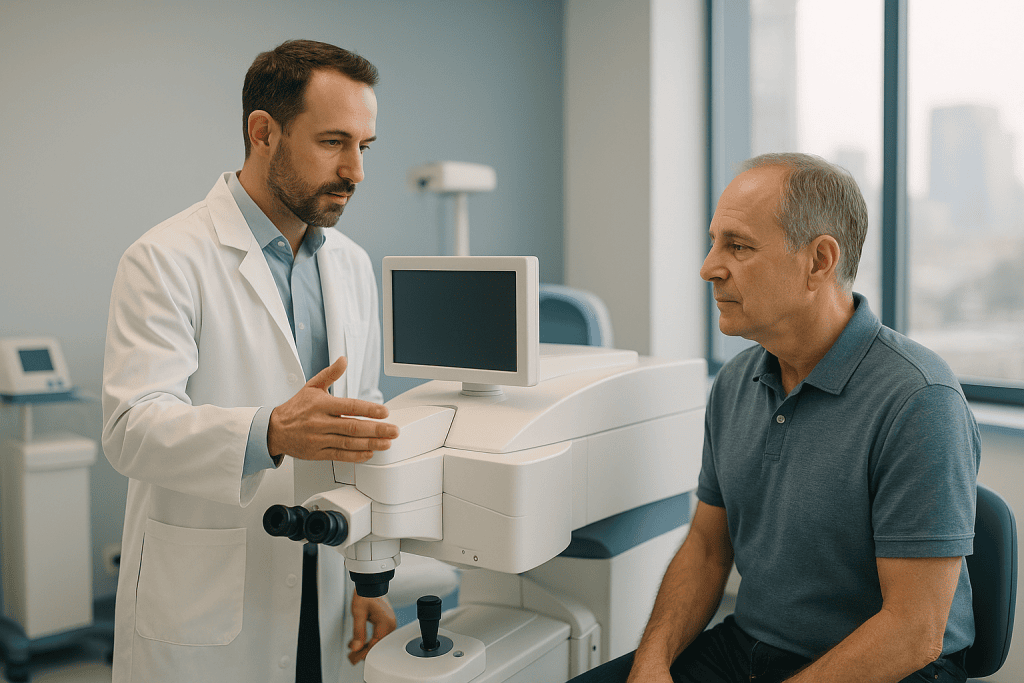
Most ophthalmic laser treatments are performed without general anaesthesia. Numbing eye drops are applied and you remain awake throughout. The ophthalmologist may place a special contact lens on the eye to focus the beam and hold the view steady. Some procedures take only minutes; others need a longer session or more than one visit. Afterwards, most patients go home the same day with instructions covering eye drops, activity restrictions and follow-up appointments. The laser is precise, but it is still a medical intervention: its benefits and risks depend on the condition being treated, the health of the eye, the accuracy of the diagnosis and the experience of the treating physician.
Is a laser operation good for eyes?
A laser procedure is good for the eyes when the diagnosis genuinely calls for it, and unnecessary, even harmful, when it does not. For a retinal tear caught early, laser treatment can help secure the surrounding retina and reduce the risk of detachment. For a cloudy capsule after cataract surgery, a brief YAG treatment often restores clarity quickly. For an eye with narrow drainage anatomy, an iridotomy can lower the risk of a sudden pressure crisis. But for an eye that does not need treatment, a laser adds risk without benefit. The honest answer is that a laser is a tool, not a therapy in itself; its value depends entirely on whether it is applied to the right problem, in the right eye, at the right time. This is why a thorough examination always comes before any decision to treat.
Types of Laser for Eyes Treatment
Laser for eyes treatment is not a single procedure but a family of distinct procedures, each with its own purpose, technique and recovery pattern. The five categories below account for most ophthalmic laser work. If your ophthalmologist has recommended one of them, the descriptions here will help you understand what the treatment is for, and what it is not for.
Retinal laser photocoagulation
Retinal laser treatment applies controlled spots of laser energy to targeted areas of the retina, the light-sensing tissue at the back of the eye. It is used to seal retinal tears before they progress, to treat areas of abnormal blood vessel growth in proliferative diabetic retinopathy, to manage leakage in selected macular and peripheral retinal conditions, and to address changes related to retinal vein occlusion. Each treated spot forms a small, deliberate scar that bonds the retina to the tissue beneath it: the effect is often compared to spot-welding, anchoring vulnerable areas in place. The number and pattern of laser applications vary widely: a small tear may need a tight ring of spots around it, while advanced diabetic disease may need extensive treatment across the peripheral retina, sometimes divided over more than one session. The goal of most retinal laser work is preservation, stabilising a high-risk area so the disease does not take more vision, rather than making you see better than you do today.
YAG laser capsulotomy
YAG laser capsulotomy treats the cloudy posterior capsule that can develop after cataract surgery, a condition sometimes called secondary cataract even though the original cataract has already been removed and cannot return. The laser creates a clear central opening in the capsule behind the artificial lens implant. Treatment is usually brief. When the cloudy capsule is genuinely the cause of blurred vision, clarity often improves within days; when blur has another cause, such as macular disease, opening the capsule alone will not fix it, which is why the examination beforehand matters.
Laser iridotomy
Laser iridotomy creates a tiny opening in the iris to help fluid circulate more freely in eyes with narrow drainage angles. Its purpose is largely preventive: in narrow-angle anatomy, the drainage pathway can close suddenly, causing a rapid and dangerous rise in eye pressure. The iridotomy provides an alternate route for fluid flow and reduces the risk of such angle-closure events. The eye is often pretreated with drops that make the pupil smaller, and eye pressure is typically checked after the procedure.
Selective laser trabeculoplasty (SLT)
Selective laser trabeculoplasty applies laser energy to the trabecular meshwork, the eye’s drainage tissue, with the aim of improving fluid outflow and lowering intraocular pressure. It is often considered in open-angle glaucoma or ocular hypertension when the drainage system is accessible and the patient is a suitable candidate. In selected patients it may reduce the need for pressure-lowering eye drops, or support pressure control when medication alone is not sufficient. The effect is not always immediate; your response is assessed over follow-up visits, and existing medication is usually continued until the treating doctor confirms the result.
Laser eye surgery for refractive errors
Laser eye surgery reshapes the cornea to correct short-sightedness, long-sightedness or astigmatism in carefully screened candidates. Techniques differ: some create and lift a thin corneal layer before reshaping the tissue beneath, while surface-based techniques treat the outer layer directly. Unlike the procedures above, refractive surgery is usually elective: the eye is healthy, and the goal is reduced dependence on glasses or contact lenses rather than disease control. Precisely because it is elective, screening is strict. Corneal thickness, corneal shape, dryness, stability of your prescription, age and overall eye health all determine whether treatment is safe. Not every patient is suitable, and a responsible clinic will decline candidates whose corneas make treatment risky. Corneal lasers are also used therapeutically in certain scarring or surface-irregularity conditions, where the aim is to smooth or clear the corneal surface rather than change your prescription.
Who May Need Vision Laser Treatment?
Vision laser treatment is usually considered after symptoms, screening findings or diagnostic imaging suggest that a laser could protect or improve sight. Some people notice changes themselves; others feel nothing and are diagnosed during a routine eye examination. Silent presentation is especially common in diabetic retinopathy and early glaucoma, where damage can progress for years before vision changes become obvious.
Findings and symptoms that commonly lead to evaluation include:
- Blurred or fluctuating vision, or reduced night vision
- New floaters, flashes of light, dark spots or visual distortion
- Glare or renewed blur months or years after cataract surgery
- Elevated eye pressure or narrow drainage angles found on examination
- A sudden change in peripheral vision
- Retinal changes detected during diabetes screening
Certain patients need closer monitoring and earlier intervention: people with diabetes, high blood pressure, previous cataract surgery, glaucoma, high myopia, existing retinal disease or a family history of eye conditions. If you fall into one of these groups, regular examinations matter even when your vision feels stable.
Diagnosis typically begins with a comprehensive ophthalmic examination: visual acuity testing, eye pressure measurement, slit-lamp examination, dilated retinal examination, corneal evaluation and assessment of the optic nerve. Depending on the suspected condition, imaging may map the retina, measure retinal thickness, evaluate blood flow abnormalities, inspect the optic nerve fibre layer or analyse the corneal surface and thickness. These tests determine whether laser treatment is appropriate, or whether another approach, such as medication, injection therapy, conventional surgery or simple observation, is better suited to your eye.
For international patients, a second opinion can be particularly valuable when a laser procedure has been recommended but the diagnosis, urgency or alternatives are not fully clear. Bringing previous reports, imaging, medication lists and surgical history allows the reviewing ophthalmologist to compare findings over time and build a more personalised plan.
Conditions and Indications Treated With Ophthalmic Lasers
Looking at the same procedures from the disease side clarifies what each treatment is actually trying to achieve. In retinal disease, laser treatment may seal retinal tears, reduce the risk of retinal detachment, manage areas of abnormal blood vessel growth, or treat leakage in selected macular and peripheral conditions. In diabetic eye disease, laser treatment can help reduce the risk of severe vision loss in proliferative diabetic retinopathy or certain patterns of retinal swelling, though modern diabetic eye care often combines laser with intraocular injections and, critically, management of the diabetes itself.
In glaucoma care, laser treatment may be recommended to improve fluid drainage or limit pressure-related damage. Selective laser trabeculoplasty suits selected open-angle glaucoma and ocular hypertension patients; laser iridotomy suits narrow-angle anatomy; other laser procedures exist for more advanced or complex glaucoma, chosen according to the state of the individual eye.
After cataract surgery, posterior capsule clouding is treated with YAG capsulotomy when it is confirmed as the cause of blur. On the cornea, lasers correct refractive errors in screened candidates and treat selected surface conditions therapeutically.
One distinction deserves emphasis, because it shapes every honest conversation about outcomes. Some laser treatments are designed to restore or improve vision; many are designed to prevent further deterioration. A retinal laser may stabilise a high-risk area, but whether vision improves depends on whether the central retina or other structures have already been damaged. A glaucoma laser may reduce pressure, but it cannot reverse vision already lost to optic nerve injury: that loss is permanent. Understanding which goal applies to your treatment keeps expectations aligned with what medicine can actually do.
How a Laser Operation for Eyesight Is Performed
Although the lasers differ, the pathway on a treatment day follows a broadly similar sequence:
- Review and consent. Your ophthalmologist confirms the diagnosis, reviews your medical history, previous eye surgery, medications and allergies, and explains the plan. Diabetes, hypertension, glaucoma, autoimmune disease and blood-thinning medication are all relevant details to mention.
- Updated measurements where needed. Some patients need fresh retinal imaging, corneal scans, eye pressure testing or optic nerve analysis on the day, so the treatment reflects the eye’s current state rather than an old report.
- Preparation drops. Depending on the procedure, drops may dilate the pupil, constrict it, numb the eye’s surface or lower eye pressure in advance.
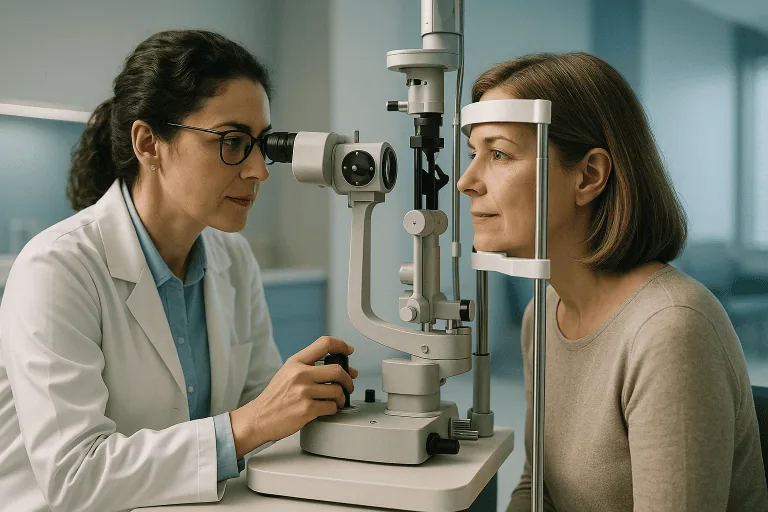
- Positioning. For most procedures you sit at a microscope-like device similar to a standard examination slit lamp. A small contact lens may be placed on the numbed eye with lubricating gel to focus the laser and keep the eye steady.
- Treatment. The laser is applied in a planned pattern. You may see bright flashes or hear clicking; sensations range from nothing at all to brief stinging or pressure, depending on the procedure and the area treated.
- Post-procedure checks. Eye pressure is often measured before you leave, and drops may be prescribed to reduce inflammation, control pressure or lubricate the eye.
The experience varies by procedure. During retinal laser treatment, spots are directed to targeted areas of the retina; patients see bright flashes, and there may be mild discomfort or a pressure sensation, particularly when the peripheral retina is treated, though many people tolerate the session well with drops alone. During YAG capsulotomy, you may hear clicking and see light; the treatment is usually brief, and floaters or temporary blurring can occur in the first days even when vision improves quickly. During laser iridotomy, a brief sting or pressure sensation is common, and pressure is checked afterwards. During selective laser trabeculoplasty, the session itself is typically short, with the real assessment happening over follow-up visits as the pressure response develops. Corneal laser procedures are guided by detailed pre-treatment measurements and require the most structured aftercare, because the quality of corneal healing directly shapes visual recovery.
How is the right eye treatment laser chosen?
The eye treatment laser your ophthalmologist selects is matched to the target tissue and the goal of care, and that decision rests on imaging as much as on the laser itself. Depending on the condition, diagnostics may include high-resolution retinal scans, corneal mapping, optic nerve analysis, visual field testing, retinal photography and angiographic imaging when blood vessel leakage or abnormal circulation needs assessment. These tools tell the physician where to treat, how extensive treatment should be, and, just as importantly, how the eye responds over time. A laser applied without adequate imaging can miss related problems or create unrealistic expectations, which is why reputable centres will not skip this step to save a day.
Almost all ophthalmic laser treatments are outpatient procedures, but expect the hospital visit to last longer than the laser itself: preparation, dilation, examination, consent, treatment and post-procedure checks all take time. Because dilation and temporary blur are common, do not plan to drive immediately afterwards. If you have travelled for treatment, the return journey, follow-up timing and what to watch for during healing are all worth discussing before you leave the hospital.
Recovery After a Laser Operation for Eyesight
Recovery from a laser operation for eyesight depends on which procedure you had and why. Some patients return to normal activities the same or the next day; others need several days of reduced activity, precautions against light sensitivity, or a course of eye drops. The general pattern most patients can expect looks like this:
| Time Period | What Patients Can Expect |
|---|---|
| Day 1 | Temporary blurred vision, light sensitivity, mild irritation or floaters may occur. Eye pressure may be checked before you leave. Driving is avoided immediately after treatment, especially if the pupil was dilated. |
| First week | Vision may fluctuate while the eye settles. Drops may be prescribed to reduce inflammation or control pressure. Following the activity instructions given at discharge helps healing stay on track; most eyes settle steadily during this period. |
| First month | Follow-up examinations assess healing, eye pressure, retinal response or corneal recovery. Some conditions require additional laser sessions or complementary treatment. |
| Longer term | Ongoing monitoring matters for chronic conditions such as diabetes, glaucoma or retinal vascular disease. The laser addresses a specific problem; the underlying disease may still need long-term care. |
Within that pattern, procedures differ. Retinal laser patients may notice temporary blurred vision, reduced night vision or peripheral visual changes, in proportion to how extensive the treatment was. Corneal laser recovery tends to involve more noticeable discomfort, light sensitivity and fluctuating vision during the early healing period, particularly after surface-based techniques. Glaucoma laser patients usually continue their existing drops and attend pressure checks until the response is confirmed. YAG capsulotomy patients often notice improvement quickly, sometimes with new floaters that settle over time.
If you are flying home after treatment, the safe timing differs by procedure: a corneal treatment, a retinal laser and cataract-related care each have different considerations, which we compare in our guide to flying after eye surgery.
How long does laser eye surgery vision correction last?
Laser eye surgery vision correction is designed to be long-lasting: the corneal tissue reshaped during treatment does not grow back, so the correction itself is permanent. What changes is the eye around it. From the mid-forties onward, most people develop presbyopia, the natural age-related loss of near focus, regardless of any earlier laser treatment, and reading glasses may eventually be needed. A minority of patients experience some regression of effect over the years, and cataracts can still develop later in life, changing vision independently of the cornea. If the question is about the procedure itself, the laser portion typically takes minutes per eye, though the full appointment is longer. Other ophthalmic lasers follow their own timelines: a YAG capsulotomy usually needs to be done only once per eye, the pressure-lowering effect of selective laser trabeculoplasty can diminish over time and may be repeatable in suitable eyes, and retinal laser treatment creates permanent treatment scars while the underlying disease, diabetes, for instance, may still progress and require further sessions.
Risks, Side Effects and Honest Limits
Every laser procedure involves trade-offs, and a page that only lists benefits is not telling you the whole story. The risks differ by procedure, and the right way to weigh them is against the risk of the untreated condition, which, for a retinal tear or narrow-angle anatomy, can be considerable.
What’s the downside to laser eye surgery?
The main downsides of laser eye surgery are dry eyes during the healing period and sometimes beyond, glare and halos around lights at night, fluctuating vision while the cornea heals, and the possibility of a residual prescription that may need spectacles or further treatment. The reshaping is not reversible, treatment does not prevent presbyopia from arriving with age, and not every eye is a safe candidate, thin or irregular corneas, unstable prescriptions and significant dryness can all rule treatment out. Other ophthalmic lasers have their own downsides: extensive retinal laser can affect peripheral or night vision, YAG capsulotomy commonly causes new floaters and carries a small risk of retinal complications, and glaucoma lasers can cause temporary pressure rises or inflammation that need monitoring. We cover the full picture, including how complications are identified and managed, in our guide to laser eye surgery risks, side effects and safety.
What is the fail rate of laser eye surgery?
There is no single fail rate for laser eye surgery, because “failure” means different things in different contexts: a residual prescription after refractive treatment, regression of effect over time, the need for an enhancement procedure, or a genuine complication affecting vision. Published figures vary with the technique used, the size and type of the prescription treated, the strictness of candidate screening and how outcomes are defined, which is why a headline number quoted without context tells you very little. More useful questions for your surgeon are: how is my individual risk profile assessed, what would a retreatment involve if I needed one, and at what point after surgery is my result considered stable? Careful screening is the single strongest protection against disappointment, because most poor refractive outcomes trace back to treating an eye that should not have been treated. If you have already had a procedure elsewhere and the result is not what you expected, our guide on when to consider a second opinion before revision treatment explains how repeat procedures are assessed.
Benefits of Ophthalmic Laser Treatment
The benefits depend on the diagnosis, but the following advantages explain why physicians often prefer a laser-based approach when the indication is right.
| Benefit | What It Means for You |
|---|---|
| Targeted treatment | Laser energy is directed to a specific structure, retina, capsule, iris, drainage angle or cornea, while limiting unnecessary disruption to surrounding tissue. |
| Outpatient care | Most ophthalmic laser procedures are performed without hospital admission, so many patients return to their hotel or home the same day. |
| Reduced need for incisions | Many laser procedures treat the eye without traditional surgical cuts, which can simplify recovery in suitable patients. |
| Vision preservation | For conditions such as diabetic retinopathy, retinal tears and glaucoma, timely treatment may reduce the risk of further vision loss. |
| Improved clarity in selected cases | Procedures such as YAG capsulotomy after cataract surgery may improve visual clarity when a cloudy capsule is the cause of blur. |
| Personalised treatment planning | Laser type, treatment extent, follow-up schedule and medication are adapted to your diagnosis, eye anatomy and overall health. |
Why Acting Early Matters
Many eye diseases are time-sensitive, and postponing a recommended laser operation for eyesight rarely makes the underlying problem easier to treat. The retina and optic nerve are particularly unforgiving. Once retinal tissue detaches, scars or loses function, or once optic nerve fibres are damaged by glaucoma, treatment may prevent further decline but cannot always restore what has been lost.
In diabetic retinopathy, abnormal blood vessels can bleed, scar or pull on the retina; early detection and appropriate treatment reduce the risk of severe complications. In a retinal tear, timely laser can help secure the retina around the tear and lower the chance of progression to retinal detachment. In narrow-angle anatomy, early recognition allows a preventive iridotomy before a sudden pressure rise threatens vision. In open-angle glaucoma, pressure control matters precisely because the vision loss it causes develops gradually and silently.
Some eye conditions behave very differently from gradual blur: a fresh retinal tear or an angle-closure episode can progress within days rather than months, which is why they occupy a different category of urgency in clinical practice. For patients planning to travel abroad for care, this time-sensitivity is a practical planning point: schedule evaluation early enough to allow diagnostic testing, treatment if needed, and appropriate follow-up before the return journey.
Factors That Influence Outcomes
The result of ophthalmic laser treatment depends on more than the procedure itself. A good outcome begins with an accurate diagnosis and honest selection: not every eye condition is best treated with laser, and not every patient with the same diagnosis needs the same approach. The ophthalmologist weighs the stage of disease, the location of the problem, the eye’s anatomy, previous surgery, current medications and your own visual goals.
The condition itself is the largest single factor. A small retinal tear identified before detachment carries a different outlook from advanced retinal disease with bleeding or scarring. A patient with mild posterior capsule clouding may notice rapid improvement after YAG capsulotomy, while a patient whose blur is caused by macular disease will not improve from capsule treatment alone. In glaucoma, the laser response varies from eye to eye, and pressure control may still require drops or additional procedures afterwards.
Timing matters in both directions. Earlier treatment can prevent complications in retinal tears, diabetic retinopathy and glaucoma-related risk, but treatment should also be properly planned. A laser performed without complete examination and imaging can miss related problems or set expectations the eye cannot meet. Diagnostic precision is not a delay; it is part of the treatment.
General health shapes eye outcomes more than most patients expect. Diabetes control, blood pressure, cholesterol, smoking, kidney disease and medication adherence all influence retinal disease. Dry eye, autoimmune conditions and corneal thickness affect corneal laser planning and healing. For glaucoma patients, consistent use of prescribed drops and attendance at follow-up visits are often as important as the laser itself.
Your own part in recovery counts too. Drops should be used as prescribed, and follow-up visits kept, particularly after retinal or glaucoma laser treatment. Complications after ophthalmic laser work are uncommon, but when they occur they tend to declare themselves early, which is why the first weeks after treatment are structured around scheduled checks rather than left open-ended.
Finally, outcomes reflect the expertise of the clinical team and the quality of the diagnostic environment. Ophthalmic laser care requires precise examination, appropriate technology, experienced interpretation of imaging and clear communication about benefits, alternatives and risks. The best result is not simply a technically successful procedure; it is a treatment plan that fits your diagnosis and protects your vision over time.
Ophthalmic Laser Care at Acibadem
International patients often come to Acibadem for ophthalmic laser evaluation because they want the diagnosis confirmed and the plan explained before anything is treated. Eye conditions are stressful, particularly when vision is changing or a procedure has been recommended urgently, and receiving care away from home adds its own uncertainties. The approach here is diagnosis-first: laser treatment is planned after detailed examination and imaging, not delivered as a one-size-fits-all intervention.
Depending on the condition, physicians use high-resolution retinal imaging, optic nerve analysis, corneal mapping, eye pressure assessment, visual field testing and related diagnostics to identify subtle disease, guide laser placement, decide whether additional treatment is needed and monitor the response over time. For a patient seeking a second opinion, updated imaging can clarify whether a recommended laser is urgent, optional or not the most appropriate option at all. When eye disease connects to wider health problems, diabetes, vascular disease, neurological symptoms, autoimmune conditions or previous complex surgery, cases can be discussed with the relevant specialists.
Judgment matters as much as equipment. In retinal disease, undertreatment may fail to control progression while overtreatment increases side effects. In glaucoma, the anatomy of the drainage angle and the stage of optic nerve damage determine which laser, if any, is suitable. In corneal work, candidate selection determines safety. Experienced ophthalmologists decide what to treat, what to leave alone, how much energy to use, whether treatment should be staged, and how to manage each patient’s specific risks.
For patients travelling for care, the practical side is coordinated as well: appointment planning, medical document transfer, interpretation and multilingual support, hospital navigation and communication with the clinical teams. This matters in ophthalmology specifically, because eye care involves multiple tests, dilation time, procedure scheduling, medication instructions and structured follow-up. Some patients complete evaluation and treatment within a short visit; others: a retinal tear needing early review, a glaucoma patient awaiting a pressure response, a corneal patient in the healing phase, need staged care, and the plan is built around that reality, including realistic advice on when flying is appropriate and whether a companion is sensible.
The priority throughout is to establish whether laser treatment is medically appropriate and to explain the alternatives honestly. Some patients benefit more from medication, intraocular injections, cataract surgery, glaucoma surgery or simple observation; others need laser as one part of a broader plan. That balanced assessment matters most when you are making decisions far from home.
Preparing for an Ophthalmic Laser Evaluation
Whichever centre examines you, a few practical steps make the evaluation more accurate and the recommendation more personalised. Gather your previous eye reports, imaging files, current medication list and the details of any past eye surgery, comparing today’s findings against older records often changes the assessment. Expect dilation at most appointments, and arrange not to drive afterwards. If you wear contact lenses and a corneal procedure is being considered, ask in advance whether you should attend in glasses, since lens wear can temporarily alter corneal measurements.
The most useful questions to ask at the consultation are simple ones. Is the goal of this laser to improve my vision or to protect what remains? What happens if I wait? What are the alternatives, and why is laser preferred in my case? Will I need one session or several? What does follow-up look like, and, if you are travelling, how should the treatment and review schedule fit around your journey home?
Ophthalmic laser treatment is a valuable option across many eye conditions, but the right decision always rests on two things: a precise diagnosis, and a clear understanding of what the treatment is meant to achieve. For some patients the goal is sharper sight; for others it is lower pressure, a stabilised retina or protection of remaining vision. Knowing which applies to you is the foundation of a confident, realistic decision about your eyes.
Preparation
- An ophthalmologist performs a detailed eye examination and may request imaging or eye pressure measurements before treatment. Contact lenses may need to be stopped before certain laser procedures. Patients should inform the doctor about medications, allergies, pregnancy, or previous eye surgery.
Aftercare
- Temporary blurred vision, light sensitivity, mild irritation, or watering may occur after ophthalmic laser treatment. Prescribed eye drops should be used as directed, and rubbing the eyes should be avoided. Follow-up visits are important to check healing, eye pressure, or retinal response.
Frequently Asked Questions
What affects the cost of ophthalmic laser treatment?
Cost depends on the diagnosis, the type of laser, diagnostic imaging, whether one or both eyes need treatment, the ophthalmologist’s subspecialty, hospital setting, medicines, and follow-up requirements. A personalised quote can be provided after reviewing your medical details.
How can I get a quote before travelling to Turkey?
You can request a free consultation by sharing your diagnosis, eye reports, imaging results, previous surgery history, and current medicines. The medical team can then advise which examinations are needed and prepare a personalised estimate.
Is ophthalmic laser treatment usually done as an outpatient procedure?
Many ophthalmic laser treatments are planned as outpatient procedures, but the exact pathway depends on the condition and the type of laser. Your specialist will explain preparation, expected visit time, and follow-up needs.
What is usually included in an international patient package?
Depending on the hospital and clinical plan, a package may include specialist examination, diagnostic tests, the laser procedure, routine medicines, interpreter support, appointment coordination, and follow-up guidance. Inclusions should always be confirmed in your written quote.
Will I need follow-up after an eye laser procedure?
Follow-up is often recommended to check vision, eye pressure, healing, or retinal response, depending on the procedure. International patients should discuss which checks must be done in Turkey and which can be arranged with a local ophthalmologist after returning home.
Medically reviewed by the Acıbadem International Medical Board August 31, 2026
See our medical review board →
Update history
- PublishedJune 8, 2026
- Medical review approvedAugust 31, 2026
- Last content updateAugust 31, 2026
Trusted care for international patients
From the Acibadem Blog
Ophthalmic Lasers Explained: Retina, Glaucoma and Corneal Lasers and What Each One Does
Eye lasers fall into three broad groups. Retinal lasers seal leaking or abnormal blood vessels and barricade retinal tears. Glaucoma lasers improve fluid drainage…