SMR
SMR (submucous resection) is an ENT surgery to correct a deviated nasal septum and improve nasal airflow. It may help reduce obstruction-related breathing problems and snoring.
Quick answer
SMR, or submucous resection, is a surgical procedure that corrects a deviated nasal septum. Working through the nostrils, the surgeon lifts the internal lining of the septum, removes or reshapes the bent cartilage and bone beneath it, then repositions the lining. It is performed to improve nasal breathing when a fixed structural blockage causes persistent obstruction, and in most cases it leaves no visible external scar.
SMR (Submucous Resection): What the Operation Is and Who It Helps
SMR, or submucous resection, is an ear, nose and throat operation that corrects a deviated nasal septum: the internal wall of cartilage and bone that separates the right and left nasal passages. Working through the nostrils, the surgeon lifts the delicate lining of the septum, removes or reshapes the bent sections underneath, and then lays the lining back in place. The operation is intended for people whose nasal blockage is structural rather than inflammatory, and whose symptoms have not settled with sprays, tablets or allergy treatment.
Nasal breathing is something you rarely think about until it stops working properly. When one side of the nose feels permanently blocked, sleep suffers, exercise becomes harder and snoring may start to affect a partner. For many people the problem is not simply discomfort. It is the sense of never getting enough air through the nose, breathing through the mouth at night, waking with a dry throat, or depending on decongestant sprays that help for a few hours and then wear off.
Medication has a real but limited role here. Steroid sprays, antihistamines and saline rinses can reduce swelling of the nasal lining, and they are often the correct first step. What they cannot do is straighten cartilage or bone. A fixed deviation stays fixed, however well the inflammation around it is controlled. That distinction, swelling versus structure, is the central question an ENT specialist tries to answer before recommending SMR.
If you are weighing up this operation, you probably have practical questions. Will surgery change how your nose looks? How uncomfortable is the recovery? How soon can you travel? Will it reduce snoring? These are reasonable concerns, and the honest answers depend on your anatomy. A careful ENT evaluation establishes whether the septum really is the main cause of your obstruction, whether other nasal structures are involved, and whether surgery is likely to improve your breathing.
What is submucous resection of the nasal septum?
Submucous resection is a technique for correcting a deviated septum by removing or reshaping the obstructing portions of cartilage and bone that lie beneath the lining of the septum. The word “submucous” describes where the surgeon works: under the mucous membrane, the moist internal lining of the nose. That lining is deliberately preserved and lifted out of the way rather than cut through. Keeping it intact matters, because the lining keeps the nose moist, carries the blood supply that heals the septum, and protects against complications such as persistent crusting or a hole in the septum, known as septal perforation.
The septum itself is cartilage at the front and thin bone towards the back. Ideally it sits close to the midline, so air passes evenly through both sides of the nose. In practice, many people have some degree of deviation and never notice it. Surgery becomes relevant when the deviation is pronounced enough to cause symptoms, when conservative treatment has not helped, or when a bent septum blocks surgical access to the sinuses for other necessary procedures.
Is SMR the same as septoplasty?
SMR and septoplasty are closely related, and patients often use the terms interchangeably, but there is a technical difference in emphasis. Traditional submucous resection involved removing the deviated segments of septal cartilage or bone. Modern septoplasty places more weight on preservation and reconstruction: reshaping and repositioning cartilage rather than taking it out, wherever the anatomy allows. Both approaches share the same goal, a straighter internal airway, and both work beneath the mucosal lining.
In contemporary ENT practice the two techniques sit on a spectrum rather than in separate boxes. A surgeon may use a conservative resection for a sharp bony spur, a reconstructive septoplasty for a bent front section, or a combination of both in the same operation. The choice is dictated by where the deviation sits, how severe it is, and how much cartilage must remain to support the nose. What matters for you is not the label but whether the plan matches your anatomy.
Does SMR change the shape of the nose?
No: SMR is a functional operation, not a cosmetic one, and it does not aim to change the visible shape of the nose. The work happens entirely inside the nostrils, so in most cases there is no external incision and no external scar. The surgeon deliberately leaves enough cartilage at the front and top of the septum to keep the bridge and tip supported. That said, if you also want the outside of the nose corrected, or if your septal deviation is part of a visibly crooked nasal framework, functional septal surgery can sometimes be combined with rhinoplasty. That is a separate decision, and it requires its own aesthetic and functional evaluation before anything is planned.
The Nasal Septum and Why It Deviates
Understanding the anatomy makes the operation easier to picture. The nasal septum is a thin partition running from the nostrils back towards the throat. Its front portion is flexible cartilage; its rear portion is thin bone. It is covered on both sides by mucosa, the same moist lining that coats the rest of the nasal passages. On either side of the septum sit the turbinates, shelf-like structures that warm, filter and humidify the air you breathe. Air has to pass through the corridors between the septum and the turbinates, so anything that narrows those corridors is felt as blockage.
A septum can deviate for several reasons. Some deviations are present from birth or develop as the facial skeleton grows, when cartilage and bone grow at slightly different rates and the partition buckles. Others follow trauma: a sports injury, a fall, a nasal fracture, or previous nasal surgery can all displace the septum. Age-related changes in the nasal tissues can make an existing deviation more noticeable over time, because the lining loses some of its ability to compensate.
Deviations also come in different shapes. Some septums bow gently to one side. Others follow an S-shape, narrowing both passages at different depths. Some develop a sharp ridge or spur that presses into the side wall of the nose. The pattern matters, because it determines which technique the surgeon uses and how much correction is needed. A deviation near the front of the nose behaves differently from a bony spur at the back, both in the symptoms it causes and in how it is repaired.
Who May Need SMR
SMR may be considered when nasal obstruction caused by a deviated septum interferes with breathing, sleep, activity or quality of life. Some people have had symptoms since adolescence and only seek help when sleep or exercise deteriorates. Others notice a clear change after an injury, a nasal fracture or a previous operation. The common thread is a blockage that is persistent, structural and resistant to medical treatment.
Symptoms that typically lead to an ENT evaluation include:
- Persistent blockage on one or both sides of the nose
- Difficulty breathing through the nose, especially during sleep or exercise
- Frequent mouth breathing and a dry mouth on waking
- Snoring that appears related to nasal obstruction
- Recurrent nasal congestion that does not respond well to medication
- Postnasal drip, facial pressure or recurrent sinus symptoms in selected cases
- Frequent nosebleeds caused by turbulent airflow and dryness of the lining
- Reduced tolerance of continuous positive airway pressure devices in people with sleep apnoea
How is a deviated septum diagnosed?
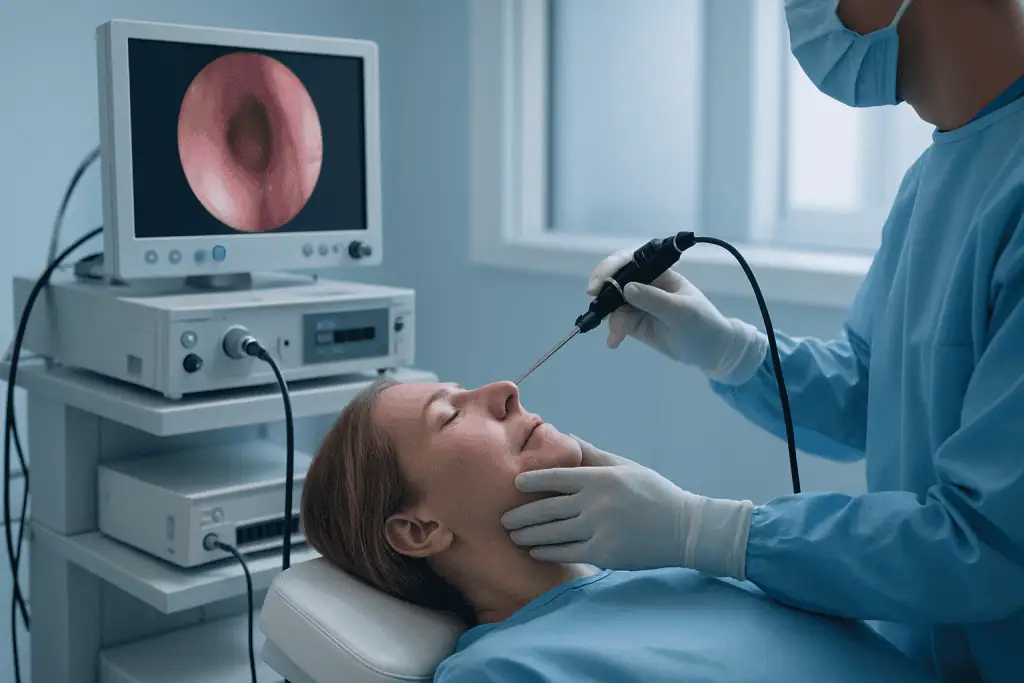
A deviated septum is diagnosed by clinical examination, usually by an ENT physician. The doctor takes a history: your symptoms, allergies, injuries, previous treatments and any earlier nasal operations, and then examines the inside of the nose. In most cases this includes nasal endoscopy: a thin instrument with a light and camera that lets the specialist see far deeper into the nasal passages than a simple front-of-nose examination allows. Endoscopy can pinpoint exactly where the airway narrows: a high deviation near the roof of the nose, a bony spur towards the back, contact points where the septum touches the side wall, enlarged turbinates, narrowing of the nasal valve, or signs of chronic sinus disease.
Imaging is not always required. A straightforward deviated septum can usually be assessed by endoscopy alone. A computed tomography scan of the sinuses becomes useful when sinus disease is suspected, when the symptom picture is complex, or when revision surgery is being planned after a previous operation. The scan shows the relationship between the septum, the turbinates and the sinus drainage pathways, and it helps the surgeon plan when SMR is to be combined with sinus surgery.
Do all deviated septums need surgery?
No. Many people have mild deviations that cause no meaningful symptoms, and those need no treatment at all. Others have congestion driven mainly by allergies, chronic rhinitis, enlarged turbinates or overuse of decongestant sprays, problems that call for medical management first, not an operation. Surgery earns its place when three things line up: the structural obstruction is significant, it is genuinely responsible for your symptoms, and the expected benefit outweighs the risks and the recovery period. An honest ENT assessment sometimes concludes that the septum is not the main problem. That conclusion is just as valuable as a surgical recommendation, because operating on the wrong cause helps no one.
Conditions and Indications SMR Can Address
The core indication for SMR is nasal airway obstruction caused by septal deviation. The deviation may involve cartilage, bone or both. It may narrow one passage, form an internal ridge or spur, press against the inferior turbinate, or disturb airflow enough to keep the nose feeling congested regardless of medication.
In practice, the operation may be recommended in several situations:
- Symptomatic deviated septum: the most common indication, persistent obstruction that affects daily breathing or sleep.
- Post-traumatic nasal obstruction: injury can displace the septum and leave long-term narrowing of the airway.
- Recurrent sinus problems in selected patients: a deviated septum can impair sinus drainage or complicate sinus treatment, although sinus disease usually has more than one cause.
- Access for sinus or nasal surgery: straightening the septum can allow safer, more effective access to the sinuses during endoscopic sinus surgery.
- Obstruction-related snoring: where nasal blockage is a major contributor, correcting it may reduce snoring in some patients.
- Difficulty using sleep apnoea equipment: improved nasal airflow may make nasal breathing and positive airway pressure therapy more tolerable in selected patients.
- Contact point symptoms: a septal spur pressing against the side wall of the nose can sometimes contribute to localised discomfort, although this diagnosis needs careful assessment before surgery is offered for it.
It is equally important to know what SMR does not treat. If your blockage is driven mainly by allergy, inflammation, nasal polyps, enlarged adenoids, collapse of the external nasal valve or reflux-related irritation, those conditions need their own specific therapy. A good surgical result starts with identifying the true cause of obstruction, and being willing to treat something other than the septum when the evidence points that way.
Can SMR reduce snoring?
SMR can reduce snoring in some patients, but only when nasal obstruction is a major contributor to it. Snoring is generated at several possible levels of the airway: the nose, the soft palate, the tongue base and the throat. If the noise comes mainly from the palate or tongue base, straightening the septum will improve nasal breathing without necessarily quieting the snoring. This is why a proper evaluation matters before surgery is framed as a snoring treatment. If obstructive sleep apnoea is suspected, pauses in breathing, gasping, marked daytime sleepiness, a sleep study may be recommended first, because sleep apnoea is managed differently and nasal surgery alone is not its treatment.
Can SMR make CPAP therapy easier to tolerate?
In selected patients, yes. Continuous positive airway pressure works best when air can flow freely through the nose, and a significantly deviated septum can make nasal masks uncomfortable or push the required pressures higher. For some people with sleep apnoea, correcting the obstruction makes nasal breathing, and therefore CPAP therapy, more tolerable. This is a supportive role: the operation is intended to improve the conditions for therapy, not to replace it, and decisions about sleep apnoea treatment remain with the treating sleep physician.
How SMR Is Performed
Preparation Before Surgery
Preparation begins with a specialist consultation and a structured medical work-up. The ENT physician examines the inside of your nose, reviews what has already been tried, and discusses what you want the operation to achieve. Bringing previous imaging, test results and a complete medication list to the consultation helps the team judge whether SMR is likely to be suitable and which further tests are still needed.
Before the operation you may have blood tests and an anaesthesia assessment, with further evaluation depending on your age, medical history and the planned anaesthetic. The surgeon will ask about blood-thinning medicines, previous bleeding problems, allergies, chronic diseases and smoking. Whether any medicine or supplement needs to be adjusted before surgery is a decision for your treating doctors, made individually, nothing should be changed on your own initiative. If there is an active nasal infection or poorly controlled allergic inflammation, treating that first may be recommended so the lining is in the best possible state for healing.
You will usually be asked not to eat or drink for a specified period before anaesthesia. The team explains what to expect on the day itself: admission, consent, the anaesthetic, the recovery area and discharge planning. The sequence of surgery, postoperative visits and the gradual return to normal activity is mapped out in advance rather than improvised afterwards.
What happens during the operation?
SMR is usually performed under general anaesthesia, although selected cases can be done with local anaesthesia and sedation, depending on the clinical situation and the surgeon’s judgement. The whole operation takes place through the nostrils. The typical sequence looks like this:
- A small incision is made inside the nose, usually on one side of the septum. There is no cut on the outside of the nose.
- The mucosal lining is carefully lifted off the cartilage and bone, exposing the deviated areas while keeping the lining itself intact.
- The obstructing portions of the septum are corrected: a limited segment of deviated cartilage or bone may be removed, a spur trimmed, cartilage reshaped, or tissue repositioned towards the midline.
- The lining is laid back into position over the straightened framework.
- The incision is closed, typically with dissolvable sutures that do not need removal.
- Soft internal splints may be placed to support the septum during early healing, depending on the surgeon’s technique and the complexity of the deviation.
Throughout, the guiding principle of modern functional nasal surgery is preservation. Enough cartilage must remain, particularly at the front and top of the septum, to keep the bridge and tip of the nose supported. The surgeon removes or reshapes only what is obstructing, not everything that is bent.
Traditional nasal packing is used less often than in the past. Where support or bleeding control is needed, modern materials are chosen to reduce discomfort and to support safe healing, and any splints placed are removed at a follow-up visit once the septum has begun to stabilise.
Is turbinate reduction done at the same time?
Often, yes, when the turbinates are enlarged, turbinate reduction can be performed during the same operation. The turbinates are normal, useful structures: they warm and humidify the air before it reaches the lungs. But when they are chronically enlarged, they narrow the airway further and can undo much of the benefit of a straightened septum. Turbinate surgery aims to reduce excess bulk while preserving the working mucosal surface, so the nose keeps doing its job of conditioning air. If chronic sinus disease is present, endoscopic sinus surgery can also be combined with SMR when the assessment supports it, so related problems are addressed in one anaesthetic rather than several.
Technology Used During Evaluation and Surgery
Several kinds of technology support accurate diagnosis and safe treatment. Nasal endoscopy lets the specialist examine regions that a simple front-of-nose examination cannot reach. High-resolution imaging is added when sinus involvement, complex anatomy or revision surgery is suspected. In the operating room, magnified visualisation and fine endonasal instruments allow precise work inside narrow passages. When combined sinus surgery is planned, image-guided navigation may be considered in selected cases to help map the anatomy during the procedure. None of this is used for its own sake: the technology is selected to serve the surgical objective, not to add complexity.
Anaesthesia monitoring is part of the same picture. Heart rhythm, oxygen levels, blood pressure and ventilation are tracked continuously throughout the operation. This structured perioperative environment also keeps communication consistent between the ENT surgeon, the anaesthesiology team and the nursing staff at every stage of the operation and the hours that follow it.
How long does SMR take, and do you stay overnight?
The duration varies with the severity of the deviation and whether other procedures are added. A straightforward correction is relatively short; complex septal reconstruction, turbinate surgery or combined sinus surgery takes longer. After the anaesthetic, you spend time in a recovery area while nurses monitor your breathing, any bleeding, pain control and general condition.
Many SMR procedures are performed as day surgery, meaning you can leave the hospital the same day if you are stable. An overnight stay may be advised when the operation is combined with other procedures, when there are medical risk factors, or when the surgeon prefers closer observation. Your surgeon will usually want to see you for at least one follow-up review before you resume long-distance travel or demanding routines.
Early recovery typically brings nasal stuffiness, mild pressure, watery discharge or blood-tinged drainage. These are expected and settle gradually. Discomfort is usually manageable with the medication prescribed. You will be asked not to blow your nose forcefully in the early period and to avoid heavy lifting, strenuous exercise, smoking and dusty environments. Saline sprays or rinses are commonly recommended to keep the healing lining moist.
Why Acting Early Matters
A deviated septum is not an emergency, and many people live with one for years. But when obstruction becomes persistent and starts to erode sleep, energy or exercise tolerance, delaying evaluation simply prolongs the symptoms and can add new ones. Chronic mouth breathing dries the throat, disturbs sleep quality and leaves you starting the day uncomfortable. Turbulent airflow through a narrowed passage dries the lining and can contribute to crusting and recurrent nosebleeds. In some people, untreated obstruction aggravates snoring or makes the management of sleep-disordered breathing harder than it needs to be.
Repeated use of over-the-counter decongestant sprays deserves particular attention. These sprays give genuine short-term relief, but prolonged use can cause rebound congestion: the nose becomes more blocked as each dose wears off, and the spray is needed more and more often. People can end up in a cycle of dependence that masks the underlying structural problem without ever addressing it. Questions about how such sprays are being used belong in the consultation with the treating doctor, where the full picture can be assessed.
Early specialist assessment separates structural obstruction from treatable inflammation. If medication is the right answer, it can be optimised. If surgery is the better option, it can be planned calmly, before the symptoms become more disruptive. Acting early also leaves time to identify related conditions, allergy, turbinate enlargement, chronic sinus disease, sleep apnoea, each of which may change the shape of the treatment plan.
Benefits of SMR
What SMR can realistically offer depends on the cause and severity of your obstruction. The operation is designed to do one thing well: remove the fixed structural blockage inside the nose so air can move as it should. From that single change, several practical benefits can follow.
| Benefit | What It Means for You |
|---|---|
| Improved nasal airflow | Breathing through the nose may become easier, especially on the side most affected by septal deviation. |
| Reduced mouth breathing | You may experience less dryness in the mouth and throat, particularly during sleep. |
| Better sleep comfort | When nasal obstruction is a major factor, improved airflow may reduce night-time congestion and obstruction-related snoring. |
| Improved response to other treatments | Allergy sprays, saline rinses or sleep apnoea devices may become easier to use when the nasal passage is more open. |
| Support for sinus care | In selected patients, correcting the septum improves access for sinus treatment and helps address contributing anatomical blockage. |
| No visible external incision in most cases | SMR is typically performed through the nostrils, so recovery is about internal healing rather than external scarring. |
Recovery After SMR
Recovery varies with the extent of surgery, whether splints or packing were used, and your general health, but most patients follow a broadly predictable healing pattern.
| Time Period | What Patients Can Expect |
|---|---|
| Day 1 | Nasal blockage, mild pressure and blood-tinged drainage are common. Rest, keep the head elevated and follow the medication instructions given at discharge. |
| First Week | Congestion often remains significant because of swelling and internal healing. A follow-up visit is usually scheduled to check the nose and remove splints if they were used. |
| First Month | Breathing usually begins to improve as swelling settles. You gradually return to normal routines while avoiding knocks to the nose and intense exertion until cleared by the surgeon. |
| Longer Term | Internal healing continues for several months. The final breathing result becomes clearer as the nasal lining settles and residual inflammation resolves. |
How long does recovery take after SMR?
Most of the visible recovery happens in the first weeks, but internal healing continues for several months. Expect the nose to feel more blocked, not less, in the first days, swelling and internal healing temporarily narrow the passages the operation has just widened. That is normal and it passes. Breathing typically starts to improve during the first month as the swelling subsides, and the true result of the operation only becomes clear once the lining has fully settled. Judging the outcome in week one is judging it too early.
When can you fly after SMR?
The timing of return travel is set individually, and most surgeons prefer to review the nose at least once before a long flight. Cabin air is dry, and pressure changes can be uncomfortable while the lining is still healing; a review also allows splints to be removed and early healing to be checked before you are far from the surgical team. How soon flying is sensible depends on how the operation went, whether other procedures were combined with it, and how your healing is progressing, so the return date belongs in the discharge plan, agreed with your surgeon rather than assumed.
What should you avoid while the nose heals?
The early instructions are simple, and following them protects the result:
- Do not blow the nose forcefully in the early period; clear it gently as instructed.
- Avoid heavy lifting and strenuous exercise until the surgeon clears you.
- Avoid smoking and smoky or dusty environments, which irritate the healing lining.
- Use saline sprays or rinses as recommended to keep the lining moist and reduce crusting.
- Protect the nose from knocks and pressure, including from glasses if advised.
- Attend every scheduled follow-up visit, even if the nose already feels better.
Factors That Influence Outcomes
A good result after SMR rests on three pillars: accurate diagnosis, appropriate surgical planning and a careful recovery. The single most important factor is whether the deviated septum really is the main cause of your symptoms. If the blockage is driven mainly by allergy, chronic inflammation, nasal valve weakness or sleep apnoea, septal surgery alone will not fully resolve it. This is why the evaluation stage deserves as much attention as the operation itself.
The location and severity of the deviation also matter. A simple posterior spur is generally easier to correct than a complex deviation involving the front support of the nose. Revision surgery after a previous septal operation is more demanding, because scarring, altered cartilage and reduced tissue flexibility limit what can be done; in such cases the surgeon may need a more reconstructive approach, and expectations should be set accordingly.
Associated conditions shape the outcome too. Enlarged turbinates, chronic sinusitis, nasal polyps, allergic rhinitis and external nasal valve collapse may need treatment at the same time or in a staged plan. If you snore, understand the limits: nasal surgery can help when obstruction contributes, but snoring often has several anatomical sources at once. Where obstructive sleep apnoea is suspected, a sleep evaluation may be recommended before conclusions are drawn about what surgery will achieve.
Finally, healing behaviour is in your hands. Smoking, poorly controlled diabetes, frequent nose blowing, returning to heavy exercise too soon or skipping postoperative visits all raise the risk of bleeding, crusting or delayed recovery. Saline care, sensible activity restriction and kept follow-up appointments are unglamorous, and they are also what smooth recoveries are made of.
What are the risks of SMR?
As with any operation, SMR carries risks, and they are discussed openly before surgery so you can make an informed decision. They may include bleeding, infection, temporary numbness of the upper teeth or nose, persistent congestion, crusting, septal perforation, a change in the sense of smell, scar tissue, the need for revision surgery, or improvement in breathing that falls short of what was hoped. Serious complications are uncommon, but “uncommon” is not “impossible”, and a surgeon who names the risks plainly is doing you a service. Weighing them against a symptom that affects every night’s sleep is exactly the conversation the preoperative consultation exists for.
Can a deviated septum come back after surgery?
It can, although this is not the usual outcome. Cartilage has a degree of “memory” and can drift back towards its old shape during healing; scar tissue can also narrow the airway again, and a new injury to the nose can create a new deviation regardless of how well the first operation went. Some patients are left with a residual deviation in an area that was deliberately preserved to protect the support of the nose. When symptoms return and are significant, revision surgery is possible, though technically more demanding than the first operation. Protecting the nose from trauma and completing the follow-up schedule are the best defences you control.
ENT Care for SMR at Acibadem
SMR is often a short procedure, but it still demands careful diagnosis, safe anaesthesia, precise technique and reliable follow-up. At Acibadem, ENT specialists evaluate each patient’s nasal anatomy and symptoms before any surgery is recommended, and treatment planning is individual rather than standardised. Some patients need only septal correction. Others benefit from combined turbinate reduction, sinus evaluation, allergy management or a sleep assessment. Rather than treating every blocked nose the same way, the aim is to identify the specific combination of structural and inflammatory factors behind your symptoms.
Where the picture is broader than the septum, care is coordinated across specialties, anaesthesiology, radiology, pulmonology, allergy and sleep medicine, so that a nasal operation is not planned in isolation from a breathing or sleep problem it sits within. Diagnostic pathways may include nasal endoscopy, imaging when indicated and review of previous treatment records. In the operating room, magnified visualisation, refined endonasal instruments and continuous anaesthesia monitoring support precision; the specific technology used follows the medical objective, not the other way round.
Second opinions have a legitimate place in septal surgery. An independent review can clarify whether SMR is appropriate at all, whether other nasal problems should be treated first, and whether combined surgery makes sense. It also anchors expectations where they belong: improved nasal airflow is a realistic functional goal, while the complete elimination of snoring or of congestion from every cause is not something any septal operation can promise.
Deciding Whether SMR Is Right for You
The decision comes down to a small number of honest questions. Is the obstruction structural, and has that been confirmed by examination rather than assumed? Have the non-surgical options, allergy treatment, sprays used correctly, saline care, been given a fair trial? Do the likely benefits, for your specific anatomy and symptoms, outweigh the risks and the recovery period? And do you have a realistic picture of what the operation will and will not change?
When the answers line up, SMR is a well-established way to correct a problem that medication cannot reach: a bent wall inside the nose. When they do not, the better path may be medical treatment, a staged plan, or no intervention at all. Either way, the strongest position to decide from is a thorough ENT evaluation, a clear explanation of the alternatives, and a plan that fits your health, your schedule and your recovery, not a template applied to every blocked nose.
Preparation
- An ENT specialist evaluates nasal obstruction, medical history, and any imaging or endoscopic findings before SMR. Blood thinners and smoking may need to be stopped as advised. Patients are usually asked not to eat or drink for several hours before anesthesia.
Aftercare
- Mild nasal swelling, congestion, and discharge are common after SMR. Patients should avoid nose blowing, heavy exercise, and trauma to the nose until cleared by the doctor. Follow-up visits help monitor healing and remove any splints or packing if used.
Frequently Asked Questions
What affects the cost of SMR surgery?
The final cost depends on septal anatomy, the extent of correction, whether additional procedures are needed, anaesthesia, hospital selection, preoperative tests, and postoperative follow-up requirements.
How can I get a personalised quote for SMR in Turkey?
You can request a free consultation by sharing your symptoms, previous ENT reports, nasal endoscopy findings if available, imaging if requested, and any history of trauma or prior nasal surgery. A specialist review is needed before a personalised quote can be prepared.
What is usually included in an SMR package?
A package may include ENT consultation, preoperative evaluation, surgery, anaesthesia, hospital services, routine postoperative checks, and international patient coordination. Exact inclusions should be confirmed in writing before travel.
Will treatment for snoring change the cost?
It may. If snoring is related mainly to nasal obstruction, SMR may be part of the plan. If other areas of the airway or a sleep-related breathing disorder are suspected, further assessment or different treatments may be recommended.
Are travel and accommodation included in the medical cost?
They are usually handled separately, although international patient teams may help coordinate logistics. Always ask which services are medical inclusions and which are travel-related expenses.
Is SMR suitable for every deviated septum?
Not always. An ENT specialist must assess the nose, airway, symptoms, and any related conditions to decide whether SMR, another surgical option, or non-surgical treatment is appropriate.
Medically reviewed by the Acıbadem International Medical Board August 31, 2026
See our medical review board →
Update history
- PublishedJune 8, 2026
- Medical review approvedAugust 31, 2026
- Last content updateAugust 31, 2026
References2
- Deviated Septum my.clevelandclinic.org
- Nose Injuries and Disorders medlineplus.gov
Trusted care for international patients
From the Acibadem Blog

SMR (Submucous Resection) Step by Step: How the Deviated Septum Is Corrected From Inside
A submucous resection (SMR) corrects a deviated septum from inside the nose. The surgeon lifts the septal lining, removes or reshapes the bent cartilage…